
On this page
Start here
Quick answer
Treat F8E4 on the newly installed Maytag MDPS6124RZ0 as a water-safety stop, not as a code to clear and ignore. Maytag's opened F8E4 guidance associates the code with water detected in the drip tray and specifically directs a new-installation check of the water connections, float-switch connection, and drip tray. Turn off the dishwasher, shut off its water supply, and isolate electrical power when it is safe to do so; do not pull the built-in unit, tip it, remove the bottom tray, or bypass the float. Because no detergent was used, excessive suds are less likely, so first document any water and inspect only visible supply and drain connection areas without disturbing wet fittings. The official product page uses the base identity MDPS6124RZ, while the task model includes the service suffix 0; confirm the complete rating-label model before applying instructions. If the code returns, water is visible in the tray or cabinet, or the source is not obvious, leave the dishwasher off and have the installer or qualified Maytag service inspect the installation and leak-detection circuit.
Before you begin
Safety first
- Stop the dishwasher, close its water supply, and isolate power when safe if water is active. Do not pull, tip, or open the built-in unit, remove the drip tray, pull the float wire, bypass the float, disconnect wet fittings, add chemicals, or test live wiring. Keep the appliance off until a leak source and safe restoration are documented.
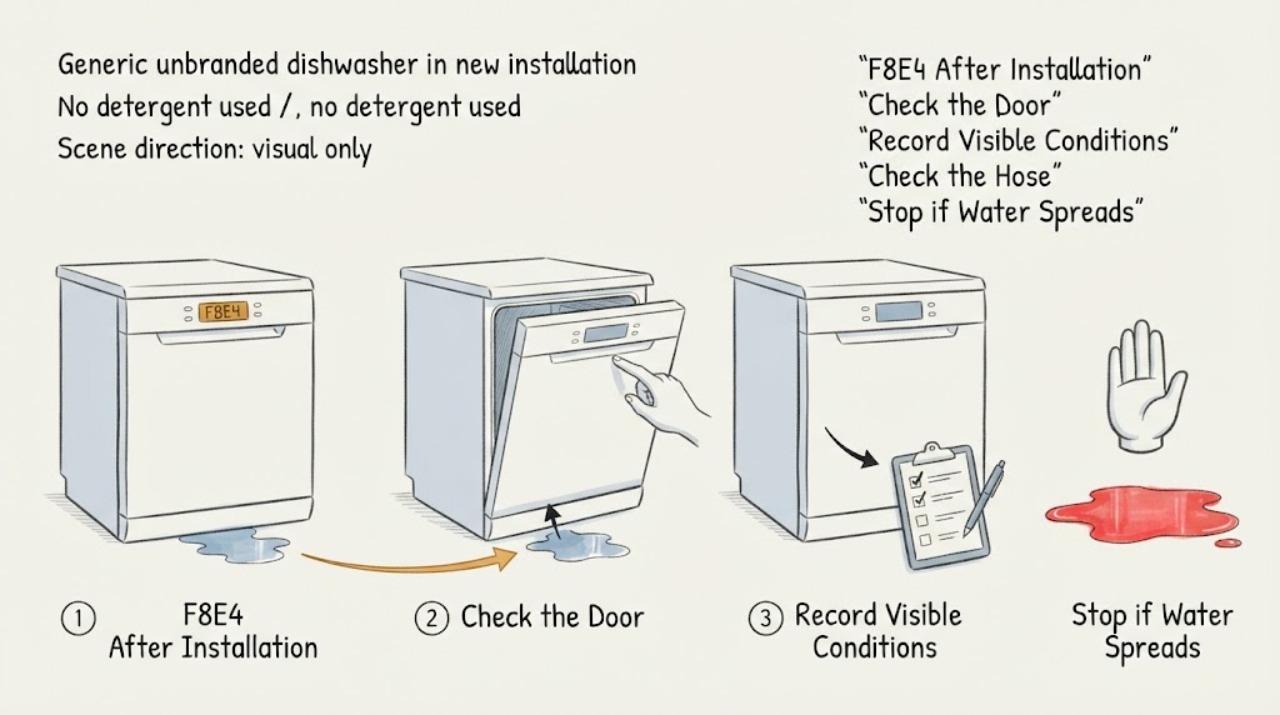
Work through in order
Diagnostic checks
Use only checks that match the exact appliance or system and its official guide.
-
Check 1
Stop the dishwasher and do not start another cycle. If water is actively running or pooling, close the dishwasher's water-supply valve and isolate electrical power at the plug or breaker from a dry, safe position. Keep the door closed if opening it could release more water or create an electrical hazard.
Expected result: There is active flow, a wet floor or cabinet, standing water near an outlet or hardwired connection, or only a stored F8E4 with no visible water.
Next step: Photograph the display and water location once safe. Leave the dishwasher off and contact the installer or qualified Maytag service if water cannot be stopped externally or the source is not clear.
Stop if: Do not reach into standing water, operate the controls with wet hands, repeatedly restore power, or restart the dishwasher to see whether F8E4 returns.
Why this matters
Why: Active water or water near electrical equipment is a safety branch. A stored code without visible water still means the leak-detection state must be explained before normal use, not repeatedly reset.
-
Check 2
Record the complete display as F8E4, the first-cycle or post-install timing, whether the unit began a drain, and where water was first seen. Confirm the rating-label model and suffix before using any manual; Maytag's public product page shows the base identity MDPS6124RZ, while the assigned service identity is MDPS6124RZ0.
Expected result: The display is exactly F8E4, the lights show a two-part pattern, a different code is present, or the model label does not match the assigned suffix.
Next step: Keep the code record with the installation paperwork and use only the matching literature. If F8E4 is confirmed, continue with the external installation evidence below; if not, arrange service rather than mapping another code to F8E4.
Stop if: Do not clear the code before recording it, follow a different Maytag model's tray procedure, or treat a flashing pattern as F8E4 without counting both groups.
Why this matters
Why: Maytag says exact codes vary by model and uses two code groups for supported flashing-light displays. A different display or mismatched suffix prevents a safe model-specific conclusion.
-
Check 3
With water off, power isolated, and no wet electrical hazard, inspect only the visible installation connections: the water-supply valve and hose, the inlet elbow area if visible, the drain-hose connection under the sink, and any accessible wet cabinet surface. Do not pull the built-in dishwasher or loosen a wet fitting.
Expected result: A supply connection or drain connection is visibly wet, the fill hose is kinked or strained, the water valve is not fully closed, or all visible connections are dry.
Next step: Leave a wet connection untouched and call the installer or service provider with photos. If everything accessible is dry, do not pull the unit to search underneath; report that the external path was checked and request an internal leak inspection.
Stop if: Do not tighten fittings by feel while wet, disconnect hoses, remove toe-kick or bottom panels, or use a cycle as a leak test.
Why this matters
Why: A new-installation drip at a connection can explain water reaching the drip tray even when there was no detergent. A dry visible area does not rule out a concealed connection, tub, valve, or tray source because Maytag lists detection exclusions and internal paths.
-
Check 4
Use the no-detergent fact to classify the event: note whether there was any foam, dish soap residue, or cleaning product in the tub, but do not add detergent, soap, oil, or another chemical. Keep the unit off while any foam or water remains.
Expected result: The tub is clear with no foam, foam is present despite no detergent, or the water is visibly dirty or contaminated by another product.
Next step: Photograph the tub and water evidence without running a rinse. Tell the installer whether the unit was completely unused, whether packaging or installation work preceded F8E4, and whether any product entered the tub.
Stop if: Do not pour in dish soap, dishwasher cleaner, vinegar, oil, or a second chemical to suppress or test the condition.
Why this matters
Why: With no detergent used, the usual wrong-soap explanation is less likely. Foam despite that history suggests an earlier residue or another product and still requires a stop; clear water shifts attention toward installation connections, overfill, tray water, or a float signal.
-
Check 5
Do not access the drip tray or float assembly yourself. Record whether F8E4 appeared with no visible external leak and whether the dishwasher stopped filling and drained; leave tray emptying, float-connector inspection, wiring, and source tracing to the installer or qualified technician.
Expected result: The cabinet and connections look dry but F8E4 returns, the display clears but the code returns on the next attempted cycle, or the machine remains in a drain or locked state.
Next step: Keep water and power off and arrange service. Give the provider the code, installation date, water location, photos, and the fact that no detergent was used; ask them to inspect the tray and float circuit without bypassing it.
Stop if: Do not remove the drip pan, pull on the float wire, tip the dishwasher to drain it, bridge the float switch, or expose live wiring.
Why this matters
Why: Maytag associates F8E4 with water detected in the drip tray and identifies the float connection and tray as relevant. A dry exterior does not prove a false alarm; the tray, float, harness, control, or concealed leak may require access that is not safe through a user opening.
-
Check 6
Only after the water source is stopped, the area is dry, the model literature matches, and no active leak remains, ask the installer or service provider whether the exact manual permits one code-clear or 30-second power reset. Record the result instead of repeating it.
Expected result: F8E4 clears and the dishwasher remains dry, F8E4 returns, the unit immediately begins draining, or the display will not respond.
Next step: Do not run a normal load. Send the reset result and the complete installation evidence to the installer or qualified Maytag service provider for a leak and overfill diagnosis.
Stop if: Do not repeatedly power-cycle, clear the code while water is present, or continue operating after F8E4 returns.
Why this matters
Why: A single documented reset can distinguish a transient control state from recurrence, but it does not repair a leak, tray water, float connection, or installation defect. Recurrence or an unresponsive control needs service.
Use your observations
Decision map
Find the observation that best matches what you see, then follow the next safe action.
-
PATH 01Safety boundary
What you see
Water is actively leaking, pooling in the cabinet or on the floor, or close to an outlet or hardwired electrical connection.
Do this next
Close the dishwasher water supply and isolate power from a dry, safe position if possible. Leave the unit off, keep the door closed when appropriate, and contact the installer or qualified service; seek urgent help for an electrical emergency.
Why this path and its safety boundary
Why it matters: This is an immediate water and electrical safety condition. The dishwasher's leak response is not a substitute for stopping the water source.
Safety stop: Do not touch wet electrical equipment, pull the unit, run a drain cycle, or restore power to test it.
-
PATH 02Next step
What you see
The first F8E4 occurs immediately after installation and a visible supply or drain connection is wet, while no detergent was used.
Do this next
Leave water and power off, photograph the connection and cabinet path, and have the installer correct the fitting, hose routing, leveling, or drain connection as applicable. Do not loosen or retighten a wet connection yourself.
Why this path and its safety boundary
Why it matters: The installation water path is more likely than a suds-driven event, but the wet fitting's exact source is not proven from a surface drip alone.
-
PATH 03Safety boundary
What you see
The external connections are dry, but F8E4 returns or the dishwasher remains in a drain or locked state.
Do this next
Keep the unit off and arrange service for tray, float, wiring, and concealed leak inspection. Tell the provider that no detergent was used and provide the exact timing and code record.
Why this path and its safety boundary
Why it matters: Water may be in the drip tray, the float connection may be open, or a concealed inlet, tub, pump, or control condition may remain. A dry cabinet does not establish a false alarm.
Safety stop: Do not remove the tray, pull the float wire, tip the dishwasher, bypass the float, or open the base for a live test.
-
PATH 04Safety boundary
What you see
There is foam despite no detergent, another product entered the tub, the model suffix does not match, or the display is not actually F8E4.
Do this next
Do not add chemicals or run another cycle. Preserve photos and the display record, confirm the rating-label identity, and ask the installer or Maytag service to follow the matching manual.
Why this path and its safety boundary
Why it matters: The incident is not safely explained by the assigned F8E4 installation path. Foam, a mismatched model, or another code requires its own exact documentation and procedure.
Safety stop: Do not map another code to F8E4, borrow a tray procedure from another model, or use soap, cleaner, oil, or repeated resets as a workaround.
Helpful context
Understand the symptom
The assigned identity is Maytag MDPS6124RZ0, but Maytag's opened US product page displays the base model MDPS6124RZ. Treat the final character as a fitment and literature check, not as a reason to borrow a different model's procedure. The product page describes a third-rack dishwasher with a Leak Detect system that can stop filling, drain the tub, and alert for service, while also noting that inlet, tub-drain connections and hoses, cracked tubs, and cracked doors may be outside that system's detection scope.
F8E4 is an installation and water-containment decision here. Maytag's F8E4 page directs a newly installed unit toward its water connections, float-switch connection, and drip tray. Since no detergent was used, do not start with a soap theory; preserve the water evidence and separate an external installation drip from water in the tray. Do not remove the tray, pull the appliance out, tip it, or defeat the float to make it run.
Only after diagnosis
Potential parts
- water-supply hose, inlet elbow, or connection seal
Consider only if the installer or technician documents a leaking or incorrectly seated connection after the new installation.
Confirm the complete MDPS6124RZ0 rating-label identity and the exact fitting before replacing a hose, elbow, washer, or seal. - float switch or drip-tray assembly
Consider only if service confirms water in the tray, a disconnected or failed float circuit, or damage that explains the F8E4 state.
Do not pull the float wire, remove the tray, or bypass the float as a user test; verify the exact suffix and connector configuration. - door or tub gasket, pump, inlet valve, or drain connection
Consider only when a technician traces the water to the specific seal, valve, pump, tub, or drain connection rather than ordering from F8E4 alone.
Maytag notes that leak detection does not cover every inlet, tub-drain, hose, door, or cracked-tub path; confirm diagnosis and exact fitment first.
When checks do not resolve it
Need a professional?
Use the installer for a first-cycle or newly installed F8E4, especially when a water-supply or drain connection is wet. Use qualified Maytag appliance service for recurring F8E4, tray or float indications, concealed leaks, overfill, persistent drain, or any internal access requirement.
Safety scope: Stop the dishwasher, close its water supply, and isolate power when safe if water is active. Do not pull, tip, or open the built-in unit, remove the drip tray, pull the float wire, bypass the float, disconnect wet fittings, add chemicals, or test live wiring. Keep the appliance off until a leak source and safe restoration are documented.
Have this ready
- Provide MDPS6124RZ0 from the rating label, the base-model identity shown in Maytag's public product page if relevant, installation date, whether the unit was ever used, exact F8E4 display or flash pattern, water location, photos of visible connections, drain behavior, foam or no-foam observation, and confirmation that no detergent was used.
Common questions
FAQ
Does F8E4 always mean the dishwasher itself is leaking?
No. Maytag lists F8E4 as water detected in the drip tray, but the water can originate from an installation connection, inlet or drain path, overfill, or another concealed condition. Maytag also notes that some inlet, hose, tub-drain, door, and cracked-tub leaks are outside Leak Detect coverage.
Why check installation first when no detergent was used?
Maytag's F8E4 guidance has a specific newly installed path for water connections, hose routing, the float connection, and the drip tray. With no detergent used, the usual wrong-soap suds explanation is less likely, so preserve the installation and water evidence first.
Can I tilt the dishwasher to empty the tray?
Do not tilt or pull out a built-in dishwasher as a workaround. Leave the water supply and power off and have the installer or qualified technician inspect the drip tray and float circuit without bypassing the leak protection.
Can I clear F8E4 and try a short cycle?
Only the matching manual or service provider should authorize one code-clear after water is stopped and the area is dry. A cleared code does not prove the installation is leak-free; if F8E4 returns, do not run a load and arrange service.
Read the exact guide
Official sources
- Dishwasher Error Codes - Reading - Product Help | MaytagMaytag · Opened Maytag code-reading page. It states that exact codes vary by model and lists F8E4 as water detected in the drip tray with drip-tray, float-switch, and water-connection checks.
- Dishwasher Leaking Troubleshooting Guide - Product Help | MaytagMaytag · Opened Maytag leaking guide used for safe external classification and escalation. It provides general dishwasher guidance and is not used to override the exact MDPS6124RZ0 manual for internal access.
- F8E4 - Dishwasher - Product Help | MaytagMaytag · Opened Maytag Product Help page for F8E4. It gives a newly-installed branch and identifies water connections, float-switch connection, drip tray, and excessive suds as distinct paths; it does not prove that every Maytag model uses identical physical access steps.
- Third Rack Dishwasher with Rapid Sani Cycle Fingerprint Resistant Stainless Steel MDPS6124RZ | MaytagMaytag · Opened Maytag US product page displays MDPS6124RZ, the base identity corresponding to the assigned MDPS6124RZ0 service suffix. The page is used for product-family scope and not to erase the suffix distinction.
Community feedback
Share a repair observation
Share a plain-text repair observation. Accepted observations are published automatically; this page may take a moment to update.