
On this page
Start here
Quick answer
Maytag defines F9E1 on dishwashers as a long-drain or not-draining condition, but a visibly clear filter does not prove that the drain system is healthy. For the exact MDB8959SKZ0, Maytag's service pointer lists this model under the F9E1 stuck-drain notice and says the possible causes include an external drain blockage or disposal connection as well as pump, wiring, or control problems that require service diagnosis. First record that the code appears immediately when drain begins, check only the accessible filter, hose, air gap or disposer connection, and look for water or suds without pulling panels or testing wiring. A single Maytag-described 30-second power cycle is reasonable only when there is no leak or water hazard. If F9E1 returns immediately with the visible path clear, stop repeating cycles and arrange qualified service rather than ordering a pump or control board from the code alone.
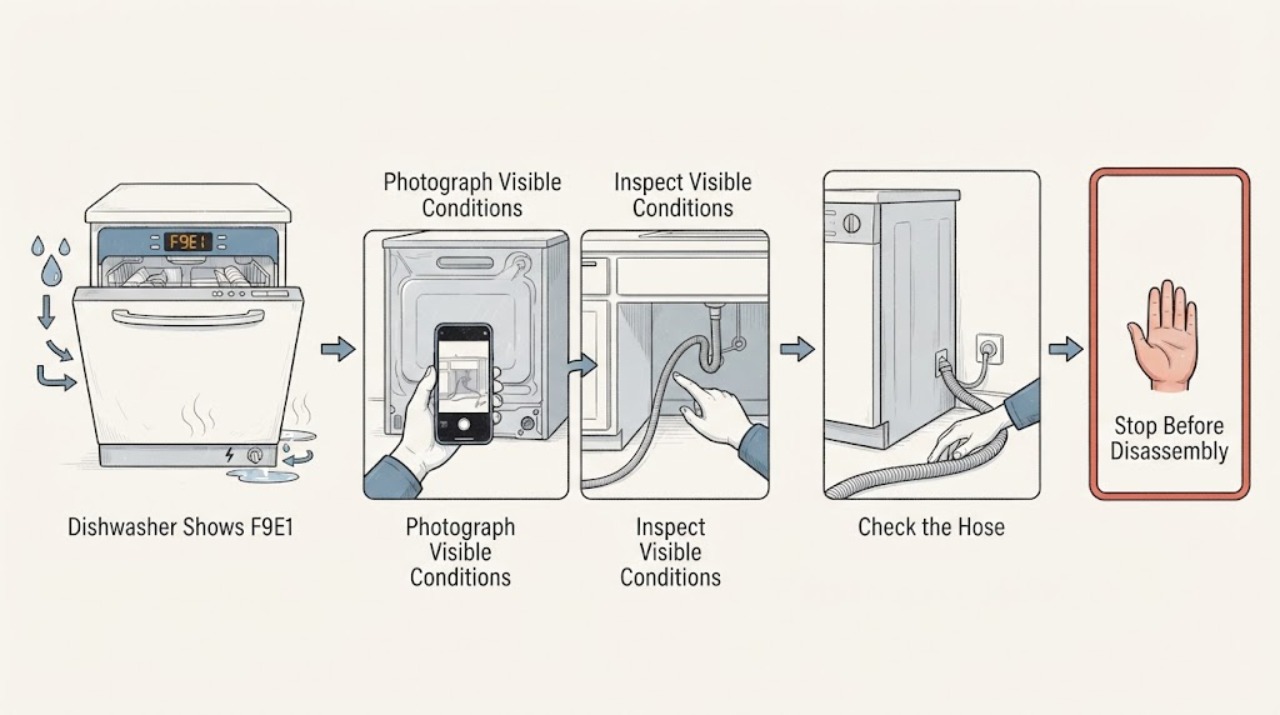
Work through in order
Diagnostic checks
Use only checks that match the exact appliance or system and its official guide.
-
Check 1
Wake the dishwasher if needed and photograph the complete display before pressing Cancel. Confirm the rating label reads MDB8959SKZ0, record whether the code is F9E1 or a different F#E# sequence, and note whether it appears immediately when drain starts, after the wash period, or only after a cycle has ended.
Expected result: The complete model is MDB8959SKZ0 and F9E1 appears at the beginning of drain, the model or code differs, or the display is actually a two-group flashing-light pattern.
Next step: If the model or code cannot be confirmed, stop part selection and use the exact Maytag literature or qualified service. If the timing is immediate at drain start, retain that fact because it changes the next decision after the external checks.
Why this matters
Why: Maytag uses F#E# codes on many digital dishwashers, but exact codes and meanings vary by model. The exact-model service pointer covers MDB8959SKZ0 and F9E1; a different model or code should not inherit this page's diagnosis.
-
Check 2
With the dishwasher stopped and the floor dry, look at the accessible filter area and the visible water level in the tub or sump. Clean only a removable filter exactly as the Maytag owner instructions allow; do not reach into a hidden pump, remove a cover, or use a tool to probe the drain opening.
Expected result: The filter is visibly soiled, the accessible area is clear, standing water remains, or water is present under the dishwasher or at the base.
Next step: If the filter is dirty and the exact manual permits cleaning, clean and reseat it, then stop to observe the next drain attempt. If water is under the dishwasher, the filter area is damaged, or standing water persists after the accessible check, keep the unit off and arrange service.
Why this matters
Why: Maytag lists a dirty filter and an obstruction among the first F9E1 checks, but a clear filter does not rule out a downstream hose, pump, harness, or control problem. Water under the unit is a leak boundary, not an invitation to keep running it.
-
Check 3
From outside the appliance, inspect the visible drain hose route to the sink or disposer and, if fitted, the air-gap cap for an obvious kink, pinch, disconnection, or leak. If the dishwasher drains into a disposer, confirm that the connection is the intended inlet and that a recent disposer installation did not leave its knockout plug in place; do not disconnect a hose or pull the machine out.
Expected result: A kink, pinch, disconnection, leak, blocked air gap, incorrect disposer inlet, or retained knockout plug is visible, or the accessible drain route looks normal.
Next step: Correct only an obvious user-accessible routing issue when the area is dry and the exact installation instructions support it. For a leak, inaccessible connection, recent installation problem, or normal-looking route with immediate F9E1, stop and arrange qualified service.
Why this matters
Why: Maytag's F9E1 guidance specifically names hose routing, the disposer knockout plug, the air gap, and visible drain obstructions. A normal-looking external route narrows the user-level checks but does not identify a pump or control fault.
-
Check 4
Open the door only when safe and look for excessive bubbles or dish soap foam. Note whether the unit made a brief drain sound and then stopped, remained silent, or made an unusual grinding or humming sound; do not put hands into the sump or run the unit with a panel removed.
Expected result: There is heavy sudsing, a normal-looking short drain sound, no drain response, an unusual sound, or no foam and no obvious external abnormality.
Next step: If heavy suds are present, turn the dishwasher off and let them dissipate before any further user-level check. If there is no foam and F9E1 appears immediately, or an unusual sound accompanies the code, stop repeated testing and give the sound/timing record to qualified service.
Why this matters
Why: Maytag says dish soap or excess detergent can create suds that interfere with draining and can cause leaking or poor performance. Sound and timing can help a technician, but they cannot safely distinguish a pump, motor, wiring, or control cause from outside.
-
Check 5
Only if there is no visible leak, standing water near electrical parts, burning odor, damaged cord, or other hazard, perform the one Maytag-described control reset: disconnect power for 30 seconds using the normal plug or the dishwasher breaker, then restore it once. Do not open the unit or bypass a control.
Expected result: F9E1 clears and the dishwasher completes the drain, F9E1 returns immediately at drain start, or the breaker trips or the unit behaves erratically.
Next step: If the code returns immediately, leave the dishwasher off and arrange qualified service with the exact model, code, timing, sound, water level, and checks already completed. Do not keep cycling power or buy a pump/control board solely from F9E1.
Why this matters
Why: Maytag describes a 30-second power cycle as a possible control reset, not as a repair. Immediate recurrence after a clear visible path is consistent with the exact-model service pointer's need for broader service diagnosis; a tripping breaker or erratic unit is an electrical stop condition.
Use your observations
Decision map
Find the observation that best matches what you see, then follow the next safe action.
-
PATH 01Next step
What you see
F9E1 appears at the beginning of drain, the filter and visible hose/disposer path are clear, and there is no suds or leak.
Do this next
Stop repeating drain cycles and arrange qualified service. Give the technician the exact model, immediate timing, display photo, sound description, water level, and the clear external-check results.
Why this path and its safety boundary
Why it matters: The user-level drain-path checks have not found the cause. For MDB8959SKZ0, Maytag's service pointer lists multiple further possibilities, so the code does not identify a replaceable pump or control by itself.
-
PATH 02Next step
What you see
The accessible filter, hose, air gap, disposer inlet, or recent installation connection shows an obvious blockage, kink, retained knockout plug, or incorrect routing, with no water hazard.
Do this next
Correct only the visible, user-accessible condition permitted by the exact installation or owner guidance, then observe one drain attempt. If F9E1 returns, stop and arrange service rather than assuming the same obstruction remains.
Why this path and its safety boundary
Why it matters: This matches the external causes Maytag places before a component diagnosis for F9E1.
-
PATH 03Next step
What you see
Heavy dish-soap foam or detergent suds are present when the door is opened.
Do this next
Turn the dishwasher off and allow the suds to dissipate. Do not add another chemical or keep restarting the cycle; arrange service if water has leaked or F9E1 remains after the safe external condition is resolved.
Why this path and its safety boundary
Why it matters: Maytag says dish soap or excess detergent can produce suds that push water out and interfere with draining; this can mimic or worsen a drain complaint without proving a pump failure.
-
PATH 04Next step
What you see
F9E1 clears after the single 30-second reset and the next drain completes normally, with no leak or electrical warning.
Do this next
Monitor the next use without repeatedly testing the dishwasher. If F9E1 returns, especially immediately at drain start, leave it off and provide the recurrence record to qualified service.
Why this path and its safety boundary
Why it matters: The control reset may have cleared a transient control state, but it does not prove that the drain path or pump will remain reliable.
-
PATH 05Next step
What you see
Water is under the dishwasher, the floor becomes wet, the breaker trips, there is a burning odor, a damaged cord, or the control becomes erratic.
Do this next
Stop using the dishwasher. Keep hands and tools away from wet electrical areas; isolate water or power only from a safe, dry position when doing so does not expose anyone to the hazard, and arrange qualified appliance service. Do not reset or retest.
Why this path and its safety boundary
Why it matters: This is a water or electrical safety boundary, not an ordinary F9E1 cleaning branch.
Helpful context
Understand the symptom
What F9E1 means on this Maytag dishwasher
Maytag's dishwasher help page labels F9E1 as a potential long-drain condition. Its general guidance is to check the accessible drain path, including the filter, hose, disposer connection, air gap, obstructions, and excessive suds, then use one 30-second control reset when appropriate. That is a drain-path diagnosis, not a statement that the pump or control board is the failed part.
Why the immediate timing matters
Maytag's service pointer specifically lists MDB8959SKZ0 among the affected dishwasher models for an F9E1 stuck-drain notice. It describes slow or no drain, an incomplete cycle, and several possible causes, including a drain obstruction, a pump condition, a connection or harness issue, or a control problem. The pointer is for service personnel, so it supports a service boundary rather than a do-it-yourself pump or wiring procedure. When the code appears at the start of drain with no visible blockage, the useful decision is to stop guessing parts and preserve the timing and code for a qualified diagnosis.
When checks do not resolve it
Need a professional?
Arrange qualified Maytag appliance service when F9E1 returns immediately after the accessible filter, hose, disposer or air-gap checks and one permitted reset, when no external obstruction is visible, or when the code is accompanied by unusual noise, incomplete cycles, standing water, a leak, a tripped breaker, or erratic controls. Stop immediately for water near electrical parts, burning odor, damaged wiring or cord, or any other safety hazard.
Common questions
FAQ
Does F9E1 mean the drain pump is bad on MDB8959SKZ0?
No. Maytag labels F9E1 as a long-drain or not-draining condition. Its exact-model service pointer lists several possible causes, so the code and a clear filter do not select a pump or control board without service diagnosis.
Why would F9E1 appear as soon as drain starts if nothing is clogged?
The timing makes a simple visible blockage less obvious, but it does not identify the hidden cause. Maytag's service pointer for MDB8959SKZ0 includes external drain issues as well as pump, connection, harness, and control possibilities. Stop guessing parts and arrange model-specific service if the clear external path is confirmed.
Can I reset the Maytag dishwasher after F9E1?
Maytag describes disconnecting power for 30 seconds as a possible control reset. Do it at most once and only when there is no leak, standing water near electrical parts, burning odor, damaged cord, or other hazard. Immediate recurrence means service, not more resets.
What should I tell the service technician?
Give the exact model MDB8959SKZ0, a photo of F9E1, the fact that it appears immediately at drain start, the water level, any pump sound or suds, whether the filter and visible drain route were clear, and what happened after one permitted reset. Do not remove the pump or open wiring to collect more evidence.
Read the exact guide
Official sources
- F9E1 - DishwasherMaytag Product Help · Maytag dishwasher F9E1 long-drain guidance and accessible drain checks
- Dishwasher Error Codes - ReadingMaytag Product Help · Maytag dishwasher F#E# display format, F9E1 long-drain meaning, and 30-second power-cycle guidance
- MDB8959SKZ | MaytagMaytag · Maytag MDB8959SKZ dishwasher owner-support page and model identification for MDB8959SKZ0 family
- Service Pointer - W11482561 - Stuck DrainMaytag · Maytag MDB8959SKZ0 exact-model F9E1 stuck-drain service scope and professional diagnostic boundary
Community feedback
Share a repair observation
Share a plain-text repair observation. Accepted observations are published automatically; this page may take a moment to update.