
On this page
Start here
Quick answer
If a never-used Maytag MDB4949SKZ3 shows FAE4, first photograph the complete display and confirm whether it really says FAE4 (or F10E4) rather than F8E4 or another two-part code. Maytag's dishwasher support page labels FAE4/F10E4 as a diverter valve error and gives one 30-second power cycle; that label does not prove that a valve is the failed part. Because this unit has just been installed, check for a visible leak or wet floor without moving the dishwasher, then return the problem to the installer or warranty service if the code remains. Do not order a part, remove the base, tilt the unit, or enter service diagnostics from the code alone.
Before you begin
Safety first
- Keep the dishwasher stationary and do not remove its base, access internal wiring, enter service diagnostics, bypass the door or leak controls, disconnect pressurized plumbing, or perform energized work. Do not treat FAE4/F10E4 as proof that a diverter valve, control, pump, or other part is the correct replacement.
Work through in order
Diagnostic checks
Use only checks that match the exact appliance or system and its official guide.
-
Check 1
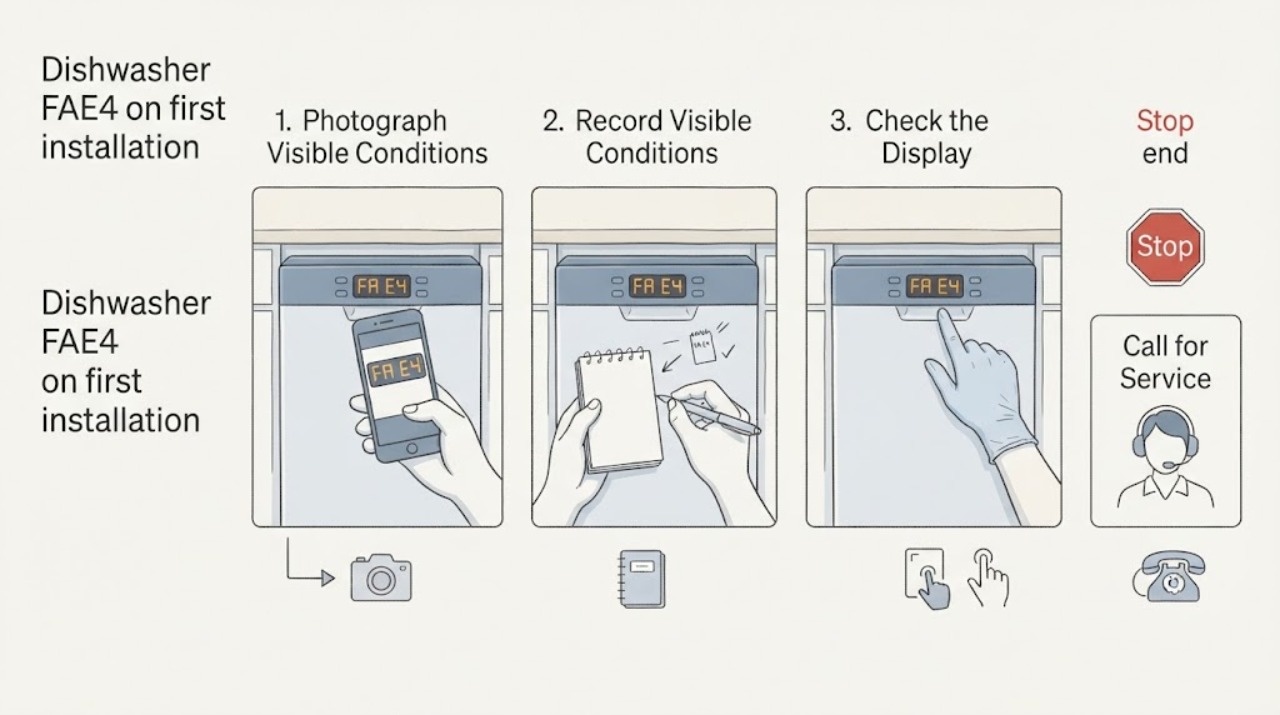
Before clearing anything, photograph or transcribe the complete display and record whether the characters are FAE4, F10E4, F8E4, or another code, including spaces, alternating segments, and any flashing-light pattern. Note whether the message appeared before a cycle, during a first attempted cycle, or immediately after installation.
Expected result: The display clearly shows FAE4/F10E4, shows a different code such as F8E4, or the characters cannot be distinguished.
Next step: Keep the photo with the delivery and installation records. If it is not clearly FAE4/F10E4, use the exact model manual or send the image to the installer or Maytag service rather than choosing a reset or part.
Why this matters
Why: Maytag's opened support page groups FAE4 with F10E4, not every similar-looking E4 code. A different or uncertain display cannot safely inherit the FAE4 meaning.
-
Check 2
Read the dishwasher rating label and record the complete model, including the final suffix MDB4949SKZ3 if that is what the label shows, plus the serial number, market, delivery date, and installer. Compare the entry with Maytag's model-number literature route; do not rely on a shortened MDB4949SKZ family name alone.
Expected result: The label and documentation match MDB4949SKZ3, match only the base family, or cannot be read or matched.
Next step: Use only the matching manual for this suffix. If the suffix cannot be confirmed, give the installer or warranty provider the label photo and do not apply a different MDB model's hidden procedure.
Why this matters
Why: Maytag's support pages identify the public base model and instruct owners to use the model number for manuals and documents. A suffix or market mismatch can change which display and installation instructions apply.
-
Check 3
With the dishwasher stationary, inspect the floor in front of it, the toe-kick edge, and the visible under-sink supply and drain area from a dry, safe position. Do not pull the unit forward, remove the toe-kick or base, or touch wet wiring. If water is already present, avoid operating controls near it.
Expected result: The floor and visible connections are dry, there is a damp area or fresh puddle, or water is near an electrical connection.
Next step: For water or wet electrical surroundings, stop the dishwasher, close the accessible water shutoff if it can be done without reaching through water, and disconnect power only from a dry, safe position. Keep the unit in place and contact the installer or authorized service.
Why this matters
Why: A new-install leak can come from an inlet, drain connection, hose, door, or an internal leak path; the exact public product page also warns that its leak system does not detect every inlet, hose, tub, or door leak. Water changes the priority from code clearing to damage and shock prevention.
-
Check 4
From outside the appliance, document the installation handoff: whether the supply shutoff is visibly open, whether the drain and supply lines are visibly kinked, whether the door closes and latches squarely, and whether the dishwasher has ever completed a cycle. Do not disconnect a pressurized line or adjust plumbing connections as a first-use experiment.
Expected result: The supply appears closed or kinked, the door will not latch squarely, the unit has never completed a cycle, or the external installation looks normal.
Next step: Photograph the visible condition and send it to the installer. Only an external shutoff position explicitly covered by the matching installation instructions may be corrected by the owner; leave line disconnection, alignment work, and internal diagnosis to the installer or qualified service.
Why this matters
Why: Maytag's installation guidance calls for a hot supply line connected to a dedicated shutoff and says to follow the Owner's Manual. A first-use problem with an installation clue is an installer/warranty handoff, not proof of a failed internal valve or control.
-
Check 5
If there is no leak, no burning smell, no damaged cord, and the controls are safe to use, perform Maytag's documented control reset once: disconnect the dishwasher from power for 30 seconds, then restore power. Use the accessible plug or the dishwasher breaker only as described by the installation and electrical arrangement; do not repeat the cycle just to chase a code.
Expected result: The code clears and the controls return normally, or FAE4/F10E4 returns immediately or on the first attempted cycle.
Next step: Record the reset time and result. If the code returns, stop operation and give the installer or warranty provider the model label, display photo, leak status, installation record, and reset result.
Why this matters
Why: Maytag describes a 30-second power cycle as a control reset, not as a component diagnosis. Recurrence after that single documented reset leaves the diverter/control path unresolved and is especially significant on a unit that has never been used.
-
Check 6
Prepare the first-use service packet: exact model and serial photos, the complete display, delivery and installation date, installer identity, whether any water entered the unit, the visible connection observations, and the result of the one permitted reset. Keep the dishwasher unused while the first-use fault is being assessed.
Expected result: The installer can inspect the installation under its initial service obligation, or the warranty provider requests a qualified Maytag service visit.
Next step: Request a written, model-specific assessment of the installation and the returning FAE4/F10E4 report before approving any part. Do not purchase or fit a diverter valve, control, pump, or other component from the code alone.
Why this matters
Why: The evidence distinguishes an installation handoff from a later-use failure and prevents the same code from being repeatedly cleared without a diagnosis. Maytag routes owners to model-specific documents and service through its Owner Center and FAE4 support page.
Use your observations
Decision map
Find the observation that best matches what you see, then follow the next safe action.
-
PATH 01Next step
What you see
The display is clearly FAE4 or F10E4, the unit is dry, the model label is documented, and the same code returns after Maytag's single 30-second power cycle.
Do this next
Leave the dishwasher off and return the case to the installer or Maytag-authorized warranty service with the display photo, suffix, serial, installation date, and reset result.
Why this path and its safety boundary
Why it matters: This matches Maytag's published diverter-valve-error category, but the code does not identify a failed diverter valve or establish part compatibility. Because the appliance is new and unused, installation or warranty service is the correct next decision.
-
PATH 02Next step
What you see
The display is actually F8E4 or another code, or the characters cannot be reliably distinguished from FAE4/F10E4.
Do this next
Use the complete model suffix and a display photo to obtain the matching Maytag manual or service interpretation. Do not reset repeatedly or select a part while the code identity is uncertain.
Why this path and its safety boundary
Why it matters: The opened FAE4 page does not establish the meaning of that different or uncertain display. Similar-looking two-part codes must not be swapped across the Maytag dishwasher code table.
-
PATH 03Next step
What you see
There is a fresh puddle, damp toe-kick or floor, water near a cord or connection, or the dishwasher appears to be filling or stopping because of water detection.
Do this next
Stop operation, close the water shutoff if safely accessible, disconnect power only from a dry safe position, and contact the installer or authorized service. Do not tilt the unit or open its base to look for a drip tray.
Why this path and its safety boundary
Why it matters: The installation has a possible leak or water-safety issue. Maytag notes that its leak system can stop filling, drain the tub, and call for service, but it does not detect every inlet, hose, drain-connection, tub, or door leak.
-
PATH 04Next step
What you see
The panel is blank, the breaker trips again, the cord or outlet is hot or damaged, or there is a burning smell, smoke, or sparking after installation.
Do this next
Keep clear and leave the dishwasher off. Arrange qualified electrical or appliance help; do not repeatedly reset the breaker, restore power to reproduce the event, or open the control area.
Why this path and its safety boundary
Why it matters: This is an electrical or fire-safety branch rather than a diverter-code troubleshooting branch.
-
PATH 05Next step
What you see
The door does not latch squarely, the visible supply shutoff is closed, a line is visibly kinked, or the installer cannot show a completed first-use handoff.
Do this next
Photograph the condition and request installer correction under the installation or warranty process. Do not move the dishwasher, disconnect a line, bypass the latch, or enter service diagnostics.
Why this path and its safety boundary
Why it matters: A visible installation condition is more actionable than guessing an internal valve, diverter, or control. The new-unit context makes the installer the appropriate first owner of that correction.
-
PATH 06Next step
What you see
FAE4 clears after the one documented power cycle, the unit remains dry, the model suffix is confirmed, and no first-use cycle has exposed another symptom.
Do this next
Do not enter service mode or repeatedly clear the message. Follow only the confirmed model's normal first-use instructions and stop if FAE4/F10E4, water, abnormal noise, or an electrical symptom returns; then use the installer or warranty packet.
Why this path and its safety boundary
Why it matters: The reset cleared the control state, but it does not prove that an internal condition is repaired or that the display was interpreted for the correct suffix. A first-use record is still valuable if the code returns.
Helpful context
Understand the symptom
The exact assigned identity is Maytag MDB4949SKZ3, while the opened Maytag product and Owner Center pages publicly identify the base model MDB4949SKZ. Read the rating label and use Maytag's model-number literature lookup to confirm the final suffix before applying any model-specific instruction. Maytag's FAE4 page is an official dishwasher code reference, but it is not permission to select a diverter valve or another part from the display alone.
A new appliance changes the first decision: preserve evidence of the installation and route a persistent first-use fault through the installer or warranty channel. Look for water without moving the machine or opening its base. If the code is actually F8E4, or if water is present, stop using the FAE4 explanation and follow the matching model documentation or leak response instead.
When checks do not resolve it
Need a professional?
For a never-used, just-installed MDB4949SKZ3, contact the installer or warranty channel first when the code returns after the single documented reset, the display identity is uncertain, the model suffix cannot be matched, or any visible installation problem or leak is found. Use qualified electrical help for supply hazards.
Safety scope: Keep the dishwasher stationary and do not remove its base, access internal wiring, enter service diagnostics, bypass the door or leak controls, disconnect pressurized plumbing, or perform energized work. Do not treat FAE4/F10E4 as proof that a diverter valve, control, pump, or other part is the correct replacement.
Have this ready
- Provide the complete model and serial label, market, display photo or transcription, whether the code was FAE4/F10E4 or another code, delivery and installation date, installer, whether any cycle was completed, floor and visible connection condition, water status, and the result of the one 30-second power cycle.
Common questions
FAQ
Is FAE4 the same as F8E4 on a Maytag dishwasher?
Do not assume they are the same. The opened Maytag support page specifically names FAE4 or F10E4 and calls that a diverter valve error; it does not establish an F8E4 meaning for MDB4949SKZ3. Photograph the full display and use the exact suffix manual or service channel.
What should I do first if my brand-new Maytag shows FAE4?
Record the full code and model suffix, check for a visible leak without moving the dishwasher, and document the installer and delivery date. If the unit is dry and electrically safe, Maytag documents one 30-second power cycle. If FAE4 returns, keep it unused and contact the installer or warranty service rather than buying a diverter valve.
Does FAE4 prove the diverter valve needs replacement?
No. Maytag labels FAE4/F10E4 as a diverter valve error category, but the display alone does not prove a failed valve or establish part fit. A persistent code needs model-specific service diagnosis, especially on a never-used installation.
What if I find water under the newly installed dishwasher?
Stop using it. Close the accessible water shutoff and disconnect power only from a dry, safe position, then contact the installer or authorized service. Do not pull the unit, tilt it, remove the base, or repeatedly clear the code; Maytag notes that some inlet, hose, drain-connection, tub, and door leaks may not be detected by its leak system.
Read the exact guide
Official sources
- Dishwasher Error Codes or Flashing LightsMaytag Product Help · Opened official Maytag dishwasher error-code index; use it only as a category index and compare the exact MDB4949SKZ3 model manual before interpreting a similar code such as F8E4.
- MDB4949SKZ | MaytagMaytag · Opened official Maytag Owner Center for the MDB4949SKZ base family. Use the assigned MDB4949SKZ3 label and market to obtain the applicable manual and warranty route; the page itself says the public base model is MDB4949SKZ.
- Dishwasher Water Supply ConnectionMaytag Product Help · Opened official Maytag installation guidance for a newly installed dishwasher: visible shutoff, supply-line condition, leak prevention, and following the exact Owner's Manual for MDB4949SKZ3.
- 24” Front Control Dishwasher with Dual Power Filtration and PowerBlast® Cycle - 50 dBA Fingerprint Resistant Stainless Steel MDB4949SKZ | MaytagMaytag · Opened official Maytag product page for the MDB4949SKZ base family. The assigned topic suffix MDB4949SKZ3 must be confirmed against the appliance label and matching regional literature; this page must not be read as listing the suffix itself.
- Appliance Manuals and Literature | MaytagMaytag · Opened official Maytag manuals page for verifying the assigned MDB4949SKZ3 suffix and market before using a code or installation instruction.
- FAE4 or F10E4 - DishwasherMaytag Product Help · Opened official Maytag dishwasher error page for the assigned FA E4 / FAE4 topic; it states Diverter Valve Error and gives a 30-second power-cycle instruction, but does not prove a part failure or suffix-specific fit for MDB4949SKZ3.
- Dishwasher Leaking Troubleshooting GuideMaytag Product Help · Opened official Maytag dishwasher leak guide used for the active-leak stop boundary and visible source-location decision; it is not used to select a part for MDB4949SKZ3.
Community feedback
Share a repair observation
Share a plain-text repair observation. Accepted observations are published automatically; this page may take a moment to update.