
On this page
Start here
Quick answer
Maytag MEDC465HW0 is an electric dryer, so do not follow gas-dryer steps or assume a gas-supply fault. First stop for a burning smell, smoke, sparks, unusual heat, a damaged cord or outlet, or a breaker that trips again. With the dryer off, confirm that the selected cycle is meant to heat, check the two accessible household breakers that serve an electric dryer, and inspect the lint screen and visible exhaust route for blockage. Do not remove the terminal cover, measure live voltage, open the cabinet, or bypass a thermal safety. If both breakers appear normal and a correctly selected heated cycle still produces no heat, arrange appliance service or a qualified electrician rather than guessing an element, fuse, or controller.
Before you begin
Safety first
- Do not open the dryer, remove the terminal or control cover, access the heater, perform live measurements, bypass thermal protection, change a breaker, or use an internal continuity result to choose a part. Leave the dryer off after a hazard symptom or repeated trip.
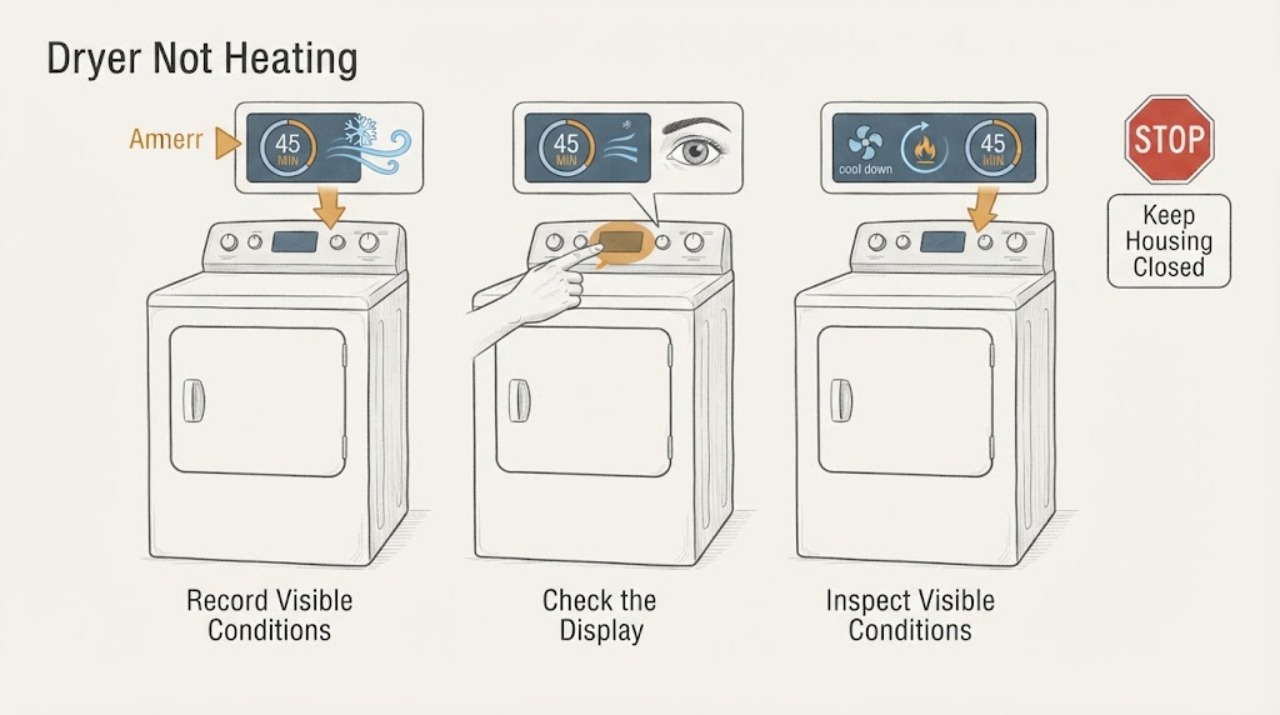
Work through in order
Diagnostic checks
Use only checks that match the exact appliance or system and its official guide.
-
Check 1
Read the rating label and record the complete model, including the final 0 in MEDC465HW0. Confirm that the appliance is the electric MEDC465HW family, not a gas model with a similar name, and note whether the drum turns, the controls light, and the complaint is cold air or a completely dead dryer.
Expected result: The label confirms MEDC465HW0 and the dryer is powered but tumbles cold, or the label is incomplete, the dryer is dead, or the appliance is a different model/fuel type.
Next step: Keep the exact label information for service. If the appliance is not MEDC465HW0, stop using this model-specific path and obtain the correct manual; do not borrow gas-dryer instructions.
Stop if: Stop immediately for smoke, burning or electrical odor, sparks, unusual cabinet or cord heat, a damaged cord or outlet, water near electrical parts, or a breaker that trips again.
Why this matters
Why: The Maytag feature sheet identifies the MEDC465HW family as electric, so a gas-shutoff explanation does not apply. A dead dryer is a power/start branch, while a running drum with cold air is a heat/supply/airflow branch; an uncertain label prevents safe model-specific conclusions.
-
Check 2
With no hazard present, inspect the selected cycle and temperature setting from the front controls. Exclude Air Only, Air Fluff, or another no-heat setting, and note whether the door is fully closed and the cycle was actually started. Do not keep starting cycles just to compare them.
Expected result: Air Only or Air Fluff was selected, the cycle was not started or the door is not latched, or a heat-capable cycle was selected and the drum already runs without warmth.
Next step: Correct only an obvious no-heat selection or door/start condition using the normal controls. If a properly selected cycle remains cold, do not open the controls or choose a component from the symptom.
Stop if: Stop rather than retry if the dryer produces an odor, smoke, spark, excessive heat, abnormal noise, or a protection-device trip.
Why this matters
Why: Maytag states that Air Only/Air Fluff adds no heat. If a heated cycle was already selected and the drum turns cold, the complaint is no longer explained by a no-heat setting; it moves to supply, airflow, or professional heating diagnosis.
-
Check 3
From a safe position, look at the accessible household breakers or fuses serving the electric dryer. Do not remove a terminal cover, pull the dryer out, inspect live wiring, or measure the outlet. If there is no damage, moisture, odor, or heat, a qualified adult may restore a visibly tripped breaker once; do not repeatedly reset it.
Expected result: One side of the dryer supply is visibly tripped or blown, both sides appear normal, or the breaker trips again when the dryer is used.
Next step: If the breaker stays on but the dryer remains cold, arrange appliance service or a qualified electrician to verify the supply and installation. If it trips again, leave it off and obtain professional electrical service.
Stop if: Do not change breaker size, use an extension cord, access the terminal block, or perform a live voltage or continuity test.
Why this matters
Why: Maytag explains that electric dryers use both sides of the household supply: one can run the motor while the other supplies the heater. A repeat trip is an electrical stop, not evidence that the heater alone needs replacement.
-
Check 4
With the dryer off and disconnected safely, clean the lint screen and inspect only the visible exhaust connection and exterior vent hood for a crushed hose, heavy lint, debris, or a blocked flap. Do not dismantle the wall vent or push the dryer into a restricted connection.
Expected result: The lint screen is loaded, the visible hose is kinked or crushed, the outside hood is obstructed, or the accessible airflow path looks clear.
Next step: Clear only accessible lint or an obvious external obstruction. Arrange qualified vent cleaning when the wall route is uncertain or restricted; if the dryer still produces no heat, move to appliance service instead of opening the cabinet.
Stop if: Stop using the dryer when the vent is severely blocked, the cabinet becomes unusually hot, or lint or odor suggests a fire risk.
Why this matters
Why: Maytag identifies Air Only as a no-heat setting and restricted venting as a cause of poor drying performance and heat stress. A blocked path can explain long or weak drying, but a clear exterior does not prove that the internal heating circuit is healthy.
-
Check 5
Review the most recent load and symptoms without running another test: note whether it was oversized, tightly packed, unusually heavy, or mixed with lightweight items, and whether the dryer had ever produced heat before the complaint. Keep the load history separate from the no-heat observation.
Expected result: The load was unusually large or dense, the dryer previously heated normally and then became cold, or the same cold-air symptom occurred with different loads.
Next step: Give the load history and whether the drum turned to the service provider. Do not use a larger or hotter load to force a diagnosis.
Stop if: Do not continue operating the dryer to compensate for a suspected internal fault or when any heat, odor, smoke, or electrical symptom is present.
Why this matters
Why: Load size can affect tumbling and drying time, but it cannot by itself prove an electric heating-component failure. Cold air across different loads after the cycle and supply checks points toward service; warm but slow drying points more toward airflow or loading.
Use your observations
Decision map
Find the observation that best matches what you see, then follow the next safe action.
-
PATH 01Next step
What you see
The rating label confirms MEDC465HW0, the drum turns, a heat-capable cycle was selected, and the accessible breakers appear normal, but the air remains cold.
Do this next
Leave the cabinet closed and arrange Maytag or qualified appliance service; use a qualified electrician if the household supply or outlet is uncertain.
Why this path and its safety boundary
Why it matters: The no-heat setting and an obvious partial supply interruption are less likely. The remaining possibilities include supply or installation conditions that require measurement and internal heating diagnosis, which the user should not perform.
-
PATH 02Next step
What you see
Air Only/Air Fluff was selected, the cycle was not started, or the door was not fully closed.
Do this next
Correct the visible control or door condition once using normal controls. If a normal heated cycle still stays cold, stop troubleshooting at the user-accessible boundary and schedule service.
Why this path and its safety boundary
Why it matters: The observed lack of heat is consistent with the selected no-heat behavior or a cycle that never entered normal operation, rather than proof of a failed heating part.
-
PATH 03Next step
What you see
One breaker is tripped, the outlet or cord shows heat or damage, or the breaker trips again.
Do this next
Leave the dryer off. Use a qualified electrician for the circuit, outlet, or cord and appliance service for the dryer; do not access the terminal block or change protection.
Why this path and its safety boundary
Why it matters: This is a supply-side electrical safety branch. A motor that still runs does not make a damaged or unstable supply safe, and a repeat trip must not be treated as a reset invitation.
-
PATH 04Next step
What you see
The dryer warms but clothes remain damp, the vent is visibly restricted, the outside hood is blocked, or drying times increased rather than heat disappearing completely.
Do this next
Clean the accessible lint screen and correct only visible external restrictions; arrange professional vent inspection if the route is hidden or persistent. Do not operate through severe overheating.
Why this path and its safety boundary
Why it matters: The pattern is more consistent with airflow, venting, or load conditions than a total no-heat complaint, although a clear visible vent does not rule out a hidden restriction.
-
PATH 05Next step
What you see
Smoke, burning odor, sparks, unusual heat, water near electrical parts, a damaged cord or outlet, or a repeated breaker trip is present.
Do this next
Stop using the dryer and disconnect power only if it can be done without touching a hot or damaged area. Keep clear and arrange qualified appliance or electrical service; use local emergency procedures for active smoke or fire.
Why this path and its safety boundary
Why it matters: This is an immediate fire, electrical, or shock stop independent of the suspected heating part.
Helpful context
Understand the symptom
The MEDC465HW0 identity matters here because MEDC465HW is the electric Maytag dryer family, whereas a similarly named MGDC model is gas. The opened Maytag feature sheet lists fuel type Electric, 240 V, 30 A, and a rear-only vent for MEDC465HW. Confirm the complete suffix on the appliance before using any manual or ordering anything.
No-heat symptoms can be caused by a cycle that intentionally uses no heat, a partial household supply interruption, or restricted airflow. They can also require internal diagnosis, but the visible symptom does not identify the heating element, thermal fuse, thermostat, timer, or control. The checks below stay outside the cabinet and stop at the point where electrical service is required.
When checks do not resolve it
Need a professional?
Request appliance service for persistent or intermittent no heat after the user-accessible checks. Request electrical service when the household supply, outlet, cord, or breaker is implicated; request vent service when the concealed exhaust path is restricted or uncertain.
Safety scope: Do not open the dryer, remove the terminal or control cover, access the heater, perform live measurements, bypass thermal protection, change a breaker, or use an internal continuity result to choose a part. Leave the dryer off after a hazard symptom or repeated trip.
Have this ready
- Provide the complete MEDC465HW0 rating-label identity, whether the drum and controls operate, selected cycle and temperature, breaker observations, lint and vent observations, load history, when heat was last normal, and any odor, heat, smoke, spark, or trip timeline.
Common questions
FAQ
Is MEDC465HW0 a gas or electric dryer?
The Maytag MEDC465HW family feature sheet identifies it as electric, with a 240 V, 30 A specification. Confirm the complete MEDC465HW0 label before applying model-specific information; do not use gas-shutoff troubleshooting for this model.
Why can the drum turn if an electric dryer has no heat?
Maytag explains that the motor and heating element use different sides of the household supply. A partial supply interruption can therefore leave the drum turning while the heater does not operate. Check only the accessible breakers; supply measurement and internal diagnosis belong to qualified professionals.
Should I replace the heating element or thermal fuse first?
No. No heat does not identify one part. Verify the cycle, accessible supply, and visible airflow first, then have a qualified provider diagnose the exact fault. Do not open the cabinet, bypass a safety, or perform live testing.
Read the exact guide
Official sources
- Dryer is Not HeatingMaytag Product Help · Opened Maytag guidance covers heated timed cycles, Air Only/Air Fluff, two-sided electric-dryer supply, qualified electrician checks, and separate gas-dryer guidance. It does not authorize user cabinet access or live testing.
- Long Dry Times - DryerMaytag Product Help · Opened Maytag guidance covers Air Dry/Fluff, lint-screen and vent restrictions, crushed or blocked exhaust, and service when drying performance or heating remains abnormal. It is not a component diagnosis for MEDC465HW0.
- Troubleshooting Maytag dryer not heating. Need help. ThanksReddit · The opened post explicitly identifies model MEDC465HW0 and reports that it runs and blows air but does not heat. Replies include unsafe internal testing and unconfirmed component theories, so they are excluded from the instructions.
- MEDC465HW | MaytagMaytag · The opened Maytag owner page identifies model MEDC465HW as a Large Capacity Top Load Dryer with Wrinkle Control, 7.0 cu. ft.; use it with the feature sheet for the assigned MEDC465HW0 variant and do not transfer information to MGDC gas models.
- Feature SheetMaytag · Opened Maytag feature sheet for the MEDC465HW family: 7.0 cu. ft., 240 V, 30 A, Fuel Type Electric, rear-only venting, and MEDC465HW product identity. The final 0 suffix must be confirmed on the appliance label.
Community feedback
Share a repair observation
Share a plain-text repair observation. Accepted observations are published automatically; this page may take a moment to update.