
On this page
Start here
Quick answer
First stop if there is a burning smell, smoke, sparks, unusual heat, a damaged cord, a gas odor, or a breaker that trips again. Otherwise confirm that the selected cycle is heated rather than Air Only, then check the accessible power supply for an electric dryer or the gas supply and shutoff for a gas dryer. Clean the lint screen and check for a crushed or blocked exhaust path. If the controls and airflow are normal, make only the model-supported empty timed-heat check; a drum that turns without heat can still have a separate heating, thermal, ignition, or supply fault. Do not open the cabinet, test live wiring, bypass a thermal safety, or relight a gas dryer repeatedly. Persistent no-heat symptoms need qualified service.
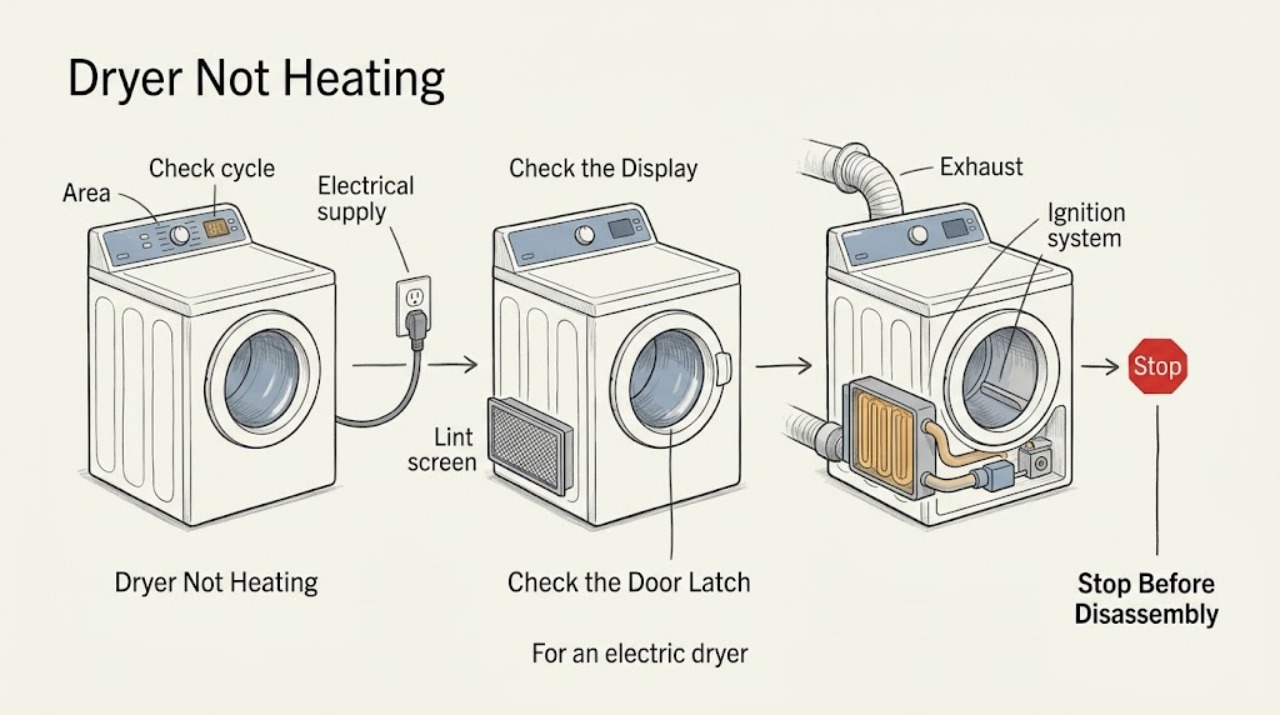
Work through in order
Diagnostic checks
Use only checks that match the exact appliance or system and its official guide.
-
Check 1
Before starting another cycle, look and listen for smoke, a burning or electrical odor, sparks, scorching, an unusually hot cabinet or cord, a gas smell or hissing, water near electrical parts, or a breaker that has tripped repeatedly. Note whether the drum turns, whether the controls light, and whether the complaint is no heat or merely a long drying time.
Expected result: A fire, electrical, gas, or severe heat warning is present; the drum and controls are dead; the drum turns but air stays cold; or the dryer heats weakly and dries slowly.
Next step: For smoke, sparks, burning odor, dangerous heat, water at electrical parts, or a repeat trip, stop and arrange qualified service. For gas odor or hissing, leave and contact local gas authorities from outside. Otherwise continue to the cycle and control check.
Why this matters
Why: Hazard signs require immediate shutdown and are not a reason to repeat a heat test. A dead dryer is primarily a supply or start problem, while a turning drum with cold air needs cycle, supply, airflow, and heating-branch checks.
-
Check 2
Check the cycle selector and temperature option against the exact Maytag manual. Do not use Air Only or Air/Fluff when testing heat. Make sure the cycle is actually running, the door is latched, and any Control Lock or moisture on a touch panel is cleared using the model's normal controls.
Expected result: Air Only or another no-heat option was selected, the cycle was not started correctly, the door or controls are locked, or a heated timed cycle is selected and running.
Next step: Select a model-supported heated timed cycle and start it normally only if no hazard is present. If the control panel remains unresponsive or the dryer will not run, stop and arrange service for the start/control fault.
Why this matters
Why: Air Only intentionally adds no heat, and a locked, unlatched, or unstarted cycle can look like a heating failure. A correctly running heated cycle moves the diagnosis to supply, airflow, and the heating system.
-
Check 3
For an electric Maytag dryer, check the accessible household breakers or fuses that serve the dryer. Both sides of the supply are needed for an electric dryer to heat even though the motor may still run. Do not remove the terminal cover or measure supply voltage yourself; if the supply is uncertain, use a qualified electrician.
Expected result: One breaker or fuse was off, both appear on but the dryer still tumbles cold, or the breaker trips again when the dryer is used.
Next step: Restore a tripped breaker only once if there is no odor, heat, moisture, or damage. If it trips again or heat does not return, stop using the dryer and arrange qualified electrical or appliance service.
Why this matters
Why: A partial supply interruption can leave the drum turning without heat. A repeat trip or normal breakers with no heat indicates an electrical or heating-system fault rather than a cycle setting.
-
Check 4
For a gas Maytag dryer, only when there is no gas odor, visually confirm that the appliance is connected to the intended gas supply and that the accessible supply shutoff has not been left closed. Do not move the dryer, open a gas connection, or investigate a valve when gas is smelled or heard.
Expected result: The gas supply is interrupted or the shutoff is closed; the supply appears available but the drum still runs without heat; or gas odor or hissing is present.
Next step: If there is no odor and a closed shutoff is safely identified, follow the exact installation instructions or have a qualified professional restore service. If the supply appears normal, stop using the dryer and arrange service. If gas is smelled or heard, leave immediately and call local gas authorities from outside.
Why this matters
Why: Maytag states that a gas dryer can tumble without heating when its gas shutoff is closed. A supply that appears available but produces no heat points to ignition, gas-valve, thermal, or control diagnosis. Odor or hissing is an emergency branch, not a supply check.
-
Check 5
With the dryer off and cool, clean the lint screen and inspect the visible exhaust hose and outside hood for a crushed route, heavy lint, or an obstruction. Do not reach into a running dryer or use the machine when the exhaust path is severely blocked. If the dryer heats but takes much longer than usual, treat airflow as the primary branch.
Expected result: The screen is blocked, the exhaust route is crushed or visibly restricted, outside airflow is weak, or the accessible airflow path is clear.
Next step: Clean the accessible lint screen and correct only an obvious external kink. Arrange professional vent cleaning or inspection for a blocked or uncertain duct. If airflow is clear but the dryer remains cold, continue to one controlled heat observation and service branch.
Why this matters
Why: Restricted airflow can cause long dry times and raise heat stress even when the heater operates. A clear accessible path does not prove the entire duct is clear; persistent weak airflow needs professional vent inspection.
-
Check 6
Only if the dryer is free of hazards, the lint path is reasonably clear, and the exact manual permits it, run one empty heated timed cycle for the model's brief heat check. Stop the cycle if an odor, smoke, spark, abnormal noise, or excessive heat appears; otherwise observe whether warm air is present at the end of the check without touching internal parts.
Expected result: Warm air is present; the drum runs but air remains cold; heat starts and then stops; or a hazard appears during the check.
Next step: Cancel the cycle and arrange qualified service for persistent no heat, intermittent heat, or any hazard. Do not open the cabinet, test a thermal fuse or element live, bypass a safety device, or attempt gas-ignition repair.
Why this matters
Why: Warm air points toward a drying-performance or load/airflow issue rather than total heater failure. Cold air with a running drum needs heating-system, supply, or ignition diagnosis. Heat that cuts out or any hazard requires professional assessment.
Use your observations
Decision map
Find the observation that best matches what you see, then follow the next safe action.
-
PATH 01Next step
What you see
Air Only or Air/Fluff is selected.
Do this next
Select a model-supported heated timed cycle instead; Air Only is designed to run without heat.
Why this path and its safety boundary
Why it matters: If a heated cycle still produces cold air, continue to supply, airflow, and service checks.
-
PATH 02Next step
What you see
The electric dryer tumbles but does not heat.
Do this next
Check the accessible dryer breakers or fuses once; do not remove the terminal cover or measure live supply yourself.
Why this path and its safety boundary
Why it matters: If both sides are on but heat is absent, or the breaker trips again, stop and arrange qualified electrical or appliance service.
-
PATH 03Next step
What you see
The gas dryer tumbles but does not heat and there is no gas odor.
Do this next
Visually check the intended gas connection and accessible shutoff without moving the dryer or opening connections.
Why this path and its safety boundary
Why it matters: If gas service appears available but the dryer remains cold, stop using it and arrange qualified diagnosis of ignition, valve, thermal, or control systems.
-
PATH 04Next step
What you see
The dryer heats but takes much longer than usual or the airflow warning appears.
Do this next
Clean the accessible lint screen and correct only an obvious external kink; arrange professional inspection for the full exhaust route.
Why this path and its safety boundary
Why it matters: If airflow remains weak or heat stress is present, stop using the dryer until the vent path is cleared.
-
PATH 05Next step
What you see
Smoke, burning odor, sparks, unusual heat, a damaged cord, or a repeat breaker trip appears.
Do this next
Stop the dryer and isolate power only from a safe location if that does not require touching a wet, hot, or damaged component.
Why this path and its safety boundary
Why it matters: Do not reconnect or test the dryer; arrange qualified service and use emergency help for fire or immediate danger.
-
PATH 06Next step
What you see
Gas is smelled or heard escaping at any time.
Do this next
Do not operate switches, phones, flames, or the dryer inside. Leave immediately and contact local gas authorities or emergency services from outside.
Why this path and its safety boundary
Why it matters: Do not return to inspect, relight, or use the dryer until professionals clear the area and appliance.
Helpful context
Understand the symptom
A running drum does not prove the heater is working
Maytag dryers use separate functions for drum movement and heat. An electric dryer can tumble while one side of its supply is missing, and a gas dryer can tumble while its gas shutoff is closed. A no-heat complaint is therefore best narrowed by cycle selection, supply type, airflow, and a brief safe observation rather than by assuming the motor or heater is the only fault.
Keep lint and heat faults within a safe boundary
Clean the accessible lint screen and look for a crushed or visibly blocked exhaust route. Do not run the dryer when lint is accumulating, airflow is severely restricted, the cabinet is unusually hot, or an odor or spark is present. Heating elements, thermal cutoffs, gas valves, igniters, and wiring are not user-level live tests.
When checks do not resolve it
Need a professional?
Arrange qualified service if a correctly selected heated cycle stays cold after the accessible supply, airflow, and one safe heat check, or if heat is intermittent., Stop immediately for smoke, burning odor, sparks, unusual cabinet or cord heat, a damaged cord, water near electrical parts, a gas odor or hissing, or a breaker that trips again. Do not open the cabinet, test live wiring, bypass a thermal safety, or open a gas connection., Arrange professional vent cleaning or inspection when airflow is weak, the exhaust route is crushed or blocked, or drying time has increased despite a clean accessible lint screen.
Common questions
FAQ
Why is my Maytag dryer running but not heating?
Check that Air Only is not selected, then identify the dryer as electric or gas and check its accessible supply. Clean the lint screen and look for restricted exhaust airflow. If the drum turns but the air stays cold after one safe heat check, the heating or ignition system needs qualified diagnosis.
Can Air Only make a Maytag dryer seem broken?
Yes. Air Only or Air/Fluff intentionally adds no heat. Select a model-supported heated cycle when checking the heater, and use the exact owner manual for cycle names and temperature options.
Why does my electric Maytag dryer tumble but stay cold?
Electric dryers use separate supply paths for the motor and heating function, so a partial supply interruption can leave the drum turning without heat. Check accessible breakers or fuses once; do not remove the terminal cover or measure live supply. If the supply is normal, arrange service.
What should I check on a gas Maytag dryer that is not heating?
Only when there is no gas odor, visually confirm the intended gas connection and accessible shutoff without moving the dryer or opening a connection. If gas is smelled or heard escaping, leave immediately without operating switches or phones inside and contact local gas authorities from outside.
Can a blocked vent cause a Maytag dryer not to heat?
Restricted airflow more commonly causes long dry times and heat stress, but it is an important part of a no-heat diagnosis. Clean the accessible lint screen and correct only an obvious external kink; arrange professional inspection for the full exhaust route if airflow is weak or drying performance has declined.
When should I stop using a Maytag dryer?
Stop for smoke, burning odor, sparks, unusual heat, a damaged cord, water near electrical parts, a repeat breaker trip, or any gas odor or hissing. Do not open the cabinet, test live components, bypass a thermal safety, or repeatedly relight a gas dryer. Arrange qualified service or emergency help as appropriate.
Read the exact guide
Official sources
- Dryer is Not Heating - Product HelpMaytag · Maytag electric and gas dryer product-help guidance; use the exact model manual for differences
- Not Heating - Electric Dryer - Product HelpMaytag · Maytag electric dryer product-help guidance; verify the exact model's installation and owner manual
- Owner's ManualMaytag · Maytag dryer owner manual for the document's model family; exact features and supply configuration vary
- Dryer Not Starting or No Operation - Product HelpMaytag · Maytag dryer product-help guidance; exact controls vary by model
Community feedback
Share a repair observation
Share a plain-text repair observation. Accepted observations are published automatically; this page may take a moment to update.