
On this page
Start here
Quick answer
If a Maytag gas oven does not ignite, first stop if you smell raw gas, hear hissing, see smoke or an abnormal flame, hear a bang, or suspect carbon monoxide. Do not keep trying to light it, use a match, remove the burner, or open the control area. From ordinary safe access, record the exact model and whether Bake or Broil was selected, confirm the control is set correctly, check that the power cord is connected to a grounded working outlet, and confirm the appliance gas shut-off valve is open. Maytag says a recently connected range can have air in the line, and its gas-oven guidance identifies the grounded power path and gas valve as prerequisites for burner operation. A short click or periodic whoosh can be normal on some Maytag gas ovens when the igniter or burner cycles, but repeated clicking without a stable flame, delayed or explosive lighting, or no heat after the model's normal sequence requires service. Keep the oven out of use after one safe check if the cause is not clear.
Before you begin
Safety first
- Keep the oven out of use after raw-gas odor, delayed ignition, smoke, abnormal flame, CO warning, electrical arcing, shock, uncontrolled heat or repeated power trips until the appropriate professional clears it.
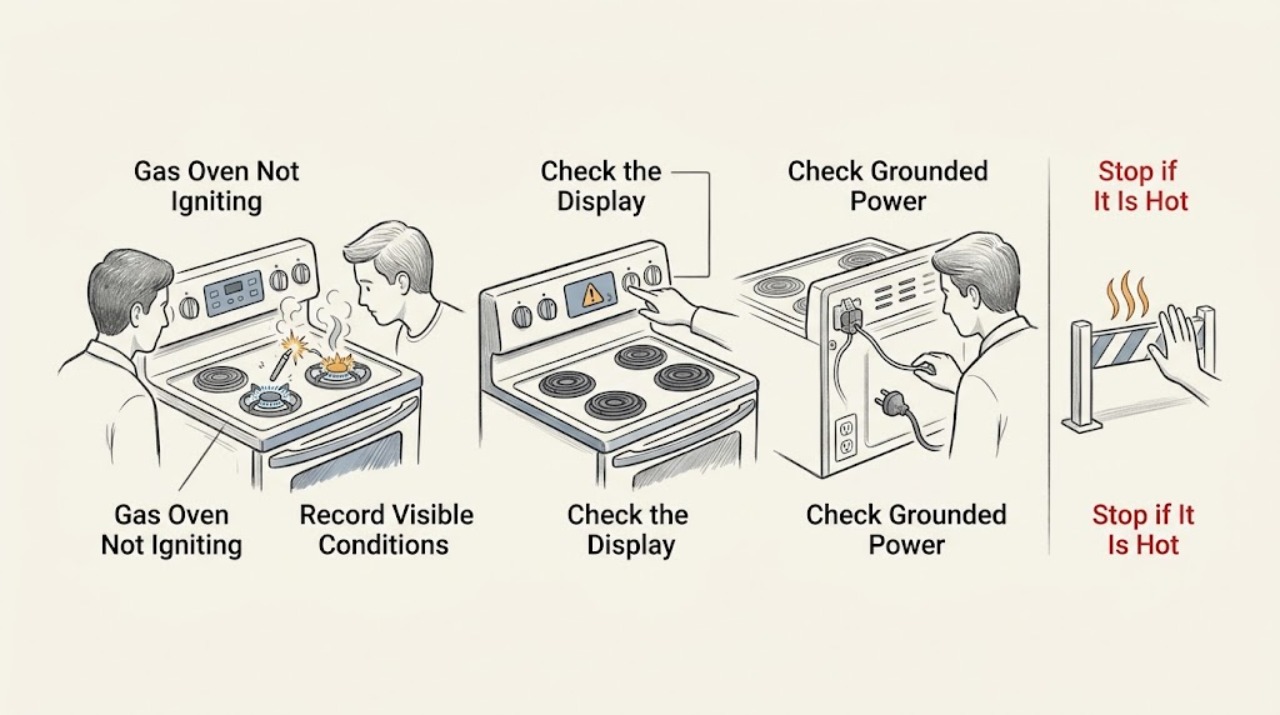
Work through in order
Diagnostic checks
Use only checks that match the exact appliance or system and its official guide.
-
Check 1
Before attempting another start, record the full model number, whether the range was recently installed or reconnected, whether Bake or Broil was selected, the time the sound begins, and whether the control panel, surface burners, oven light, or any display code responds. Keep the oven off while making the notes.
Expected result: Classify the event as no sound and no heat, short clicks with no flame or heat, a normal-looking periodic click or whoosh with heat, a delayed pop or bang, hissing, a raw-gas odor, unstable flame, smoke, or an electrical crackle. Note whether the surface burners work, but do not use them to purge air or perform a test if any gas odor or abnormal behavior is present.
Next step: Use the model number to select the exact Maytag manual and follow the safe branch below. If the sound is a bang, hissing, or abnormal electrical event, skip further testing and arrange qualified help.
Stop if: Stop immediately for raw-gas odor, hissing, delayed or explosive lighting, smoke, a burning smell, visible arc, unstable flame, CO alarm, headache, dizziness, nausea, or a repeated breaker trip.
Why this matters
Why: The same symptom can arise from the control sequence, grounded power, gas supply, air after reconnection, igniter, burner, valve, or a safety fault. The event timing and fuel-safety signs determine whether any external check is appropriate.
-
Check 2
With the oven cool and the gas odor absent, verify from the front that the correct Bake or Broil function is selected, the temperature or mode is set as the manual requires, the door is closed as required, and no visible cookware, foil, or debris is obstructing the door edge or control. Do not remove the oven floor, burner cover, door, or control panel.
Expected result: Record whether the control accepts the command, whether the display shows a lock or error indication, whether the door closes fully, and whether the appliance starts a normal sequence but produces no stable heat. Do not infer a component fault from a display that has not been matched to the exact model manual.
Next step: Correct only a clearly incorrect setting or visible obstruction using the model instructions, then make no more than one safe start attempt if no stop condition exists. If the door, lock, display, or control remains abnormal, request service.
Stop if: Stop for a door that will not close, damaged glass, a stuck control, smoke, heat outside the cavity, burning odor, gas odor, or any need to bypass a lock or remove a panel.
Why this matters
Why: A wrong mode, locked control, incomplete door closure, or model-specific control condition can prevent the requested burner operation without proving that the igniter or gas valve has failed.
-
Check 3
From a dry, safe position, inspect that the range cord is fully seated in the grounded outlet specified by the model and that the breaker has not tripped. Look only for visible outlet or cord damage; do not remove the outlet cover, use an adapter or extension cord, or measure energized circuits.
Expected result: Classify the outlet and cord as secure and cool, loose, warm or hot, discolored, wet, damaged, or without power. Note whether the control panel is blank or whether surface functions work while the oven burner does not.
Next step: If the connection is secure and cool, retain the observation for one model-authorized start attempt. If power is absent or the connection is damaged, leave the oven off and obtain qualified electrical or appliance service before reuse.
Stop if: Stop for a hot or discolored cord or outlet, moisture, smoke, arcing, shock, a damaged plug, or a breaker that trips again.
Why this matters
Why: Maytag states that a proper ground path is needed for the oven igniter, and its support guidance identifies a grounded operational outlet as a prerequisite. A hot, wet, damaged, or repeatedly tripping connection is an electrical hazard rather than a burner-lighting experiment.
-
Check 4
Only when there is no gas odor or hissing, confirm from the visible shut-off position that the main gas valve for the range is open as shown by the exact Maytag manual. If the range was recently installed or reconnected, record that fact and do not loosen any fitting or adjust the regulator. Do not attempt to purge a line by repeated oven starts.
Expected result: Record the valve as open, closed, inaccessible, stiff, damaged, or uncertain; note whether the surface burners and oven behave differently. Do not use a working surface burner as proof that the oven branch, regulator, igniter, or valve is safe.
Next step: If the valve is visibly closed and can be opened normally without force or gas release, restore it only as the manual directs, then make one controlled start attempt. If it is open, uncertain, stiff, or the oven still does not light, stop and request service.
Stop if: Stop for any gas odor, hissing, a valve that will not operate normally, damaged tubing or fittings, a delayed bang, smoke, abnormal flame, or a need to access sealed gas components.
Why this matters
Why: Maytag says air can be trapped after reconnection and that the main gas valve must be on, but the user cannot safely distinguish a supply issue from a burner, valve, or control fault by repeated ignition attempts. A gas odor or hissing overrides this check.
-
Check 5
If the model, power and gas conditions are confirmed and no hazard is present, perform one normal Bake or Broil start exactly as the manual describes while observing from a safe position. Do not remove the oven bottom, look under a burner shield, use a match, or place a hand near the burner. Stop at the first abnormal sound, odor, flame, smoke, or heat behavior.
Expected result: Record one of these outcomes: a short click followed by stable heat, a periodic whoosh or click with stable heat, repeated clicking with no heat, no click and no heat, a delayed pop or bang, an unstable flame, or an odor or smoke event.
Next step: Turn the control off after this one observation. If there is no stable heat or the sound is abnormal, keep the oven out of service and give the exact model, mode, timing and result to authorized or qualified appliance service.
Stop if: Stop immediately for a bang, delayed lighting, raw-gas odor, hissing, unstable or yellow flame, smoke, soot, burning smell, visible arc, CO alarm, or abnormal heat.
Why this matters
Why: Maytag documents short clicking until the flame is detected and periodic whoosh during some Bake or Broil cycles as normal. Repeated clicks with no stable heat, no sound, delayed lighting, or any combustion warning means the expected sequence is not completing and the internal cause cannot be safely identified from outside.
-
Check 6
After the single safe observation, turn the oven off. If the model manual permits a control reset and no hazard occurred, perform that one reset with power isolated only as the manual directs; otherwise do not reset anything. Do not repeat the Bake or Broil test, cycle the gas valve, or reset a tripped breaker to continue troubleshooting.
Expected result: Record whether the display and controls recover, whether the same no-light condition returns, whether a code appears, and whether any heat, odor, flame or sound abnormality remains after the control is off.
Next step: Stop troubleshooting and arrange qualified Maytag gas-appliance service with the exact model, fuel setup, mode, sound description, timing, code and every observation.
Stop if: Stop for any recurrence of gas odor, hissing, delayed ignition, smoke, burning smell, abnormal flame, CO warning, shock, arcing, hot connection, or breaker trip.
Why this matters
Why: A transient control state can clear once, but a recurring no-light symptom after power, gas and control checks points toward the igniter, burner, valve, wiring, sensor, grounding or control system. Repeated attempts can add unburned fuel or worsen an electrical fault.
Use your observations
Decision map
Find the observation that best matches what you see, then follow the next safe action.
-
PATH 01Next step
What you see
The oven produces only a short click and then stable heat, or a periodic whoosh during Bake or Broil with no odor, smoke, abnormal flame or excessive heat.
Do this next
Confirm the sound against the exact model manual and continue use only while the flame, heating and controls remain normal.
Why this path and its safety boundary
Why it matters: Maytag documents these brief, periodic sounds as normal on applicable gas-oven models.
-
PATH 02Next step
What you see
The control is set correctly, the door is closed, the outlet is grounded and operational, and the visible gas valve is open, but the oven gives repeated clicks or no heat.
Do this next
Turn the control off after one observation, keep the oven out of use, and arrange qualified service. Do not open the burner area or test live wiring.
Why this path and its safety boundary
Why it matters: The expected burner-lighting sequence is not completing; an internal igniter, burner, valve, grounding, wiring or control issue remains possible.
-
PATH 03Next step
What you see
The range was recently installed or reconnected and the model's first-use sequence takes longer, but there is no gas odor, bang, smoke, or abnormal flame.
Do this next
Follow the exact model manual once; turn the control off if the burner does not light as directed. If it still fails, request authorized service rather than repeating starts.
Why this path and its safety boundary
Why it matters: Maytag notes that air can be present in a reconnected gas line and that first lighting can take longer on covered models.
-
PATH 04Next step
What you see
The main gas valve is closed, stiff, damaged or uncertain, or a fitting, regulator or tubing is inaccessible.
Do this next
Do not force or disassemble the gas path. Keep the oven off and arrange qualified gas-appliance service; leave immediately if gas is smelled or heard.
Why this path and its safety boundary
Why it matters: The gas-supply condition cannot be safely resolved by appliance sound diagnosis.
-
PATH 05Next step
What you see
A bang, delayed lighting, raw-gas odor, hissing, unstable flame, soot, smoke, CO warning, burning smell, electrical arc, abnormal heat or repeated breaker trip occurs.
Do this next
Stop using the oven, leave immediately for gas or suspected combustion danger, avoid switches and electronics, and contact the gas utility or emergency service from outside. Keep the appliance out of service until cleared.
Why this path and its safety boundary
Why it matters: This is a fuel, combustion, fire, shock or control emergency, not a normal ignition sound.
Helpful context
Understand the symptom
Identify the sound without turning a failure into a fuel test
A brief, light click can be part of a Maytag gas oven's normal burner-lighting sequence, and Maytag describes a periodic whoosh during Bake or Broil cycling on applicable ranges. Those statements do not make every click or whoosh safe. A click that continues while no flame or heat appears, a delayed bang, a harsh pop, hissing, or a sound paired with raw-gas odor is a stop condition. Record the sound and the exact model rather than repeatedly selecting Bake or Broil.
Power and gas supply both matter
Maytag explains that electronic oven igniters need a good ground path, and its gas-oven support page asks whether the cord is in a grounded operational outlet and whether the main gas valve is on. A recently installed or reconnected range can also have air in the gas line. Check only the visible, model-appropriate supply conditions; do not loosen a gas fitting, adjust a regulator, or perform a live electrical test. If the valve is open and the outlet is sound but the oven still does not light, the next step is qualified service.
The exact model controls the timing and procedure
Maytag's gas range manual gives an example of an oven burner lighting within a model-specific interval and notes that first use can take longer when air is in the line. That is not a universal timing rule for every Maytag gas oven. Use the model number to retrieve the correct manual, record whether this is Bake or Broil, and stop rather than repeating a trial when the model's sequence does not complete normally.
Only after diagnosis
Potential parts
- oven igniter
Consider this only after a qualified diagnosis links no stable burner lighting to the igniter rather than the gas supply, burner, valve, grounding, wiring or control.
Confirm the full Maytag model and fuel configuration; do not replace an igniter from a sound or symptom alone. - oven burner assembly
Consider this only when qualified inspection finds a blocked, damaged or misaligned burner that explains the failed lighting and the gas path is otherwise safe.
Gas burner fit and adjustment are model-specific and should be handled by qualified service. - oven gas valve or safety valve
Consider this only after a qualified technician confirms that supply and ignition commands are present but the model-specific valve does not deliver fuel correctly.
Do not alter or bypass a gas valve; confirm exact model fit and professional installation.
When checks do not resolve it
Need a professional?
Safety scope: Keep the oven out of use after raw-gas odor, delayed ignition, smoke, abnormal flame, CO warning, electrical arcing, shock, uncontrolled heat or repeated power trips until the appropriate professional clears it.
Common questions
FAQ
Is clicking normal on a Maytag gas oven?
Maytag says short clicks can be normal while the igniter detects a flame. The sound should be brief and paired with stable burner operation on the applicable model. Repeated clicking with no heat, a harsh crackle, a delayed bang, raw-gas odor, smoke or an unstable flame is not a reason to keep trying; turn the control off and arrange service.
Why does my Maytag gas oven click but not light?
The control may be requesting burner lighting while the ground, gas supply, igniter, burner, valve or control path is not completing the sequence. Check only the grounded power and visible gas-valve conditions in the exact manual, then make no more than one safe observation. If the burner still does not light, keep the oven off and request qualified service.
Can a whoosh be normal when a Maytag gas oven is heating?
Maytag describes a whoosh when gas is ignited from Bake or Broil on applicable ranges and says it may recur during the cycle. Treat that as normal only when it is brief, predictable, and accompanied by stable heat with no odor, smoke, bang, abnormal flame or excessive heat. A worsening or delayed whoosh needs service.
Should I light the Maytag oven with a match if the igniter fails?
No. Do not use a match, bypass the ignition system, remove the burner cover, or open the gas path to make the oven light. Turn the control off after the safe external checks and arrange qualified gas-appliance service, especially if there was any gas odor or delayed lighting.
When should I stop troubleshooting a Maytag gas oven that will not ignite?
Stop for raw-gas odor, hissing, a bang or delayed lighting, unstable or yellow flame, smoke, soot, burning smell, a CO warning, abnormal heat, visible arcing, shock or a repeated breaker trip. Leave immediately for gas or suspected combustion danger and keep the oven out of use until the appropriate qualified professional clears it.
Read the exact guide
Official sources
- Carbon-Monoxide-Questions-and-AnswersU.S. Consumer Product Safety Commission · General fuel-burning appliance safety; apply it to this gas oven when combustion or CO concern exists.
- Why is My Oven Not Turning On?Maytag · Maytag consumer guidance across oven types; gas-specific claims are conditional and exact model instructions take priority.
- CPSC Warns of Generator, Carbon Monoxide and Fire Hazards Ahead of Hurricane SeasonU.S. Consumer Product Safety Commission · General household safety guidance, not a Maytag repair procedure.
- Slide-In Gas Ranges Owner's ManualMaytag · The manual's listed slide-in gas-range models; do not apply its timing or controls to another model without checking that manual.
- Oven Not Working - Gas - Product HelpMaytag Product Help · Maytag gas ranges; use the visible supply checks only when they match the exact appliance and manual.
- Whoosh or Poof Noise in Oven - RangeMaytag Product Help · Maytag gas ranges covered by the article; a sound accompanied by a safety symptom is not treated as normal.
- Product Manuals & LiteratureMaytag · Use with the exact model number to retrieve the applicable manual.
- Clicking Noise in a Gas OvenMaytag Product Help · Maytag gas ovens covered by the product-help article; exact model behavior controls.
Community feedback
Share a repair observation
Share a plain-text repair observation. Accepted observations are published automatically; this page may take a moment to update.