
On this page
Start here
Quick answer
After the Maytag M1TXEGMYB freezer or refrigerator door has been open for about 8 hours, warm air and humidity can create frost, block airflow and temporarily raise both compartment temperatures. Close both doors, protect food first, and measure the refrigerator and freezer rather than judging by cabinet feel. Confirm cooling is on, the controls were not changed, the door gasket closes fully and the vents are clear. Maytag's general guidance says many refrigerators need several hours to pull down and up to 24 hours to fully stabilize, but that is not a guarantee for this exact model. If temperatures do not recover after the model's normal stabilization period, frost returns, the door will not seal, or the compressor/fan needs internal testing, arrange Maytag service. Do not chip ice with a sharp object, apply a heater or hair dryer, open panels, or guess a replacement part.
Before you begin
Safety first
- Do not use a knife, screwdriver, hair dryer, heater or electrical device to clear frost; do not remove evaporator or rear panels, bypass a door switch, test live wiring, or guess a compressor, fan, thermostat or control replacement. Use only the exact manual for ordinary external settings and checks.
Work through in order
Diagnostic checks
Use only checks that match the exact appliance or system and its official guide.
-
Check 1
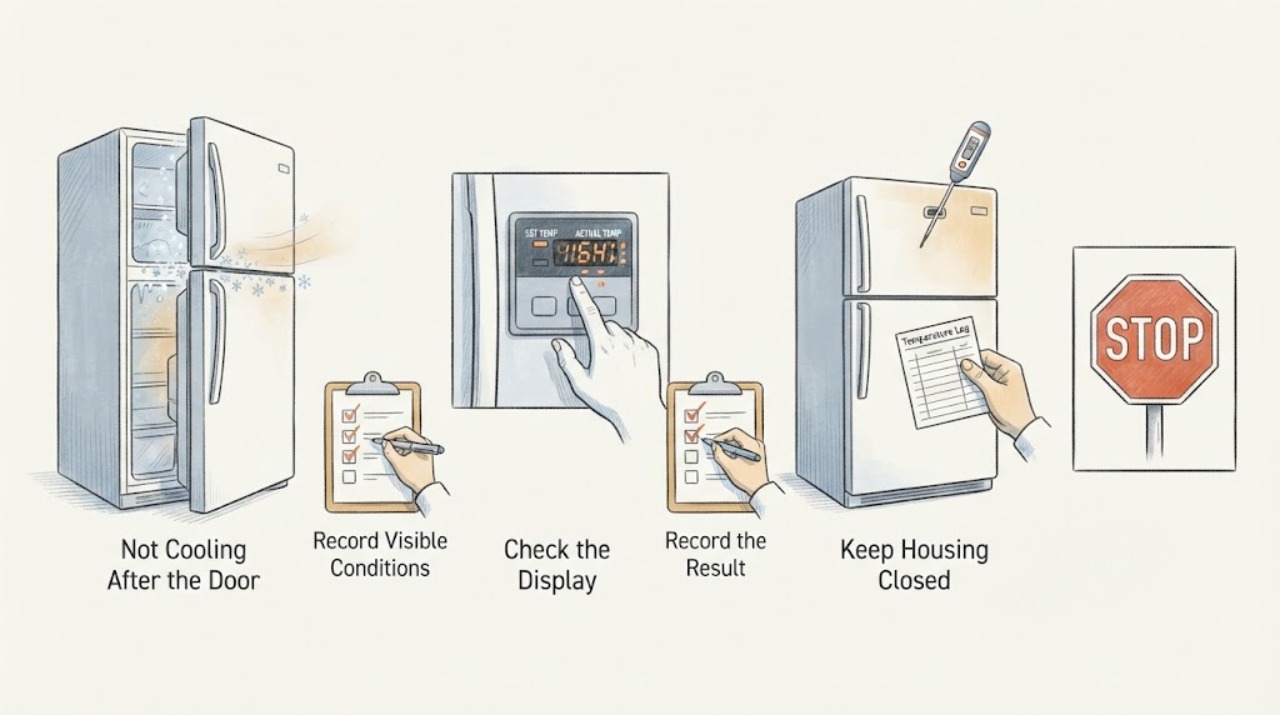
Close the freezer and refrigerator doors completely, remove only items that visibly prevent sealing, and keep them closed while you document the event. Record which door was open, whether the interior light stayed on, how long it was open, whether food softened, and the room conditions.
Expected result: The door now seals, the light goes off as designed, and the compartments begin cooling, or the door remains ajar, the light stays on, food blocks the gasket or the cabinet is visibly damaged.
Next step: Remove only the accessible obstruction and close the door. If the gasket, hinge, cabinet or door switch cannot make proper contact, stop relying on recovery and arrange model-specific service.
Stop if: Do not force the door, reshape the gasket with heat, remove hinges or tape a door switch closed.
Why this matters
Why: A prolonged open door explains warm humid air and frost, but a door that still cannot close can keep the condition going and prevent recovery. A light or door-switch anomaly may also keep the refrigerator warm on some models.
-
Check 2
Check the Maytag control panel or temperature controls from the front and confirm cooling is on, no Cooling Off or Showroom/Demo state is displayed, and the settings have not been changed during the incident. Use the exact M1TXEGMYB manual for the control sequence.
Expected result: Cooling is off or a showroom state is active, the controls are at their normal setting, or the display is unavailable or different from the manual.
Next step: Restore cooling only with the matching manual, then leave the settings stable. Do not repeatedly toggle controls or treat a control correction as proof that the cooling system is healthy.
Stop if: Do not enter an unverified diagnostic mode, remove the control panel or change several settings at once.
Why this matters
Why: Maytag says some refrigerators will not cool when cooling is turned off or showroom mode is active even though lights work. A normal display does not rule out frost, airflow or an internal fault.
-
Check 3
Place appliance thermometers in the center of the refrigerator and freezer compartments, away from doors, walls and vents, then record readings without repeatedly opening the doors. Compare the freezer with 0°F and the fresh-food section with 37°F as Maytag's general starting guidance, while following the exact model manual.
Expected result: Both sections are warming, the freezer is near its target but the refrigerator is warm, or both temperatures improve during the closed-door recovery period.
Next step: Keep the doors closed and record the trend. If temperatures remain unsafe or fail to improve after the model's normal stabilization period, protect food and arrange service instead of repeatedly resetting the unit.
Stop if: Do not use a thermometer reading to justify opening an evaporator cover or testing a compressor or fan.
Why this matters
Why: A cold freezer with a warm refrigerator points toward air distribution or a blocked/frosted vent; two warm sections make cooling mode, power, environment or a cooling-system issue more important. Maytag says temperature changes need time to stabilize.
-
Check 4
Inspect only the visible freezer and refrigerator vents for food packages, containers or loose bags pressed against them, and look for frost on visible walls or around the air path. Do not scrape, chip, drill or heat the frost; keep all stored items clear of the vents.
Expected result: The vents are blocked, visible frost is present, the door was left open in a humid room, or there is no visible frost or obstruction but temperatures remain abnormal.
Next step: Clear only storage obstructions and follow the exact manual for a permitted defrost. If frost is behind a panel, returns quickly, or the appliance remains warm, arrange qualified service.
Stop if: Do not use sharp tools, a hair dryer, a heater, hot water, an electrical device or a chemical defroster, and do not remove an evaporator cover.
Why this matters
Why: Maytag says prolonged door opening lets humidity enter and can build frost, and that blocked vents reduce circulation between the freezer and refrigerator. Hidden ice cannot be safely diagnosed from a visible patch alone.
-
Check 5
Check the refrigerator and freezer door gaskets from the outside: look for food, ice, dirt, a folded section or a gap around the closed door. Check only accessible cabinet clearance and whether a recent load of warm food or repeated openings occurred; do not move a heavy appliance or remove panels.
Expected result: A gasket does not contact the cabinet, a package blocks the door, the unit is in a hot or poorly ventilated location, or the seals and surroundings appear normal.
Next step: Close the doors promptly, remove only accessible obstructions and use the manual's installation guidance for clearance. Wait for a stable trend before making another adjustment; service the unit if cooling remains abnormal.
Stop if: Do not use a heat gun, pull the refrigerator out alone, bend the cabinet or attempt to repair a gasket or hinge without model-specific instructions.
Why this matters
Why: Maytag links poor sealing, warm surroundings, frequent openings and large warm loads with elevated temperature and frost. Correcting an accessible obstruction may allow recovery, but normal seals do not exclude an internal cooling issue.
-
Check 6
Evaluate food safety using measured temperatures and the elapsed time, and do not taste food as a test. Keep the doors closed, transfer food only if it can be done safely, and record any thawing, unusual odor, texture change or excessive ice crystals for the service report.
Expected result: Frozen food remains at or below the safe target, food has partially thawed but still contains ice crystals, or refrigerated perishables were above their safe temperature for too long.
Next step: Follow Maytag and local food-safety guidance for discarding or safely transferring affected food. Continue appliance diagnosis only after food is protected; arrange prompt service if the compartments are not recovering.
Stop if: Do not taste food to decide whether it is safe, and do not keep opening the appliance to monitor it by feel.
Why this matters
Why: Maytag prioritizes temperature-based food safety and notes that thaw-and-refreeze signs can include texture changes, odors, discoloration or excessive ice crystals. Cooling recovery does not restore food that has already spent too long warm.
Use your observations
Decision map
Find the observation that best matches what you see, then follow the next safe action.
-
PATH 01Next step
What you see
Both doors now seal, cooling is on, there is no dangerous frost or obstruction, and measured temperatures improve after remaining closed.
Do this next
Keep the doors closed and allow the model's normal stabilization period, using measured temperatures to verify recovery. Maytag's general guidance allows several hours and up to 24 hours for stabilization, not a guaranteed M1TXEGMYB deadline.
Why this path and its safety boundary
Why it matters: Warm humid air from the 8-hour opening is a plausible explanation, and the refrigerator is following a recovery path rather than demonstrating a confirmed component failure.
-
PATH 02Next step
What you see
The freezer has visible frost or blocked vents while the refrigerator is warmer, especially after the door was left open in humid conditions.
Do this next
Clear only storage obstructions and use the exact manual's permitted defrost procedure. If frost is behind a panel, returns quickly or cooling does not recover, request Maytag service.
Why this path and its safety boundary
Why it matters: The pattern makes moisture-related frost or restricted air distribution more likely than a conclusion about the compressor. Hidden frost remains unconfirmed without service access.
-
PATH 03Next step
What you see
The display shows Cooling Off or Showroom/Demo, or the controls were changed while the doors were open.
Do this next
Use the matching M1TXEGMYB manual to restore cooling once, then keep the doors closed and verify measured temperatures. Escalate if temperatures remain unsafe after stabilization.
Why this path and its safety boundary
Why it matters: Maytag says the refrigerator may have lights without cooling in these states. Restoring the documented setting is a control correction, not proof that the appliance has no other fault.
-
PATH 04Next step
What you see
Both compartments remain warm after the doors seal, controls are normal, vents are clear and the recovery period has passed, or the compressor/fan needs internal observation.
Do this next
Protect food and arrange qualified Maytag service with the model, temperature log, frost photos, control state, door-seal result and event timeline. Do not open panels or run repeated forced cycles.
Why this path and its safety boundary
Why it matters: The prolonged-open event no longer explains the complete symptom. Maytag's public guidance does not justify naming a compressor, fan, control, sealed-system or other replacement part from temperature alone.
-
PATH 05Next step
What you see
There is smoke, a burning odor, arcing, a damaged cord, repeated breaker operation, liquid near electrical parts or another immediate hazard.
Do this next
Stop using the refrigerator, disconnect power only if safe without touching damaged parts, keep clear and obtain qualified electrical or appliance service. Do not restore power as a confirmation test.
Why this path and its safety boundary
Why it matters: This is an electrical or appliance safety event, not a normal recovery delay.
Helpful context
Understand the symptom
Leaving a refrigerator or freezer door open for hours is a different starting condition from an unexplained no-cooling failure. Warm, humid room air can enter, frost can form, and the frost or misplaced food can restrict the air path. The correct first decision is whether the unit is recovering with both doors closed, or whether a seal, airflow, control or cooling fault remains after recovery time.
The Maytag Owner Center identifies M1TXEGMYB as a 21 cu. ft. top-freezer refrigerator, but the opened page lists no documents. Use the complete rating-label model and Maytag's manual lookup for any control sequence. Do not transfer settings or service steps from a similar M1TXEGMY variant.
Food safety comes before diagnosis. Use measured temperatures and local food-safety guidance, not smell or a taste test. Never use a knife, screwdriver, hair dryer or heater to clear hidden frost; if frost is behind a panel or the appliance needs internal access, stop and arrange service.
When checks do not resolve it
Need a professional?
Call Maytag or qualified appliance service for persistent warmth after recovery, hidden or recurring frost, failed sealing, an unexplained control state, or any internal cooling diagnosis. Use qualified electrical service for cord, outlet, arcing or breaker concerns.
Safety scope: Do not use a knife, screwdriver, hair dryer, heater or electrical device to clear frost; do not remove evaporator or rear panels, bypass a door switch, test live wiring, or guess a compressor, fan, thermostat or control replacement. Use only the exact manual for ordinary external settings and checks.
Have this ready
- Provide the complete M1TXEGMYB rating-label model, market, which door was open and for how long, temperature readings over the recovery period, frost and vent photos, door-seal and control observations, recent loading or moving history, and food-safety actions taken.
Common questions
FAQ
How long should the Maytag refrigerator take to recover after the door was open for 8 hours?
There is no exact M1TXEGMYB recovery promise in the opened model page. Maytag's general guidance says many refrigerators need several hours and up to 24 hours to fully stabilize, depending on starting temperature, room conditions, door openings and load. Keep the doors closed and verify with thermometers; service it if it does not recover.
Can leaving the freezer door open create frost that stops cooling?
It can create a frost and airflow problem. Maytag says a door left open for a long period lets humid air enter and frost build, and that blocked vents reduce circulation between the freezer and refrigerator. Do not chip hidden ice or heat the cabinet; use the exact manual or arrange service.
Should I turn the temperature colder repeatedly after the door was left open?
No. Confirm cooling is on and use the model manual, then make at most a documented small adjustment and allow time to stabilize. Maytag says to wait 24 hours between adjustments; repeated changes make the recovery harder to interpret.
When should I throw out food after the refrigerator was warm?
Use measured temperature and local food-safety guidance rather than smell or a taste test. Maytag's guidance says refrigerated foods should stay at or below 40°F and frozen foods at or below 0°F, with additional discard guidance when perishables have been above the safe temperature too long.
Read the exact guide
Official sources
- What to Do During a Power OutageMaytag Product Help · Opened Maytag food-safety guidance for temperature-based decisions after a warm event; a door-left-open event is not a power outage, so only the temperature and no-tasting principles are transferred.
- How to Test if the Door Switch is ActivatedMaytag Product Help · Opened Maytag door-switch guidance for the safe external symptom boundary; it notes that door status can affect lights, fans and cooling depending on the model and does not authorize bypassing the switch.
- How Long to Wait Before Adding Food to a New RefrigeratorMaytag Product Help · Opened Maytag cooling-time page for the bounded recovery estimate; it is general guidance for refrigerators and is not a guaranteed M1TXEGMYB door-left-open service interval.
- How to Help Eliminate Condensation and FrostMaytag Product Help · Opened Maytag guidance for prolonged door opening, gasket sealing, humidity and model-specific defrost/manual boundaries; controls and hidden frost remain model-specific.
- M1TXEGMYBMaytag · Opened Maytag's exact model page to verify M1TXEGMYB as a 21 cu. ft. top-freezer refrigerator; the page states no documents are available there, so it does not support an unverified model-specific control sequence.
- How to Check the Air Vents for Blockage-Ensuring Proper Air FlowMaytag Product Help · Opened Maytag airflow guidance for vent blockage, warm spots, unusual fan sounds and recovery after door openings; vent locations and controls vary by model.
- Appliance Manuals and LiteratureMaytag · Opened Maytag's official manual page for the model-identity boundary; it directs owners to enter the appliance model number to retrieve the matching documents.
- Tips for Properly Setting the ControlsMaytag Product Help · Opened Maytag control guidance for cooling-off/showroom boundaries, small adjustments, thermometer placement and waiting between changes; the exact M1TXEGMYB sequence must come from its manual.
Community feedback
Share a repair observation
Share a plain-text repair observation. Accepted observations are published automatically; this page may take a moment to update.