
On this page
Start here
Quick answer
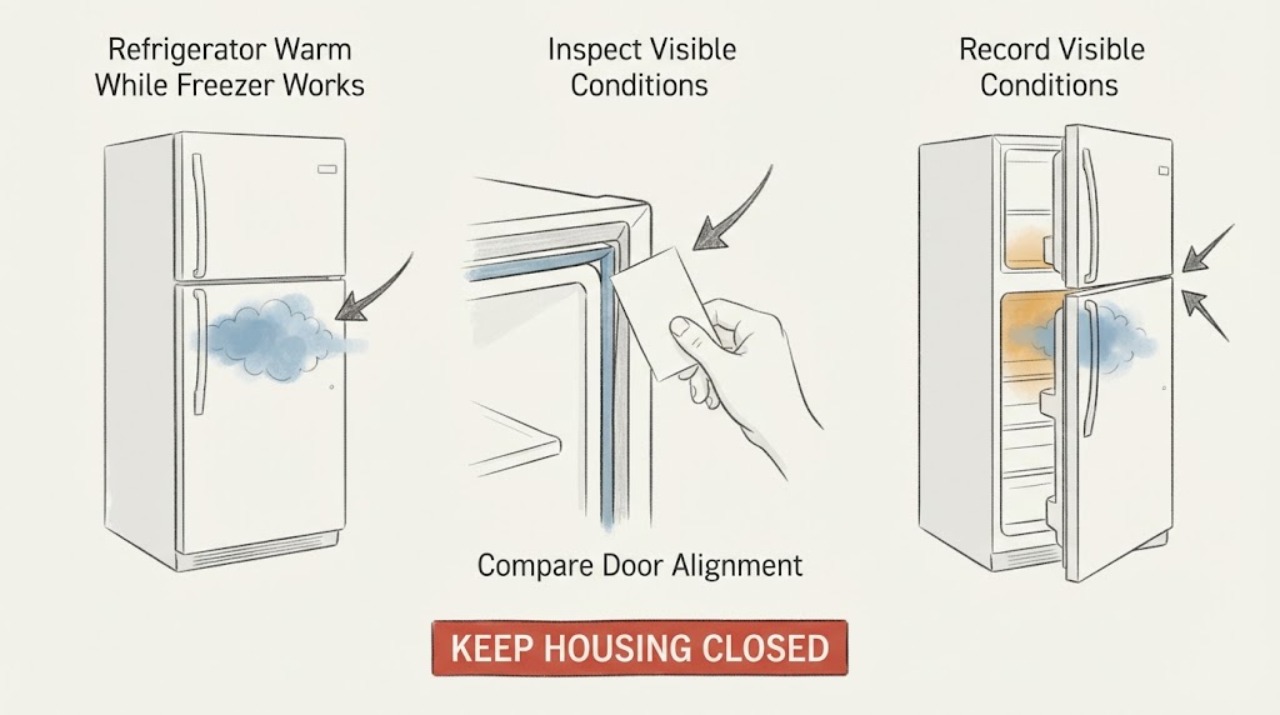
If the Maytag MBL2258XES6 freezer is cold but the refrigerator section is warm and the fresh-food door will not close, treat the door as the first fault to contain: move bins or food that hold it open, inspect the full gasket contact, and check that the cabinet is level. An unsealed door lets warm, humid air in and can also promote frost that restricts the cold-air path. Measure both compartments rather than judging by touch; Maytag recommends keeping the refrigerator at 33–40°F and the freezer around 0°F. Keep perishable food in a known-safe cold location if the fresh-food temperature is above 40°F. Do not remove the rear panel, force the hinge, or guess a damper, fan, or control board. If the door still cannot seal, frost blocks airflow, or the refrigerator remains warm after safe external corrections and stabilization, arrange qualified Maytag service.
Before you begin
Safety first
- Do not remove the rear or freezer panels, chip or melt hidden ice with tools, force or remove the door/hinge, bypass door switches, access wiring, or perform electrical measurements. Keep perishables out of a refrigerator that is above a safe temperature. Stop for water near electrical parts, smoke, burning odor, abnormal heat, a damaged cord, or repeated breaker operation.
Work through in order
Diagnostic checks
Use only checks that match the exact appliance or system and its official guide.
-
Check 1
Read the refrigerator label and confirm MBL2258XES6. Place an appliance thermometer in the fresh-food section and another in the freezer without blocking vents, and record the readings, how long the door has been failing to close, and whether the freezer is actually maintaining its normal temperature.
Expected result: The model is confirmed and the fresh-food section is above 40°F while the freezer is near its normal target, or the model/temperature result is uncertain.
Next step: Move perishable food to a known-safe cold location if the fresh-food temperature is above 40°F or its safety history is uncertain. If the label or readings are uncertain, retrieve the MBL2258XES6 literature before any part or adjustment decision.
Why this matters
Why: A warm refrigerator with a cold freezer points first toward door sealing or air distribution, but a temperature measurement is needed to protect food and avoid mistaking a short recovery period for a fault.
-
Check 2
With the refrigerator stationary, open the fresh-food door and look for a shelf, bin, bottle, drawer, or package preventing the door from reaching the cabinet. Wipe visible soil from the gasket and the mating cabinet surface with a soft cloth and water; do not pull the gasket out or force the door.
Expected result: An obstruction or dirty gasket is present, or the door closes but a continuous gap remains around the gasket.
Next step: Remove only the accessible obstruction and clean the contact surfaces. Close the door gently and recheck the seal; if the gap remains, stop using the refrigerator for perishable storage and arrange service rather than ordering a gasket or hinge by appearance.
Why this matters
Why: Maytag identifies obstructions, dirty/worn gaskets, and poor contact as causes of an ineffective seal. Warm humid air can enter through that gap and worsen fresh-food temperature and frost conditions.
-
Check 3
Check the cabinet from outside with a level if available and look at the door from the front and side. Note a visible sag, uneven top gap, or door that swings open instead of settling closed; do not remove the toe grille, hinge covers, or door.
Expected result: The cabinet appears out of level or the door alignment is visibly abnormal, or the cabinet and door appear square while the gasket still will not seal.
Next step: Use the MBL2258XES6 Owner's Manual or qualified service for any leveling or hinge adjustment. Do not force the door, shim it with loose material, or keep running it while the seal is open.
Why this matters
Why: Maytag says an unlevel refrigerator can prevent proper door closing and that door alignment affects sealing. A visible alignment problem changes the next step to model-specific installation/service guidance, not a cooling-component diagnosis.
-
Check 4
After the door is able to close, inspect only the visible air vents in the freezer and fresh-food section. Move food away from those openings and note any heavy frost or ice covering a vent; do not remove a rear panel, chip ice, or probe behind the liner.
Expected result: A vent is blocked by food, a vent is visibly covered with frost, or the visible vents are open and clear.
Next step: Clear only a safe storage obstruction and keep the door sealed. If frost blocks the passage or returns after the door is corrected, protect food and arrange service; do not dismantle the freezer interior.
Why this matters
Why: Maytag explains that cold air moves between compartments through vents and that blocked airflow can leave the refrigerator warm even when the freezer is cold. Frost covering a vent may be a consequence of the failed seal or a recurring defrost/airflow condition.
-
Check 5
Check the controls for an unintended Cooling Off, Showroom/Demo, or changed temperature setting, and note whether the refrigerator was recently installed, heavily loaded, or opened frequently. Change only one setting according to the exact manual and allow the appliance to stabilize before rechecking temperatures.
Expected result: A cooling mode or setting is abnormal, a large warm load/recent installation explains a short recovery period, or settings and usage are normal.
Next step: Restore only the documented setting and keep the door closed as much as practical while monitoring. If the door still will not seal or the fresh-food temperature stays above 40°F after stabilization, stop relying on the unit for perishables and request service.
Why this matters
Why: Maytag lists cooling mode, settings, recent loading, and frequent openings as possible contributors. A normal freezer does not prove the fresh-food air path is healthy, and changing several controls at once hides the result.
Use your observations
Decision map
Find the observation that best matches what you see, then follow the next safe action.
-
PATH 01Next step
What you see
The fresh-food temperature is above 40°F, the freezer is cold, and a package, bin, dirty gasket, or visible door gap is preventing the MBL2258XES6 door from sealing.
Do this next
Protect perishable food, correct only an accessible obstruction or clean the contact surfaces, and recheck closure. If the gap remains, arrange qualified Maytag service without selecting a gasket, hinge, damper, or fan from the symptom.
Why this path and its safety boundary
Why it matters: The door-seal path is the highest-priority explanation and an immediate food-safety concern. Warm air entry can also lead to moisture or frost that restricts airflow.
-
PATH 02Next step
What you see
The door closes and seals after an obstruction is removed, but a fresh-food vent is blocked by food or visible frost while the freezer remains cold.
Do this next
Keep vents clear and the door closed. Do not chip ice or remove a liner/panel; if frost persists or returns, protect food and arrange service for the exact model.
Why this path and its safety boundary
Why it matters: Air distribution is more likely than a whole-system cooling failure. Maytag describes cold air moving between compartments through vents; frost may reflect the earlier open-door condition or a recurring hidden problem.
-
PATH 03Next step
What you see
The door is aligned and sealed, vents are visibly clear, settings are normal, and the refrigerator remains above 40°F while the freezer stays cold.
Do this next
Stop repeated adjustments and arrange qualified Maytag service. Provide the model, both temperature readings, door-seal history, frost observations, and the time allowed for stabilization.
Why this path and its safety boundary
Why it matters: The symptom is no longer explained by the safe external door and airflow checks. A concealed airflow, temperature-sensing, defrost, or cooling-control problem is possible, but the evidence does not identify a damper, fan, or board.
-
PATH 04Next step
What you see
The refrigerator was recently installed or loaded with a large amount of warm food, the door now seals, and temperatures are trending toward the recommended range.
Do this next
Keep the door closed and monitor with a thermometer. If the fresh-food temperature does not return to a safe range, or the door gap returns, arrange service.
Why this path and its safety boundary
Why it matters: A recovery period is plausible; Maytag notes that a recent installation or large warm load can require time to stabilize. The result does not explain a door that remains unable to close.
-
PATH 05Next step
What you see
There is a persistent open door, uncontrolled temperature rise, heavy recurring frost, water near electrical parts, smoke, burning odor, a hot/damaged cord, or repeated breaker operation.
Do this next
Move perishables to a known-safe cold location, stop using the refrigerator, and obtain qualified appliance service. Do not remove panels, force the hinge, or touch wet electrical parts.
Why this path and its safety boundary
Why it matters: This is a food-safety or appliance-safety event, not a component experiment. Continued operation can spoil food or increase electrical and water damage risk.
Helpful context
Understand the symptom
The combination of a cold freezer, a warm fresh-food section, and a door that will not close changes the order of checks. First establish whether the door is held open by food or bins, whether the gasket contacts the cabinet, and whether the refrigerator is level. A door that remains ajar can admit warm humid air and create frost or temperature instability; it should not be treated as proof that a damper or fan has failed.
Maytag's public guidance is general and directs owners to use the exact model manual. The MBL2258XES6 manual lookup should therefore control any hinge, door-alignment, defrost, or service-test procedure. Safe checks here stay external: temperature measurement, visible seal/obstruction inspection, vent clearance, settings, and food protection.
When checks do not resolve it
Need a professional?
Arrange qualified Maytag service when the MBL2258XES6 door still cannot seal after accessible obstructions and contact surfaces are corrected, when frost repeatedly blocks airflow, or when the fresh-food temperature remains above 40°F while the freezer is cold after safe external checks and stabilization. Do not select a damper, fan, gasket, hinge, or control board solely from this symptom.
Safety scope: Do not remove the rear or freezer panels, chip or melt hidden ice with tools, force or remove the door/hinge, bypass door switches, access wiring, or perform electrical measurements. Keep perishables out of a refrigerator that is above a safe temperature. Stop for water near electrical parts, smoke, burning odor, abnormal heat, a damaged cord, or repeated breaker operation.
Have this ready
- Provide the complete MBL2258XES6 model label, market, fresh-food and freezer thermometer readings, whether the freezer is normal, the exact door gap or obstruction, gasket contact condition, cabinet-level observation, vent/frost pattern, settings, recent installation or loading history, and the time allowed for temperature recovery.
Common questions
FAQ
Why can the freezer be cold while the refrigerator section is warm?
Maytag explains that cold air moves between compartments through vents. A blocked vent, frost, or a door that does not seal can leave the fresh-food section warm even while the freezer remains cold; this does not identify a specific internal part.
Can a door that will not close cause the cooling problem?
Yes. Maytag says obstructions, poor gasket contact, an unlevel cabinet, or misaligned doors can prevent a proper seal. Correct only accessible obstructions and use the exact manual or service for alignment work.
What temperature is safe for the refrigerator section?
Maytag recommends a refrigerator range of 33–40°F and a freezer setting around 0°F. Use a thermometer; if the fresh-food compartment is above 40°F or its temperature history is unknown, move perishable food to a known-safe cold location.
Should I replace the damper, fan, or control board?
No. A door gap, obstruction, level, vent blockage, frost, setting, or recovery period can produce the same pattern. Have a qualified provider confirm the exact fault and model-compatible part before replacement.
Read the exact guide
Official sources
- MAYTAG® MANUALS & LITERATUREMaytag · Official Maytag manual portal; the exact model number must be entered to retrieve the applicable owner and installation literature.
- Refrigerator Troubleshooting: Possible Solutions for Fixing 7 ProblemsMaytag · Official Maytag general refrigerator guidance; used for door obstruction, gasket contact, leveling, cooling settings, and vent checks, not for an unverified MBL2258XES6 internal part mapping.
- 10 Reasons Your Refrigerator is Not CoolingMaytag · Official Maytag general troubleshooting article; used to distinguish safe external causes from professional-only component diagnosis.
- Recommended Refrigerator and Freezer Temperature SettingsMaytag · Official Maytag temperature guidance used for measurement and food-safety triage, not as a substitute for the MBL2258XES6 manual.
- Too Warm in Freezer Compartment - Top Freezer RefrigeratorMaytag · Official Maytag product-help guidance used only for the general relationship between vents, door alignment, sealing, and temperature; top-freezer layout details are not applied to the MBL2258XES6.
Community feedback
Share a repair observation
Share a plain-text repair observation. Accepted observations are published automatically; this page may take a moment to update.