
On this page
Start here
Quick answer
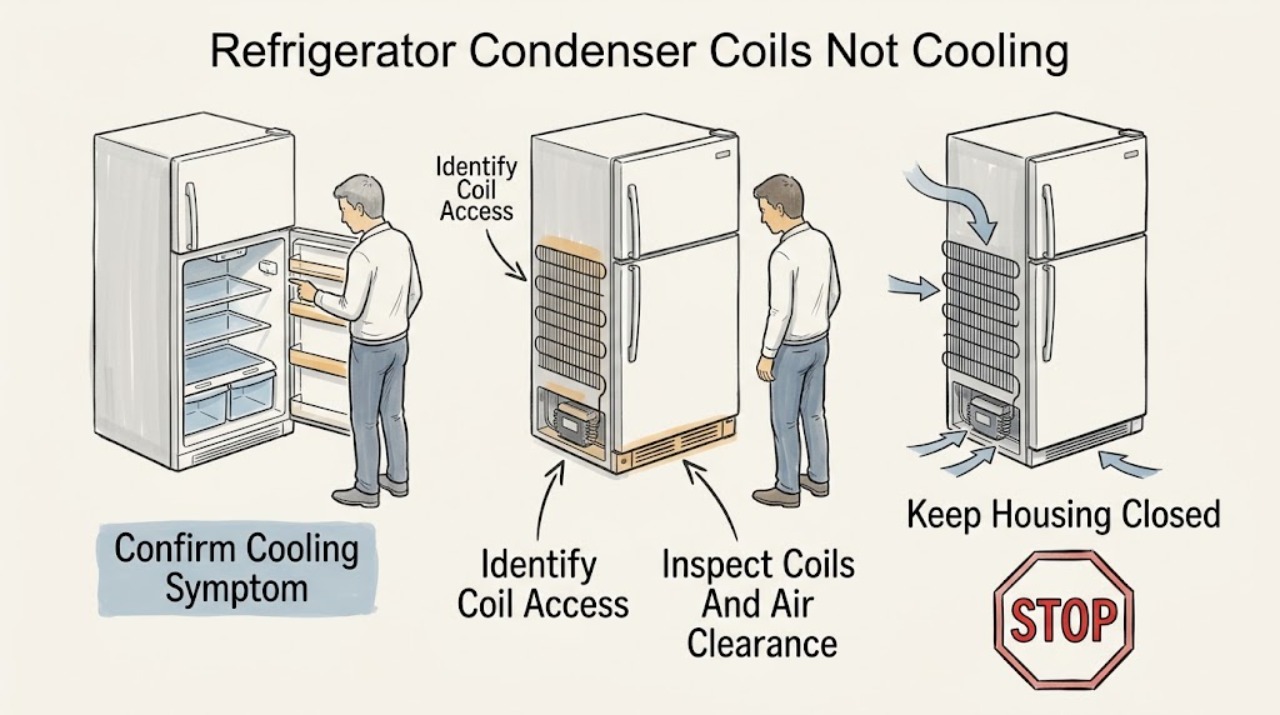
The condenser coils do not make the inside of a refrigerator cold; they release heat removed from the cabinet. If the refrigerator is not cooling and the condenser area looks dusty, first identify the coil location and confirm that your model permits owner cleaning. Unplug the refrigerator before any permitted cleaning, keep water lines and tubing undisturbed, and use only the brush or soft vacuum method in the owner’s guide. Many newer models have a concealed or maintenance-free condenser, so do not remove covers to reach it. After restoring the grille and power, allow the refrigerator to run and check whether cooling and compressor cycling improve. If the coils are clean or inaccessible, the refrigerator remains warm, the compressor or condenser fan is abnormal, or the unit has heavy frost, leaks, a burning smell, or repeated electrical trips, stop troubleshooting and arrange appliance service. Dirty coils can contribute to poor heat rejection, but they do not prove that the sealed system, fan, compressor, or control is defective.
Work through in order
Diagnostic checks
Use only checks that match the exact appliance or system and its official guide.
-
Check 1
Check the refrigerator and freezer compartments without dismantling anything: note whether both compartments are warm, only the refrigerator compartment is warm, the compressor runs continuously, or there is little or no operating sound; check the control setting and whether doors close fully.
Expected result: Both sections are warm, only the refrigerator section is warm, the unit runs constantly, the compressor is silent, or the doors and settings appear normal.
Next step: Record the pattern and protect perishable food. Continue only with external checks; arrange service if cooling is absent, the compressor is unusually hot or silent, or the cabinet temperature continues to rise.
Stop if: Do not remove a cover, touch the compressor or fan, change wiring, or keep food in a warming refrigerator without confirming that it remains safe.
Why this matters
Why: Warm compartments in both sections can keep condenser heat rejection, compressor, controls, or sealed-system issues in focus. A warm refrigerator with a cold freezer can instead point to internal airflow or evaporator-side circulation. A silent unit may have a control or power issue, while constant operation indicates that the system is not reaching its target or is losing cooling capacity.
-
Check 2
Use the model number and owner’s manual to identify whether the condenser coils are behind the base grille, on the back, on top, or concealed, and whether the manual permits owner cleaning; inspect only the specified accessible area with power left on until the manual says to disconnect it.
Expected result: The manual shows accessible coils, a concealed or maintenance-free condenser, a professional-only procedure, or the model and coil location cannot be confirmed.
Next step: Follow the exact manual if cleaning is permitted. Otherwise stop at the external inspection and arrange service if the refrigerator is not cooling.
Stop if: Do not remove rear covers, machine-compartment panels, or trim that the manual does not identify as owner-removable, and do not move a heavy refrigerator without safe help and a clear path.
Why this matters
Why: An accessible coil with explicit cleaning instructions supports a limited, model-specific cleaning step. A concealed, maintenance-free, professional-only, or unidentified design means a grille or cover should not be forced off and a dirty-coil diagnosis cannot be made from an unrelated opening.
-
Check 3
With the refrigerator unplugged only if the manual permits the procedure, inspect the accessible condenser and grille for dust, pet hair, grease, or an obstruction and check that the refrigerator is not pressed against a wall or blocking its required ventilation path; do not bend fins or disturb tubing.
Expected result: The accessible coil or grille is heavily soiled, the airflow path is blocked, the condenser is visibly clear, or the coil cannot be reached safely.
Next step: If the model manual permits cleaning, proceed with a soft brush or soft vacuum method. If the area is clear or inaccessible and cooling is poor, arrange service rather than opening the sealed system.
Stop if: Do not use water, compressed air that can drive debris into the appliance, sharp tools, or force against fins, refrigerant tubing, wiring, or a fixed panel.
Why this matters
Why: Heavy soil or blocked ventilation can reduce heat release and contribute to poor cooling or long run times. A clear accessible coil or an unreachable condenser makes a coil-only explanation less likely and leaves the fan, compressor, controls, internal airflow, or sealed system unresolved.
-
Check 4
If the owner’s manual permits cleaning and the coils are accessible, disconnect power, remove only the specified grille, use a soft-bristle coil brush or soft vacuum on the grille and exposed coil surface, replace the grille securely, and reconnect power as directed.
Expected result: Dust and pet hair are removed without bending the coil, the grille cannot be reinstalled correctly, the coil is damaged, or the refrigerator still does not cool after the permitted cleaning.
Next step: Monitor whether the refrigerator resumes normal cooling and document the result. If it remains warm, runs continuously, or develops an abnormal sound, unplug it if safe and schedule appliance service.
Stop if: Stop if the manual does not permit the procedure, the grille resists removal, tubing or wiring is exposed, the coil is punctured or bent, or power cannot be disconnected safely.
Why this matters
Why: Removing surface soil can restore airflow around a serviceable condenser, but successful cleaning does not prove that the compressor, fan, refrigerant circuit, or controls are healthy. A damaged coil, unsecured grille, or persistent no-cooling symptom requires professional evaluation.
-
Check 5
After a permitted cleaning and secure reassembly, record whether the compressor cycles normally, whether the condenser fan operates when the model calls for it, whether both compartments begin recovering, and whether frost, water, smoke, or an unusual odor appears; observe externally only.
Expected result: Cooling improves, the refrigerator remains warm despite a clean coil, the fan is not operating as expected, the compressor cycles abnormally, or a leak, frost, smoke, or odor appears.
Next step: Keep doors closed and protect food while arranging service for no improvement or any abnormal component behavior. Do not probe, oil, electrically test, or replace the fan or compressor yourself.
Stop if: Turn the appliance off and seek urgent appliance or electrical help for smoke, burning odor, exposed wiring, a refrigerant or water leak near electrical parts, or repeated breaker trips.
Why this matters
Why: Improvement after cleaning supports restricted heat rejection as a contributor but does not rule out other maintenance needs. No improvement keeps fan, compressor, control, airflow, or sealed-system faults in focus. Frost, smoke, leaks, and odors raise the safety and service boundary.
-
Check 6
Prepare the refrigerator model and serial information, coil location and access result, before-and-after cooling pattern, cleaning date if permitted, compressor and fan sound, door-seal condition, visible frost or leaks, and any diagnostic display information for the technician.
Expected result: The coil is inaccessible or clean, cooling remains poor, the unit is running continuously, both compartments are warm, or another warning symptom is present.
Next step: Arrange qualified appliance service and provide the record. Keep the appliance off if it is unsafe or likely to damage food or property, and follow the technician’s instructions for food storage.
Stop if: Do not open the refrigerant circuit, replace a compressor or fan from appearance, bypass a control, or continue using the appliance after an electrical, smoke, or leak warning.
Why this matters
Why: This record prevents a technician from assuming that the condenser is the only fault and helps distinguish heat-rejection, internal airflow, compressor, control, and sealed-system paths. Persistent no cooling after a permitted check is evidence for service, not for ordering a generic coil or motor.
Use your observations
Decision map
Find the observation that best matches what you see, then follow the next safe action.
-
PATH 01Next step
What you see
The manual identifies owner-accessible condenser coils and the grille or coil is covered with dust, pet hair, or grease.
Do this next
Disconnect power and clean only as the model manual directs, then restore the grille and power securely. Arrange service if cooling does not improve.
Why this path and its safety boundary
Why it matters: Restricted condenser airflow is a plausible contributor to poor heat rejection and long run time, but it is not proof of a failed sealed system or compressor.
-
PATH 02Next step
What you see
The manual identifies a concealed or maintenance-free condenser, or the coil cannot be located without removing a cover.
Do this next
Stop at the external checks and arrange service for continued poor cooling; provide the model number so the technician can use the correct procedure.
Why this path and its safety boundary
Why it matters: A homeowner coil-cleaning step is not supported for this design. Forcing access can damage the appliance or expose electrical and refrigerant components.
-
PATH 03Next step
What you see
The accessible condenser is cleaned according to the manual, but both compartments remain warm or the compressor runs continuously.
Do this next
Protect perishable food and arrange qualified appliance service. Do not open the sealed system or substitute a generic component.
Why this path and its safety boundary
Why it matters: A coil-only explanation is less likely. Condenser fan, compressor, controls, internal airflow, door sealing, frost, or sealed-system problems remain possible and cannot be identified by the cleaning result.
-
PATH 04Next step
What you see
The freezer remains cold but the refrigerator compartment is warm, while the condenser is clear or inaccessible.
Do this next
Check only for blocked interior vents and proper door closure without dismantling the liner. Arrange service if airflow or temperature does not recover.
Why this path and its safety boundary
Why it matters: Internal airflow, vent blockage, evaporator fan, damper, frost, or door-seal issues become more likely than a condenser-only problem.
-
PATH 05Next step
What you see
The refrigerator has smoke, a burning or electrical odor, exposed wiring, a leak near electrical parts, repeated breaker trips, or a damaged cord.
Do this next
Disconnect power only if it can be done without contact with the hazard, leave the area if there is smoke or fire risk, and contact emergency or qualified appliance/electrical help from a safe location.
Why this path and its safety boundary
Why it matters: This is a safety or electrical fault, not a routine condenser-cleaning problem.
Helpful context
Understand the symptom
Condenser coils release heat rather than make cold
The compressor sends refrigerant through the condenser coils, where heat is released to the surrounding air. A dusty, obstructed condenser can make heat rejection less effective and may contribute to long run times or poor cooling, but a visual check cannot establish that the coils are the only problem. The freezer, evaporator, fan, controls, door seals, airflow passages, and sealed system can also affect cabinet temperature.
Model design determines whether cleaning is appropriate
Condenser coils may be behind the base grille, on the back, on top, or concealed. Some refrigerators have a condenser that does not require owner cleaning. Use the exact owner’s manual for the model before removing a grille or moving the appliance. If the manual directs professional cleaning or the access point is unclear, stop at the visual check.
Protect food and electrical safety while checking cooling
Keep refrigerator and freezer doors closed as much as practical while you document the problem and move perishable food to safe cold storage if the appliance is warming. Unplug the refrigerator before permitted coil cleaning, keep water lines and cords from being pulled or pinched, and never reach into a running fan or energized compartment.
Safety boundary
Stop conditions
- Stop the check if the coil location is unknown, the manual does not permit owner cleaning, a grille or cover resists removal, tubing or wiring is exposed, or the refrigerator cannot be disconnected safely. Turn the appliance off and seek qualified appliance or electrical service for smoke, a burning or electrical odor, exposed wiring, a damaged cord, a leak near electrical parts, repeated breaker trips, a continuously running compressor, heavy frost, or no cooling after a permitted cleaning. Protect perishable food rather than repeatedly testing a warming appliance. Do not open the sealed system, touch energized parts, bend fins or tubing, use water on electrical areas, or replace a compressor, fan, or control based only on appearance.
Only after diagnosis
Potential parts
- condenser fan motor or fan assembly
Consider this only if a qualified technician confirms that the condenser fan is not operating correctly or is causing the cooling and airflow symptom after the condenser path is clear.
Confirm the complete refrigerator model and manufacturer-approved electrical specification before selecting a component. - compressor start device
Consider this only after professional testing links a no-start or repeated-start symptom to the start device rather than the compressor, control, or wiring.
Do not infer compatibility from appearance; verify the refrigerator model and the technician’s test results. - compressor
Consider this only if a qualified refrigeration technician confirms compressor failure and rules out airflow, control, start-device, and refrigerant causes.
Compressor selection and sealed-system work require model-specific professional service; no generic fit is assumed.
When checks do not resolve it
Need a professional?
Arrange qualified appliance service when the condenser is clean or inaccessible but the refrigerator remains warm, when both compartments are affected, when the compressor or fan behavior is abnormal, when heavy frost or a leak appears, or when the appliance has an electrical or safety symptom. A permitted cleaning may be monitored only when the unit is otherwise safe and the manual supports it.
Have this ready
- Provide the model and serial information, condenser location, manual cleaning instructions, soil level, before-and-after cooling pattern, compressor and fan observations, door and vent checks, frost or leak observations, and any display code.
Common questions
FAQ
Are refrigerator condenser coils supposed to feel cold?
No. Condenser coils reject heat from the refrigerant into the surrounding air, so they are part of the heat-release side of the system. A refrigerator that is not cooling can have a dirty condenser, but coil temperature alone does not diagnose the fault.
Should I clean the condenser coils on my refrigerator?
Only if the owner’s manual identifies accessible coils and permits owner cleaning. Whirlpool and GE both note that location and access vary, and some models have a concealed or maintenance-free condenser. Disconnect power and follow the exact model instructions before cleaning.
Can dirty condenser coils make a refrigerator stop cooling?
Dirty or obstructed coils can reduce heat rejection and contribute to long run times or poor cooling, but they do not prove that the coils are the only problem. If a permitted cleaning does not restore cooling, fan, compressor, control, airflow, frost, or sealed-system diagnosis is needed.
Where are refrigerator condenser coils located?
Depending on the model, coils may be under the refrigerator behind the base grille, on the back, on top, or concealed. Use the model’s owner’s manual instead of removing a cover to search for them.
What if my refrigerator is warm but the freezer is cold?
That pattern makes internal airflow, a blocked vent, evaporator fan, damper, frost, or door-seal issue more likely than a condenser-only issue. Check only accessible vents and door closure; arrange service if the refrigerator compartment does not recover.
When should I call for refrigerator service instead of cleaning the coils?
Call when the coils are clean or inaccessible but cooling remains poor, when the compressor or fan behaves abnormally, or when there is heavy frost, a leak, smoke, a burning odor, exposed wiring, or repeated breaker trips. Do not open the sealed system or replace a component from appearance alone.
Read the exact guide
Official sources
- Parts of a Refrigerator: A Visual GuideWhirlpool · Manufacturer explanation of compressor, condenser, expansion, and evaporator roles and why complex replacement varies by model.
- Refrigerator - Not Cooling EnoughGE Appliances · Manufacturer troubleshooting for refrigerator temperature, door closure, airflow, condenser, ventilation, and when to schedule service.
- How and When to Safely Clean the Condenser CoilsWhirlpool Product Help · Manufacturer guidance that coil access and cleaning differ by refrigerator model and that permitted cleaning requires disconnected power and care around tubing and fins.
- Maintenance ChecklistENERGY STAR · Government-backed maintenance guidance supporting use of manufacturer instructions, safe controls checks, and professional maintenance for equipment components.
- Refrigerator - Cleaning Condenser CoilsGE Appliances · Manufacturer guidance on accessible and maintenance-free condenser designs and model-specific cleaning procedures.
Community feedback
Share a repair observation
Share a plain-text repair observation. Accepted observations are published automatically; this page may take a moment to update.