
On this page
Start here
Quick answer
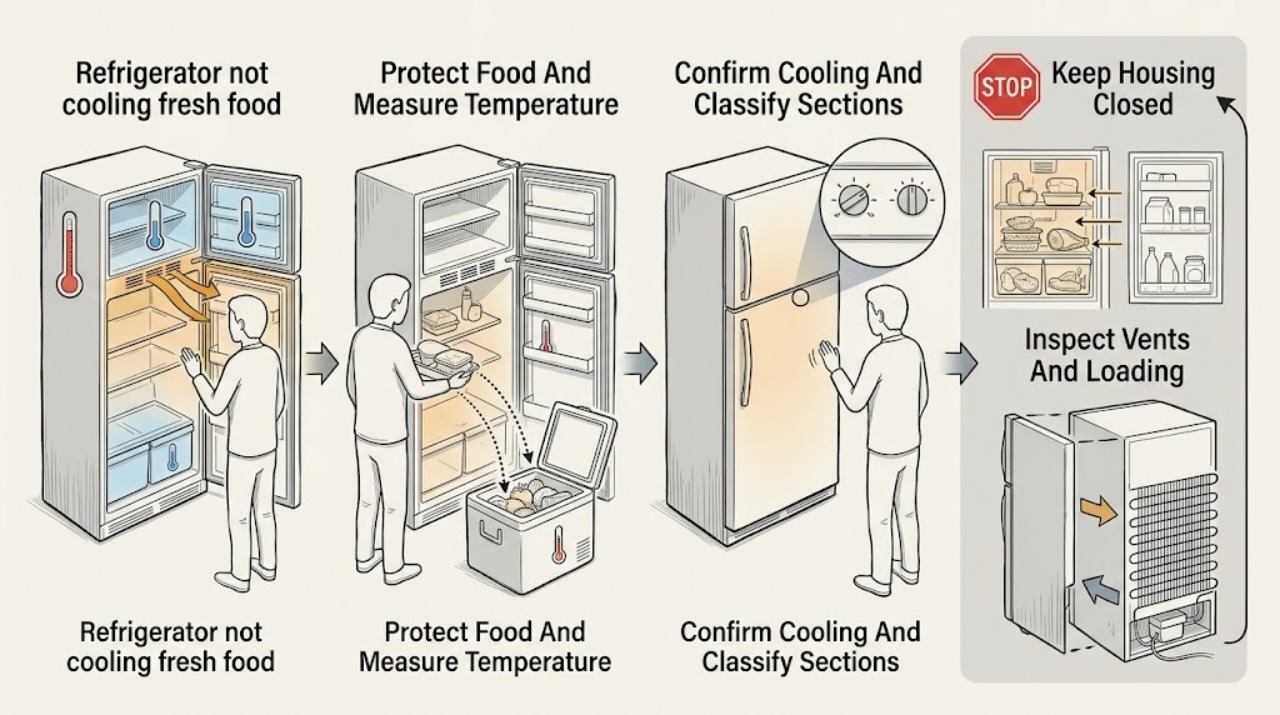
A warm fresh-food section can result from blocked air vents, a crowded cabinet, a door that is not sealing, an incorrect control or showroom setting, a recent power interruption or food load, frost blocking the shared freezer-to-refrigerator airflow, or a cooling-system fault. First protect perishable food and measure the refrigerator with an appliance thermometer; FDA guidance says the refrigerator should be at or below 40°F. Then confirm cooling is on, check the freezer and fresh-food vents, make sure doors close, and adjust the control only as the exact model guide permits, allowing the stated stabilization time. If the freezer is cold but little air reaches the fresh-food section, both sections are warm, frost returns, the compressor or fan is abnormal, or the temperature remains above 40°F after safe checks, arrange appliance service. Do not chip ice with a sharp tool, open sealed or electrical components, or use food appearance or smell to decide whether it is safe.
Before you begin
Safety first
- This article covers food protection and ordinary external or interior shelf-level observations only. A qualified technician must access fans, defrost components, electrical controls, condenser assemblies, refrigerant circuits, and sealed-system parts.
Work through in order
Diagnostic checks
Use only checks that match the exact appliance or system and its official guide.
-
Check 1
Keep the refrigerator and freezer doors closed as much as practical, place an appliance thermometer in the fresh-food compartment, and move perishable food to a known-safe cold location if the temperature is rising; do not taste food to judge safety.
Expected result: Record the fresh-food temperature, freezer temperature if available, when the warm condition began, whether there was a power interruption or large warm load, and whether food has been above 40°F for an uncertain period.
Next step: Keep doors shut and follow FDA food-safety guidance for uncertain perishable food; continue appliance checks only after food is protected and the cabinet is safe to approach.
Stop if: Do not taste questionable food, repeatedly open the refrigerator to check it, or keep perishable food in a compartment that remains above 40°F without a safe cold-storage plan.
Why this matters
Why: A measured refrigerator temperature at or below 40°F supports safe cold storage while troubleshooting continues. A reading above 40°F or an unknown time-temperature history changes the priority to food safety; appearance and smell cannot rule out harmful bacteria.
-
Check 2
From outside the appliance, confirm that the refrigerator is plugged in and the cooling function is on, then note whether the display and interior light work, whether the freezer is cold, and whether the compressor or fan sound is present without removing a cover or moving the cabinet.
Expected result: Classify the symptom as fresh-food warm but freezer cold, both sections warm, lights on with no cooling sound, recent power loss or surge, showroom or demo indication, or abnormal clicking, buzzing, or repeated starting.
Next step: Use the exact model manual to confirm the cooling setting and any documented demo mode. If both compartments remain warm, cooling never starts, or abnormal sounds repeat, arrange appliance service rather than resetting repeatedly.
Stop if: Do not open the electrical compartment, touch wiring, move a heavy refrigerator, or continue operating after smoke, burning odor, sparking, a hot cord, water near electrical parts, or repeated protective trips.
Why this matters
Why: A cold freezer with a warm fresh-food section makes airflow, frost, damper, or evaporator-fan issues more likely. Both sections warm or no cooling after a power event points toward cooling function, controls, condenser, compressor, or another system fault. A display or light alone does not prove cooling is operating.
-
Check 3
With food protected, inspect the visible supply and return vents in both compartments and rearrange packages only enough to leave the vents and air paths open; do not force shelves, remove covers, or poke through frost.
Expected result: Record whether a package blocks a vent, the cabinet is tightly overpacked, air is weak or absent at the fresh-food supply, frost covers a vent or rear panel, or the vents are open but the section remains warm.
Next step: Leave air paths open and monitor the temperature without repeatedly opening the doors. Arrange service if airflow does not return, frost reappears, or the warm condition persists.
Stop if: Do not chip, scrape, melt with a heat gun, or pry ice from a vent or evaporator area, and do not remove an interior cover to reach a fan or coil.
Why this matters
Why: Blocked vents or overpacking can disrupt the freezer-to-fresh-food air path and create warm spots. Frost or absent airflow after the vents are cleared points toward a fan, damper, defrost, or control problem; clear vents do not prove that an internal component works.
-
Check 4
Check the temperature setting, cooling mode, door closure, door gasket contact, recent long door openings, and room conditions from ordinary safe access; make only the small model-approved control adjustment and wait the manufacturer's stated stabilization period before judging it.
Expected result: Record whether cooling was off or in a special mode, the control was changed recently, the door or gasket leaves a gap, warm food was added, the room is unusually hot or cold, or the appliance is installed outside the model's recommended environment.
Next step: Restore the documented setting, close the door fully, and allow the model's recovery period. If temperature remains above the safe target or the gasket will not seal, request service.
Stop if: Do not defeat a door switch, stretch or glue the gasket, change controls repeatedly, or run the refrigerator in an environment outside its manual's limits as a troubleshooting experiment.
Why this matters
Why: A control state, poor closure, frequent opening, warm load, or unsuitable ambient condition can temporarily raise the fresh-food temperature. A sound door and correct setting with a persistent warm compartment makes airflow, frost, or cooling-system diagnosis more likely.
-
Check 5
From outside the refrigerator, check that the required clearance and base or rear ventilation are not blocked by boxes, dust, pet hair, or other debris; clean or clear only the areas and method identified as user-serviceable in the exact Owner's Manual.
Expected result: Record a clear installation area, heavy visible debris, an unusually hot room, a refrigerator installed in a garage or other unsuitable location, or a condenser area that the manual reserves for certified service.
Next step: Restore the documented clearance and arrange service when the condenser is inaccessible, the unit has abnormal heat or sound, or temperatures do not recover after the safe external check.
Stop if: Do not move the appliance alone, remove a rear cover, reach into a fan, wash electrical parts, or clean a condenser when the manual says it requires certified service.
Why this matters
Why: Restricted external airflow or a harsh environment can reduce cooling performance, but many models differ in condenser location and cleaning requirements. A clean, correctly installed exterior with both compartments warm points toward internal cooling or control diagnosis.
-
Check 6
After the safe setting, door, loading, vent, and clearance checks, keep a temperature log for the fresh-food section and freezer and note whether cooling sounds, airflow, frost, or warm spots change without opening internal panels.
Expected result: The fresh-food section recovers, remains warm while the freezer is cold, both sections remain warm, frost returns, the compressor or fan is silent or abnormal, or the temperature stays above 40°F.
Next step: Stop self-troubleshooting and arrange qualified appliance service with the model, temperature log, freezer comparison, door and vent observations, frost pattern, sounds, and recent events. Protect or discard food according to the measured temperature and time history.
Stop if: Do not keep operating a refrigerator with smoke, burning odor, sparking, a hot or damaged cord, refrigerant damage, water near electrical parts, exposed moving parts, or persistent temperatures unsafe for perishable food.
Why this matters
Why: Recovery supports a temporary setting, loading, door, or airflow condition but does not prove a component repair. Persistent fresh-food warmth with a cold freezer suggests internal air distribution or defrost diagnosis; both sections warm or an abnormal compressor pattern suggests a broader cooling-system fault.
Use your observations
Decision map
Find the observation that best matches what you see, then follow the next safe action.
-
PATH 01Safety boundary
What you see
The freezer is cold, but the fresh-food compartment is warm and a supply or return vent is blocked, the cabinet is crowded, or airflow is weak.
Do this next
Open the visible air paths, leave space around vents, and monitor without removing covers. Arrange service if airflow remains absent or frost returns.
Why this path and its safety boundary
Why it matters: The shared air path is the leading safe check; packages, frost, a damper, or an evaporator fan can limit cold air reaching the fresh-food section.
Safety stop: Do not remove an interior cover, reach a fan, or chip ice from a vent or evaporator area.
-
PATH 02Safety boundary
What you see
The cooling function was off or in a special mode, the setting changed, the door was opened frequently, the gasket is not closing, or a large warm load was recently added.
Do this next
Restore the model-documented cooling setting, close the door fully, keep openings brief, and allow the manual's stabilization time before reassessing with a thermometer.
Why this path and its safety boundary
Why it matters: A control, door, usage, or recovery condition may explain the warm compartment without proving a component failure.
Safety stop: Request service if the door cannot seal, the temperature remains above 40°F, or the condition persists after the recovery period.
-
PATH 03Safety boundary
What you see
The fresh-food section and freezer are warm, or the lights and display work but there is no normal cooling sound or recovery after a power event.
Do this next
Confirm the cooling function and model-specific mode only; protect food and arrange appliance service if cooling does not start or temperatures remain unsafe.
Why this path and its safety boundary
Why it matters: Cooling function, control, condenser, compressor, power, or sealed-system problems become more likely than a fresh-food vent blockage.
Safety stop: Do not remove the rear cover, handle refrigerant components, or repeatedly cycle power to force cooling.
-
PATH 04Safety boundary
What you see
Frost or ice repeatedly covers a vent or rear freezer panel, airflow returns only temporarily, or the fresh-food temperature rises again after a temporary thaw.
Do this next
Keep the doors closed, document the frost location and timing, and request model-specific service. Follow a manual defrost procedure only when the exact Owner's Manual explicitly permits it.
Why this path and its safety boundary
Why it matters: A defrost, door-seal, fan, damper, or control problem is possible; manually removing ice may hide the cause and can damage the cabinet or cooling circuit.
Safety stop: Do not use knives, picks, heat guns, open flame, or improvised thawing, and do not open the evaporator area.
-
PATH 05Safety boundary
What you see
The fresh-food compartment stays above 40°F, food has an uncertain warm-time history, or the refrigerator has smoke, burning odor, sparking, water near electrical parts, a damaged cord, or an abnormal hot or exposed component.
Do this next
Protect or discard perishable food according to FDA guidance, keep people away from a hazardous appliance, and arrange urgent qualified appliance or electrical service; follow local emergency guidance for smoke or fire.
Why this path and its safety boundary
Why it matters: Food safety or an electrical, fire, water, or mechanical hazard takes priority over troubleshooting.
Safety stop: Do not taste questionable food, operate a smoking or sparking refrigerator, touch hot or wet electrical parts, or restart a damaged appliance repeatedly.
Helpful context
Understand the symptom
Protect food before troubleshooting the refrigerator
A warm fresh-food compartment is both an appliance symptom and a food-safety problem. Put a refrigerator thermometer in the compartment, keep the doors closed as much as practical, and move perishables to a known-safe cold location if the temperature is rising. FDA says the refrigerator should be at or below 40°F and warns that unsafe food may not look or smell spoiled. Do not taste food to test it.
A cold freezer with a warm fresh-food section points to air movement first
Many refrigerator-freezer designs make cold air in the freezer and send it through vents into the fresh-food section, then return air to be cooled again. Packages against a supply or return vent, an overfilled shelf, frost, a stopped evaporator fan, or a damper problem can leave the refrigerator warm while the freezer still feels cold. External observations can identify the pattern, but internal fan, damper, defrost, and sealed-system repairs require the model guide or a technician.
Controls, doors, room conditions, and recent changes can delay recovery
Whirlpool's guidance says to confirm the cooling function is on, check the control setting, consider unusually warm surroundings, limit long door openings, and allow time after a large warm load or adjustment. A showroom or demo mode can leave lights on while the compartments do not cool on some models. Because control panels and serviceable condenser arrangements vary, use the exact Owner's Manual rather than a generic button sequence.
Safety boundary
Stop conditions
- Do not use food appearance, smell, or taste as the safety test; measure the refrigerator and follow FDA guidance for food above 40°F or with an uncertain time-temperature history.
- Do not chip, scrape, drill, pry, or heat ice near vents, an evaporator, or a rear panel, and do not remove an internal cover to reach a fan or defrost part.
- Do not open electrical or sealed-system covers, handle refrigerant, reach into a moving fan, or move the refrigerator without the model instructions and appropriate help.
- Stop for smoke, burning odor, sparking, a hot or damaged cord, water near electrical parts, exposed moving parts, refrigerant damage, or repeated protective trips; arrange urgent qualified service.
- If the fresh-food compartment remains above 40°F after safe control, door, loading, vent, and clearance checks, protect food and arrange qualified appliance diagnosis rather than guessing a part.
Only after diagnosis
Potential parts
- refrigerator door gasket
Consider this category only if inspection confirms that the exact door gasket is torn, distorted, missing, or unable to seal and the model guide identifies it as replaceable.
Confirm the exact refrigerator model, door position, gasket profile, and manufacturer's fit information; a gasket does not correct an internal cooling or airflow fault. - evaporator fan motor
Consider this category only after qualified diagnosis confirms absent or failed evaporator airflow as the cause of a warm fresh-food section, especially when the freezer is cold.
Confirm the exact model, fan assembly, electrical specifications, and service procedure; do not access the fan or wiring based on temperature symptoms alone. - air damper or diffuser assembly
Consider this category only when the model uses a serviceable damper and qualified diagnosis finds that it is not regulating cold air into the fresh-food section.
Confirm model-specific design and fitment; some refrigerators use different airflow arrangements and the assembly may require professional access. - refrigerator temperature sensor or control
Consider this category only when qualified testing identifies a failed sensor or control after airflow, door, loading, and defrost causes are excluded.
Confirm the exact model and control revision with the manufacturer or technician; do not infer sensor or control failure from a warm shelf alone.
When checks do not resolve it
Need a professional?
Arrange qualified appliance service when the fresh-food section remains warm while the freezer is cold, both sections are warm, airflow is absent, frost returns, the compressor or fan is abnormal, the door cannot seal, the cooling function will not start, or temperature stays above 40°F after model-approved checks. Treat smoke, burning odor, sparking, a hot or damaged cord, water near electrical parts, refrigerant damage, or unsafe food temperature as urgent boundaries.
Safety scope: This article covers food protection and ordinary external or interior shelf-level observations only. A qualified technician must access fans, defrost components, electrical controls, condenser assemblies, refrigerant circuits, and sealed-system parts.
Common questions
FAQ
Why is my refrigerator warm while the freezer is cold?
Many refrigerator-freezer designs send cold air from the freezer into the fresh-food section through supply and return vents. Blocked vents, crowding, frost, a fan, damper, or defrost problem can interrupt that path. Check only visible airflow and arrange service if the freezer is cold but the refrigerator remains warm.
What temperature should the fresh-food section reach?
FDA says the refrigerator should be at or below 40°F. Use an appliance thermometer rather than relying on the control display, and protect or discard perishable food when the temperature or exposure time is unsafe or uncertain.
Can blocked refrigerator vents make the fresh-food section warm?
Yes. Packages pushed against supply or return vents can restrict the freezer-to-refrigerator air path and create warm spots or uneven cooling. Leave the visible vents open and do not remove an interior cover to reach a fan or coil.
How long should I wait after changing the refrigerator setting?
Whirlpool advises waiting at least 24 hours between control adjustments on its general warm-compartment guidance, but your model's Owner's Manual controls. Make one small documented adjustment, keep the door closed, and reassess with a thermometer.
Should I remove ice from the vents if the refrigerator section is warm?
Do not chip, scrape, drill, pry, or heat ice near vents, an evaporator, or a rear panel. Document the frost pattern and use only a model-approved defrost procedure; recurring frost or absent airflow needs qualified service.
When should I call for refrigerator service?
Call when the fresh-food compartment remains above 40°F, the freezer is cold but airflow does not return, both sections are warm, frost recurs, cooling will not start, or the compressor or fan sounds abnormal. Treat smoke, burning odor, sparking, water near electrical parts, or a hot or damaged cord as urgent.
Read the exact guide
Official sources
- Not Cooling - Both Sections - RefrigeratorWhirlpool Product Help · Supports distinguishing freezer-to-fresh-food airflow problems from both-section cooling faults and checking loading, power, cooling mode, controls, room conditions, condenser access, and recovery time.
- Refrigerator Thermometers - Cold Facts about Food SafetyU.S. Food and Drug Administration · Supports using an appliance thermometer, the 40°F refrigerator target, minimizing door opening, and discarding food with uncertain or unsafe time-temperature exposure.
- How to Check the Air Vents for Blockage-Ensuring Proper Air FlowWhirlpool Product Help · Supports checking visible vent blockage and explaining why a warm fresh-food section can occur when freezer-to-refrigerator airflow is restricted.
- Are You Storing Food Safely?U.S. Food and Drug Administration · Supports protecting perishable food, avoiding overpacking, using 40°F as the refrigerator limit, and handling food after a prolonged warm or power condition.
- Too Warm in Refrigerator CompartmentWhirlpool Product Help · Supports external checks for cooling-on state, control setting, door use, room conditions, vent blockage, and model-specific escalation.
Community feedback
Share a repair observation
Share a plain-text repair observation. Accepted observations are published automatically; this page may take a moment to update.