
On this page
Start here
Quick answer
Check the simple causes first: confirm the Amana refrigerator is powered on and cooling is enabled, verify the controls were not changed, make sure food is not blocking the freezer and refrigerator vents, and check that the doors close and seal. Amana says a recent installation, warm room, frequent door opening, large load, blocked airflow, Demo or Showroom mode, and model-dependent condenser access can all affect cooling. Make one small control change only as the exact owner manual permits, then allow the appliance its full stabilization period before judging the result. If both sections stay warm, frost blocks airflow, the compressor or fan does not run, food is warming, or the issue persists after these checks, protect the food and arrange qualified appliance service rather than opening sealed or electrical components.
Before you begin
Safety first
- This article supports visible control, loading, vent, door, location, and model-permitted condenser checks only. Electrical diagnosis, hidden fan or defrost access, sealed-system work, refrigerant handling, and food-safety assessment beyond ordinary observation require qualified service.
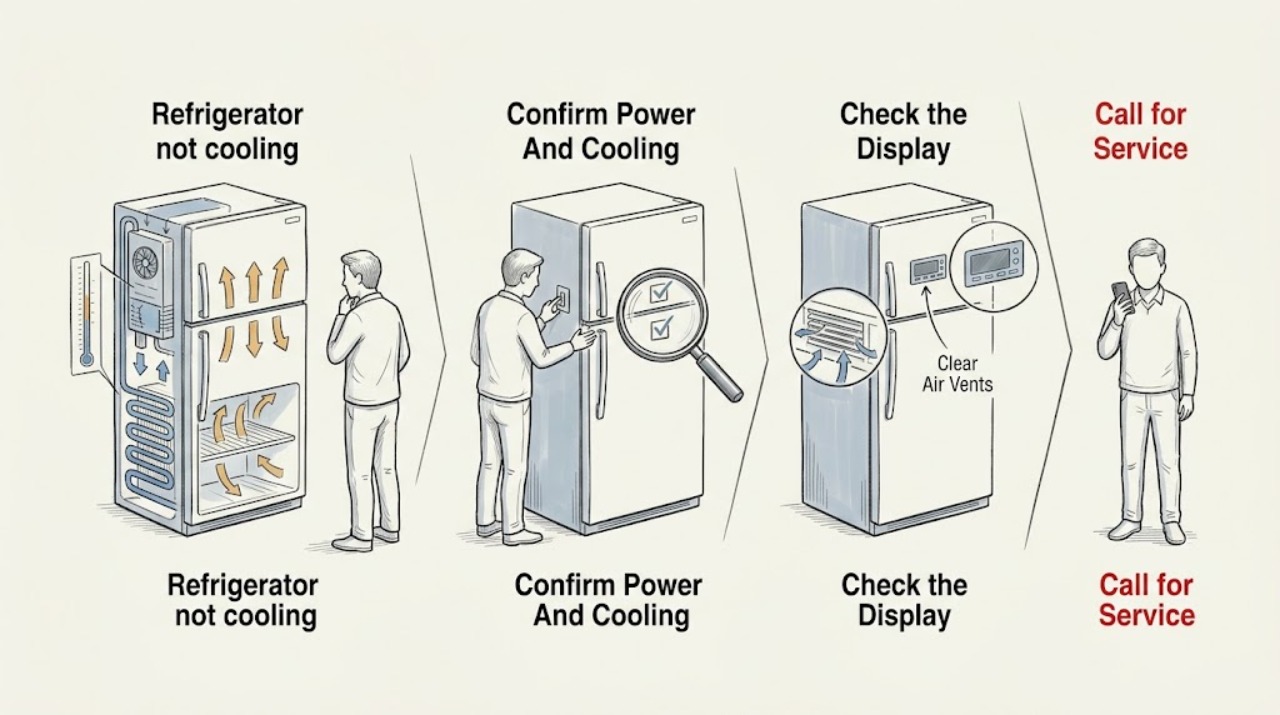
Work through in order
Diagnostic checks
Use only checks that match the exact appliance or system and its official guide.
-
Check 1
Check from outside the appliance that the interior light or display is active, the power cord is seated, and the control panel does not show Cooling Off, Demo, or Showroom mode; use only the exact Amana manual sequence for changing a mode.
Expected result: Record whether the light or display is dead, cooling is visibly turned off, a Demo or Showroom indicator is present, or the controls appear normal while the compartments remain warm.
Next step: Restore a clearly disabled cooling setting only through the model instructions, then allow the unit to stabilize; arrange electrical or appliance service if power is absent or the mode cannot be changed safely.
Stop if: Do not remove covers, probe wiring, bypass controls, or repeatedly reset a breaker that trips again.
Why this matters
Why: A power or cooling-mode condition can make both sections warm without proving a compressor or refrigerant fault. Normal controls with no cooling move the check toward airflow, environment, or a mechanical/electrical fault.
-
Check 2
Read the current refrigerator and freezer settings and review whether the unit was recently installed, lost power, had a large warm load added, or has had doors open often; compare the display or an appliance thermometer with the exact manual's recommended settings.
Expected result: Record whether a setting was changed, a power event occurred, the refrigerator is still within its initial stabilization period, or the compartments remain warm despite normal settings and a closed door.
Next step: Make at most one small model-approved adjustment and wait through the manual's stabilization interval before reevaluating; move perishable food if temperatures are unsafe.
Stop if: Do not set controls to the coldest position as a substitute for diagnosis, keep changing settings repeatedly, or ignore food-safety concerns.
Why this matters
Why: A changed setting, recent outage, installation, or large warm load can temporarily explain the symptom. Persistent warmth with normal settings and no recent event makes a blocked-airflow, seal, condenser, fan, or cooling-system issue more likely.
-
Check 3
Inspect the visible supply and return vents in both compartments and rearrange only food packages that are directly blocking them, leaving room for air to circulate without removing panels or shelves that are not meant to move.
Expected result: Record whether one compartment is warmer, items near a vent are freezing, frost or moisture is concentrated around a vent, or all visible vents are clear while both sections remain warm.
Next step: Restore ordinary airflow, close both doors, and allow the unit to stabilize; arrange service if frost blocks an inaccessible vent or temperatures do not recover.
Stop if: Do not chip frost, remove evaporator covers, reach into a fan, or use a sharp tool inside a vent.
Why this matters
Why: A blocked vent can create uneven cooling or warm spots because cold air must circulate between the freezer and refrigerator. Clear vents with persistent warmth or heavy frost suggest a hidden airflow, defrost, fan, or cooling-system issue.
-
Check 4
Check that the refrigerator is not next to a heat source, blocked behind a cabinet door, or in an environment outside the model's allowed range; inspect the accessible base grille or condenser area only if the Amana manual says the model is user-cleanable and the appliance can be safely disconnected.
Expected result: Record a warm or unusually dusty location, a blocked base grille, visible dust at an accessible condenser, or a model whose condenser cleaning is restricted to a certified technician.
Next step: Correct only a visible placement or grille obstruction and follow the model-approved cleaning method; leave sealed or inaccessible condenser work to service.
Stop if: Do not remove sealed panels, use water or flammable cleaner near the appliance, work while connected to power, or vacuum a component the manual reserves for a technician.
Why this matters
Why: Heat, poor ventilation, and heavy dust can lengthen run time or reduce cooling, but Amana notes that some models do not require condenser cleaning and others allow it only for a certified technician. A clear, correctly located appliance with both sections warm needs deeper diagnosis.
-
Check 5
Inspect the refrigerator and freezer doors from a dry, visible position for a package holding a door open, a dirty or damaged gasket, missed installation packaging, or a gap; record the Amana model number and protect food before arranging service if the cooling problem remains.
Expected result: Record whether a door closes fully, the gasket contacts the cabinet around its perimeter, frost or condensation follows a gap, or both doors seal while the compartments remain warm.
Next step: Remove only a clearly misplaced package or installation material, close the door, and allow stabilization; arrange qualified Amana appliance service for persistent warmth, heavy frost, unusual sounds, or inaccessible component checks.
Stop if: Do not pry the gasket, remove door panels, test live electrical parts, open the sealed refrigeration system, or keep food in an unsafe temperature condition.
Why this matters
Why: A door that cannot seal admits warm, moist air and can cause frost and poor cooling. Properly sealing doors with persistent warmth shifts suspicion toward the fan, defrost system, controls, compressor, or sealed system.
Use your observations
Decision map
Find the observation that best matches what you see, then follow the next safe action.
-
PATH 01Safety boundary
What you see
The refrigerator was recently installed or lost power, Cooling Off or Demo mode is active, or a control was changed and the doors and vents are normal.
Do this next
Use the exact Amana manual to restore normal cooling and allow the full stabilization interval; protect perishable food while waiting.
Why this path and its safety boundary
Why it matters: The warm condition may be a setting or recovery issue rather than a confirmed mechanical failure.
Safety stop: Stop repeated setting changes and arrange service if the unit remains warm after stabilization or power cannot be maintained.
-
PATH 02Safety boundary
What you see
One area is warm or items near a vent freeze, packages block visible vents, frost or moisture follows a door gap, or a door does not close completely.
Do this next
Clear only visible package obstructions, restore the door seal by removing a misplaced item, and monitor after the model-approved stabilization period.
Why this path and its safety boundary
Why it matters: Airflow or warm-air entry is more likely than an immediately proven sealed-system failure.
Safety stop: Do not chip frost or disassemble the evaporator, fan, door, or gasket when the cause is not clear.
-
PATH 03Safety boundary
What you see
The refrigerator is in a hot or unsuitable location, near a heat source, behind restricted ventilation, or has heavy dust at a user-accessible condenser area.
Do this next
Correct only the visible placement or grille issue and follow the exact Amana manual for condenser cleaning; use service when the condenser is inaccessible or technician-only.
Why this path and its safety boundary
Why it matters: The operating environment or condenser airflow may be reducing cooling performance, but condenser access and cleaning vary by model.
Safety stop: Do not remove sealed panels, use liquids near electrical parts, or clean a model that reserves condenser work for certified service.
-
PATH 04Safety boundary
What you see
Both refrigerator and freezer sections are warm despite normal settings, clear vents, closed doors, and a suitable environment.
Do this next
Move perishable food to a safe cold location, record sounds, frost pattern, displays, and recent events, and arrange qualified Amana appliance service.
Why this path and its safety boundary
Why it matters: A fan, defrost, control, compressor, power, or sealed cooling-system fault is more likely than a simple loading issue.
Safety stop: Do not open the sealed system, remove electrical panels, bypass a control, or keep operating if the appliance is overheating or repeatedly trips power.
-
PATH 05Safety boundary
What you see
Heavy frost blocks an internal air path, temperatures remain unsafe, food has warmed, or a leak, burning odor, repeated breaker trip, or unusual motor/fan symptom accompanies the no-cooling condition.
Do this next
Protect food and people, keep the appliance closed or power-isolated only from a dry safe position, and arrange qualified appliance service; follow local food-safety guidance for affected food.
Why this path and its safety boundary
Why it matters: The problem has crossed the ordinary-access boundary and may involve electrical, defrost, refrigerant, or food-safety risk.
Safety stop: Do not chip ice, use heat to defrost, touch live parts, or restart a refrigerator that smells burned or repeatedly trips protection.
Helpful context
Understand the symptom
Separate a setting problem from a cooling-system problem
Interior lights do not prove that cooling is running. A refrigerator can be powered while cooling is turned off or a Demo or Showroom mode is active. Conversely, correct settings with blocked airflow, a poor door seal, an unusually warm location, or a recent large load can make the compartments warm without an immediate sealed-system failure. Check the visible, model-independent causes before opening any panel.
Airflow links the freezer and fresh-food sections
Amana describes supply and return vents that move cold air from the freezer into the refrigerator and back toward the evaporator. Food pushed against a vent can create a warm area in one compartment and freezing in another. Clear only visible obstructions and keep the doors closed while the appliance stabilizes; do not remove a frost-covered panel to reach a hidden fan or evaporator.
Food safety sets the stopping point
Move perishable food to a known-safe cold appliance when the Amana refrigerator is warming, minimize door opening, and avoid relying on touch or a single warm item to judge the whole compartment. If food temperature is uncertain, follow local food-safety guidance. A continuing warm condition, heavy frost, a tripped breaker, or an unusual motor or fan symptom needs service-level assessment.
Safety boundary
Stop conditions
- Protect or relocate perishable food when the refrigerator or freezer is warming; do not rely on touch alone to establish safe storage.
- Do not chip frost, heat the appliance, reach into a fan, or remove evaporator, electrical, or sealed-system panels.
- Do not bypass Demo or Cooling Off controls, probe live wiring, or repeatedly reset a breaker that trips again.
- Do not clean an inaccessible condenser or use liquids or flammable cleaners near electrical parts; follow the exact Amana manual.
- Stop and arrange qualified service for both sections warm after visible checks, heavy frost, burning odor, repeated power trips, unsafe food, or persistent no-cooling symptoms.
Only after diagnosis
Potential parts
- Amana refrigerator door gasket
Consider this category only when inspection confirms a torn, hardened, deformed, or non-sealing gasket after packages and door alignment are ruled out.
Confirm the exact Amana model and manufacturer's fit information before ordering; do not force a gasket into place or use it to compensate for a misaligned door. - Amana refrigerator temperature control or sensor
Consider this category only after service diagnosis identifies a control or sensor fault with normal power, airflow, door sealing, and environment.
Confirm the exact model and service procedure; a control or sensor is not a substitute for diagnosing a fan, defrost, compressor, or sealed-system issue.
When checks do not resolve it
Need a professional?
Arrange qualified Amana appliance service when both sections remain warm after the model-approved setting, airflow, door, and environment checks, when frost blocks an inaccessible path, the condenser or fan is technician-only, power trips, food safety is uncertain, or the next step would require electrical, sealed-system, defrost, compressor, or refrigerant access.
Safety scope: This article supports visible control, loading, vent, door, location, and model-permitted condenser checks only. Electrical diagnosis, hidden fan or defrost access, sealed-system work, refrigerant handling, and food-safety assessment beyond ordinary observation require qualified service.
Common questions
FAQ
Why is my Amana refrigerator running but not cooling?
Check whether cooling is turned off or Demo mode is active, then verify the controls, vents, door seals, room conditions, food load, and condenser access permitted by the model. Interior lights or a running sound alone do not prove that both compartments are cooling normally.
Can blocked vents make an Amana refrigerator warm?
Yes. Amana explains that cold air moves between the freezer and refrigerator through supply and return vents. Packages directly in front of those vents can create warm spots, freezing near the airflow, frost, or uneven temperatures.
Should I keep adjusting the Amana temperature control?
Make one small adjustment only through the model instructions, then wait through the full stabilization interval before judging it. Repeatedly moving the control to the coldest position can hide an airflow, door, power, or cooling-system fault.
When should I call for Amana refrigerator service?
Arrange service when both sections stay warm after visible checks, frost blocks an internal air path, the condenser or fan is not user-accessible, power trips, food safety is uncertain, or diagnosis would require electrical, defrost, compressor, or sealed-system access.
Read the exact guide
Official sources
- Not Cooling - Refrigerator Section - RefrigeratorAmana Product Help · Amana French-door bottom-freezer refrigerator guidance; model-specific controls and condenser access vary.
- Not Cooling - Freezer Section - RefrigeratorAmana Product Help · Amana French-door bottom-freezer refrigerator guidance; use the exact manual for a different design.
- Tips for Properly Setting the ControlsAmana Product Help · Amana general refrigerator-control guidance; use the exact owner manual for a particular model's controls.
- How to Check the Air Vents for Blockage-Ensuring Proper Air FlowAmana Product Help · Amana general airflow guidance; vent locations and access vary by refrigerator model.
Community feedback
Share a repair observation
Share a plain-text repair observation. Accepted observations are published automatically; this page may take a moment to update.