
On this page
Start here
Quick answer
A Maytag washer door or lid can stay locked normally while the tub is moving, water is too hot or too high, a drain routine is still running, or a model option such as Fresh Hold or TumbleFresh is active. Do not pry it open. First note whether this is a front-load door or top-load lid, wait for motion and heat to stop, look for standing water or a displayed code, and use the exact model instructions to cancel or drain. If the control is locked, deactivate Control Lock using the model's marked control; if the washer is dry and idle, clean only visible debris around the latch or gasket. A single model-approved power reset may help, but a lock that stays engaged after safe draining and reset, or any leak, smoke, burning smell, hot outlet, spark, or repeated trip requires qualified service.
Before you begin
Safety first
- This article covers observation and model-documented controls only. Do not force the door or lid, bypass the interlock, open panels, reach into moving or hot parts, or work on wet electrical equipment.
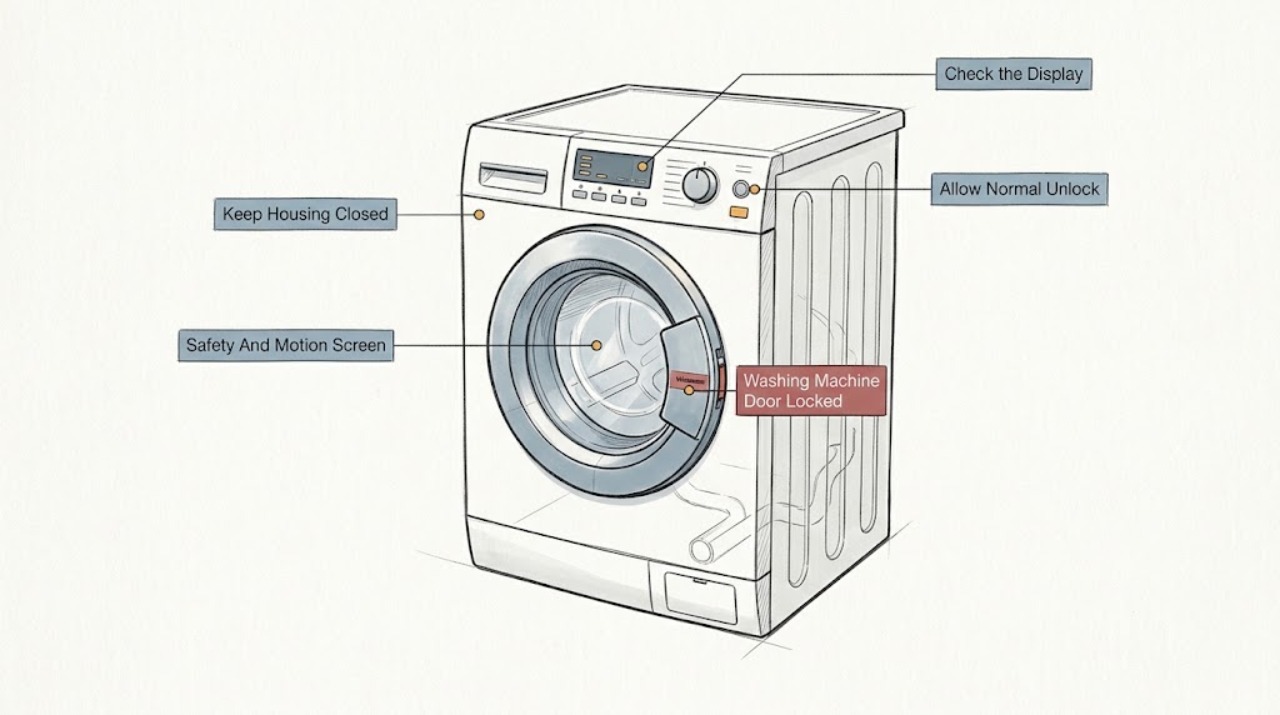
Work through in order
Diagnostic checks
Use only checks that match the exact appliance or system and its official guide.
-
Check 1
Stand on a dry floor and observe whether the washer is still filling, draining, tumbling, spinning, hot, leaking, smoking, sparking, or making an electrical or burning smell; use Pause or Cancel only if the controls and area are safe.
Expected result: Record whether the tub or basket is moving, water is visible, the glass or lid feels hot from ordinary observation, and whether any leak, smoke, odor, heat, spark, or repeated protection trip is present.
Next step: If the machine is moving or hot, wait for the model's safe stop and cooling behavior; if a hazard is present, keep clear, isolate power or water only when safe, and arrange qualified or emergency help. If dry and idle, identify the form factor and code.
Stop if: Do not touch a plug, outlet, or wet appliance while standing in water; do not reset a tripped breaker repeatedly, reach into a moving tub, or force the locked door or lid.
Why this matters
Why: Motion, heat, or water can be a normal lock-safety state. Smoke, burning, sparks, water near electricity, or repeated trips is a stop condition and cannot be solved by unlocking the door.
-
Check 2
Read the model label and note whether the machine has a front door or a top lid; photograph or transcribe the exact lock light, countdown, code, and cycle or option shown without opening any panel.
Expected result: Classify the state as front-load door, top-load lid, Control Lock indication, Fresh Hold or TumbleFresh-style option, drain-related display, door/lid code, or no display; record whether the cycle was paused, canceled, or completed.
Next step: Use the exact model documentation and follow only the matching branch below; do not apply front-load door-release instructions to a top-loader or infer a code meaning across models.
Stop if: Do not remove the console, bridge the lock, use an unverified emergency-release tool, or keep pressing controls when the machine is wet, smoking, sparking, or repeatedly tripping protection.
Why this matters
Why: The model and state select different safe procedures. A code or Control Lock indication should be interpreted only with the exact owner's manual; a locked door after a completed cycle may still reflect water, heat, or a continuing option.
-
Check 3
If the machine is in a cycle or has just been canceled, leave the door or lid closed and wait at a safe distance until the basket stops, the water drains, and any high-temperature condition clears; use the model's Pause or Cancel command as documented.
Expected result: Record whether the lock indicator turns off after the tub stops and draining completes, whether the machine remains in a periodic tumble option, or whether it stays locked with no motion and no water.
Next step: Cancel the documented hold option or select the model-approved drain routine when safe; if the lock remains after the documented stop and drain, continue to the single reset or service branch.
Stop if: Do not pull the handle, insert a card or tool, lift the lid against resistance, or open the door while water, heat, or motion remains.
Why this matters
Why: Unlocking after the safe delay supports normal lock behavior. A continuing Fresh Hold/TumbleFresh-type option or residual water can intentionally keep the lock engaged; a dry, idle lock points to control, latch, or lock-system diagnosis.
-
Check 4
When the washer is stopped and dry, check the panel for Control Lock or a model-specific LOC/LC indication, then use only the marked control and exact manual hold instruction; for a door or lid that will not latch, inspect the visible gasket, strike, latch area, lid edge, and detergent or lint buildup without tools.
Expected result: Record whether Control Lock clears, the door or lid closes without resistance, clothing or debris is blocking the seal, the visible lock area is dirty, or the lock indication remains with a clean and correctly closed opening.
Next step: Remove only loose visible debris and wipe the accessible area with a damp cloth as the model guidance allows; request service for a damaged latch, gasket, strike, lock, or persistent lock indication.
Stop if: Do not pry the latch, push a finger into the lock, bypass the interlock, remove screws, or operate with a cracked door, damaged lid, torn gasket, or exposed wiring.
Why this matters
Why: A cleared Control Lock or visible obstruction explains a control or latch symptom. A clean opening that still will not latch or unlock suggests a lock, strike, sensor, wiring, or control fault that should not be bypassed.
-
Check 5
If water is visible in the drum or tub and there is no electrical or leak hazard, use the exact model's Drain and Spin or drain routine with the drain hose correctly positioned; keep a suitable container ready only where the manual permits and keep hands out of the water and lock area.
Expected result: Record whether water drains, the pump runs continuously, a drain or fill code appears, the lock releases after draining, or water remains.
Next step: If the model-approved routine completes and the door unlocks, remove the load normally. If water remains, the pump runs abnormally, or the hose leaks, stop and arrange qualified service rather than opening the lock or wet filter area by guesswork.
Stop if: Do not drain into an electrical area, pull a filter or hose from a water-filled machine without the exact procedure, handle wastewater in standing water, or run another cycle with a leak.
Why this matters
Why: Maytag identifies residual water and drain problems as reasons a front-load door can remain locked. A successful drain followed by unlock points to a retained-water state; no drain or a continuing pump suggests a drain-path or control problem requiring model-specific service.
-
Check 6
Only when the washer is dry, stopped, and free of smoke, odor, heat, sparks, leaks, or repeated trips, disconnect power using the plug or accessible disconnect for the exact model's documented reset interval; reconnect once and allow the control to initialize.
Expected result: Record whether the display returns normally, the lock indicator clears, the machine begins a documented drain routine, or the lock and code remain unchanged.
Next step: If the exact model directs a drain-and-spin after reset and the washer is safe, run it once; otherwise stop using the washer and provide the model and code to qualified service.
Stop if: Do not cycle power repeatedly, reach behind a wet cabinet, use an extension lead, or reconnect a washer with a hot cord, damaged outlet, smoke, or electrical smell.
Why this matters
Why: A single successful reset can clear a control state, but it does not prove a mechanical lock or drain fault is repaired. A persistent lock after reset, especially with a code, is evidence for service.
-
Check 7
After a safe model-approved drain or reset has cleared the lock, close the door or lid normally and run at most one short documented check while staying nearby; do not test with an open or bypassed interlock.
Expected result: Record whether the lock engages and releases at the expected cycle points, water remains absent, the machine stays stable, and no code, leak, noise, odor, heat, or electrical symptom returns.
Next step: Stop further use and arrange service for a recurring or incomplete lock cycle; provide the service record, model, code, cycle, water state, reset result, and any photos.
Stop if: Stop immediately for a door or lid that strains, a lock that clicks continuously, water near electricity, smoke, burning odor, sparks, hot wiring, violent movement, or a repeated trip.
Why this matters
Why: Normal locking and release with no hazard supports a cleared control or retained-water state. A recurrence, failed latch, persistent code, leak, or abnormal electrical symptom means the cause remains unresolved.
Use your observations
Decision map
Find the observation that best matches what you see, then follow the next safe action.
-
PATH 01Safety boundary
What you see
The washer is tumbling, spinning, hot, draining, or in a documented hold option, and the door or lid is locked without a leak or electrical hazard.
Do this next
Wait for the tub to stop and the documented drain or hold option to finish, then use the exact Pause or Cancel command if needed.
Why this path and its safety boundary
Why it matters: The lock is serving its safety function; forcing it could expose moving parts, hot water, or a flood risk.
Safety stop: Do not pull, pry, or bypass the door or lid interlock.
-
PATH 02Safety boundary
What you see
The panel shows a Control Lock indication such as LOC or LC, or buttons do not respond while the washer is otherwise safe and idle.
Do this next
Use the marked Control Lock control and the exact model manual, then reassess the door or lid without forcing it.
Why this path and its safety boundary
Why it matters: The control lock can intentionally prevent selections; Maytag says the activating control and hold method vary by model.
Safety stop: Do not dismantle the console or assume a three-second sequence applies to every model.
-
PATH 03Safety boundary
What you see
Water remains, the washer is still hot, a pump is draining, or the control reports a drain or fill state.
Do this next
Use only the exact model's drain routine with the hose safely placed; wait for cooling and verify that water is gone before another unlock attempt.
Why this path and its safety boundary
Why it matters: The lock may remain engaged to prevent access during a hot, moving, or flooded condition.
Safety stop: Do not open a wet filter or hose by guesswork, drain water toward electricity, or continue if the hose leaks or the pump runs abnormally.
-
PATH 04Safety boundary
What you see
The machine is stopped and dry, and clothing, lint, detergent buildup, or a mis-seated gasket visibly prevents the door or lid from closing or opening.
Do this next
Remove only loose visible debris and clean the accessible area with the model-approved method; request service if the obstruction is trapped, the seal is damaged, or the lock still fails.
Why this path and its safety boundary
Why it matters: A visible obstruction can stop the lock from engaging or opening, but the interlock remains a safety component.
Safety stop: Do not insert tools, pry the latch, force the door or lid, or bypass the interlock.
-
PATH 05Safety boundary
What you see
The washer is cool, dry, stopped, and drained, but the lock remains engaged after the exact model's cancel, Control Lock, and one documented reset or drain attempt.
Do this next
Stop using the washer and arrange qualified Maytag appliance service with the model, code, cycle, water state, and steps already taken.
Why this path and its safety boundary
Why it matters: A latch, lock, sensor, drain, wiring, or control fault is possible; repeated user resets cannot distinguish them safely.
Safety stop: Do not bypass, short, or manually release the lock, remove panels, or run another cycle solely to reproduce the fault.
-
PATH 06Safety boundary
What you see
There is a leak near electricity, smoke, burning smell, hot wiring or outlet, a spark, cracked glass under strain, or a repeated protection trip.
Do this next
Keep clear, isolate power or water only when safe, and use qualified appliance, electrical, plumbing, or emergency help as appropriate.
Why this path and its safety boundary
Why it matters: The appliance may present water, fire, or electrical danger; unlocking is not the immediate objective.
Safety stop: Do not touch wet electrical equipment, operate a sparking machine, reset protection repeatedly, or investigate a suspected gas or fire condition.
Helpful context
Understand the symptom
A locked door is often a safety state, not a failed latch
The lock prevents access while a front-load drum or top-load basket can move. A cycle may also hold the lock while water is present or hot. A front-loader can take several minutes to stop spinning and draining after cancellation, and a top-loader may keep its lid locked until the basket fully stops. Wait for the machine to become quiet and cool before trying the next model-approved step.
Separate front-load door checks from top-load lid checks
Record the model number and form factor before following a procedure. Maytag's front-load guidance discusses a door, drain-and-spin, Add a Garment, Fresh Hold, and front-door codes; its top-load guidance discusses a lid, lid-lock indicator, and basket movement. Features and button sequences vary, so a front-load emergency release or a top-load reset must not be assumed to fit another model.
Water and controls explain many locked states
If water remains in a front-load washer, the door can stay locked to prevent a flood; a drain-and-spin or the exact model's drain routine may be needed. A Control Lock indication such as LOC or LC can make the panel appear dead, while a pause, cancel, or Fresh Hold/TumbleFresh state can be normal. Read the displayed code exactly and use the owner's manual rather than guessing at a lock release.
Know when to stop
Never pull the door, insert a tool, bypass a lid or door interlock, or open a wet cabinet to reach the lock. Stop for a leak near electricity, smoke, burning odor, hot wiring or outlet, sparks, repeated breaker trips, cracked glass, or a door or lid that is under strain. A persistent lock after the safe model-specific steps is a service diagnosis, not a reason to force entry.
Safety boundary
Stop conditions
- Do not pry, pull, drill, insert a card or tool, or bypass the door or lid interlock.
- Stop for standing water near electricity, smoke, burning odor, sparks, a hot cord or outlet, exposed wiring, cracked glass, or a repeated breaker trip.
- Do not reach into a moving or hot tub, open a wet filter or hose without the exact model procedure, or drain water toward an electrical area.
- Do not cycle power repeatedly, remove panels, short the lock, or run a washer with a damaged gasket, latch, door, lid, or leaking hose.
- If the washer remains locked after the exact model's safe cancel, drain, Control Lock, and one documented reset steps, stop and arrange qualified service.
Only after diagnosis
Potential parts
- door or lid lock assembly
Consider this category only after qualified diagnosis confirms that the lock assembly fails when the washer is cool, dry, drained, and the latch area is unobstructed.
Confirm the exact model, lock design, connector, and manufacturer's fit information before ordering; never bypass the lock to keep using the washer. - door gasket, strike, or latch component
Consider this category only if inspection or service confirms a torn gasket, damaged strike, or latch obstruction is preventing safe closure or release.
Confirm the exact model and the manufacturer's fit information; a damaged interlock area requires correct alignment and safe installation. - drain pump or drain-path component
Consider this category only if qualified diagnosis links residual water, a failed drain routine, or an abnormal pump condition to the drain system after safe hose checks.
Confirm the exact model, water-handling design, seals, and manufacturer's fit information before ordering; do not open a water-filled pump housing by guesswork.
When checks do not resolve it
Need a professional?
Arrange qualified appliance service when the door or lid remains locked after the washer is stopped, cool, drained, and one exact-model reset or drain attempt; when a latch, gasket, strike, lock indicator, code, or control remains abnormal; or when water does not drain. Seek immediate qualified electrical, plumbing, or emergency help for smoke, burning smell, sparks, exposed wiring, a hot outlet, repeated trips, a leak near electricity, or any fire or gas concern.
Safety scope: This article covers observation and model-documented controls only. Do not force the door or lid, bypass the interlock, open panels, reach into moving or hot parts, or work on wet electrical equipment.
Common questions
FAQ
Why is my Maytag washer door still locked after the cycle ends?
Wait until the drum stops, the water drains, and heat clears. Fresh Hold or a similar model option can keep a front-load door locked, and residual water can keep the lock engaged. Use the exact model's cancel or Drain and Spin routine once; if the washer is cool and drained but remains locked, do not pry it open and arrange service.
How do I unlock a Maytag washer with Control Lock on?
Look for the Control Lock, LOC, or LC indication and use the marked control and hold duration in the exact owner's manual. Maytag says the activating button can differ by model. Do not remove the console or bypass the door or lid lock.
Can I force open a Maytag washer door if water is inside?
No. Water may be hot, the drum may still move, and opening the lock can release water and create a flood or injury risk. Use only the model-approved drain routine when the area is safe; if water will not drain, stop and arrange qualified service.
What does a locked Maytag top-load lid mean?
The lid normally stays locked while the basket moves. Wait for the basket to stop, check for a visible obstruction or detergent buildup around the lid area when the washer is dry, and use the model's documented reset once if safe. A lid that remains locked while stopped, or any damaged latch, needs service.
When should I call service for a Maytag washer door lock?
Call when the machine is cool, stopped, and drained but remains locked after the exact model's cancel, Control Lock, and one reset or drain step; when a code persists; or when the latch, gasket, door, or lid is damaged. Stop immediately for a leak near electricity, smoke, burning smell, sparks, hot wiring, or repeated breaker trips.
Read the exact guide
Official sources
- Front Load Washer Door Will Not OpenMaytag Product Help · Maytag front-load washer support; timing and controls vary by model.
- Error Codes in Front Load WashersMaytag Product Help · Maytag front-load washer error guidance; not every code appears on every model and the owner's manual controls.
- Lid Locking on a Top Load High Efficiency WasherMaytag Product Help · Maytag top-load high-efficiency washers; operations and indicators vary by model.
- Latching a Front Load Washer DoorMaytag Product Help · Maytag front-load washer support; use the owner's manual for the particular model.
- Maytag Product HelpMaytag · Official Maytag support entry point for locating the owner's manual and service path for a specific model.
- Door Will Not Lock or Unlock - Front Load WasherMaytag Product Help · Maytag front-load washer support; exact model documentation controls options and button sequences.
- Not Starting or Not Operating - Front Load WasherMaytag Product Help · Maytag front-load washer support; codes and button combinations vary by model.
Community feedback
Share a repair observation
Share a plain-text repair observation. Accepted observations are published automatically; this page may take a moment to update.