
On this page
Start here
Quick answer
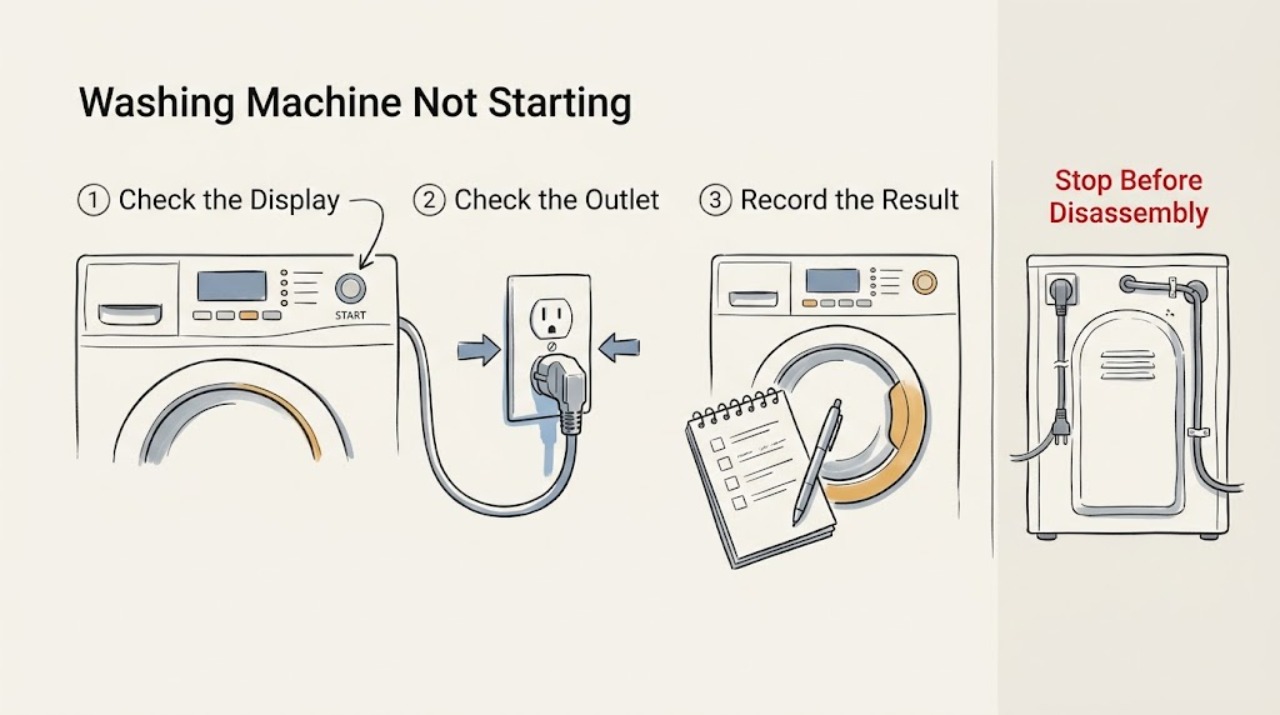
First separate a completely dead washer from one that has lights but will not begin. For no display, check the grounded outlet, household breaker or GFCI, and fuse without using an extension cord; a recurring trip, hot outlet, smoke, burning smell, arcing, water near electrical parts, or a moving machine requires immediate shutdown and qualified help. If the display works, select a real cycle, cancel delay or control lock, close the front door or top lid fully, and press and hold Start for up to 3 seconds when the model requires it. A front-load model also needs its water supplies connected and the door lock engaged; a top-load model may lock before starting or may fill before locking depending on the model. If safe checks fail, disconnect power for 5 minutes once to reset the control, then stop if the washer still will not start or shows a recurring code.
Before you begin
Safety first
- Keep the washer stopped and dry around the controls. Do not bypass locks, work on internal electrical parts, reach into a moving basket, or repeatedly reset a protective device.
Work through in order
Diagnostic checks
Use only checks that match the exact appliance or system and its official guide.
-
Check 1
Classify the failure before touching settings: note whether the display is completely blank, whether any lights or sounds occur, whether the washer is top-load or front-load, and whether water or a prior cycle remains inside.
Expected result: There is a hot outlet or cord, smoke, burning smell, arcing, water at electrical equipment, repeated breaker or GFCI trips, or the basket is moving unexpectedly.
Next step: Stop using the washer. From a safe, dry location isolate power if it can be done without touching wet or damaged equipment; close water valves only when safely reachable, and arrange qualified emergency or appliance service. Do not restart to reproduce the symptom.
Why this matters
Why: This is an electrical, water, fire, or mechanical safety event rather than a normal no-start condition.
-
Check 2
For a washer with no display, inspect the power cord and grounded outlet visually, check the household breaker or GFCI, and confirm that no extension cord is being used; do not remove an electrical cover.
Expected result: The outlet is dead, a breaker or GFCI is open, the cord or outlet is warm or damaged, or power returns but the washer remains dark.
Next step: Restore a tripped protective device only once if it is cool, dry, and safe. If it trips again, the outlet is damaged, or the display stays blank, leave the washer off and have an electrician or qualified appliance technician diagnose it.
Why this matters
Why: The start failure may be at the household supply, cord, line filter, or washer control rather than at the cycle or lock.
-
Check 3
For a powered washer, check the selected cycle, delay or pause state, and Control Lock indicator; then press and hold the model's Start or Start/Pause control for up to 3 seconds instead of tapping it once.
Expected result: The cycle starts after a real cycle is selected, the delay is canceled, Control Lock is released, or Start is held; alternatively, the panel still ignores every command.
Next step: Use the owner's guide for the exact Control Lock key and delay procedure. If the controls still do not respond, do not bypass the lock or open the console; arrange service.
Why this matters
Why: A non-cycle selector position, delayed start, Control Lock, or short Start press can look like a dead washer. A panel that remains unresponsive points to a control or power fault.
-
Check 4
Check the loading-door interlock without forcing it: a top-loader should have the lid fully closed and the lid striker aligned; a front-loader should have no clothing or residue in the gasket or lock area and the door should close firmly.
Expected result: The lid or door locks and the washer begins its start sequence, or the lock light flashes, the door will not latch, or an obstruction or damage is visible.
Next step: Remove only visible clothing, lint, detergent residue, or packing material when the washer is stopped. Wipe external contact areas with a soft damp cloth; do not bypass, pry, or replace the lock without a model-specific diagnosis.
Why this matters
Why: Maytag washers use the lid or door lock as a safety interlock, but timing differs by model. A flashing lock can mean the lock motor cannot move, the striker is obstructed, or the lid or door is not fully closed.
-
Check 5
For a front-load model, confirm both hot and cold supply valves are open and both inlet hoses are connected; for a top-load model, confirm the lid is closed and the selected cycle is valid before interpreting a no-fill condition as a no-start.
Expected result: A front-loader has a closed valve, missing hose, or installation condition, or the top-loader begins after the lid and cycle are corrected; alternatively, the washer still does not start with supplies available.
Next step: Correct only an obvious, cool, dry external valve or hose condition. Stop for leaks or water near electrics; if the washer still will not start, record the stage and code and arrange service.
Why this matters
Why: Front-load Maytag guidance requires the water connections for correct operation, while top-load models vary in whether they lock before filling or fill before locking.
-
Check 6
Record any display code, flashing lock light, countdown, or unusual sequence exactly, including whether the code appears before or after Start; do not substitute a different model's code meaning.
Expected result: The display shows LoC or LC, Err, dr, -:--, a lock flash, or an unlisted code, or no code appears.
Next step: Use the model manual or Maytag support page for the exact code. If the code returns after its documented user step, leave the washer off and schedule qualified diagnosis.
Why this matters
Why: Maytag uses different messages for Control Lock, an open door, a cycle-selector position, a door that has not been opened across cycles, and lock hardware. An unlisted code needs model-specific documentation.
-
Check 7
Only when the washer is dry, stopped, and free of the safety symptoms above, disconnect its power for 5 minutes, reconnect it, and attempt one normal cycle with the lid or door closed; do not repeatedly cycle a breaker or outlet.
Expected result: The controls recover and one normal cycle starts, or the washer remains dark, unresponsive, locked, leaking, or shows the same code.
Next step: If the symptom returns, stop using the washer and arrange qualified service. Do not open the console, defeat the lock, or continue resetting a tripping protective device.
Why this matters
Why: A successful one-time reset can clear a temporary control state. A repeated no-start means the underlying supply, lock, control, water, or other interlock fault remains.
Use your observations
Decision map
Find the observation that best matches what you see, then follow the next safe action.
-
PATH 01Next step
What you see
The washer has no display, no response, or a protective device will not stay reset.
Do this next
Leave it off and have the circuit and washer checked by a qualified electrician or appliance technician. Do not use a hot or damaged outlet and do not test live wiring.
Why this path and its safety boundary
Why it matters: Household supply, cord, outlet, line protection, or the washer's power circuit is more likely than a cycle setting.
-
PATH 02Next step
What you see
The display is on, but Control Lock, delay, an invalid selector position, or a short Start press prevents the cycle.
Do this next
Select a valid cycle, cancel delay, follow the model-specific Control Lock procedure, and hold Start as instructed. Escalate if the panel remains unresponsive.
Why this path and its safety boundary
Why it matters: The washer may be waiting for a user setting rather than failing mechanically.
-
PATH 03Next step
What you see
The top-load lid or front-load door will not close or lock, or the lock indicator flashes.
Do this next
Remove only visible debris while stopped and clean the external contact area gently. Do not bypass or force the lock; arrange service if it still will not latch.
Why this path and its safety boundary
Why it matters: An obstruction, residue, striker or hinge alignment issue, lock motor, or interlock fault may be preventing a safe start.
-
PATH 04Next step
What you see
A front-load washer has missing water connections or a top-load washer has model-dependent lid behavior.
Do this next
Use the owner's guide for that model, correct only obvious external supply conditions when safe, and stop for a leak or wet electrical area.
Why this path and its safety boundary
Why it matters: The water or lid interlock may be preventing the start sequence, and top-load behavior cannot be generalized across models.
-
PATH 05Next step
What you see
A code or unusual sequence returns after its documented user step or one five-minute reset.
Do this next
Leave the washer off, preserve the exact code and timing, and arrange qualified appliance service.
Why this path and its safety boundary
Why it matters: The control, lock, supply, or another interlock needs model-specific diagnosis; the code alone does not prove a part.
-
PATH 06Next step
What you see
There is leaking water near electrical equipment, a hot outlet or cord, smoke, burning smell, arcing, violent movement, or repeated breaker or GFCI operation.
Do this next
Stop immediately. From a safe, dry location isolate power and water only if safely reachable, keep clear of moving parts, and obtain qualified emergency or appliance service.
Why this path and its safety boundary
Why it matters: Continued start attempts could create shock, fire, flood, or mechanical injury.
Helpful context
Understand the symptom
Use the first observable symptom to choose the path
A washer that has no lights has a different starting point from one that lights up but ignores Start. Top-load and front-load Maytag washers also use different lid or door hardware. Record whether the control panel lights, whether the lid or door clicks or locks, whether a cycle countdown appears, whether water enters, and the exact code or flashing light. Do not assume a lid-lock light or a brief click means the same thing on every model.
Safety before a reset
Stop before troubleshooting if there is leaking water near electrical equipment, a hot outlet or cord, smoke, a burning smell, arcing, repeated breaker operation, violent movement, or a drum or basket that is still moving. Keep hands out of the machine while it moves, do not bypass a door or lid lock, and do not open a console or test live wiring.
Safety boundary
Stop conditions
- Stop for water near electrical equipment, a hot outlet or cord, smoke, burning smell, arcing, violent movement, a damaged door or lid, or repeated breaker or GFCI trips.
- Do not bypass, pry, or hold a lid or door lock closed, reach into a moving basket, open the console, or test energized wiring.
- Do not repeatedly reset a breaker, GFCI, or washer after the same no-start condition returns.
- Leave the washer off for a recurring error code, a lock that will not latch, a persistent blank display, or any leak that cannot be stopped safely.
Only after diagnosis
Potential parts
- lid lock or front door lock assembly
Consider this only when the door or lid is correctly aligned and clean but qualified testing finds that the lock or interlock does not prove a safe closed state.
Top-load and front-load locks differ; confirm the full model and manufacturer's fit information before ordering. - washer control or user-interface assembly
Consider this only after supply, Control Lock, cycle selection, door or lid, and one reset have been checked and diagnosis identifies a control-side fault.
Do not infer a control replacement from a blank display or code alone; verify the model and diagnosis first. - water inlet valve or inlet screen service
Consider this only for a model-specific no-fill or start interlock diagnosis after both external water supplies and hoses are confirmed safe and available.
Valve configuration and electrical fit are model-specific; do not open water or electrical connections without qualified service. - power line filter or related supply component
Consider this only when qualified testing identifies a washer-side power-path fault after the outlet, breaker or GFCI, cord, and installation are checked.
Electrical ratings and fit must be verified for the exact model by qualified service.
When checks do not resolve it
Need a professional?
Call a qualified technician or electrician for a blank display, recurring breaker or GFCI trip, persistent Control Lock or no-response condition, door or lid lock fault, recurring code, or a no-start condition after the documented reset.
Safety scope: Keep the washer stopped and dry around the controls. Do not bypass locks, work on internal electrical parts, reach into a moving basket, or repeatedly reset a protective device.
Common questions
FAQ
Why is my Maytag washer not starting but the display is on?
Check that a real cycle is selected, Delay Start is canceled, Control Lock is off, the door or lid is fully closed, and Start is held for the time your model requires.
What should I check if my Maytag washer has no lights?
Visually check the grounded outlet, breaker or GFCI, fuse, and cord. Restore a tripped protective device only once if it is safe; a blank display or repeated trip needs qualified diagnosis.
How long should I hold Start on a Maytag washer?
Some Maytag washers require Start to be pressed and held for up to 3 seconds, sometimes with a countdown. Use the model manual if the control behaves differently.
Why does the lid-lock light flash on my Maytag top-load washer?
Maytag lists an unmoved lock, an unpowered lock motor, or an incompletely closed lid as possibilities. Check only visible obstruction or residue while stopped; do not bypass the lock.
Why will my Maytag front-load washer not start?
The front door must close and lock, both hot and cold supplies must be connected, Control Lock must be off, and Start may need to be held. Exact codes such as Err, dr, or -:-- need model-specific interpretation.
How do I reset a Maytag washer that will not start?
If the washer is stopped, dry, and free of safety symptoms, disconnect power for 5 minutes and reconnect once. If the no-start or code returns, stop resetting and arrange service.
When should I stop troubleshooting a Maytag washer?
Stop for leaking water near electrics, a hot outlet or cord, smoke, burning smell, arcing, violent movement, a damaged lock, or repeated breaker or GFCI trips.
Read the exact guide
Official sources
- Lid Lock Flashing - WasherMaytag · Maytag top-load washer models; lock timing and striker position vary by model.
- Door Will Not Lock or Unlock - Front Load WasherMaytag · Maytag front-load washer models; exact cycle and door behavior varies by model.
- Lid Not Latching - WasherMaytag · Maytag top-load washer models; use the model manual for exact operation.
- Lid Locking on a Top Load High Efficiency WasherMaytag · Maytag top-load high-efficiency washer guidance; operations vary by model.
- No Power - Not Turning On - Front Load WasherMaytag · Maytag front-load washer models; exact electrical installation instructions control.
- Not Starting - WasherMaytag · Maytag top-load washer models; exact model manual controls feature differences.
- Not Starting or Not Operating - Front Load WasherMaytag · Maytag front-load washer models; codes and controls vary by model.
- No Power - WasherMaytag · Maytag top-load washer models; use the model manual for electrical details.
Community feedback
Share a repair observation
Share a plain-text repair observation. Accepted observations are published automatically; this page may take a moment to update.