
On this page
Start here
Quick answer
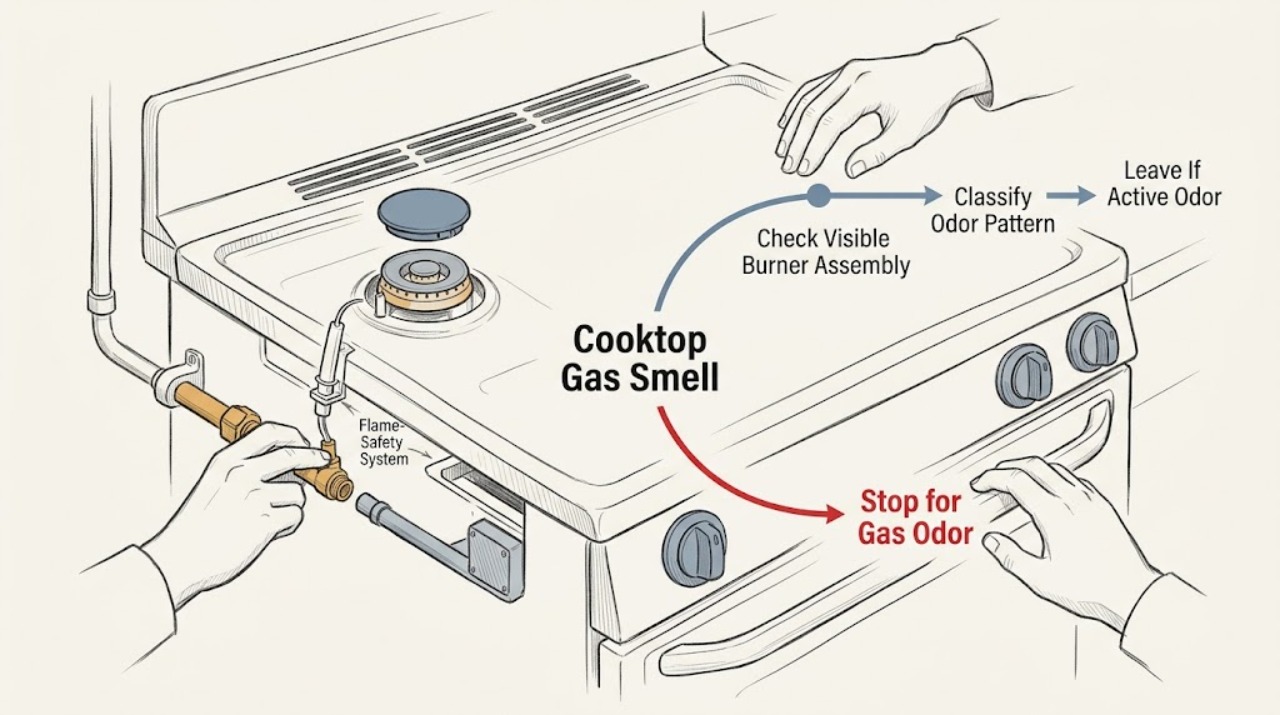
Treat a Miele cooktop gas smell as a gas-safety question first, not as a cleaning task. If the odor is present now, is strong or persistent, comes with hissing, an unlit burner, delayed ignition, or an abnormal flame, leave the building immediately without operating lights, switches, appliances, or a phone inside; call the gas supplier or emergency services from outside and do not move the appliance. Miele says a brief smell after the cooktop was used can be normal because of gas residue on or around the burners, but that explanation applies only to the specific short-lived after-use pattern with no continuing odor or abnormal operation. Once the area is confirmed safe and the odor has cleared, use the exact Miele manual to check that visible burner parts are correctly assembled, clean, and dry, and that the shutoff and appliance power conditions are as instructed. If the smell returns, the source is uncertain, or a burner will not ignite or stay lit, stop using the cooktop and book qualified Miele or gas-appliance service.
Before you begin
Safety first
- This article supports emergency recognition, safe documentation from outside, and ordinary-access visible burner care only after the odor has cleared and the area is confirmed safe. It does not authorize connector inspection by moving the appliance, gas-path work, leak testing, nozzle/valve adjustment, or repeated ignition.
Work through in order
Diagnostic checks
Use only checks that match the exact appliance or system and its official guide.
-
Check 1
If you smell gas now or hear hissing, stop troubleshooting, leave the building immediately, and from outside contact the gas supplier or emergency services; do not operate lights, switches, the hood, any appliance, a match, or a phone inside.
Expected result: Record from a safe location whether the odor was persistent or strong, whether hissing was heard, whether anyone felt unwell, and whether the smell was present before the cooktop was used.
Next step: Remain outside and follow local gas-emergency instructions; do not re-enter or restore the appliance until the appropriate authority or qualified professional says it is safe.
Stop if: Never move the cooktop, inspect the connector yourself, relight a burner, or return indoors to switch equipment while gas may be present.
Why this matters
Why: An active or uncertain odor is a possible gas leak, not a burner-cleaning problem. CPSC's emergency guidance takes priority over Miele's limited statement about a brief after-use residue odor.
-
Check 2
Only after the area is confirmed safe, write down when the smell occurs: immediately after a burner is turned off, during ignition, before any use, around one burner, around the whole cooktop, or after the appliance has been off for a while.
Expected result: Classify the odor as brief and post-use only, recurring after each use, present while off, accompanied by a failed ignition, or associated with a visible flame change.
Next step: Use the brief post-use branch only when the smell fully clears and operation is normal; otherwise stop using the cooktop and request qualified gas-appliance service.
Stop if: Do not repeat a cooking test to see whether the smell returns, and do not dismiss an odor that is persistent, worsening, or hard to localize.
Why this matters
Why: Miele describes the brief post-use residue pattern as normal, but an odor before use, a recurring/persistent odor, or odor with ignition or flame abnormality is not established as that normal condition.
-
Check 3
When there is no continuing odor and the cooktop is cool, follow the exact Miele manual to inspect only visible burner parts for correct assembly, a seated cap, moisture, dirt, or blocked cap openings; do not remove gas fittings or move the appliance.
Expected result: Record whether parts are correctly positioned and dry, a cap or head is displaced, food residue is visible, or the suspected source is hidden or cannot be reached without disassembly.
Next step: Clean and dry visible burner parts only as the exact operating instructions permit, reseat them correctly, and stop if the smell returns or ignition remains abnormal.
Stop if: Do not use abrasive tools, enlarge openings, remove nozzles, disconnect gas, use steam, or inspect behind the appliance yourself.
Why this matters
Why: Miele identifies incorrect assembly and wet, dirty, or clogged burner parts as possible ignition causes. A hidden, damaged, or unverified gas connection is a professional boundary, not a reason to force the assembly.
-
Check 4
Without moving the cooktop or touching a gas connector, compare the exact Miele manual's supply requirements with the visible installation: controls off, shutoff position accessible only if it can be observed without approaching an active odor, electrical plug condition, and propane cylinder status where applicable.
Expected result: Record whether the shutoff appears closed, the plug is disconnected, a model-dependent safe state is indicated, or a propane cylinder may be empty; do not treat a visual check as a leak test.
Next step: Use only the manual's ordinary user procedure for a confirmed supply/control state; contact a qualified gas professional when the installation, connector, cylinder, or leak condition is uncertain.
Stop if: Do not move the appliance, disconnect or reconnect gas, pressure-test, relight repeatedly, or approach the installation while an odor or hissing is present.
Why this matters
Why: Miele lists a closed shutoff, interrupted power, a model-dependent safe state, and an empty propane cylinder as possible reasons a burner will not ignite. None authorizes opening the gas path or continuing to operate when odor persists.
-
Check 5
Only if the odor has cleared, the manual allows normal use, and no safety symptom exists, perform at most one ordinary ignition attempt on the affected burner while remaining ready to turn the control off; do not use an external flame.
Expected result: Record whether the burner lights promptly and stays stable, clicks without lighting, lights and goes out, produces a changed flame, or creates a new gas smell.
Next step: Turn the control off, preserve the observation, and arrange qualified Miele or gas-appliance service for any abnormal result or recurring smell.
Stop if: Stop immediately for odor, hissing, delayed ignition, flame rollout, yellow/unstable flame, soot, or a burner that will not shut off normally.
Why this matters
Why: A prompt, stable flame without returning odor supports normal operation but does not prove a hidden connection is sound. Failure, delayed ignition, flame change, or renewed odor requires service and no further attempts.
-
Check 6
If the smell returns, persists, or cannot be classified as a brief post-use residue odor, stop using the cooktop and prepare a service report with the exact model, fuel type, affected burner, odor timing, flame behavior, recent cleaning or spill, and whether the cooktop was moved.
Expected result: Confirm whether the smell occurs with controls off, after one burner, after all burners, after a power interruption, or after an installation or repair.
Next step: Book Miele or qualified gas-appliance service and keep the cooktop out of use until the cause and safe return-to-use procedure are confirmed.
Stop if: Do not re-enter an evacuated area to gather details, move the cooktop for photos, or replace a nozzle, valve, ignitor, or connector yourself.
Why this matters
Why: A repeatable pattern helps a technician distinguish burner assembly/ignition from supply or connector concerns, but the user should not diagnose or repair a gas leak from this information.
Use your observations
Decision map
Find the observation that best matches what you see, then follow the next safe action.
-
PATH 01Safety boundary
What you see
Gas odor is present while the cooktop is off, persists, is strong or worsening, is accompanied by hissing, or cannot be confidently classified.
Do this next
Leave immediately, avoid all switches, flames, appliances, and phones inside, and contact the gas supplier or emergency services from outside.
Why this path and its safety boundary
Why it matters: Treat the condition as a possible gas leak; the brief post-use residue explanation does not apply safely.
Safety stop: Do not move the appliance, inspect its connector, relight burners, or return until qualified authorities clear the area.
-
PATH 02Safety boundary
What you see
A mild odor occurs only briefly after normal cooktop use, fully clears with the appliance off, and there is no hissing, abnormal flame, failed ignition, or odor before use.
Do this next
Follow the exact manual's burner cleaning and assembly care instructions when cool, and stop using the cooktop if the odor becomes persistent or changes pattern.
Why this path and its safety boundary
Why it matters: This matches Miele's published explanation of gas residue on and around burners, but it remains a pattern to monitor rather than a license to ignore change.
Safety stop: Do not repeat ignition tests, move the appliance, or dismiss a return of odor while the cooktop is off.
-
PATH 03Safety boundary
What you see
There is no continuing odor, but one burner is wet, dirty, incorrectly assembled, clogged, clicking without ignition, or going out after ignition.
Do this next
Allow cooling, clean/dry/reassemble only as the exact manual permits, and stop after one abnormal result rather than repeatedly allowing gas to flow.
Why this path and its safety boundary
Why it matters: Miele identifies burner assembly, moisture/dirt, cap openings, power, shutoff, and model-dependent safe state as possible ignition factors.
Safety stop: Stop for renewed odor, delayed ignition, flame change, hissing, or any need to access gas fittings or hidden components.
-
PATH 04Safety boundary
What you see
The cooktop was recently installed or moved, the gas type or propane configuration is uncertain, the shutoff/connector cannot be safely confirmed, or the odor follows installation work.
Do this next
Keep the appliance out of use and arrange Miele-approved service or a licensed gas professional without moving the cooktop.
Why this path and its safety boundary
Why it matters: Supply, connector, conversion, or installation conditions require qualified assessment; visible user checks cannot establish leak safety.
Safety stop: Do not disconnect gas, change nozzles, move the appliance, or attempt a leak test yourself.
-
PATH 05Safety boundary
What you see
The flame is yellow, unstable, unusually high, sooting, delayed, or cannot be shut off normally, or there is damage around the burner or control.
Do this next
Turn controls off if it is safe to do so, stop using the cooktop, and arrange qualified Miele/gas-appliance service; use the emergency gas branch if odor or hissing is present.
Why this path and its safety boundary
Why it matters: The condition may involve wrong gas configuration, burner assembly, ignition safety, gas control, or another hazardous fault.
Safety stop: Do not adjust nozzles or valves, continue cooking, relight repeatedly, or use the appliance until assessed.
Helpful context
Understand the symptom
Separate a brief post-use odor from an active gas leak
Miele's support page specifically describes a gas smell after the cooktop was used as normal when it is caused by gas residue on and around burners. That does not make every gas odor safe. Ask whether the smell is brief and limited to immediately after normal use, or whether it is present before ignition, persists after the appliance is off, becomes stronger, or occurs with hissing or an abnormal flame. If you cannot confidently place it in the brief post-use pattern, use the emergency branch.
The emergency response comes before troubleshooting
If gas is suspected, do not switch lights or the hood, operate another burner, light a match, use a phone inside, or move the cooktop to inspect the connector. Leave immediately and contact the gas supplier or emergency services from a safe location outside. CPSC warns that moving a gas appliance can cause a weakened connector to fail, so connector inspection and replacement belong to a qualified professional.
Only inspect visible burner parts after the odor has cleared
When the area has been declared safe and there is no continuing smell, hissing, or abnormal flame, use the exact Miele operating instructions to check visible burner assembly. Miele identifies incorrect assembly and wet, dirty, or clogged burner parts as possible ignition problems, and says the burner cap openings and area around the ignitor may need cleaning according to the instructions. Keep controls off and do not use abrasive tools, disassemble the gas path, or substitute nozzles.
Do not turn a burner test into repeated gas release
A burner that does not light or goes out can leave unburned gas. Do not keep trying to ignite it. Miele's support identifies a closed shutoff, interrupted electrical supply, a model-dependent safe state, and an empty propane cylinder as possible causes of a burner that does not ignite, but gas smell makes continued testing unsafe. Record which burner, when the odor appeared, and whether the smell remained after controls were off, then arrange service if the condition is not immediately resolved by the exact manual's safe instructions.
Safety boundary
Stop conditions
- If gas odor is present now, persistent, strong, worsening, or uncertain, leave immediately and contact the gas supplier or emergency services from outside; do not use switches, lights, appliances, matches, or a phone inside.
- Do not move the cooktop to inspect the connector, disconnect gas, change nozzles, adjust valves, or perform a leak test yourself.
- Do not repeatedly ignite a burner, use an external flame, or continue operation after delayed ignition, hissing, flame rollout, yellow/unstable flame, soot, or a burner that will not shut off normally.
- Do not remove hidden gas components, probe live electrical parts, bypass ignition safety, or treat a one-time post-use odor as proof that the installation is safe.
- Keep the cooktop out of use until qualified Miele or gas-appliance service confirms the cause and safe return-to-use procedure when the odor recurs or cannot be classified.
When checks do not resolve it
Need a professional?
Use the gas-emergency route immediately for an active, persistent, strong, worsening, or uncertain gas odor, hissing, or suspected leak. Arrange Miele or qualified gas-appliance service when the smell returns, occurs before use, follows installation or movement, a burner fails to ignite or stay lit, the flame is delayed or abnormal, the connector or gas type is uncertain, or visible cleaning and assembly checks do not resolve the issue.
Safety scope: This article supports emergency recognition, safe documentation from outside, and ordinary-access visible burner care only after the odor has cleared and the area is confirmed safe. It does not authorize connector inspection by moving the appliance, gas-path work, leak testing, nozzle/valve adjustment, or repeated ignition.
Common questions
FAQ
Is a gas smell after using a Miele cooktop always a leak?
No, Miele says a brief smell after cooktop use can come from gas residue on or around burners. That limited explanation does not cover an odor before use, a persistent or worsening smell, hissing, failed ignition, or an abnormal flame; use the emergency branch for those symptoms.
What should I do if I smell gas right now?
Leave immediately. Do not switch lights, operate appliances, light a match, use a phone, or move the cooktop inside. Contact the gas supplier or emergency services from outside and do not return until the appropriate authority or professional confirms it is safe.
Can a wet or dirty Miele burner cause gas odor?
Miele identifies wet, dirty, clogged, or incorrectly assembled burner parts as possible ignition issues. Only after the odor has cleared and the area is confirmed safe should you clean, dry, and reassemble visible parts according to the exact manual. Do not keep trying to ignite a burner that fails.
Should I move my Miele cooktop to check the gas connector?
No. CPSC warns that moving a gas appliance can cause a weakened connector to fail. Connector inspection, leak testing, gas conversion, and replacement belong to a qualified professional.
When does a Miele cooktop gas smell need service?
Use emergency gas guidance for an active, persistent, strong, worsening, or uncertain odor, hissing, or suspected leak. Book qualified Miele or gas-appliance service when the smell returns, ignition fails, the flame changes, the installation is uncertain, or visible safe cleaning does not resolve the issue.
Read the exact guide
Official sources
- Certain Older Gas Connectors May Be DangerousU.S. Consumer Product Safety Commission · Official CPSC consumer safety bulletin; emergency gas and local authority instructions control a real incident.
- The gas cooktop burner does not igniteMiele USA · Official Miele USA gas-cooktop support; exact model operating instructions control the user procedure.
- Gas smell after cooktop was usedMiele USA · Official Miele USA support article for a gas smell after the cooktop was used; it does not override emergency gas-leak guidance for persistent or uncertain odor.
- The appearance of the gas cooktop flame suddenly changesMiele USA · Official Miele USA gas-cooktop support; abnormal flame or gas configuration requires qualified service.
- The ignitor on the gas cooktop burner does not function properlyMiele USA · Official Miele USA gas-cooktop support; used only for visible residue/cleaning and professional escalation boundaries.
Community feedback
Share a repair observation
Share a plain-text repair observation. Accepted observations are published automatically; this page may take a moment to update.