
On this page
Start here
Quick answer
Treat an unexplained gas smell from a Samsung cooktop as a possible leak, not as a routine burner-cleaning issue. Do not light a flame, operate electrical switches, plug in a cord, use a phone inside, or deliberately relight a burner while the odor is present. If the smell is strong, persists with every knob off, or anyone feels unwell, leave the building and contact the gas provider or emergency services from outside. If the odor has cleared and the gas provider or a qualified professional has ruled out a leak, a cool cooktop can be checked for a correctly seated, clean, and fully dry burner head and cap. Persistent odor, delayed ignition, unstable flame, or an odor that returns after cleaning requires qualified service.
Before you begin
Safety first
- Gas valves, pressure, supply connections, ignition switches, burner ports, and internal manifold work require qualified gas-appliance personnel.
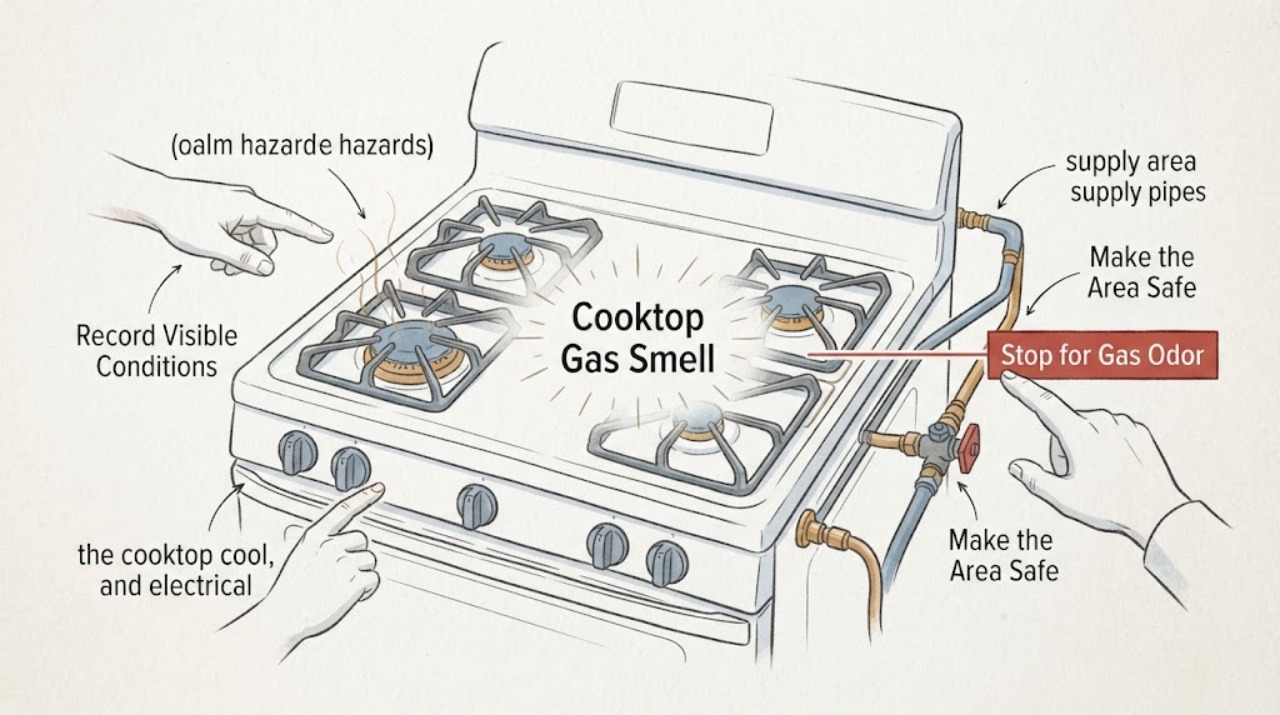
Work through in order
Diagnostic checks
Use only checks that match the exact appliance or system and its official guide.
-
Check 1
Treat the odor as a gas-safety event: leave all burner knobs in their current safe position without trying to ignite anything, avoid flames and electrical switches, and move people away from the cooktop.
Expected result: The odor is strong, spreading, present while all knobs are off, or accompanied by hissing, smoke, flame, dizziness, nausea, or breathing difficulty; or it has already cleared and no one is unwell.
Next step: If the odor is present or anyone feels unwell, evacuate, do not use a phone or switch inside, and contact the gas provider or emergency services from outside. Do not return to test the cooktop until professionals say it is safe. If the odor has cleared, contact the gas provider for guidance before any inspection.
Why this matters
Why: A persistent odor or symptom can indicate an active leak or unsafe combustion and cannot be diagnosed by burner cleaning. A cleared odor still needs careful escalation if its cause is unknown.
-
Check 2
Once professionals have confirmed there is no active gas hazard, record when the smell occurred without deliberately recreating it: with every knob off, during a particular ignition attempt, after a delayed light, around one burner, or after the flame was turned off.
Expected result: The odor occurs with all knobs off; only one burner is involved; ignition is delayed or bursts into flame; the flame is unstable; or the odor is absent after normal ignition.
Next step: Give the timing to the gas provider, installer, or Samsung technician. Do not turn the burner on again to verify the pattern while an odor or abnormal flame is present.
Why this matters
Why: An odor with all knobs off points toward the supply, valve, or connection and is not a user adjustment. One-burner or delayed-ignition patterns can involve burner assembly, moisture, blocked openings, ignition, or gas pressure, but the timing does not identify a part.
-
Check 3
With the gas supply declared safe, the cooktop cool, and electrical power off as directed by the model manual, visually check the affected burner head and cap for obvious food residue, moisture, incorrect placement, or a burner opening blocked by debris.
Expected result: The head and cap are clean, fully dry, correctly seated, and aligned; or there is moisture, residue, damage, or an uncertain reassembly.
Next step: Correct only the external placement or drying issue described by the model manual, and never spray into the manifold or gas openings. If the assembly is damaged, uncertain, or the odor returns, stop and arrange qualified service.
Why this matters
Why: A wet, dirty, damaged, or misaligned burner assembly can cause delayed or uneven ignition. A clean and correctly assembled burner with recurring odor shifts the concern toward gas pressure, ignition, valve, or supply diagnosis.
-
Check 4
After the gas provider has cleared the appliance for use, observe one normal ignition only if the exact manual permits it. Note whether the igniter clicks, the burner lights promptly, the flame is stable, and the odor stops once the flame is established.
Expected result: The burner lights promptly with a stable flame and no continuing odor; it clicks without lighting; it lights after a delay or burst; or the flame flickers, lifts, or will not stay lit.
Next step: If any odor remains, the flame is abnormal, or the burner fails to light promptly, turn the control off, stop using the cooktop, and contact the gas provider or Samsung service. Do not keep clicking or relighting it.
Why this matters
Why: A stable flame without continuing odor supports a burner assembly or moisture condition that has cleared. Failure to ignite, delayed or burst ignition, and unstable flame can indicate ignition, burner, gas pressure, or supply problems that require escalation.
-
Check 5
Check only the external controls and surrounding surface for moisture or cleaner residue after the gas situation is safe. Confirm that knobs return to Off and that no liquid has entered the ignition openings; do not remove the cooktop or disturb gas lines.
Expected result: The controls and surface are dry and stable; a knob sticks or does not return to Off; or moisture is present near an ignition opening or manifold.
Next step: Keep the cooktop off until the surface is fully dry and the exact manual permits use. If a knob sticks, moisture persists, or the odor returns, stop and arrange qualified service; never spray cleaner into openings.
Why this matters
Why: Moisture can affect ignition switches and a control that does not reliably return to Off can leave gas operation unpredictable. Moisture near the manifold or a stuck control needs professional attention if drying does not resolve it.
-
Check 6
Prepare a service handoff without opening the appliance: record the model, affected burner, odor timing, whether all knobs were Off, ignition delay, flame appearance, burner-head and cap condition, gas-provider findings, and any recent cleaning or spill.
Expected result: The odor is repeatable only when the appliance is used, remains absent after the safety check, or cannot be safely reproduced without risking another gas release.
Next step: Keep the cooktop out of service if the cause is uncertain or any abnormal odor or flame returns. Request Samsung service or qualified gas-appliance help; do not perform leak testing with a flame or internal repair.
Why this matters
Why: The record gives the gas provider and technician a safe diagnostic path while avoiding another ignition or leak exposure.
Use your observations
Decision map
Find the observation that best matches what you see, then follow the next safe action.
-
PATH 01Next step
What you see
Gas odor is present with knobs off, is strong or spreading, or anyone feels unwell
Do this next
Evacuate, avoid flames, switches, plugs, and phones inside, and contact the gas provider or emergency services from outside. Do not return until cleared.
-
PATH 02Next step
What you see
One burner has delayed, burst, or unstable ignition after the gas supply is confirmed safe
Do this next
Turn the control off and stop using that burner. Have the burner assembly, ignition, and gas pressure assessed by a qualified professional.
-
PATH 03Next step
What you see
Burner head or cap is wet, dirty, damaged, or not seated correctly after a safe clearance
Do this next
Follow the exact model manual to clean, dry, and correctly reassemble the external parts. If odor returns, request service.
-
PATH 04Next step
What you see
Moisture is near the ignition openings or a knob does not reliably return to Off
Do this next
Keep the cooktop off and do not spray or pour into the openings. Arrange qualified service if drying and the documented external care procedure do not resolve it.
-
PATH 05Next step
What you see
The burner lights promptly with a stable flame and no continuing odor after professional clearance
Do this next
Use the cooktop only according to the model manual and monitor for recurrence. Stop immediately and seek help if odor, abnormal flame, or delayed ignition returns.
Helpful context
Understand the symptom
Gas odor changes the troubleshooting order. First decide whether the smell is present with every knob off, appears during an ignition attempt, or remains after a flame is established or extinguished. Do not repeat an ignition attempt just to classify the odor. Samsung directs users with gas-safety concerns, including a gas smell, to contact the gas provider.
While an odor is present, do not create an ignition source: do not light a match or lighter, use a phone inside, operate electrical switches, or plug in a cord. Leave the area and contact the gas provider or emergency services from outside. Do not use a flame or improvised test to search for a leak.
Only after the gas provider or a qualified professional has ruled out a leak should you inspect a cool cooktop. Samsung's cleaning guidance says the burner head, cap, and surface must be fully dry and correctly reassembled, and that water must not enter the burner base or brass gas openings. A burner that still smells, lights late, burns unevenly, or will not stay lit needs service rather than more cleaning.
Do not pull a built-in cooktop out or disturb the gas manifold, valves, or supply connection. The exact model manual controls burner layout and any permitted cleaning. Record which burner was involved, whether the smell occurred with the knobs off, ignition delay, flame appearance, and what changed after the gas provider made the situation safe.
Only after diagnosis
Potential parts
- burner head or burner cap
Consider this only when the gas supply is safe and service or the model manual confirms a damaged or incorrectly matched external burner assembly after other causes are ruled out.
Confirm the exact Samsung model and manufacturer fit information; burner pieces are not universally interchangeable. - ignition electrode or ignition switch
Consider this only when a safe supply is confirmed but a burner has no spark, delayed ignition, or persistent clicking and qualified testing isolates the ignition path.
Use model-specific service findings and fit information before selecting a part. - gas valve or pressure regulator
Consider this only when the gas provider or qualified technician confirms a pressure, valve, or supply-control issue after ruling out the external burner assembly.
Gas components require qualified installation and exact model compatibility; do not replace them from an odor alone. - ignition control module or wiring
Consider this only when safe gas supply and burner assembly checks are normal but service testing identifies an internal ignition or control fault.
Internal electrical and gas work is model-specific and should be performed by qualified personnel.
When checks do not resolve it
Need a professional?
Call the gas provider for any suspected leak or gas odor, and call qualified Samsung appliance service for persistent burner, ignition, control, or flame problems after the gas supply is declared safe.
Safety scope: Gas valves, pressure, supply connections, ignition switches, burner ports, and internal manifold work require qualified gas-appliance personnel.
Have this ready
- Provide the Samsung model, affected burner, whether the odor was present with all knobs Off, ignition timing, flame behavior, recent cleaning or spill, visible burner-head and cap condition, and the gas provider's clearance or findings.
Common questions
FAQ
What should I do first if my Samsung cooktop smells like gas?
Do not light anything, touch switches, plug in a cord, or use a phone inside. Leave the building and contact the gas provider or emergency services from outside, especially if the odor is strong or persists with every knob off.
Is a short gas smell during ignition normal?
Do not assume an unexplained or recurring odor is normal. If the smell remains, ignition is delayed, the flame is unstable, or the odor occurs with knobs off, stop using the cooktop and contact the gas provider or qualified service.
Can I clean the Samsung gas burner to fix the smell?
Only after the gas provider or qualified professional has ruled out an active leak and the cooktop is cool and power is off. Then follow the model manual to clean and dry the external head and cap. Never spray into gas openings or remove the cooktop.
Why does one Samsung burner light late or with a burst of flame?
Samsung lists burner-head and cap position, moisture, blocked openings, ignition, and gas pressure as possible contributors. Turn the burner off and arrange qualified help if the condition persists; do not keep relighting it.
When should I call Samsung service for a gas smell?
Call the gas provider for any suspected leak or odor, especially with all knobs off. Call Samsung service for recurring odor, abnormal flame, delayed ignition, a stuck control, moisture near ignition openings, or a burner that remains unsafe after the gas supply is cleared.
Read the exact guide
Official sources
- How to clean your Samsung gas cooktopSamsung US · Official Samsung cleaning and moisture-safety guidance for gas cooktop surfaces, burner parts, controls, and manifold openings
- What can you do when the burner of your Samsung gas cooktop does not ignite or has other ignition issuesSamsung Canada · Official Samsung gas-cooktop guidance for gas-odor safety, burner ignition, burner-head and cap placement, gas pressure, and service escalation; settings may vary by country and model
Community feedback
Share a repair observation
Share a plain-text repair observation. Accepted observations are published automatically; this page may take a moment to update.