
On this page
Start here
Quick answer
A KitchenAid gas cooktop can give a brief gas odor while a burner is being lit, but gas smell when the cooktop is off or an odor that lingers is a stop condition. Turn every control to Off only if you can do so without approaching a hazard; do not light anything, operate electrical switches, or investigate a suspected leak. Leave the area and follow the local gas-emergency procedure from a safe location. If the odor occurs only during use and there is no active leak concern, let the cooktop cool, then check for a burner cap that is missing, wet, dirty, or sitting on the wrong base, and for clogged ports or spill residue. KitchenAid says caps must be seated correctly, clean caps help ignition, and abnormal yellow or noisy flames need an installation and gas-supply check. Persistent odor, soot, abnormal flames, a failed ignition, or any need to access the gas line requires qualified service.
Before you begin
Safety first
- A homeowner may check control positions and accessible, cool burner parts only when there is no active gas hazard. Gas-line, pressure, conversion, valve, regulator, ignition-wiring, and leak diagnosis require qualified service.
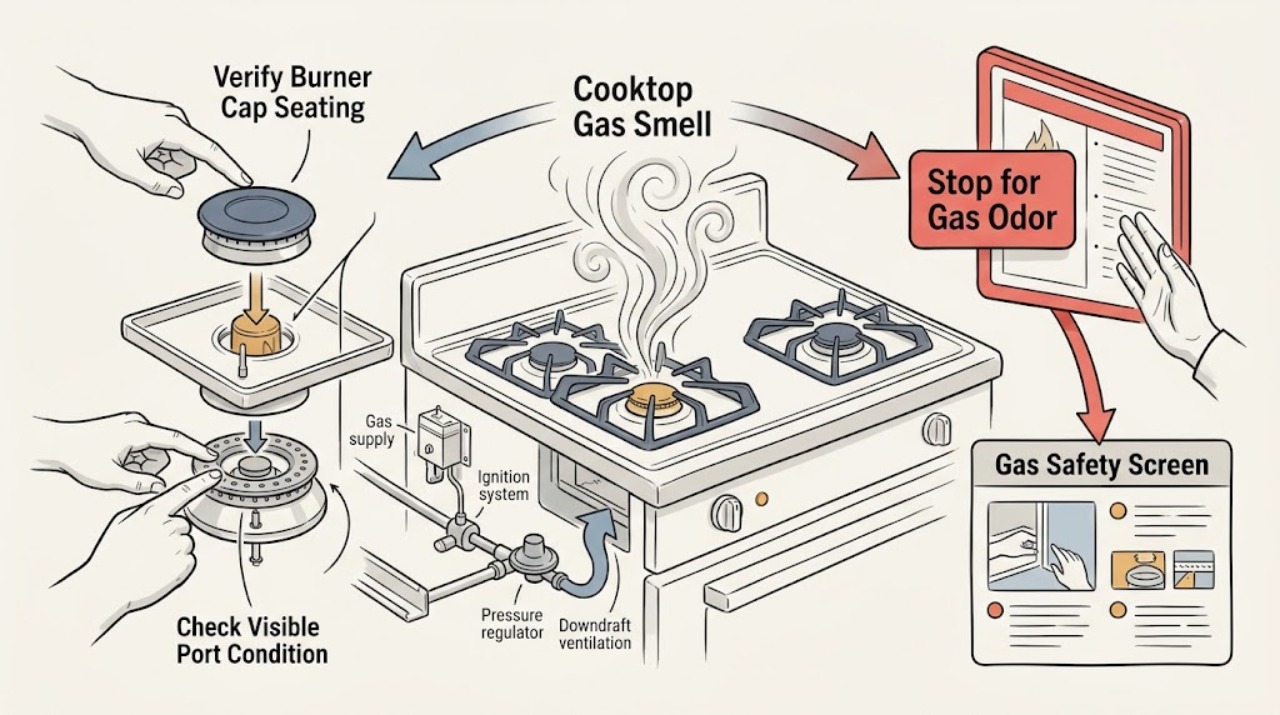
Work through in order
Diagnostic checks
Use only checks that match the exact appliance or system and its official guide.
-
Check 1
From a safe position, determine whether the odor is present with all burners off, and do not create a flame or operate an electrical switch to test it.
Expected result: Note whether the smell is strong or persistent, whether any control is accidentally on, and whether there is hissing, dizziness, smoke, or another sign of a possible leak.
Next step: Leave the area as appropriate and follow the local gas-emergency procedure from a safe location. If the odor is absent with every control Off and there was a clear accidental control position, do not relight until the appliance is safe and the model instructions permit it.
Stop if: Stop immediately for persistent gas odor, hissing, illness, flame, smoke, or any uncertainty about whether gas is escaping.
Why this matters
Why: Gas smell with no intentionally operating burner, a persistent odor, or other leak sign is not a burner-cleaning problem.
-
Check 2
Only after the cooktop is cool and the gas-safety screen is clear, inspect each visible burner cap and base without removing the cooktop surface.
Expected result: Check whether a cap is missing, wet, dirty, cracked, tilted, or installed on the wrong base; look for food or grease from a spillover around the cap and ports.
Next step: Clean and dry the accessible cap and burner area using the model's instructions, then seat the original cap on its matching base. Do not force a cap or improvise a replacement.
Stop if: Stop if the cap, base, grate, surface, or surrounding material is damaged, melted, or cannot be safely identified.
Why this matters
Why: A misplaced or dirty cap can cause poor ignition, uneven flames, and an odor during use. Damage or a part that does not clearly match its base needs model-specific help.
-
Check 3
With the cap removed only as the model guide allows, inspect the visible burner ports and the area around the burner for dried spill residue or moisture; do not enlarge or probe the ports.
Expected result: Record whether one burner is affected, several burners are affected, the ports are visibly blocked, or the odor remains even though the burner areas are clean and dry.
Next step: Clean only by the procedure in the exact model manual and allow parts to dry fully. Escalate a repeated odor, failed ignition, or multi-burner symptom to qualified service.
Stop if: Do not continue if cleaning requires a sharp tool, compressed gas, panel removal, gas-line access, or live electrical work.
Why this matters
Why: A localized blocked or wet burner can explain poor ignition and odor during use. Multiple affected burners or an odor with no burner operating points toward supply, installation, or a leak concern.
-
Check 4
If the gas-safety screen is clear and the manual permits normal operation, observe the burner from a safe distance only while it is intentionally lit; do not lean over the flame.
Expected result: Note whether the flame is soft blue for natural gas or blue with slightly yellow tips for LP gas, and whether it is noisy, excessively yellow, too high, too low, lifting, uneven, or sooting cookware.
Next step: Turn the control Off if the flame is abnormal and use the model installation instructions or qualified service for gas-supply and conversion checks. Do not adjust the regulator or convert fuel type yourself.
Stop if: Turn the control Off and stop if the burner will not light, flame is unstable or lifting, soot appears, odor increases, or any flame enters an unintended area.
Why this matters
Why: An abnormal flame can indicate a clogged port, cap placement issue, incorrect gas supply, pressure-regulator issue, or improper conversion; flame appearance alone cannot identify which part is at fault.
-
Check 5
If the cooktop has a downdraft vent and the odor is clearly cooking vapor rather than gas, inspect the accessible grate and grease filter after switching the ventilation system off.
Expected result: Look for a grease film, blocked filter, incorrect filter position, or weak extraction; note whether the odor is limited to cooking and improves when the vent is clean and operating normally.
Next step: Clean or replace the filter only as directed by the model guide and have a technician assess a blocked or incorrectly installed duct. Return to the gas-safety branch if the smell is gas-like or persists without cooking.
Stop if: Stop if the vent requires wiring access, duct alteration, roof or wall work, or if the odor could be gas rather than cooking vapor.
Why this matters
Why: A dirty or poorly seated filter can leave cooking odor in the room, but ventilation cannot correct a gas leak or an odor present while the cooktop is off.
-
Check 6
If the odor persists or any flame, ignition, supply, or vent symptom is abnormal, keep the cooktop off and prepare a service handoff without opening the appliance.
Expected result: Document the exact model and serial information, fuel type, affected burner, when the odor occurs, flame appearance, recent spill or installation work, and any visible damage.
Next step: Arrange qualified appliance or gas service and provide the notes and photographs from a safe, non-invasive inspection.
Stop if: Do not remove the cooktop, test live ignition wiring, adjust gas pressure, change fuel conversion parts, or search for a leak yourself.
Why this matters
Why: This history helps a qualified technician distinguish a cap or port issue from a gas-supply, conversion, ignition, regulator, valve, or ventilation fault.
Use your observations
Decision map
Find the observation that best matches what you see, then follow the next safe action.
-
PATH 01Safety boundary
What you see
Gas smell is present with every burner off, persists, is strong, or is accompanied by hissing or illness.
Do this next
Leave the area as appropriate, avoid flames and electrical switching, and follow local gas-emergency instructions from a safe location.
Why this path and its safety boundary
Safety stop: Do not relight a burner, troubleshoot the cap, operate the vent as a test, or open the cooktop.
-
PATH 02Safety boundary
What you see
A control was accidentally turned on and the odor stops after the control is safely returned to Off, with no other warning signs.
Do this next
Keep the area ventilated as appropriate, verify the control position, and consult the model instructions before normal use.
Why this path and its safety boundary
Safety stop: If odor remains or returns with all controls Off, use the possible-leak branch and arrange qualified service.
-
PATH 03Safety boundary
What you see
The odor occurs only during use and a cool, safe inspection finds a wet, dirty, misplaced, or mismatched cap or spill residue.
Do this next
Clean and dry accessible parts as directed, place each cap on its matching base, and reassess only under normal safe operation.
Why this path and its safety boundary
Safety stop: Do not force parts, probe ports, or continue when there is damage, persistent odor, or an abnormal flame.
-
PATH 04Safety boundary
What you see
The flame is noisy, excessively yellow, too high or low, uneven, sooting, or the appliance was converted to LP gas.
Do this next
Turn the burner Off and use the model installation instructions or qualified service for supply, pressure, and conversion checks.
Why this path and its safety boundary
Safety stop: Do not adjust the regulator, alter the gas line, or change conversion components as a household test.
-
PATH 05Safety boundary
What you see
The odor is cooking vapor, occurs only while cooking, and a fitted downdraft vent has a dirty or incorrectly seated filter.
Do this next
Clean the accessible filter according to the model guide and arrange service for duct or airflow faults.
Why this path and its safety boundary
Safety stop: Return to the possible-leak branch for gas-like odor or any smell while the cooktop is off.
Helpful context
Understand the symptom
Separate an ignition odor from a possible gas leak
A short odor during ignition can have a different cause from gas smell while the cooktop is off. If the odor is strong, persists, is accompanied by hissing, or is present when no burner is intentionally operating, stop troubleshooting. Do not light another appliance, use a switch, or search under the cooktop. Move to a safe location and follow the gas supplier or local emergency instructions. A gas detector or smell alone cannot replace that safety decision.
Inspect only the accessible burner parts after the cooktop is safe
When there is no active gas concern and the cooktop is cool, verify that each control is Off and inspect the visible burner cap, burner base, ports, and grate. A spill can leave food or moisture around the cap and ports, while a cap on the wrong base can disturb ignition and the flame. KitchenAid recommends cleaning caps after spillovers and routinely removing and cleaning them. Follow the model manual; do not probe ports with a sharp object or remove the cooktop surface.
Use flame appearance to decide whether service is needed
A burner that lights with a soft blue flame is behaving differently from one that is noisy, excessively yellow, too high, too low, or soots cookware. KitchenAid identifies a clogged burner port, misplaced cap, incorrect gas supply, or improper LP conversion as possibilities and directs the user to installation instructions or service. Do not adjust the regulator, change gas type, or work on the supply line as a household experiment.
Ventilation can reduce cooking odor but cannot make a leak safe
If the cooktop has a downdraft system, a grease-coated filter or ventilation chamber can leave cooking vapors and odor in the room. Clean or service that system only as the model instructions allow and only after the gas-safety screen is clear. Ventilation is not a substitute for isolating a suspected gas leak, and an odor that remains with every burner off needs qualified diagnosis.
Only after diagnosis
Potential parts
- burner cap
Consider only if the cap is cracked, warped, missing, or cannot seat on the matching base after cleaning; odor alone does not identify the cap.
Confirm the exact cooktop model and the matching burner position before selecting any replacement. - burner head or ignition component
Consider only after a qualified diagnosis when one burner repeatedly fails to ignite or has abnormal flame behavior despite a clean, dry, correctly seated cap.
Do not choose a burner or ignition component from appearance alone; model-specific fit and gas configuration must be confirmed. - gas valve, regulator, or supply component
Consider only after service diagnosis for persistent odor, incorrect pressure, abnormal flames across burners, or a confirmed supply or conversion fault.
Gas-supply and pressure work requires a qualified installer, gas supplier, or appliance technician; do not bypass or adjust safety controls. - downdraft grease filter
Consider only when a fitted downdraft system leaves cooking vapor odor and the filter is damaged or cannot be cleaned as directed.
Verify the exact ventilation and cooktop model before any replacement decision.
When checks do not resolve it
Need a professional?
Keep the cooktop off and arrange qualified service for gas odor with all burners off, a persistent or strong odor, abnormal or sooting flames, a failed ignition, repeated ignition problems, suspected incorrect fuel conversion, damaged gas components, or any need to access the gas supply, regulator, valve, or wiring.
Safety scope: A homeowner may check control positions and accessible, cool burner parts only when there is no active gas hazard. Gas-line, pressure, conversion, valve, regulator, ignition-wiring, and leak diagnosis require qualified service.
Have this ready
- Provide the exact model and serial information, natural-gas or LP fuel type, affected burner, timing and location of the odor, flame description, recent spill or installation work, and photographs from a safe inspection.
Common questions
FAQ
Is a brief gas smell while my KitchenAid burner lights normal?
KitchenAid says a slight gas odor can sometimes occur while using the cooktop, but the odor should not be treated casually. If it is strong, persistent, present with all burners off, or accompanied by hissing or illness, leave the area and follow local gas-emergency instructions.
Why does the cooktop smell like gas when it is off?
First, do not light anything or operate switches. A control may have been accidentally turned on, but if every control is Off and the odor remains, treat it as a possible gas leak and arrange the local emergency or qualified service response from a safe location.
Can a dirty burner cap cause a gas odor?
A dirty, wet, misplaced, or mismatched cap can cause poor ignition and abnormal flame behavior during use. After the cooktop is cool and the gas-safety screen is clear, clean and seat the cap according to the model guide. Persistent odor still requires service.
What does a yellow or noisy flame mean?
KitchenAid lists a clogged port, cap-placement problem, incorrect gas supply, and improper LP conversion among possible causes. Turn the burner Off if the flame is abnormal and use the installation instructions or qualified service rather than adjusting gas pressure yourself.
Can the downdraft vent fix a gas smell?
No. A clean filter can improve removal of cooking vapor, odor, and smoke when the system is fitted, but ventilation cannot make a gas leak safe. Any gas-like odor or odor while the cooktop is off takes priority over vent cleaning.
Read the exact guide
Official sources
- Noisy or Yellow Flames - Gas CooktopKitchenAid · KitchenAid Product Help guidance for gas cooktop flame concerns; flame details vary by fuel type and model.
- Preventative Maintenance - CooktopsKitchenAid · KitchenAid Product Help routine-maintenance guidance; exact cleaning access and products vary by model.
- Odors or SmellsKitchenAid · KitchenAid Product Help guidance for gas cooktops; confirm the exact model manual for model-specific details.
- Downdraft Vent Not Removing Odor - Gas CooktopKitchenAid · Applies only to KitchenAid gas cooktops equipped with the described downdraft system; follow the exact model installation and care instructions.
- GAS COOKTOPKitchenAid · Applies to the model families covered by this manual; use the exact model's manual for the installed cooktop.
Community feedback
Share a repair observation
Share a plain-text repair observation. Accepted observations are published automatically; this page may take a moment to update.