
On this page
Start here
Quick answer
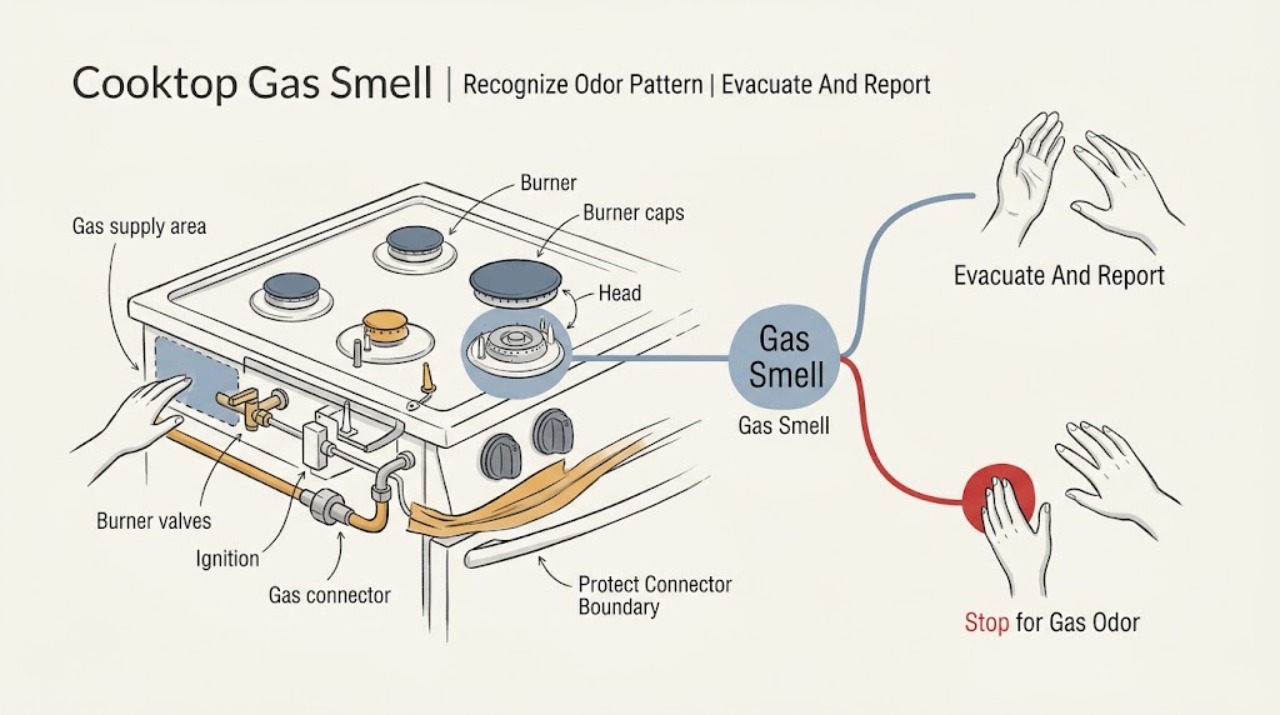
If a GE gas cooktop smells like unburned gas or rotten eggs, stop using it and treat the odor as a gas emergency: do not light a burner, touch electrical switches, use a device inside, or move the cooktop. Extinguish an open flame only if it is safe to do so, clear everyone from the area, leave, and call the gas supplier or emergency responders from outside. A brief odor during first use can be combustion odor, but a persistent or uncertain odor is not a user troubleshooting problem. After the gas supplier or a qualified professional declares the area safe, arrange qualified gas-appliance service rather than relighting or opening the appliance yourself.
Work through in order
Diagnostic checks
Use only checks that match the exact appliance or system and its official guide.
-
Check 1
From a safe distance, note whether the odor resembles rotten eggs or unburned gas, remains with all controls off, or is only a brief odor during first heating of a new cooktop.
Expected result: A persistent sulfur-like odor or any odor that cannot be confidently identified is present; a brief first-use odor may dissipate.
Next step: If persistent or uncertain, do not continue diagnosis: leave and follow the emergency response. If it was only a brief first-use odor and has fully cleared, keep the cooktop off and use the post-clearance branch.
Stop if: Stop immediately if the odor is strong, increasing, present while the cooktop is off, or anyone feels unwell.
Why this matters
Why: Persistent or uncertain odor is not a normal burner-cleaning issue and must be handled as suspected unburned gas. GE says a short initial combustion odor can be normal only when it dissipates.
-
Check 2
Stop using the cooktop; do not light a burner, operate electrical switches, or use a device inside the odor area. Clear occupants, leave the home, and contact the gas supplier or emergency responders from outside.
Expected result: The area is empty and the report has been made from a safe location; do not return based only on a reduced odor.
Next step: Follow the gas supplier or emergency responder's instructions and wait for their clearance before re-entering or using the cooktop.
Stop if: Do not re-enter, relight, or resume use while an odor remains or until the responsible gas professional gives clearance.
Why this matters
Why: The immediate priority is preventing ignition and getting an authorized assessment, not locating the leak yourself.
-
Check 3
After moving to safety, leave the cooktop in place; do not pull it out, remove panels, handle a gas connector, or attempt to locate the leak behind the appliance.
Expected result: The odor or suspected connection cannot be examined without approaching or moving the appliance.
Next step: Tell the gas supplier and the qualified service professional where the odor was noticed and whether the appliance had recently been installed or moved.
Stop if: Stop all hands-on work and keep the appliance out of service until the gas supplier or qualified professional has assessed it.
Why this matters
Why: A connector or gas-line fault can create a fire or explosion hazard, and moving the appliance can worsen the condition; this is qualified-professional work.
-
Check 4
Only after an authorized gas professional declares the area safe, record whether the odor returns with the cooktop off or appears during a controlled professional test, and note any yellow or orange flame, soot, delayed ignition, or clicking.
Expected result: The odor returns, or abnormal flame, soot, delayed ignition, or clicking is observed during the cleared assessment.
Next step: Keep the cooktop out of service and provide the observations to the gas supplier or qualified GE gas-appliance technician; do not repeat the test yourself if odor returns.
Stop if: Stop and leave again if any gas odor returns, a flame behaves abnormally, or anyone feels unwell.
Why this matters
Why: Return of odor is not a normal operating variation. GE links yellow flames or soot with an air-flow, pressure, fuel-conversion, or orifice concern and recommends gas-supplier or service support; persistent ignition clicking also needs service.
-
Check 5
When the area is cleared but the cooktop still needs diagnosis, give the service professional the model and serial information, fuel type, installation or move history, odor timing, and any flame or ignition observations.
Expected result: The professional can correlate the symptom with the gas supply, connector, burner valve, burner assembly, or ignition system without the user opening the appliance.
Next step: Schedule qualified gas-appliance service and keep the cooktop unused until the professional completes the safety assessment and repair.
Stop if: Do not order or replace a gas component based only on the odor, and do not restore use if the odor persists after service.
Why this matters
Why: Gas-supply and internal gas components require qualified assessment; the same odor can have different causes and should not be assigned to a part from smell alone.
Use your observations
Decision map
Find the observation that best matches what you see, then follow the next safe action.
-
PATH 01Next step
What you see
The odor is persistent, strong, sulfur-like, present while the cooktop is off, or uncertain.
Do this next
Leave, avoid flames and electrical switches, contact the gas supplier or emergency responders from outside, and wait for clearance.
Why this path and its safety boundary
Why it matters: Treat it as suspected unburned gas, not as a burner adjustment.
-
PATH 02Next step
What you see
The odor occurred only briefly during first use of a new cooktop and has completely dissipated.
Do this next
Keep the controls off until the area is clear; if the odor returns or cannot be distinguished from unburned gas, use the emergency branch and arrange service.
Why this path and its safety boundary
Why it matters: GE describes a short initial combustion odor as potentially normal, but it should not persist or recur as unburned-gas odor.
-
PATH 03Next step
What you see
After clearance, a burner shows yellow or orange flame or soot.
Do this next
Stop using the cooktop and contact the gas supplier or qualified service; do not adjust gas fittings or orifices yourself.
Why this path and its safety boundary
Why it matters: GE associates this with possible airflow, gas-pressure, fuel-conversion, or orifice problems.
-
PATH 04Next step
What you see
After clearance, a burner clicks continuously, ignites slowly, or does not ignite.
Do this next
Leave the cooktop out of service and have qualified service check the ignition and gas system; do not test it if odor returns.
Why this path and its safety boundary
Why it matters: Wet or dirty burner parts can affect ignition, but persistent clicking after controls are off or abnormal ignition requires service.
-
PATH 05Next step
What you see
The odor began after installation, moving, or work near the supply connection.
Do this next
Tell the gas supplier and qualified technician about the recent work and keep the appliance in place and unused.
Why this path and its safety boundary
Why it matters: The connector or connection area needs professional inspection; moving the appliance to look is unsafe.
-
PATH 06Next step
What you see
The odor returns after a professional clearance or repair.
Do this next
Leave again and contact the gas supplier or emergency responders from outside, then request a renewed qualified assessment.
Why this path and its safety boundary
Why it matters: The appliance or supply is not safe to return to normal use.
Helpful context
Understand the symptom
First decide whether this is a gas emergency
A rotten-egg or sulfur-like odor, an odor that remains while the cooktop is off, or an odor whose source is uncertain should be treated as unburned gas. GE distinguishes that from a brief combustion odor when a new gas appliance first heats, which should dissipate. Do not stay near the cooktop trying to identify the source, and do not test it by lighting a burner.
The safe response comes before diagnosis
Avoid flames, electrical switches, and any device inside the odor area. If an open flame can be extinguished without approaching the suspected leak, do so; otherwise leave immediately. Get everyone outside and contact the gas supplier or emergency responders from a safe location. Do not move the appliance to inspect a connector or reach behind it.
What service should establish
Once the gas supplier or a qualified professional says the area is safe, give the technician the cooktop model information and a timeline: odor at rest or only during attempted ignition, which burner was involved, and whether there was yellow or orange flame, soot, delayed ignition, or persistent clicking. Those observations help separate a supply or connection issue from a burner, valve, or ignition fault, but they do not justify user repair of gas fittings.
Safety boundary
Stop conditions
- Stop and leave immediately for a strong, persistent, sulfur-like, or uncertain odor.
- Do not light a burner, operate electrical switches, or use a device inside the odor area.
- Do not move the cooktop, remove panels, handle connectors, or adjust gas components.
- Do not re-enter or resume use until the gas supplier or qualified professional gives clearance.
- If odor returns after clearance, leave again and request renewed gas-safety assessment.
- If anyone feels unwell or there is fire, smoke, or an explosion risk, leave and contact emergency responders from outside.
Only after diagnosis
Potential parts
- gas burner valve or regulator
Consider this category only if a qualified diagnosis identifies a metering or valve fault after the gas supply and connections are made safe.
Confirm the complete cooktop model and fuel configuration with GE documentation or a qualified technician before any part is selected. - spark ignition electrode or module
Consider this category only when the area is safe and service diagnosis links persistent clicking or failed ignition to the ignition circuit rather than to gas supply or burner condition.
Ignition layouts differ by cooktop design; verify the exact model and have a qualified technician confirm the fault. - gas connector or supply line
Consider this category only if the gas supplier or qualified professional identifies a connection or line defect; odor alone is not enough to select it.
Do not move or open the appliance to inspect this category; the professional must verify the approved connection and model installation requirements.
When checks do not resolve it
Need a professional?
Call the gas supplier or emergency responders immediately from outside for a persistent, strong, sulfur-like, or uncertain odor, or if anyone feels unwell. After authorized clearance, arrange qualified gas-appliance service for any returning odor, abnormal flame, soot, delayed ignition, persistent clicking, suspected connector issue, or any symptom that cannot be safely distinguished from unburned gas.
Common questions
FAQ
Is a gas smell from a GE cooktop always a leak?
Not always: GE says a short odor during first combustion of a new gas appliance can dissipate, but a rotten-egg or unburned-gas odor, a persistent odor, or an uncertain odor should be treated as an emergency and reported from outside.
Can I light a burner to see whether the smell goes away?
No. Do not use a flame to test the cooktop. Leave the area, avoid electrical switches and devices inside, and contact the gas supplier or emergency responders from outside.
Should I pull the cooktop out to check the gas connection?
No. CPSC advises that a qualified professional inspect gas connectors and that the appliance not be moved to inspect them. Tell the gas supplier or technician what you noticed instead.
What if the odor is accompanied by yellow flames or soot?
After the area has been cleared by a gas professional, keep the cooktop out of service and arrange qualified service. GE links yellow flames or soot with possible airflow, gas-pressure, fuel-conversion, or orifice concerns.
What if the odor returns after the cooktop was cleared?
Leave again and contact the gas supplier or emergency responders from outside. A returning odor is not a reason to repeat ignition tests or continue using the cooktop.
What information should I give the service professional?
Provide the model and serial information, fuel type, recent installation or move history, when the odor appeared, whether it was present with controls off, and any professionally observed flame, soot, delayed-ignition, or clicking symptoms.
Read the exact guide
Official sources
- Gas Range & Cooktop - Yellow Flames or Soot on Top BurnersGE Appliances · GE gas cooktop guidance for yellow flames or soot after the area is safe
- Gas Range - What is Normal Operation vs What Requires ServiceGE Appliances · GE guidance on first-start odor and gas conditions requiring qualified service
- If You Smell Gas in Your HomeGE Appliances · GE safety guidance for suspected gas odor around a home appliance
- Gas Range & Cooktop - Electric Ignition for Surface BurnersGE Appliances · GE gas cooktop ignition and persistent-clicking service boundary
- gasU.S. Consumer Product Safety Commission · CPSC safety notice on older gas connectors and immediate response to gas odor
- Gas Range - Gas OdorsGE Appliances · GE distinction between brief combustion odor and unburned gas odor
Community feedback
Share a repair observation
Share a plain-text repair observation. Accepted observations are published automatically; this page may take a moment to update.