
On this page
Start here
Quick answer
Treat a Thermador cooktop gas smell as a safety issue, not a normal cleaning problem. If the odor is strong, persistent, returns after ignition, or is accompanied by hissing, do not relight a burner, smoke, use a flame, operate switches, unplug anything, or use a phone inside. Leave with everyone and pets, move to a safe location, and call 911 or your local gas utility from outside; do not re-enter until they say it is safe. Thermador notes that a brief gas odor can occur for up to about four seconds after ignition, but an odor that does not go away requires the gas supply and the appliance to be checked. Only after the area has been cleared by the gas utility or qualified professional should a cool cooktop receive a non-invasive check of the knob positions and burner-cap alignment. Do not dismantle the cooktop, test for leaks with a flame, adjust a regulator, or relight it to see whether the smell returns.
Before you begin
Safety first
- If gas is suspected, leave immediately and call 911 or the local gas utility from outside. Do not use flames, switches, phones, appliance controls, vehicles, or valves in the odor area. Do not dismantle the cooktop, adjust the regulator, test with a flame, or relight it to reproduce the odor.
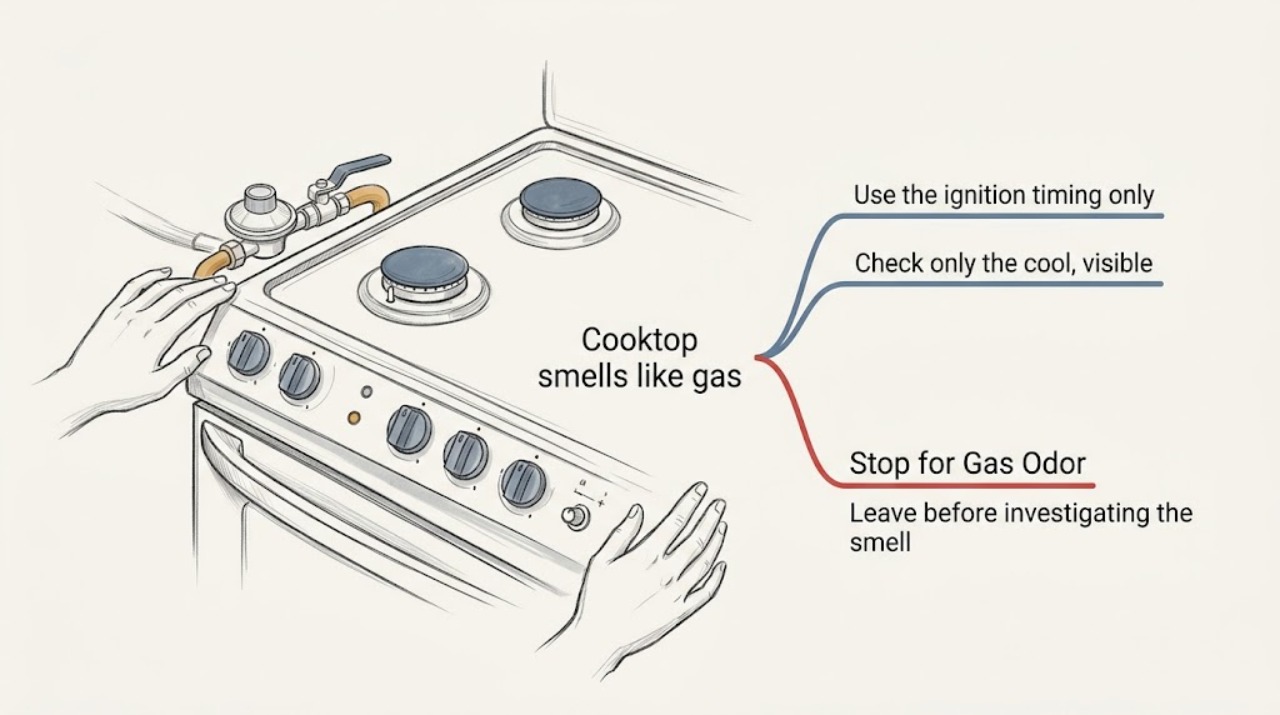
Work through in order
Diagnostic checks
Use only checks that match the exact appliance or system and its official guide.
-
Leave before investigating the smell
If you smell gas around the Thermador cooktop, especially if the smell is strong, persistent, returns after ignition, or comes with hissing, stop using the cooktop and leave the building with people and pets. Do not operate electrical switches, appliance controls, lights, fans, phones, matches, lighters, or vehicle ignition while in the odor area.
Expected result: From outside, note only safe facts you already observed: odor before ignition or after ignition, whether it persisted, any hissing, and whether the odor was near the cooktop or throughout the building. Do not go back in to confirm the location.
Next step: From a safe location, call 911 or the local gas utility's emergency service and explain that a gas odor is suspected at a Thermador cooktop. Follow their instructions and wait for an all-clear before returning.
Stop if: Do not re-enter, search for the leak, close or adjust a valve, unplug equipment, ring a doorbell, or try to extinguish a gas fire; wait for trained emergency or gas personnel.
Why this matters
Why: A suspected gas leak can ignite from a spark and cannot be safely localized by a homeowner. The smell pattern does not make it safe to re-enter or perform a burner test.
-
Use the ignition timing only as a service clue
After the gas utility or emergency professional has cleared the area, write down whether the odor was present before a burner was lit, lasted beyond the brief ignition period, returned between uses, or occurred with every burner; do not relight the cooktop to reproduce it.
Expected result: The record should say one of: odor before ignition, odor that continued after ignition, odor that returned when the cooktop was off, a brief odor that cleared, or timing unknown.
Next step: Give the timing record to the gas utility and qualified Thermador servicer. Keep the cooktop out of service until they determine why the odor occurred and explicitly clear it for use.
Stop if: Do not repeat ignition, hold a knob open to observe the flame, sniff a connection closely, or use a match, lighter, flame, leak detector, or homemade test while troubleshooting.
Why this matters
Why: Thermador says a smell for up to about four seconds after ignition may be normal, but a smell that does not disappear requires the gas supply and a service visit. A persistent or off-state odor cannot be classified as normal ignition odor.
-
Check only the cool, visible burner arrangement
Only after the area is declared safe and the cooktop is completely cool, verify visually that every knob is in OFF and that each burner cap is seated with its tabs aligned with the burner-base notches; do not open the cooktop or disturb gas connections.
Expected result: Record whether a knob was not fully off, a cap was visibly out of alignment, the caps and knobs appear normal, or the appliance is still warm or inaccessible.
Next step: If a cool cap is visibly misaligned, provide the model and photos to the qualified servicer or follow the exact owner guidance after the all-clear; if the odor returns or the arrangement looks normal, keep the cooktop off and request service.
Stop if: Do not adjust a regulator, remove burner bases, disconnect tubing, force a cap, open the appliance, or continue if any gas odor is present.
Why this matters
Why: Thermador identifies incomplete knob shutoff and misaligned caps as possible contributors, but a normal visual arrangement does not prove the appliance or supply is leak-free.
-
Prepare a safe handoff to the gas professional
Collect the cooktop model and installation information from paperwork or a location that can be accessed safely, plus the odor timing, affected burner if known, knob/cap observations, recent cleaning or installation work, and the all-clear or findings supplied by the gas utility.
Expected result: Confirm whether the odor was isolated to the cooktop, present elsewhere in the building, associated with a recent installation or service, or not safely attributable to one appliance.
Next step: Request an authorized Thermador service visit or another appropriately qualified gas-appliance professional. Tell them that the appliance has an unresolved gas-odor report and remains unused.
Stop if: Do not remove panels, test pressure, adjust the regulator, disconnect a flex connector, or perform combustion or leak testing yourself.
Why this matters
Why: The same symptom can involve the cooktop, its installation, the building supply, or another gas appliance. The record helps the professional choose the correct gas-supply and appliance-safety assessment without asking the homeowner to dismantle anything.
-
Return the cooktop to use only after qualified clearance
Keep the Thermador cooktop off until the gas utility or qualified gas-appliance professional has assessed the condition, completed any required repair, and told you that it is safe to use; do not treat a temporarily absent smell as a repair.
Expected result: The service record should identify what was inspected or repaired, whether the gas supply and appliance were cleared, and what operating restrictions or follow-up apply.
Next step: Follow the professional's written operating instructions and monitor only during normal use. If any gas odor, abnormal flame, hissing, or ignition problem returns, stop using the cooktop and repeat the emergency branch.
Stop if: Do not resume use after a self-made adjustment, a reset, or a successful relight alone; stop for any returning odor, unstable flame, damage, or concern about carbon monoxide or ventilation.
Why this matters
Why: A gas odor that fades can still have an intermittent or concealed cause. A qualified clearance is the decision boundary; a brief smell-free interval is not proof of safety.
Use your observations
Decision map
Find the observation that best matches what you see, then follow the next safe action.
-
PATH 01Safety boundary
What you see
The gas smell is strong or persistent, occurs while the cooktop is off, returns after ignition, or is accompanied by hissing.
Do this next
Leave immediately, keep away from ignition sources, and call 911 or the local gas utility from a safe location. Do not re-enter until trained personnel give an all-clear.
Why this path and its safety boundary
Why it matters: Treat this as a suspected gas leak or unsafe gas appliance condition, not as a burner-cap cleaning issue.
Safety stop: Do not touch switches, phones, appliance controls, valves, plugs, flames, or vehicles in the odor area.
-
PATH 02Safety boundary
What you see
A faint odor was noticed only at ignition and cleared within Thermador's stated brief ignition period, with no return, hissing, abnormal flame, or off-state odor.
Do this next
Do not reproduce the event. Record the timing and ask an authorized servicer if the odor is new, stronger than usual, or associated with any ignition or flame abnormality; keep the appliance off if uncertain.
Why this path and its safety boundary
Why it matters: Thermador says an odor for up to about four seconds after ignition may be normal, but this does not authorize repeated relighting or rule out a developing fault.
Safety stop: If the smell lasts longer, returns, or the timing is uncertain, use the suspected-leak branch and leave.
-
PATH 03Safety boundary
What you see
After an official all-clear, the cooktop is cool and a knob is not fully OFF or a burner cap is visibly misaligned.
Do this next
Do not operate the cooktop to test the change. Provide the observation and model information to a qualified servicer and follow only the instructions they give after the all-clear.
Why this path and its safety boundary
Why it matters: Thermador lists incomplete knob shutoff and cap misalignment as possible contributors, but the gas system still requires qualified clearance.
Safety stop: Stop for any returning odor, warm surface, resistance, damage, or need to remove parts or access gas connections.
-
PATH 04Safety boundary
What you see
After an all-clear, all knobs appear OFF and caps appear correctly seated, but the odor occurred or its source is uncertain.
Do this next
Keep the cooktop unused and request qualified gas-appliance service; report whether the odor was before ignition, after ignition, or present while off.
Why this path and its safety boundary
Why it matters: A visual check cannot establish that the regulator, valve, connection, building supply, or combustion system is safe.
Safety stop: Do not sniff closer, relight, open the appliance, adjust the regulator, or make an improvised leak test.
-
PATH 05Safety boundary
What you see
Anyone has symptoms, a carbon-monoxide alarm sounds, there is smoke/fire, or the flame/ventilation appears abnormal.
Do this next
Leave the building, call emergency services from outside, and do not return until responders or qualified professionals say it is safe.
Why this path and its safety boundary
Why it matters: This exceeds appliance troubleshooting and may be a life-safety emergency even if no gas smell is present.
Safety stop: Do not try to ventilate, relight, investigate, or extinguish a gas fire yourself.
Helpful context
Understand the symptom
A gas odor is an emergency branch first
Natural gas is odorized so a possible leak can be noticed, but smell alone cannot tell you whether the source is a burner, a connection, a regulator, the building supply, or another appliance. A strong or persistent odor, a hissing sound, or an odor that remains after a burner is turned off is not a prompt to keep testing. Leave by foot, keep away from flames and anything that could spark, and contact emergency responders or the local gas utility from a safe location. Never use a phone, light switch, fan, appliance control, garage opener, lighter, match, or vehicle ignition in the odor area.
The short-after-ignition exception does not justify repeated relighting
Thermador's support guidance distinguishes a gas odor lasting up to about four seconds after ignition from an odor that continues. That timing is context, not a test for a homeowner to repeat. If the smell lasts longer, returns between uses, is present before ignition, or you are unsure whether it cleared, treat it as unresolved gas odor: leave, call from outside, and do not use the cooktop until a qualified party clears it.
After the all-clear, make only the checks that do not disturb the gas system
If the gas utility or emergency professional has declared the area safe and the cooktop is completely cool, record whether every knob is in OFF and whether each burner cap sits with its tabs in the base notches. Thermador identifies incomplete knob shutoff and misaligned caps as possible contributors to a cooktop gas odor. This is a visual/restoration check only: do not remove gas tubing, adjust the regulator, open the appliance, or attempt a leak test with a flame or improvised solution. If an odor returns at any point, stop and leave again.
What a qualified service visit should establish
Give the technician the cooktop model if available, whether the odor was before ignition or after it, which burner was involved, whether all knobs were fully off, whether a cap was recently moved or cleaned, and what the gas utility or emergency responder observed. A qualified gas-appliance professional should determine whether the issue is in the appliance, its regulator or connection, the building gas supply, or combustion behavior. Thermador says that gas-appliance dismantling and repair should be performed by an officially qualified person. The article cannot establish a leak-free condition remotely, so do not resume use based on a smell disappearing for a few minutes.
When checks do not resolve it
Need a professional?
Safety scope: If gas is suspected, leave immediately and call 911 or the local gas utility from outside. Do not use flames, switches, phones, appliance controls, vehicles, or valves in the odor area. Do not dismantle the cooktop, adjust the regulator, test with a flame, or relight it to reproduce the odor.
Common questions
FAQ
Is it normal for a Thermador cooktop to smell like gas when it starts?
Thermador says a brief gas odor for up to about four seconds after ignition may be normal. Do not repeatedly relight the burner to time it. If the smell lasts longer, returns, occurs while the cooktop is off, or you are uncertain, leave and use the gas-emergency branch.
What should I do first when I smell gas near the cooktop?
Stop using the cooktop and leave the building with people and pets. Do not touch switches, appliance controls, phones, plugs, flames, or vehicle ignition in the odor area. From outside, call 911 or the local gas utility and wait for an all-clear.
Can I check the Thermador burner caps myself?
Only after the area has been cleared as safe and the cooktop is completely cool should you make a visual check that a cap is seated in its base notches. A visual check does not prove there is no leak. Do not open the appliance, adjust the regulator, disconnect gas tubing, or relight it as a test.
Should I turn off the main gas valve when I smell gas?
Do not return into an odor area or operate a valve as a DIY investigation. Leave first and follow the local gas utility or emergency responder's instructions about any shutoff. PHMSA warns against operating pipeline valves yourself; Thermador directs persistent cooktop odor to gas-supply and qualified service attention.
When can I use the cooktop again?
Do not use it because the smell temporarily disappeared. Keep it off until the gas utility or an appropriately qualified gas-appliance professional has assessed the condition, completed any repair, and told you it is safe to return to service. If the odor returns, leave again.
Read the exact guide
Official sources
- Guidelines for Cleaning Safely After a DisasterCenters for Disease Control and Prevention · CDC disaster-safety guidance; emergency responders and local gas utilities control incident-specific re-entry decisions.
- Gas Supply DisruptionsNew York City Emergency Management · New York City emergency guidance used here for general safety boundaries; local emergency and utility procedures vary.
- Gas Cooktops & Rangetops - TroubleshootingThermador · Thermador's official support guidance for its gas cooktops and rangetops; the exact appliance manual and local gas requirements also apply.
- Pipeline Leak Recognition and What to DoU.S. Department of Transportation, Pipeline and Hazardous Materials Safety Administration · PHMSA public gas-leak response guidance; local gas-utility and emergency instructions control a particular incident.
Community feedback
Share a repair observation
Share a plain-text repair observation. Accepted observations are published automatically; this page may take a moment to update.