
On this page
Start here
Quick answer
Treat a gas smell at a cooktop as a possible gas emergency, not a routine appliance fault. Do not light anything, operate electrical switches or phones in the area, or try to find the leak. If a control is immediately and safely reachable, leave it in the off position without lingering; otherwise leave at once. Get everyone outside, move to a safe location, and contact the gas emergency service or fire department from there. Do not re-enter or test the cooktop until qualified responders say it is safe.
Before you begin
Safety first
- This is an emergency-first gas-safety topic. Evacuate before troubleshooting, contact emergency or gas assistance from a safe location, and wait for qualified clearance. Never perform a flame test or use a phone or electrical switch in the odor area.
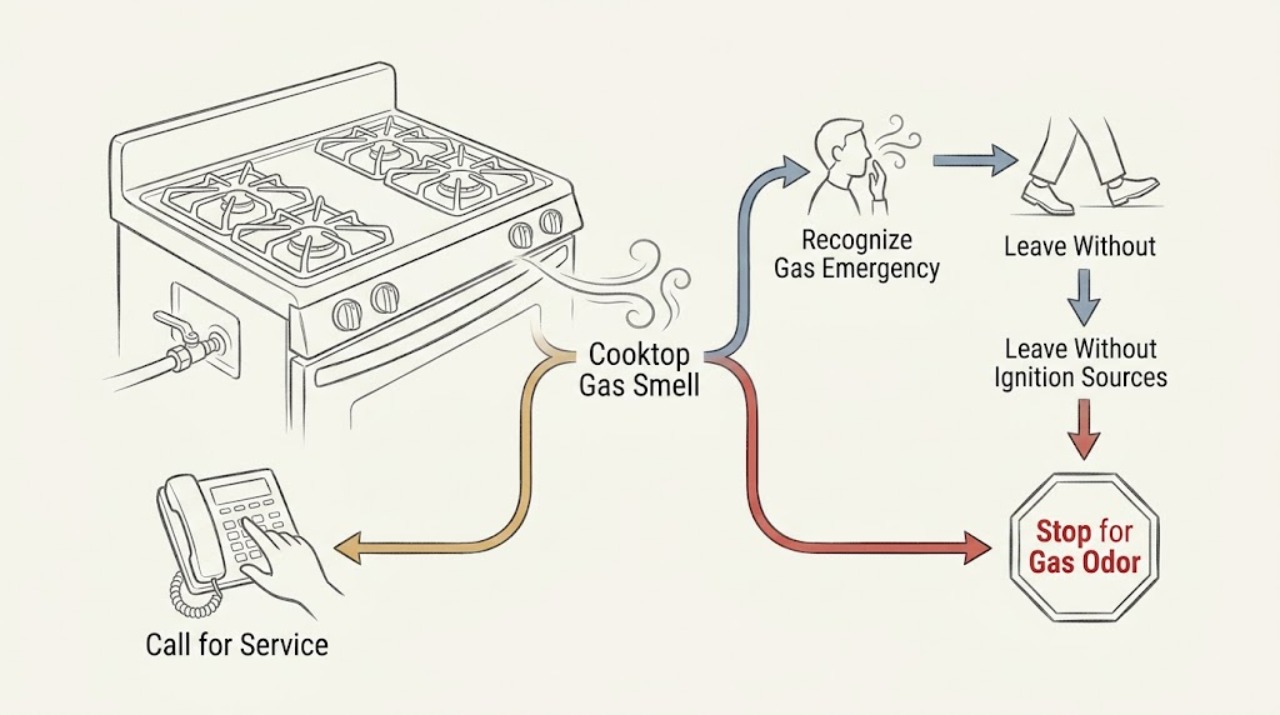
Work through in order
Diagnostic checks
Use only checks that match the exact appliance or system and its official guide.
-
Check 1
From where you are, note whether the odor resembles sulfur or rotten eggs, whether there is hissing or roaring, visible vapor, a flame where there should not be one, or a carbon-monoxide alarm or exposure symptom. Do not approach the cooktop to confirm the source.
Expected result: Any gas-like odor, hissing, vapor, unexpected flame, alarm, headache, dizziness, nausea, or breathing difficulty is present; or no warning is currently noticed.
Next step: If any warning is present, stop all appliance use and go outside immediately. If no warning is present but the original report remains unexplained, do not resume use until a qualified professional has assessed the cooktop.
Stop if: Stop immediately for a gas-like smell, hissing, visible vapor, unexpected flame, carbon-monoxide alarm, or symptoms of exposure.
Why this matters
Why: Any credible gas or combustion warning is sufficient to treat the situation as an emergency; the absence of a current smell does not prove that a leak is gone.
-
Check 2
Do not light matches, lighters, cigarettes, or burners; do not turn lights, fans, switches, garage controls, or other electrical equipment on or off; do not use a phone in the odor area. Warn others to leave only if doing so does not delay your exit.
Expected result: Everyone can leave without touching an ignition source, or someone is at immediate risk and needs emergency assistance.
Next step: Leave by the safest available route on foot, keep people away from the building, and move upwind or well away from the odor. From there, contact the gas emergency service or fire department.
Stop if: Do not return inside for belongings, do not start a vehicle in the affected area, and do not re-enter until responders give an all-clear.
Why this matters
Why: A small spark from a switch, phone, motor, flame, or plug can ignite accumulated gas. Evacuation speed and distance are more important than identifying the appliance fault.
-
Check 3
Only if a cooktop control is already directly within reach during your immediate exit, without searching, leaning over the appliance, or touching any electrical control, leave that control in the off position; otherwise do not approach the cooktop or attempt to shut a valve.
Expected result: The control was already safely reachable and is off, or reaching it would require moving toward the odor, using a switch, moving the appliance, or manipulating a gas valve.
Next step: In either case, leave immediately and report the suspected leak from a safe location. Do not test the cooktop after the control is off and do not attempt to locate the leak.
Stop if: Stop and evacuate if the control is not immediately reachable or if gas odor increases, a flame is abnormal, or anyone feels unwell.
Why this matters
Why: A nearby control may stop an obvious burner flow, but approaching a leak or operating a valve can increase exposure and delay evacuation. Public guidance prioritizes leaving and qualified response.
-
Check 4
Once outside or at another safe location, contact the local gas emergency service or fire department and describe the suspected cooktop gas odor, any hissing or flame, whether a carbon-monoxide alarm sounded, and any symptoms. Keep people away until responders arrive.
Expected result: Emergency or gas personnel are responding and have given instructions, or the odor was reported but no professional has cleared the appliance.
Next step: Follow responder instructions and do not re-enter or operate the cooktop until the area and appliance are declared safe. Arrange qualified appliance or gas service for the cooktop if directed.
Stop if: Do not return to inspect, relight, reset, ventilate with powered equipment, or use the cooktop before professional clearance.
Why this matters
Why: Only trained responders can assess the atmosphere, supply, connector, ventilation, and appliance safely. A fading odor or a control that is off is not an all-clear.
-
Check 5
Only after the gas utility or emergency responders declare the area safe, record the cooktop make, model, fuel type if known, the burner or area involved, whether the odor happened before ignition or during operation, and any visible damage without removing parts or moving the appliance.
Expected result: A professional found and corrected a supply or installation issue, the appliance was referred for service, or the cause remains unknown.
Next step: Follow the professional's repair or replacement direction and use the exact manual only for ordinary surface care after clearance. If the odor returns, treat it as a new emergency and evacuate again.
Stop if: Stop for any returning odor, hissing, abnormal flame, smoke, heat, or suspected carbon-monoxide exposure; do not perform a flame or leak test.
Why this matters
Why: A professional finding or unresolved recurrence is more useful than a homeowner leak test. Cooktop controls, regulators, connectors, burners, and ignition systems are model- and fuel-dependent.
-
Check 6
Before any future use, confirm that a qualified gas or appliance professional has assessed the cooktop and that the source was corrected; if the odor recurs or no qualified clearance exists, keep the appliance out of service.
Expected result: The cooktop has documented professional clearance and no odor returns, or the odor returns, the cause is unknown, or clearance has not occurred.
Next step: If clearance is absent or the odor returns, evacuate and report the emergency again. If clearance is documented, follow the professional's model- and fuel-specific operating instructions and stop at the first abnormal sign.
Stop if: Never relight, reconnect, move, disassemble, or operate the cooktop to see whether the odor returns.
Why this matters
Why: A recurring or unexplained gas smell is not a maintenance nuisance. Continuing to use the cooktop can expose occupants to fire, explosion, or combustion hazards.
Use your observations
Decision map
Find the observation that best matches what you see, then follow the next safe action.
-
PATH 01Next step
What you see
A gas-like odor, hissing or roaring, visible vapor, unexpected flame, or combustion warning is present.
Do this next
Do not troubleshoot. Leave immediately, avoid switches, flames, phones, and vehicles in the affected area, and contact gas emergency service or fire responders from a safe location.
-
PATH 02Next step
What you see
A carbon-monoxide alarm sounds or anyone has headache, dizziness, nausea, breathing difficulty, confusion, or loss of coordination.
Do this next
Leave and seek urgent emergency help from a safe location. Do not re-enter or use the cooktop because a CO hazard may exist without an odor.
-
PATH 03Next step
What you see
The odor has faded but no qualified responder has found and corrected the cause.
Do this next
Keep the cooktop out of service and arrange qualified gas or appliance assessment. Do not relight a burner, inspect a connector, or test for a leak.
-
PATH 04Next step
What you see
The smell returns after a professional assessment or after the appliance is used again.
Do this next
Treat it as a new gas emergency and evacuate again. Report the recurrence and do not operate the cooktop until responders provide a new clearance.
Helpful context
Understand the symptom
The first response is evacuation, not troubleshooting
A sulfur or rotten-egg odor, hissing, visible vapor, or an unexplained fuel smell around a cooktop can mean escaping gas. You cannot safely decide from smell strength whether a leak is small. Do not light a burner to identify the source, check fittings with a flame, or use an electrical appliance to improve visibility. Leave people and pets, avoid creating sparks, and report the suspected leak from outside or another safe location.
Do not search behind the cooktop
Do not move the appliance, remove a burner, lift a cooktop, loosen a connector, operate a gas meter valve, or apply a leak-testing liquid. The CPSC warns that moving an appliance can damage an older connector, and the Department of Transportation says the public should not try to locate a leak or operate pipeline valves. These are qualified-professional tasks after the area has been declared safe.
A smell that disappears still needs attention
Gas odor can fade as gas disperses; that does not prove the cooktop is safe. If emergency responders or the gas utility clear the area, identify the cooktop's exact make and model before any later inspection. Different appliances may use natural gas or propane and may have different controls, ignition systems, and installation arrangements. Do not relight a pilot or restart a burner unless the responsible professional or the exact manual provides a safe, model-appropriate procedure after the hazard is cleared.
Carbon monoxide is a separate warning
A gas appliance can create a carbon-monoxide concern even when there is no odor. Carbon monoxide is colorless and odorless; headache, fatigue, nausea, dizziness, shortness of breath, confusion, or loss of coordination are reasons to leave and seek urgent help. Never use a gas range or cooktop as a heater. A carbon-monoxide alarm should be treated as a real warning, not as a reason to keep testing the appliance.
What information is safe to provide
From a safe location, tell the gas emergency service or fire department that the odor was noticed at a cooktop, whether anyone heard hissing or saw a flame, whether a carbon-monoxide alarm sounded, and whether anyone has symptoms. After the area is cleared, give a qualified appliance or gas professional the make, model, fuel type if known, location of the smell, and what was happening immediately beforehand. Do not try to diagnose the leak yourself.
Safety boundary
Stop conditions
- Stop and evacuate for any gas-like odor, hissing, visible vapor, unexpected flame, smoke, or carbon-monoxide alarm or symptoms.
- Do not use phones, switches, lights, fans, matches, lighters, vehicles, or other ignition sources in the affected area.
- Do not search for the leak, move the cooktop, operate a gas valve, remove parts, relight a burner, or re-enter before professional clearance.
When checks do not resolve it
Need a professional?
Contact the gas emergency service or fire department immediately from a safe location for any suspected gas leak, odor, hissing, unexpected flame, or carbon-monoxide warning. After emergency clearance, use a qualified gas or appliance professional for the cooktop; do not attempt leak finding, connector work, valve work, or internal repair.
Common questions
FAQ
What should I do first if my cooktop smells like gas?
Do not light anything or operate switches or phones in the area. Leave immediately, move to a safe location, and contact the gas emergency service or fire department from there.
Can I use a flame to find where the cooktop leak is?
Never. Do not use a flame, leak-finding test, or electrical device to locate a suspected gas leak. Leave and let qualified responders assess it.
Should I turn off the cooktop knob when I smell gas?
Only leave a control off if it is already immediately and safely reachable during your exit; do not approach the odor, search for a valve, or delay evacuation. Report the suspected leak from a safe location.
The smell went away. Can I use the cooktop now?
No. A fading odor is not proof that the source is corrected. Keep the cooktop out of service until qualified responders or a gas or appliance professional has assessed and cleared it.
Can a carbon-monoxide alarm matter if I do not smell gas?
Yes. Carbon monoxide is odorless and colorless. Leave for an alarm or symptoms such as headache, dizziness, nausea, or breathing difficulty, and seek urgent help from a safe location.
Read the exact guide
Official sources
- Certain Older Gas Connectors May Be DangerousU.S. Consumer Product Safety Commission · Gas-appliance connector safety and suspected gas-leak response
- Protect Your Family from Carbon Monoxide PoisoningU.S. Consumer Product Safety Commission · Carbon-monoxide hazards, symptoms, alarms, and gas-appliance safety
- Pipeline Leak Recognition and What to DoU.S. Department of Transportation Pipeline and Hazardous Materials Safety Administration · Recognizing gaseous odors and safe response to suspected gas leaks
Community feedback
Share a repair observation
Share a plain-text repair observation. Accepted observations are published automatically; this page may take a moment to update.