
On this page
Start here
Quick answer
A Miele cooktop frame can become hot during long cooking, high power, large cookware, or use of several zones without indicating a fault. A zone that reduces power or switches off, an E2 or FE44 message, or repeated shutdown after the surface has cooled is different: Miele identifies empty cookware, high-power fat or oil, blocked underside ventilation, unsuitable induction cookware, and a hot zone restarted after a power outage as possible overheat triggers. Stop heating, keep hands away until the surface is safe, remove only an obvious ventilation obstruction below the cooktop, and use cookware suited to the exact model. If overheat protection returns after the cause is removed, the fan is blocked internally, the cooktop will not cool or restart, or there is smoke, burning odor, cracked glass, or electrical damage, stop using it and arrange qualified Miele service.
Before you begin
Safety first
- Stop using the cooktop for smoke, burning odor, sparking, cracked glass, visible electrical damage, or repeated supply trips. Keep hands away from hot surfaces and do not remove covers or bypass thermal or safety controls.
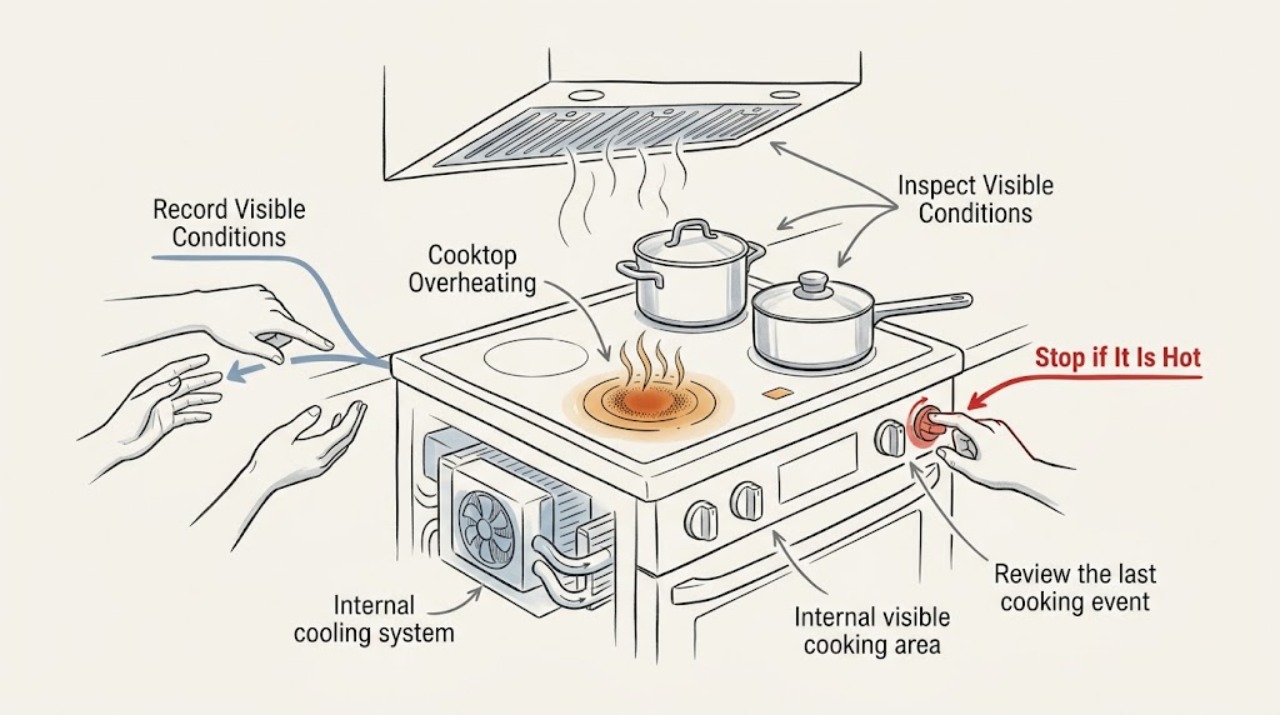
Work through in order
Diagnostic checks
Use only checks that match the exact appliance or system and its official guide.
-
Check 1
Record what is hot and what the controls are doing: the frame only, the glass around one zone, the cookware, or the underside area. Note whether power is being reduced, a zone switches off, the whole cooktop switches off, a cooling fan runs, or a code such as E2 or FE44 appears.
Expected result: Only the frame is hot with normal control operation; one zone has reduced or stopped; the whole cooktop has stopped; or a fault code is displayed.
Next step: Use the normal-heat branch to review cookware and cooking intensity. Use the protection branch to stop heating, let the cooktop cool safely, and continue only with external checks.
Why this matters
Why: Miele describes a hot frame under intensive use as potentially normal. Power reduction, automatic shutdown, or an E2 or FE44 indication is consistent with overheat protection and changes the priority to cooling and cause removal.
-
Check 2
Turn the affected zone and cooktop off using the normal controls and move people away from the hot surface. Leave the cookware in place until it can be handled safely, and do not cover the glass or touch it to test its temperature. Observe whether the residual heat indication or protection message clears after a complete cool-down.
Expected result: The indication clears and normal operation returns after cooling; the cooktop remains disabled; or the surface, controls, or cookware shows smoke, scorching, cracking, or other damage.
Next step: If it recovers, continue to the cookware and ventilation checks before using high power again. If it does not recover or damage is present, stop using the cooktop and arrange qualified service.
Why this matters
Why: Miele says affected zones can be used again once the temperature has fallen to a safe level. Failure to recover after cooling, or visible heat damage, is no longer an ordinary one-time response and needs service evaluation.
-
Check 3
Review the last cooking event. For an induction model, check whether a pan was empty, whether fat or oil was heated at a high power level, and whether the cookware is suitable and centered on the zone. Use the model manual for cookware requirements; where the manual permits, a magnet that sticks to the base is Miele's general suitability check for induction cookware.
Expected result: The pan was empty, oil or fat was heated intensely, the pan is unsuitable or too small for induction, or the cookware and heat level were appropriate.
Next step: After the cooktop is cool, use a suitable pan with a moderate setting and monitor one zone. If protection returns with suitable cookware and ordinary use, stop testing and request service.
Why this matters
Why: Miele lists empty cookware, high-power fat or oil, and unsuitable cookware as overheat or detection triggers. Correct cookware and a lower, appropriate setting reduce the chance that the protection mechanism is being repeatedly triggered; they do not prove an internal fault is absent.
-
Check 4
With the cooktop cool and not being used, inspect the accessible space below it. Remove objects in a drawer that block the documented air path and clear visible dust or storage items near an intake or fan opening. Do not remove the cooktop, reach into the fan, or alter the installation clearance.
Expected result: A drawer or stored item blocks the underside; visible dust obstructs an accessible opening; the underside is clear; or the fan is noisy, silent when it should run, or repeatedly reports a blocked condition.
Next step: Restore only the clearance described by the exact installation instructions and run one supervised, moderate-use test after cooling. If the fan remains abnormal or overheat protection returns, stop using the cooktop and call service.
Why this matters
Why: Miele identifies insufficient underside ventilation and a blocked fan as overheat causes. Clearing an obvious external obstruction can restore cooling, while a recurring blocked-fan message or abnormal fan behavior can indicate an internal cooling-system fault.
-
Check 5
Check whether the event followed a power outage or interruption. Do not immediately restart a still-hot zone. After the surface and cookware are safe, restore operation through the model's normal controls and observe whether the same zone or the whole cooktop overheats again during ordinary use.
Expected result: The event occurred immediately after power returned; the cooktop operates normally after cooling; or the same protection response returns without an empty pan, high-power oil, unsuitable cookware, or blocked ventilation.
Next step: Use only a normal, moderate setting for one test if the model manual allows it. If the protection repeats, do not keep resetting or cycling the cooktop; arrange qualified service.
Why this matters
Why: Miele lists turning a hot cooking zone back on after a power outage as a possible overheat trigger. A single recovery after cooling supports that explanation. Recurrence after the stated external causes are removed points to a cooling, sensor, control, or power-electronics issue that requires diagnosis.
-
Check 6
If the display remains unavailable after cooling, check the model manual for the exact fault meaning and record the code, affected zones, cookware, power setting, and whether the fan or ventilation path was clear. If the model-specific instructions permit a controlled electrical reset, have it performed only through the appropriate household disconnect; do not access the cooktop wiring or remove covers.
Expected result: The cooktop restarts and remains stable; a fault code returns; the breaker or residual-current device trips; or the cooktop stays unavailable.
Next step: If the fault returns, the supply device trips, or the cooktop remains unavailable, stop using it and provide the model number and recorded observations to Miele Service or a qualified electrician.
Why this matters
Why: Miele's support guidance allows a controlled supply interruption for a technical fault, but a returning fault or protection-device trip indicates that the appliance needs professional diagnosis. A restart alone does not establish that an overheating component is repaired.
Use your observations
Decision map
Find the observation that best matches what you see, then follow the next safe action.
-
PATH 01Next step
What you see
Only the frame is hot after prolonged use, high power, large cookware, or several zones, with no protection message
Do this next
Treat the temperature as potentially normal, reduce intensity or use smaller flat cookware where practical, and follow the model manual.
-
PATH 02Next step
What you see
A zone reduces power or shuts off, or E2 or FE44 appears
Do this next
Stop heating and allow the cooktop to cool. Check empty cookware, high-power oil, induction cookware suitability, and underside ventilation before one moderate test.
-
PATH 03Next step
What you see
A drawer, stored item, dust, or other object blocks the underside air path
Do this next
Remove only the accessible obstruction and restore the model-specified clearance. If the fan or protection fault returns, arrange service.
-
PATH 04Next step
What you see
The cooktop overheats again after suitable cookware, ordinary settings, cooling, and clear ventilation
Do this next
Stop using the cooktop and request qualified Miele service for the cooling system, sensor, control, or power electronics.
-
PATH 05Next step
What you see
There is smoke, burning odor, cracked glass, visible electrical damage, or a repeated breaker or residual-current trip
Do this next
Stop immediately, keep clear of the appliance, and arrange qualified service or electrical help; do not continue reset attempts.
Helpful context
Understand the symptom
A hot frame is not the same as an overheating fault
Miele says the frame temperature depends on operating time, power level, cookware size, and the number of cooking zones in use. That heat can be normal. Treat the situation as overheat protection when a zone reduces power or shuts off, the display shows a documented fault such as E2 or FE44, or the cooktop repeatedly disables itself after the heat source and cookware conditions have been corrected.
Identify the cooktop type before changing cookware
The E2 and FE44 guidance applies to Miele induction cooktops. An electric or gas model can have different controls, safety devices, and failure modes. Find the model number and use its operating instructions for cookware, ventilation clearance, lock controls, and service access; do not assume an induction fault code or remedy applies to every Miele cooktop.
Safety boundary
Stop conditions
- Stop using the cooktop for smoke, a burning odor, sparking, cracked or shattered glass, melted controls, visible wiring damage, or a repeated breaker or residual-current trip.
- Do not touch a hot surface to test it, move hot cookware without safe handling, pour water onto hot glass, or cover the cooktop while it is hot.
- Do not remove the cooktop, open the control or power electronics, reach into a fan, alter ventilation clearances, or work on live wiring as a user check.
- If overheat protection returns after the external cause is removed, or the cooktop will not cool and restart normally, stop repeated resets and arrange qualified Miele service.
Only after diagnosis
Potential parts
- cooling fan or airflow component
Only consider this part class if the underside is clear but a technician confirms that a fan or airflow component is blocked or not operating and is causing repeat overheat protection.
Confirm the exact Miele model and diagnosed fan assembly before ordering; do not access the fan through the cooktop yourself. - temperature sensor or thermal protection component
Only consider this class after a qualified diagnosis confirms repeated protection with suitable cookware, appropriate power, and clear ventilation.
Confirm the exact model and approved component from Miele service documentation; an overheat code alone does not prove sensor failure. - induction power module or control board
Only consider this class if a technician isolates the electronics or control as the source of repeat overheat shutdowns after external causes are removed.
Confirm the exact model, electrical configuration, and technician diagnosis before any part decision.
When checks do not resolve it
Need a professional?
Call qualified Miele service when an E2 or FE44 condition returns after cooling and the cookware and ventilation checks, the fan remains blocked or abnormal, the cooktop stays disabled, a fault code returns, the protection device trips, or heat damage is visible. Contact a qualified electrician when the cooktop has no supply or its household protection device repeatedly trips.
Safety scope: Stop using the cooktop for smoke, burning odor, sparking, cracked glass, visible electrical damage, or repeated supply trips. Keep hands away from hot surfaces and do not remove covers or bypass thermal or safety controls.
Have this ready
- Miele model number and cooktop type
- whether the frame, one zone, or the whole cooktop became hot
- exact display code, if any
- cookware material, size, and whether it was empty
- power setting and duration before shutdown
- whether oil or fat was heated at high power
- whether the underside ventilation path was clear
- whether the event followed a power outage and whether a breaker or residual-current device tripped
Common questions
FAQ
Is a hot Miele cooktop frame always a fault?
No. Miele says frame heat can be normal after long operation, high power, large cookware, or several zones in use. A zone reducing power, switching off, or showing an overheat code is a different condition and should be allowed to cool before further checks.
What causes a Miele induction cooktop to overheat?
Miele lists empty cookware, heating fat or oil at high power, insufficient underside ventilation, unsuitable induction cookware, and restarting a hot zone after a power outage. Correct only the external cause that you can identify safely, then stop if protection returns.
What does E2 or FE44 mean on a Miele cooktop?
Miele's support pages associate E2 and FE44 with overheat protection or an overheated induction cooktop. Let it cool, check cookware and accessible underside ventilation, and contact Miele Service if the indication persists or returns.
Can I keep using a Miele cooktop if it overheats repeatedly?
No. If the overheat protection triggers again after suitable cookware, ordinary settings, cooling, and clear ventilation, Miele directs you to service. Do not remove the cooktop or open its electrical components to investigate.
Read the exact guide
Official sources
- Fault FE44 appears on the display of an induction cooktop cooking zone.Miele USA · Official Miele USA support guidance for induction cooktops displaying FE44; cookware and display behavior are model-specific.
- Cooktop or cooking zones cannot be switched on.Miele USA · Official Miele USA support guidance for cooktops or zones that cannot be switched on.
- E2 flashes in the cooking zone displays.Miele USA · Official Miele USA support guidance for induction cooktops displaying E2; exact model behavior may vary.
- Cooktop frame gets hotMiele USA · Official Miele USA guidance for cooktop frames that become hot during use; it does not diagnose a particular model's internal fault.
Community feedback
Share a repair observation
Share a plain-text repair observation. Accepted observations are published automatically; this page may take a moment to update.