
On this page
Start here
Quick answer
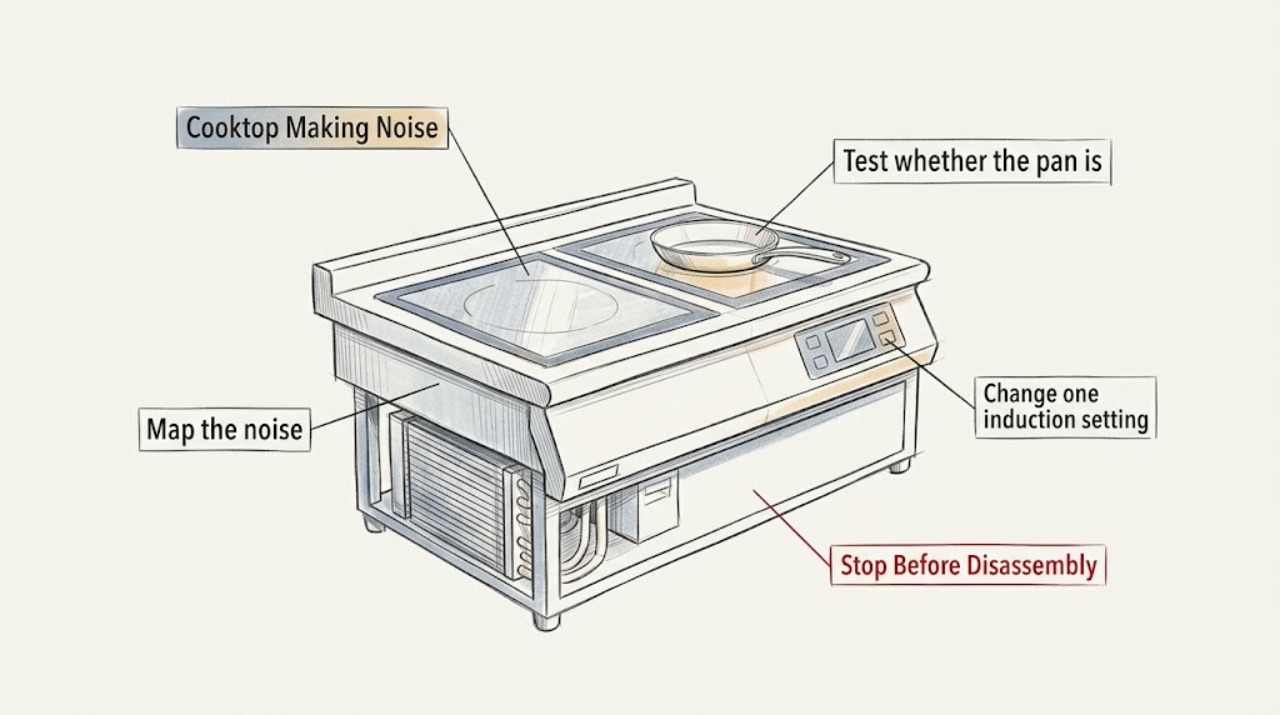
A Miele cooktop can make normal buzzing, crackling, whistling, or clicking sounds during induction cooking because of the cookware, power level, or electronic switching. A cooling fan may hum during intensive use and may continue after the cooktop is switched off until it cools. First identify whether the noise follows a pan, a high power setting, pan recognition, or the cooling fan. Stop using the cooktop for smoke, burning smell, visible damage, liquid inside the appliance, repeated electrical trips, or a harsh noise that remains with suitable cookware and normal operation, then arrange qualified service.
Work through in order
Diagnostic checks
Use only checks that match the exact appliance or system and its official guide.
-
Map the noise to the cooktop state
With the surface clear and safe to operate, note whether the sound occurs only while a zone is heating, only with a pan present, during several zones at once, or after all controls are off. Record whether the cooking zone still heats normally and whether the sound comes from the cookware or below the glass.
Expected result: A sound that follows a pan or power setting is more consistent with induction cookware behavior. A hum from below the cooktop during intensive use or after switch-off can be the cooling fan. A harsh sound independent of use needs escalation.
Next step: If the sound follows cookware or power, continue with the pan checks. If it follows heat and continues briefly after switch-off, check ventilation and cooling-fan conditions. If it is harsh, accompanied by a fault symptom, or present when cool and idle, stop and arrange service.
Why this matters
Why: Timing and location are more useful than a recording of volume because Miele documents several normal sound mechanisms with different triggers.
-
Test whether the pan is the sound source
For an induction model, turn the zone off, allow the pan to cool enough to handle, and repeat the same cooking setting with a different induction-suitable pan of a different construction. Do not heat an empty pan and do not slide cookware across the glass.
Expected result: If the buzz, crackle, whistle, or vibration changes or disappears with the other pan, the cookware base is the likely source. If the same sound remains with different suitable pans, the cooktop or installation needs the next check.
Next step: Use the quieter suitable pan if it meets the model's instructions. If the noise does not follow cookware, continue to the power-level and linked-zone checks rather than ordering a cooktop part.
Why this matters
Why: Miele attributes several induction noises to cookware material, layered bases, or imperfectly joined layers and states that changing cookware can avoid them.
-
Change one induction setting at a time
If the sound is a buzz or whistle, reduce the zone power one step and, if relevant, use only one linked cooking zone at a time. Keep the pan centered and use the exact control method in the operating instructions; do not change hidden programming settings just to suppress a noise.
Expected result: A buzz that decreases or stops at a lower power level supports a normal high-power cookware interaction. A whistle that occurs only when connected zones are used together supports the same explanation. A noise unaffected by these changes is not identified by this test.
Next step: Continue cooking only if the surface, pan, and power response remain normal. If the noise is loud, new, or joined by heat loss, display errors, or visible damage, turn the appliance off and arrange service.
Why this matters
Why: Miele specifically describes high-power buzzing and linked-zone whistling as possible induction behavior, so a power-dependent change is a useful result rather than evidence of a failed motor.
-
Check for normal pan-recognition clicking
If the sound is a repeated click immediately after the cooktop is turned on and it comes from zones where cookware is placed, compare it with the model's support page or operating instructions. Do not enter customer programming mode unless the exact manual identifies that feature and you understand the effect on pan recognition.
Expected result: On supported Miele models, continuous clicking can be produced by pan recognition and is described as normal. If clicking occurs with no pan, continues with controls off, or is joined by an error or heat problem, it is not explained by this check.
Next step: Leave the setting unchanged unless the exact manual supports a deliberate change. For unexplained clicking or clicking with a fault symptom, turn the cooktop off and schedule qualified service.
Why this matters
Why: Pan-recognition settings vary by model. Disabling the feature can change how cookware is detected and how zone displays appear, so noise reduction is not automatically a repair.
-
Distinguish cooling-fan noise after use
After a high-power or prolonged cooking session, turn the zones off and listen from a safe distance without blocking vents or reaching under the appliance. Check only that the area below the cooktop is not packed with stored items and that the model's required ventilation path has not been obstructed; do not remove the drawer or underside cover if doing so exposes wiring.
Expected result: A steady hum or whir that starts during intensive use and stops after the appliance cools can be the cooling fan. Miele says the fan may continue to run after switch-off and can restart briefly while residual heat remains.
Next step: Allow normal cooling and keep ventilation clear. If the fan is harsh, obstructed, never stops while cool, or the cooktop reports a fault, switch it off and arrange service.
Why this matters
Why: A post-use fan sound is a protective cooling function, not by itself a fan failure. A scraping, grinding, intermittent stall, or fan noise while the appliance is cool is different.
-
Escalate a noise with a performance or safety change
Write down the model, noise type, zone used, cookware, power level, whether the sound continues after switch-off, and any display or heating symptom. Turn the appliance off and keep it unused if there is smoke, burning smell, liquid ingress, visible cracking, repeated electrical trips, or an abnormal gas symptom.
Expected result: A persistent mechanical sound, a cooling fan that scrapes or stalls, power loss, overheating, error indication, cracked glass, or any gas or electrical hazard remains after the non-invasive checks.
Next step: Arrange qualified Miele appliance service or the appropriate electrician or gas professional. Do not open the cooktop or continue repeated power cycles to see whether the sound changes.
Why this matters
Why: These signs can involve the fan, electronics, installation ventilation, glass, wiring, or a gas system. A generic noise description cannot establish the failed component safely.
Use your observations
Decision map
Find the observation that best matches what you see, then follow the next safe action.
-
PATH 01Safety boundary
What you see
The noise changes or disappears when a different suitable induction pan is used.
Do this next
Do not replace the cooktop solely because one pan buzzes, crackles, whistles, or vibrates.
Why this path and its safety boundary
Safety stop: Continue with the power, linked-zone, and cooling-fan checks.
-
PATH 02Safety boundary
What you see
The buzz decreases when the induction power level is reduced.
Do this next
Escalate if the noise is harsh, new, or accompanied by poor heating or a fault display.
Why this path and its safety boundary
Safety stop: A noise independent of power needs further observation and may need service if persistent.
-
PATH 03Safety boundary
What you see
Clicking begins when a supported cooktop recognizes cookware and stops or changes when the cookware is removed.
Do this next
A click with no pan, controls off, or a fault indication should be assessed by service.
Why this path and its safety boundary
Safety stop: Do not attribute clicking to pan recognition; investigate cooling, controls, or service symptoms.
-
PATH 04Safety boundary
What you see
A hum or whir starts during intensive cooking and continues briefly after switch-off while the surface cools.
Do this next
Arrange service if the fan is mechanically noisy, airflow is obstructed, or a fault appears.
Why this path and its safety boundary
Safety stop: A scrape, grind, stall, or noise while cool is not explained by normal fan cooling.
-
PATH 05Safety boundary
What you see
There is a gas odor, flame outside the burner area, smoke, burning smell, or visible fire damage.
Do this next
Do not relight, disassemble, or repeatedly power-cycle the appliance after a safety event.
Why this path and its safety boundary
Safety stop: Continue only with the non-invasive checks for the noise type.
-
PATH 06Safety boundary
What you see
The noise is accompanied by loss of heating, a fault display, repeated electrical trips, cracked glass, or overheating.
Do this next
A persistent unexplained noise still merits service even if the cooktop currently heats.
Why this path and its safety boundary
Safety stop: Monitor a documented cookware or cooling-fan sound after the safe checks.
Helpful context
Understand the symptom
Do not diagnose a cooktop by loudness alone. Note whether the sound comes from the pan, the underside of the cooktop, or the control area; whether it changes when power is reduced or cookware is changed; and whether it continues after switch-off. Miele's published noise guidance is primarily for induction models, so use the operating instructions for the exact model if yours is gas, radiant, or a ventilation-integrated design.
Safety boundary
Turn all controls off and let the surface cool before cleaning or moving cookware. If you smell gas, see a flame outside the burner area, notice smoke or a burning smell, see liquid inside the appliance, or a breaker trips repeatedly, stop using it and leave electrical or gas work to a qualified professional. Do not remove the glass, underside cover, fan, wiring, or induction components to chase a noise.
Safety boundary
Stop conditions
- Stop immediately for gas odor, flame outside the normal burner area, smoke, burning smell, visible fire damage, or suspected gas or electrical fault.
- Stop using the cooktop for cracked glass, liquid inside the appliance, repeated breaker trips, an error indication with overheating, or a fan that scrapes or stalls.
- Do not remove the glass, fan, underside cover, wiring, electronics, gas components, or induction parts to investigate a noise.
- Do not heat an empty pan, block ventilation, or change model programming without the exact operating instructions.
Only after diagnosis
Potential parts
- cooling fan assembly
Only consider this category if a technician confirms a mechanical fan fault after verifying that normal post-use cooling and ventilation are not the explanation.
Confirm the complete Miele model and installation configuration before any part decision; no generic fit is implied. - induction power or control module
Only consider this category after a qualified technician isolates an electronic fault associated with a persistent noise or performance symptom.
Do not infer module failure from cookware buzzing or a normal cooling hum; exact model fit and diagnosis are required. - cooktop glass or mounting component
Only consider this category when visible glass or mounting damage is confirmed and replacement is judged appropriate for the exact model.
Glass and mounting parts are model-specific and require qualified installation; do not operate cracked glass.
When checks do not resolve it
Need a professional?
Arrange qualified service for a persistent or worsening noise that does not follow cookware or normal cooling, any scraping or grinding fan sound, a fault display, poor heating, overheating, damaged glass, repeated electrical trips, or a gas or burning symptom. An electrician or gas professional should handle supply, wiring, or gas concerns rather than a general cooktop user.
Common questions
FAQ
Is a buzzing sound from a Miele induction cooktop normal?
It can be. Miele says some cookware can buzz at higher power levels, and the noise may reduce or stop when power is reduced. Try a different suitable pan; arrange service if the noise is harsh, persists without cookware, or comes with poor heating or a fault.
Why does my Miele cooktop hum after I turn it off?
The cooling fan may continue to run until the cooktop has cooled and can briefly restart while residual heat remains. Keep the ventilation path clear and seek service for scraping, grinding, stalling, or a fan that remains noisy when cool.
Why does my Miele induction cooktop crackle or whistle?
Cookware with layered or differently constructed bases can crackle, and linked cooking zones with certain pans can whistle. Reduce power or try a different suitable pan; escalate if the noise is independent of cookware or is joined by a fault.
Is continuous clicking from a Miele cooktop a fault?
On supported models, clicking can be a normal pan-recognition function or electronic switching sound. It should not be assumed normal if it occurs with no cookware, after controls are off, or together with loss of heating, an error, smoke, or burning smell.
Read the exact guide
Official sources
- Noise during pan recognition (KMDA 7774)Miele USA · Miele cooktop pan-recognition support
- Noises coming from induction cooktop during cookingMiele USA · Miele induction cooktop noise support
- Induction cooktop buzzes during useMiele USA · Miele induction cookware buzzing support
- Cooling fan operating after switch-offMiele USA · Miele cooktop cooling-fan support
- Gas smell after cooktop was usedMiele USA · Miele gas cooktop odor support
- Power drops of its own accordMiele USA · Miele cooktop overheating and power behavior support
- Fault FE 47Miele USA · Miele induction cooktop ventilation and fan fault support
- Induction Cooktop KM5778 Operating InstructionsMiele USA · Miele induction cooktop operating and safety guidance
Community feedback
Share a repair observation
Share a plain-text repair observation. Accepted observations are published automatically; this page may take a moment to update.