
On this page
Start here
Quick answer
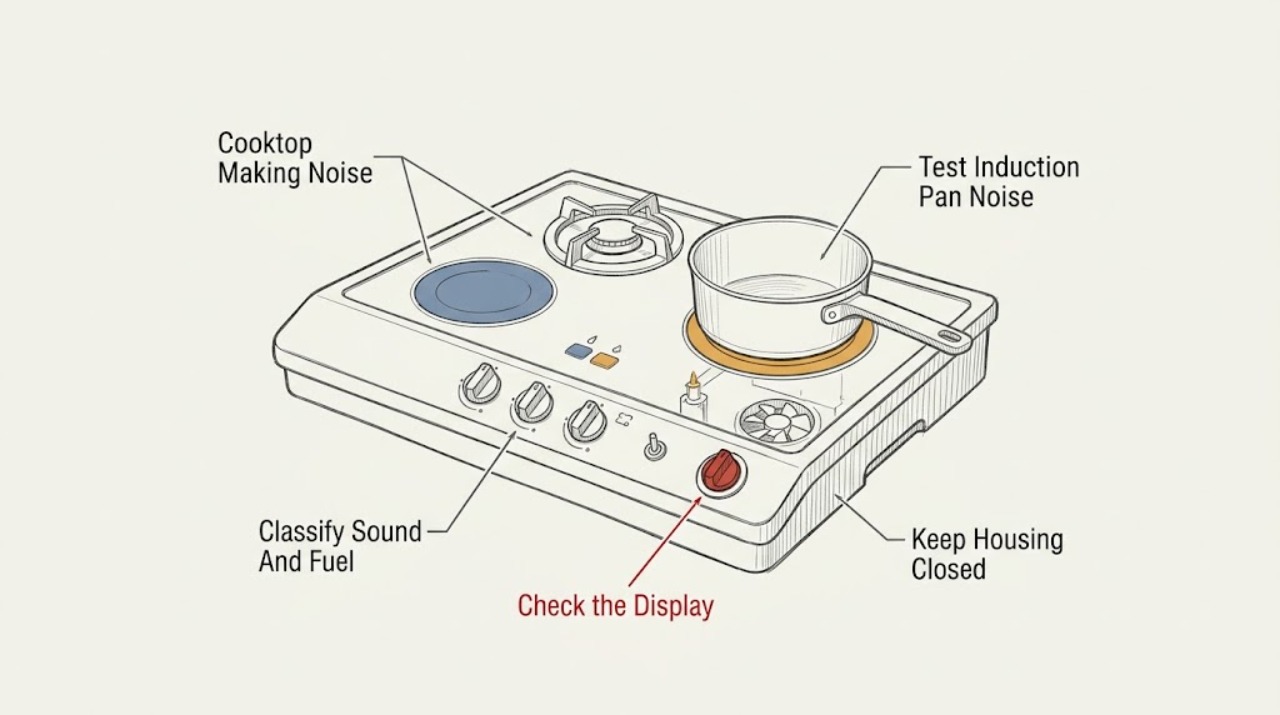
First identify whether the Frigidaire cooktop is induction, electric radiant, or gas, then note whether the sound follows the pan, a burner ignition attempt, a cooling cycle, or a particular control. Frigidaire says induction cookware can hum or buzz, controls can click while regulating temperature, temperature changes can cause expansion sounds, and fans can run to cool the appliance; those sounds are normally part of operation. On a gas cooktop, a recently cleaned or uneven burner can have moisture, a mis-seated cap, or clogged ports, so stop the burner, let it cool, and inspect only the visible cap and ports as the model instructions allow. Stop using the cooktop and arrange qualified service for a new loud electrical buzz, scraping or grinding, repeated sparking or clicking after the control is off, an abnormal flame, gas odor, smoke, visible damage, a tripped breaker, or a sound that remains after the safe checks.
Before you begin
Safety first
- Do not remove the glass, open the control area, probe live wiring, adjust gas pressure, disconnect gas tubing, or continue operating through gas odor, smoke, arcing, unstable flame, or overheating.
Work through in order
Diagnostic checks
Use only checks that match the exact appliance or system and its official guide.
-
Check 1
With all controls off and the cooktop cool enough to approach safely, identify the cooktop type from its controls, visible burners, or model documentation, then listen from a safe distance and record whether the sound occurs only while heating, only after heating, during ignition, or while completely idle.
Expected result: Classify the sound as a pan-dependent hum or buzz, a brief control click, a fan-like airflow after heating, gas ignition clicking, rattling or scraping, or an unexplained sound that continues with every control off.
Next step: Follow the matching pan, induction, gas, or stop-use branch below; consult the exact model manual before changing settings or removing any component.
Stop if: Stop immediately for gas odor, smoke, visible arcing, a hot or damaged control, exposed wiring, a breaker trip, or any sound accompanied by loss of safe flame or heating.
Why this matters
Why: A pan-dependent induction sound or a cooling/control sound has a plausible normal-operation path. Gas ignition noise needs a burner and flame check. A fixed, harsh, idle, or newly intensified noise is not explained by the normal induction guidance and should move toward service.
-
Check 2
If the cooktop is induction, with a suitable pan already in use and no safety symptom, change only one ordinary cooking variable at a time: compare the sound with the pan centered, with a different compatible pan if available, and at a lower power setting; do not slide rough cookware across the glass.
Expected result: Note whether the hum or buzz stops when the pan is removed, changes with the pan, becomes quieter at lower power, or remains equally loud from the cooktop body with no pan present.
Next step: Use the pan or setting that the manual permits if the sound is mild and operation is otherwise normal; arrange service if the sound is loud, new, body-mounted, or paired with a fault.
Stop if: Do not open the cooktop, probe live terminals, remove the glass, or continue operating when there is smoke, burning odor, arcing, cracked glass, or a breaker trip.
Why this matters
Why: A sound that follows the pan or quiets as power is reduced is consistent with Frigidaire's explanation that cookware can hum or buzz during induction cooking. A sound that persists with no pan, is harsh or scraping, or is accompanied by heating failure is not established as normal by that observation.
-
Check 3
For an induction or electronic cooktop, note whether the sound is a brief click during power regulation or a smooth fan-like sound that begins during or after heating; let the appliance complete its normal cool-down without blocking its ventilation or touching hot surfaces.
Expected result: Record whether the click or fan starts and stops with a heating cycle, whether it fades as the appliance cools, and whether the sound changes into rattling, scraping, grinding, or an electrical buzz.
Next step: If the sound is smooth and cycle-linked with normal heating, compare it with the model manual; if it is harsh, persistent, or accompanied by a fault, stop using the affected zone and arrange qualified service.
Stop if: Do not remove covers or reach into the ventilation area; stop for a burning smell, smoke, visible damage, abnormal heat, or electrical noise that is not a soft cycle-linked sound.
Why this matters
Why: Frigidaire says controls can click to create even cooking temperatures and fans can cool appliance parts, including when the appliance is off; a cycle-linked, smooth sound therefore has a normal-operation explanation. A rough or escalating sound, or a sound that never follows a cycle, points outside that explanation.
-
Check 4
If the cooktop is gas and there is no gas odor, turn the affected burner off, allow it to cool, and inspect only the visible burner cap and burner-head slots or ports; check whether the cap sits level and whether recent cleaning left moisture or visible food debris.
Expected result: Record a level, dry cap with open-looking ports; a cap that is displaced, moisture after cleaning, clogged-looking slots, an uneven or too-high flame, or a burner that will not light.
Next step: Use the exact model instructions to clean only accessible burner parts, dry them fully, reseat the cap, and retest once; if the sound, flame problem, or ignition issue remains, stop and schedule qualified service.
Stop if: Do not test or relight when gas odor is present, a flame is unstable or lifting, a line or fitting is damaged, or the problem requires removing gas controls or tubing.
Why this matters
Why: Frigidaire lists cap seating, moisture, clogged slots or ports, and a high surface-knob setting as checks for uneven or too-high gas flames. A visible issue can explain ignition or flame behavior, but it does not justify adjusting gas pressure or opening the appliance.
-
Check 5
Only if the model instructions allow it and the burner is cool, use Frigidaire's visible-port cleaning guidance: soften residue with hot soapy water, use a soft brush for the burner head and slots, clear an ignition port only with an appropriate non-damaging tool, wipe clean, and confirm the cap is seated before use.
Expected result: After the parts are dry and restored, observe whether ignition is prompt and the flame is even, whether clicking continues with the knob off, or whether the original noise or flame symptom is unchanged.
Next step: Stop further cleaning and arrange service when the symptom persists; provide the technician with the affected burner, whether cleaning preceded the issue, and whether the click occurs with the control off.
Stop if: Do not use abrasive cleaners, oven cleaner, steel wool, force, flame tests, electrical probing, or any attempt to adjust or dismantle gas components.
Why this matters
Why: Improved ignition or flame after accessible residue and cap issues are corrected supports a burner-area cause. Continued clicking with the control off, continued uneven flame, or no change means the ignition or gas-control fault is not proven user-serviceable.
-
Check 6
After the safe, visible checks, run no further diagnostic experiment if the noise is new and loud, comes from inside the cooktop, or is paired with a performance or safety symptom; record a short description rather than dismantling the appliance.
Expected result: Note the sound character, affected zone, fuel type, control state, flame or heating behavior, any display message, recent spill or cleaning, and whether the sound remains when the controls are off.
Next step: Stop using the affected cooktop and contact qualified appliance service or the manufacturer through the official support path; follow local emergency guidance first for gas odor, fire, or electrical danger.
Stop if: Do not continue operation to reproduce a spark, smoke, gas odor, overheating, cracked glass, exposed wiring, or a tripped protective device.
Why this matters
Why: A repeatable symptom with its timing and consequence gives service a useful diagnostic starting point. A persistent or hazardous sound cannot be assigned to a specific part safely from the noise alone.
Use your observations
Decision map
Find the observation that best matches what you see, then follow the next safe action.
-
PATH 01Next step
What you see
The sound is a mild hum or buzz only while an induction pan is heating and changes with the pan or power setting.
Do this next
Treat it as a likely normal induction/cookware sound, keep the pan centered and use the model's permitted cookware and settings; seek service if it becomes loud, harsh, or affects heating.
-
PATH 02Next step
What you see
The sound is a brief control click or a smooth fan-like sound during or after an electronic or induction heating cycle.
Do this next
Allow the cycle to cool normally and compare the behavior with the exact manual; escalate if the sound becomes scraping, grinding, electrical, or persistent outside a cycle.
-
PATH 03Next step
What you see
A gas burner has a displaced cap, moisture after cleaning, clogged-looking ports, or an uneven or too-high flame.
Do this next
Turn it off, let it cool, clean only as the model guidance permits, dry and reseat the cap, and retest once; arrange service if the sound or flame symptom remains.
-
PATH 04Next step
What you see
Gas ignition clicking continues after the affected control is off, or the burner will not light after the visible cap/port check.
Do this next
Stop using the burner and arrange qualified appliance service; do not open the control area or replace an ignition component based only on the sound.
-
PATH 05Next step
What you see
The noise occurs with gas odor, smoke, visible arcing, damaged glass or wiring, an unstable flame, abnormal heat, or a tripped breaker.
Do this next
Stop use immediately, leave the appliance in a safe state without touching damaged or live parts, follow local emergency guidance for gas or fire danger, and use qualified service for the appliance.
-
PATH 06Next step
What you see
The sound is new, loud, harsh, scraping, grinding, or remains with every control off and no pan present.
Do this next
Stop using the affected zone and document the timing and location for a qualified technician; do not dismantle the cooktop or probe its electrical or gas systems.
Helpful context
Understand the symptom
A sound that follows the pan is different from a sound that follows the cooktop
A gentle hum or buzz that starts with an induction pan and changes when the power level or pan changes is usually a cookware-and-induction interaction. Frigidaire also describes clicking from controls, expansion and contraction during temperature changes, and fans that cool appliance parts as normal sounds. A noise that comes from one fixed area, becomes much louder, includes scraping or harsh vibration, or continues when every control is off deserves a service decision rather than repeated testing. Because the task does not identify the fuel type or model, use the exact Owner's Manual for controls, lock states, and access instructions.
Gas cooktops need a flame check, not a noise-only diagnosis
On a gas Frigidaire cooktop, observe the flame only during ordinary operation and only if there is no gas odor or other hazard. Frigidaire says to check that burner caps are seated, that moisture from cleaning is not present, that slots or ports are not clogged, and that the surface knob is not set too high when flames are uneven or too high. Its ignition guidance also says to restore caps correctly before using the cooktop. Do not remove gas tubing, adjust a regulator, or open the control area to chase a click or hum.
When a normal sound becomes a repair symptom
The useful dividing line is repeatability and consequence: a pan-dependent induction hum, a brief control click, or a cooling fan that follows heating can be expected; a new sound paired with loss of heating, unstable flame, visible arcing, smoke, burning odor, a breaker trip, or physical damage is not a safe user repair. Record the sound, when it starts and stops, which zone is involved, the fuel type, and any display or flame change. Give that record and the model identification to a qualified appliance technician or Frigidaire support.
Safety boundary
Stop conditions
- Stop and follow local emergency guidance for gas odor, smoke, fire, or visible arcing.
- Stop using the cooktop for a cracked surface, exposed wiring, damaged gas parts, unstable flame, abnormal heat, or a tripped breaker.
- Do not open the cooktop, probe live electrical parts, adjust gas pressure, or remove gas controls to identify a noise.
- Arrange qualified service when the sound persists after the relevant visible check, recurs with a performance fault, or cannot be matched to the exact model manual.
- Do not continue operating solely to reproduce a hazardous sound; record the symptom and provide it to the technician instead.
When checks do not resolve it
Need a professional?
Contact qualified appliance service when the noise is new, loud, harsh, persistent with controls off, associated with a flame or heating fault, or accompanied by gas odor, smoke, arcing, damaged glass or wiring, abnormal heat, or a tripped breaker. Do not diagnose internal electrical, ignition, gas-control, or regulator components from sound alone.
Safety scope: Do not remove the glass, open the control area, probe live wiring, adjust gas pressure, disconnect gas tubing, or continue operating through gas odor, smoke, arcing, unstable flame, or overheating.
Common questions
FAQ
Is a humming or buzzing Frigidaire induction cooktop always a failure?
No. Frigidaire says cookware can hum or buzz during induction cooking and calls induction control clicks, expansion sounds, and cooling-fan sounds normal. A loud, harsh, new, or performance-affecting sound still needs service.
Why does the sound stop when I remove the pan?
A pan-dependent sound is consistent with Frigidaire's explanation that some cookware hums or buzzes during induction cooking. Compare only with cookware and settings allowed by the exact manual, and stop if the sound is harsh or accompanied by a fault.
What should I check on a noisy gas Frigidaire cooktop?
Turn the burner off and let it cool, then check only visible cap seating, moisture after cleaning, and clogged-looking burner slots or ports. Frigidaire says these checks matter for uneven or too-high flames and burner lighting; do not adjust gas components yourself.
Can I keep using a gas burner that keeps clicking?
Do not keep using it when clicking persists after the control is off, the burner will not light, the flame is unstable, or there is gas odor. After the safe visible cap and port check, arrange qualified service rather than opening the ignition or gas-control area.
Why does my cooktop make a noise after I turn it off?
On induction models, Frigidaire says fans can cool appliance parts even when the appliance is off, and temperature changes can make parts expand or contract. A smooth cycle-linked sound may be normal; scraping, grinding, smoke, or a persistent electrical sound is a service boundary.
What information should I give the technician?
Give the model, fuel type, affected zone, sound character, control state, whether the sound follows a pan or heating cycle, and any flame, heating, display, spill, cleaning, odor, smoke, arcing, or breaker symptom. State which visible checks were made and what changed.
Read the exact guide
Official sources
- Gas Range / Cooktops - Burners are not lightingFrigidaire · Frigidaire support article applying to gas cooktops and gas ranges; it covers burner lighting and visible gas-flow checks.
- Why does my Induction Range make noises when I’m cooking?Frigidaire · Frigidaire support article explicitly applying to induction cooktops and induction ranges; exact sound behavior and controls vary by model.
- Gas Cooktop Ignition Port Cleaning GuideFrigidaire · Frigidaire guide applying to gas cooktops and gas ranges; use the exact model manual for access and any model-specific limits.
- What should I do if my gas flames are uneven or too high?Frigidaire · Frigidaire support article applying to gas cooktops and gas ranges; it addresses flame symptoms rather than every possible noise.
Community feedback
Share a repair observation
Share a plain-text repair observation. Accepted observations are published automatically; this page may take a moment to update.