
On this page
Start here
Quick answer
A Bosch cooktop noise can be normal or can indicate a fault, and the useful first clue is the cooktop type and when the sound occurs. On an induction model, a low hum, whistle, crackle, or cooling-fan sound can depend on cookware, heat setting, or residual temperature; reduce the setting, center suitable cookware, and see whether the sound changes. On a gas model, brief clicking during ignition is different from continuous clicking: with the cooktop off and cool, check that the burner cap and base are seated and that the igniter area is dry and clean, without moving the appliance or working on the gas supply. For any model, note error messages, overheating, a cracked surface, sparks, burning odor, or a sound that persists after safe checks. Stop using it and arrange qualified appliance service for persistent or abnormal noise. If you smell gas, leave immediately, avoid lights, switches, and phones inside, and contact the gas supplier or emergency services from outside.
Before you begin
Safety first
- User checks are limited to external listening, cookware placement and lower settings on induction, cooling, drying the external control panel, and aligning cool visible gas burner caps according to the manual. Do not open the cooktop, touch live electrical parts, move a gas appliance, inspect or repair gas connectors, adjust gas valves, bypass protections, or continue after gas odor, smoke, sparks, burning odor, or a cracked surface.
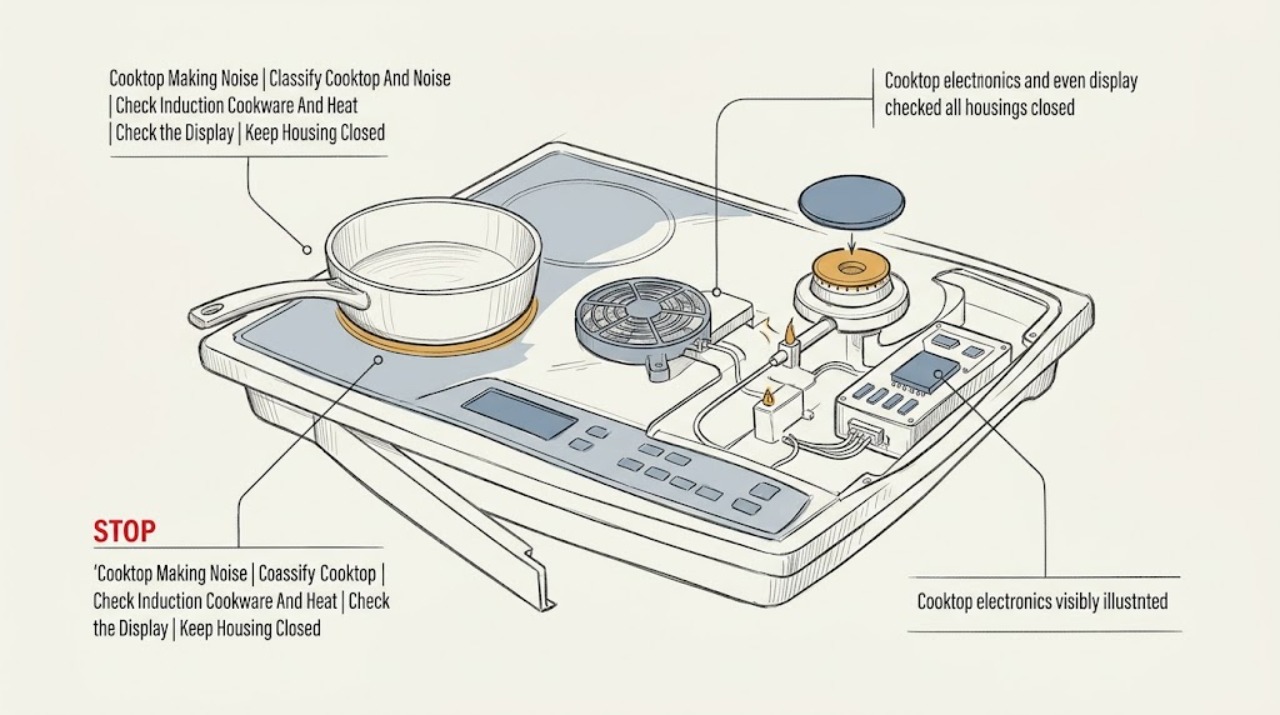
Work through in order
Diagnostic checks
Use only checks that match the exact appliance or system and its official guide.
-
Check 1
From a safe position, identify whether the Bosch cooktop is induction, electric, or gas, and record when the noise begins: while a zone heats, when cookware is empty, when two zones are on high, while a gas burner ignites, after the cooktop is switched off, or with no cooking activity. Do not deliberately reproduce a loud, hot, sparking, or gas-related sound.
Expected result: The sound is a low hum, whistle, crackle, or fan noise on induction; a click during gas ignition; continuous or intermittent gas clicking; a pop when a gas burner is turned off; or an unexplained electrical buzz, snap, or rattle.
Next step: Continue with the matching induction, electric, or gas observation. If the appliance type is unclear without moving or opening it, use the model information and arrange service rather than guessing.
Stop if: Stop immediately for gas odor, smoke, sparks, burning odor, a cracked surface, exposed wiring, water entering controls, or an appliance that moves or rocks.
Why this matters
Why: Induction sound often tracks cookware, power level, or cooling. Gas ignition sounds are judged by whether they stop after lighting and whether the cap, igniter, and controls are dry and correctly positioned. An unexplained electrical or mechanical sound cannot be identified safely by listening alone.
-
Check 2
For an induction Bosch cooktop, turn the setting down and observe whether a low hum or high-pitched whistle becomes quieter. With the zone off and cookware cool enough to handle, center one suitable pan on the zone; do not run an empty pan merely to test the sound. If the cookware is empty, add the intended food or liquid before normal use, following the appliance manual.
Expected result: The sound becomes quieter at a lower setting, stops when food or liquid is added, changes with a different suitable pan, or persists across pans and settings.
Next step: Use cookware that the exact Bosch manual accepts, center it on the zone, and use a lower setting when practical. If the persistent noise is accompanied by an error, poor heating, overheating, or a control problem, stop and arrange Bosch-qualified appliance service.
Stop if: Do not place metal objects on the surface, open the cooktop, remove glass, block ventilation, or continue if the glass is cracked, the controls flash unexpectedly, or there is smoke or a burning smell.
Why this matters
Why: Bosch describes hum at high heat, whistle with empty cookware, crackle with layered or mixed cookware, and high-pitched noise when multiple zones are used at high settings as possible normal induction behavior. A noise that is unchanged by cookware and setting is less consistent with those normal patterns.
-
Check 3
For an induction or electric Bosch cooktop, switch the cooking zones off and allow the surface and electronics to cool. Observe whether a fan continues briefly after cooking, whether the control panel is dry and free of objects, and whether an error code or flashing indicator appears. Do not remove panels or attempt to reach the internal fan.
Expected result: The fan stops after cooling, the noise continues while the cooktop is hot, the control panel is wet or covered, an error remains, or the noise continues after cooling with a clear control panel.
Next step: Remove only an external object and dry the control surface with the appliance off. If the noise, error, or overheating returns, leave the cooktop off and provide the exact model and observed message to qualified service.
Stop if: Do not spray liquid into controls, bypass a thermal or electrical protection, reset repeatedly, or touch internal wiring, capacitors, fans, or terminals.
Why this matters
Why: Bosch manuals describe automatic fan operation and continued fan operation while the cooktop remains hot. A wet or obstructed control panel can cause signals or faults. Persistent noise after cooling, repeated errors, or overheating points to a service issue rather than a normal fan cycle.
-
Check 4
For a gas Bosch cooktop, turn all knobs off and wait until the cooktop and burner parts are cool. From above, check that a burner cap and base are seated and aligned as the manual shows, and that the visible igniter area is dry and free of food or grease. Do not remove the cooktop, move the appliance, inspect a gas connector, or adjust a gas valve.
Expected result: Clicking stops after a burner lights, clicking continues with the knob off, the cap/base was misaligned, the igniter was wet or dirty, the flame is uneven, or there is no click or ignition.
Next step: After cool external parts are correctly seated and dry, make only one normal ignition attempt if there is no gas odor. If clicking persists, ignition fails, the flame is abnormal, or wiring is suspected, turn the knob off and call qualified appliance or gas service.
Stop if: If gas is smelled or heard escaping, leave immediately without operating switches or phones inside. Do not move the cooktop or work on gas connectors, igniters, wiring, or regulators.
Why this matters
Why: Bosch gas guidance links continuous or intermittent clicking with cap/base alignment, a wet or dirty igniter, or incorrect housing wiring. No click can indicate an igniter fault. An uneven flame or persistent clicking is not proven safe by cleaning or repositioning alone.
-
Check 5
Record the Bosch model number without dismantling the appliance, cooktop type, exact sound description, zone or burner involved, heat setting, cookware or cap position, whether the sound stops after cooling or ignition, visible error code, and any heat, odor, spark, crack, or recent spill. Decide whether the noise has a documented normal trigger and disappears when that trigger changes.
Expected result: The sound follows a documented induction cookware/heat/fan pattern or a brief gas ignition event and disappears normally; alternatively, it is persistent, worsening, unexplained, accompanied by a fault, or connected to gas or electrical warning signs.
Next step: For persistent or abnormal noise, stop using the affected zone or cooktop and arrange qualified appliance service. For gas odor, smoke, sparks, burning odor, or a cracked surface, leave the area or home as appropriate and obtain urgent professional help; do not operate the appliance.
Stop if: Do not open the cooktop, probe electrical parts, alter gas components, move a gas appliance, or order a replacement component based only on the sound.
Why this matters
Why: A repeatable sound tied to Bosch's described induction behavior or a brief successful ignition may be normal. A persistent or unexplained sound can involve an igniter, fan, electronics, wiring, burner assembly, or surface damage and needs model-specific diagnosis.
Use your observations
Decision map
Find the observation that best matches what you see, then follow the next safe action.
-
PATH 01Next step
What you see
An induction hum, whistle, crackle, or fan sound changes with cookware, heat setting, or cooling and there is no error or damage.
Do this next
Center suitable cookware, reduce the setting when practical, avoid heating an empty pan, and allow the fan to finish cooling. Arrange service if the sound becomes persistent or is joined by a fault.
-
PATH 02Next step
What you see
Induction or electric noise continues after cooling or is accompanied by an error, overheating, poor heating, flashing controls, or a cracked surface.
Do this next
Leave the cooktop off and arrange qualified Bosch appliance service. Do not open the surface or attempt internal electrical tests.
-
PATH 03Next step
What you see
A gas burner clicks briefly while igniting and the clicking stops after the burner lights normally.
Do this next
Keep the cap/base aligned and igniter area dry and clean, following the exact manual. If clicking becomes continuous or ignition changes, stop using that burner and call service.
-
PATH 04Next step
What you see
A gas cooktop clicks continuously or intermittently, fails to ignite, has an uneven flame, or clicks with knobs off.
Do this next
Turn knobs off and arrange qualified appliance or gas service. Do not move the cooktop or inspect/repair the connector, igniter wiring, regulator, or gas supply.
-
PATH 05Next step
What you see
Gas is smelled or heard escaping, or there is smoke, sparking, a burning odor, exposed wiring, or a cracked cooktop.
Do this next
Leave immediately, do not operate lights, switches, electrical equipment, or phones inside, and contact gas authorities or emergency services from outside. Do not re-use the appliance until qualified professionals clear it.
Helpful context
Understand the symptom
Identify the sound before treating it as a failure
A Bosch induction cooktop can hum or whistle because of the cookware and selected heat, crackle with certain layered or mixed cookware, and run a fan while the electronics are hot. A gas cooktop can click while an igniter is trying to light a burner; continuous or intermittent clicking can follow a misaligned cap/base, a wet or dirty igniter, or an electrical issue. The same word—noise—therefore needs a type-specific check.
Keep checks on the user side of the boundary
Turn the cooktop off and let hot parts cool before handling cookware or burner parts. Do not lift or move a gas appliance to inspect a connector, open the cooktop, expose wiring, test live circuits, or adjust gas components. A noise accompanied by a cracked glass surface, smoke, sparking, a burning odor, or repeated protective shutdown is a stop signal, not a reason to keep testing.
Gas odor is an evacuation issue
If gas is smelled or heard escaping, leave the home immediately. Do not operate lights, switches, electrical equipment, or a phone inside; contact the gas supplier or emergency services from a neighbor's location. Do not return to the cooktop until the hazard has been addressed.
When checks do not resolve it
Need a professional?
Arrange qualified Bosch appliance service when noise persists after the matching safe check, appears with an error, overheating, poor heating, a cracked surface, repeated gas-ignition failure, continuous clicking, or any suspected wiring, fan, igniter, burner, or electronics fault. If gas is smelled or heard escaping, leave immediately and contact gas authorities or emergency services from outside; do not operate the cooktop.
Safety scope: User checks are limited to external listening, cookware placement and lower settings on induction, cooling, drying the external control panel, and aligning cool visible gas burner caps according to the manual. Do not open the cooktop, touch live electrical parts, move a gas appliance, inspect or repair gas connectors, adjust gas valves, bypass protections, or continue after gas odor, smoke, sparks, burning odor, or a cracked surface.
Have this ready
- Provide the Bosch model number from its normal rating location, cooktop type, zone or burner, sound description and timing, heat setting, cookware or cap position, whether it stops after cooling or ignition, error message, recent spill or cleaning, and any odor, spark, crack, or flame change. Do not move the appliance to obtain a connector photo.
Common questions
FAQ
Is a humming or whistling Bosch induction cooktop always broken?
No. Bosch documents several induction sounds as normal and related to heat setting, cookware material or size, an empty pan, multiple zones, or cooling. If the sound persists after cooling or appears with an error, overheating, or poor heating, arrange service.
Why does my Bosch gas cooktop keep clicking?
Continuous or intermittent clicking can be associated with a misaligned cap or burner base, or a wet or dirty igniter; no click can indicate an igniter issue. Turn the knobs off, let parts cool, check only visible alignment and dryness, and call service if it persists.
Why does the induction fan keep running after I turn the Bosch cooktop off?
Bosch manuals describe a fan that can continue while the cooktop electronics remain hot. Let it cool. A fan that stays noisy after cooling or is accompanied by an error needs qualified service.
Can I move a Bosch gas cooktop to inspect the source of a noise?
No. Do not move a gas appliance or inspect its connector yourself. A persistent gas-cooktop noise should be evaluated by qualified appliance or gas service.
What should I do if I smell gas while the Bosch cooktop is making noise?
Leave immediately. Do not use lights, switches, electrical equipment, or a phone inside; contact the gas supplier or emergency services from outside, and do not return to or operate the cooktop until cleared.
Read the exact guide
Official sources
- Bosch Electric Cooktop Troubleshooting & Repair | Bosch – Fix Cooktop Not Heating, Not Turning on & Other ProblemsBosch Home Appliances · Bosch electric cooktop support page; model-specific instructions control.
- Certain Older Gas Connectors May Be DangerousU.S. Consumer Product Safety Commission · Government safety guidance for gas odor and appliance-movement boundaries, not a Bosch repair procedure.
- 9000957336_5V0SSP_NGM2014_QRG_EN.inddBosch Home Appliances · Bosch NGM gas-cooktop quick reference guide; use the exact model manual for another appliance.
- Use and Care Manual HII8057U, HII8057C, HII8047UBosch Home Appliances · Bosch manual for specified HII models used for general induction noise examples; follow the exact model manual for another cooktop.
- Frequently Asked Questions (FAQ)Bosch Home Appliances · Bosch FAQ for induction cooktops; exact noise behavior and controls depend on the model.
- Bosch Gas Cooktop & Rangetop TroubleshootingBosch Home Appliances · Bosch gas cooktop support page; exact burner construction and controls depend on the model.
Community feedback
Share a repair observation
Share a plain-text repair observation. Accepted observations are published automatically; this page may take a moment to update.