
On this page
Start here
Quick answer
First identify the sound and whether the Samsung cooktop is gas, electric, or induction. Samsung says induction cookware can buzz, higher power can make a low hum, different cookware materials used on two induction zones can create a higher-pitched hum, and a cooling fan can whirr during and after use. Gas burners may click while igniting, but continuous clicking with every knob off can indicate moisture near the ignition switches. Turn the cooktop off for smoke, a gas smell, arcing, cracked glass, uncontrolled heat, or a noise that is suddenly much louder, grinding, or paired with a burner or control problem. Keep hands, cleaners, and water away from hot or internal parts; use only the exact model guide for any service or reset.
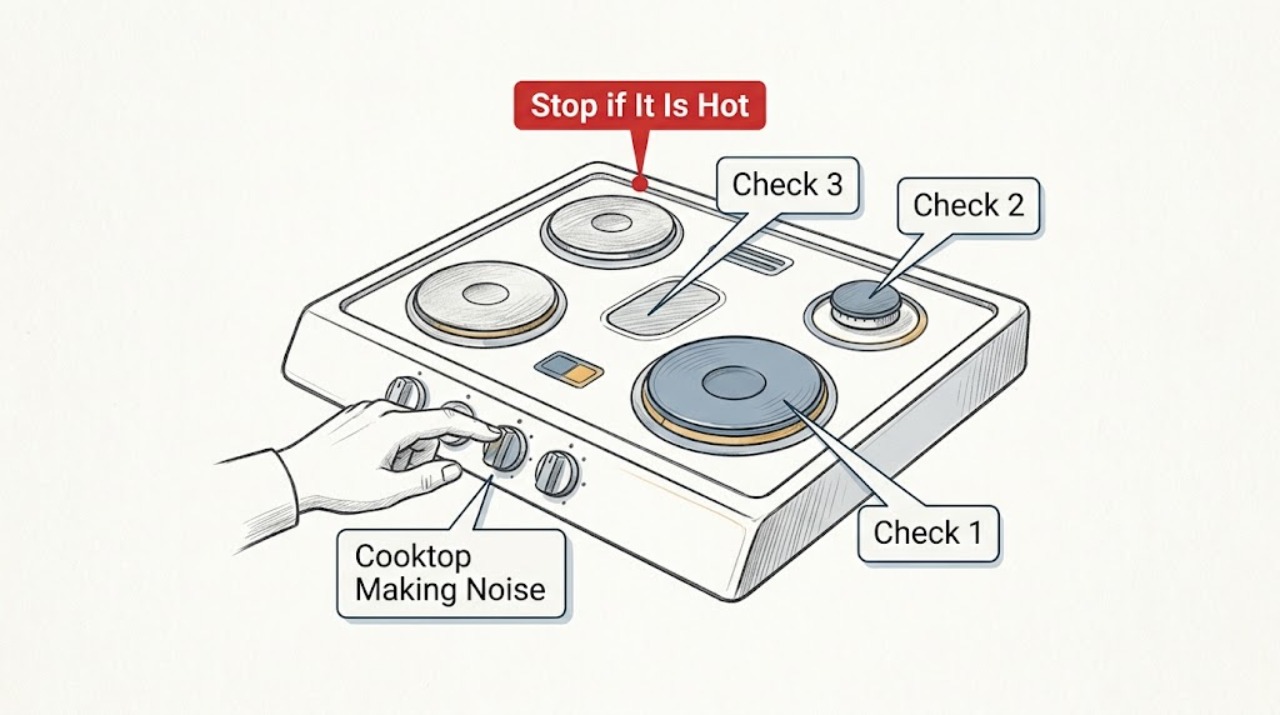
Work through in order
Diagnostic checks
Use only checks that match the exact appliance or system and its official guide.
-
Check 1
From a safe position, switch the cooktop controls off and record the noise without touching hot surfaces: note whether it is clicking, buzzing, humming, whistling, hissing, whirring, rattling, thumping, or popping, and whether it occurs during heating, ignition, or cool-down.
Expected result: The sound occurs only while gas is igniting, only with induction cookware, only at a high power level, while a fan runs, after the cooktop is turned off, or while no control is selected.
Next step: Record whether the unit is gas, electric, or induction, the active zone, power setting, cookware, and whether there is smell, smoke, heat, or a display warning. Stop immediately for a gas smell, smoke, arcing, cracked glass, or uncontrolled heat.
Stop if: Do not reach over hot cookware, remove panels, touch burner openings, or continue operation during a hazardous sound or smell.
Why this matters
Why: Timing narrows the path. Samsung describes several condition-dependent sounds as normal, but a sound that continues with an unexpected control state or changes substantially from normal operation needs closer checking.
-
Check 2
For an induction or electric cooktop, observe whether the buzz or hum changes when the same zone is turned off, when the power level changes, or when one pan is removed after the surface is safe to handle; keep cookware centered and dry.
Expected result: The sound follows the active zone or power level, changes with cookware material, stops when heating stops, or continues with no zone selected.
Next step: If the sound is cookware- or power-dependent and there is no heat, glass, or control problem, compare with flat, dry, induction-compatible cookware specified by the manual. If it persists without heating or is unusually loud, stop use and request service.
Stop if: Do not test with empty cookware, place wet items on the surface, touch a hot pan, or remove the glass top.
Why this matters
Why: Samsung says induction buzzing can depend on cookware material, higher power can make a low hum louder, and different cookware materials on two zones can create a high-pitched hum. A sound that continues with no heating condition or is much louder than before is not explained by those normal paths.
-
Check 3
For a gas Samsung cooktop, confirm every knob is fully in the OFF position and observe whether clicking occurs only during ignition or continues with no knob at LITE; do not spray or pour cleaner into burner or ignition openings.
Expected result: Clicking stops when ignition ends; clicking continues with all knobs off; a burner does not light normally; or there is a gas odor, abnormal flame, or visible moisture around the controls.
Next step: If there is no gas odor and the cooktop is safe, stop using the affected burner and let the surface dry according to the model manual. If clicking continues, a burner behaves abnormally, or any gas odor is present, turn controls off, leave the area if needed, and arrange qualified gas-appliance help.
Stop if: For gas odor, hissing at an unexpected location, smoke, or abnormal flame, do not relight, troubleshoot ignition, or use switches near the appliance; leave the area and follow local emergency/gas guidance.
Why this matters
Why: Samsung describes ignition clicking as expected while lighting and says continuous clicking with no knob at LITE may be related to moisture on ignition switches. Gas odor or abnormal flame is a safety stop, not a noise adjustment.
-
Check 4
If the noise is whirring, blowing, hissing, or a low fan-like hum, switch the cooktop off and observe from a safe distance whether the sound fades as the internal components cool; do not block vents or reach under the cooktop.
Expected result: The fan-like sound occurs during use and fades after cool-down; it continues unusually long; it becomes grinding or rattling; or it is significantly louder than before.
Next step: Keep vents clear and compare only with the model guide. If the sound is new, loud, grinding, rattling, or accompanied by overheating or a fault, stop using the cooktop and request qualified service.
Stop if: Do not insert tools into vents, remove covers, or continue cooking through an overheating or abnormal fan symptom.
Why this matters
Why: Samsung says the cooling fan can run during use and continue afterward until internal components cool. A significantly louder or mechanically harsh sound is a service signal rather than a reason to open the appliance.
-
Check 5
Once the cooktop is off and cool, inspect the accessible surface, pan bottoms, grates, and burner components for spill residue, loose cookware, debris, or parts that are visibly out of place; use only the model's cleaning method.
Expected result: A loose pan or grate, residue, wet surface, or removable part is visibly causing vibration; the surface is clear; or the glass, burner, grate, or control area is damaged.
Next step: Remove only loose surface debris with the cooktop off and cool, dry all cookware and removable components, and reseat only parts the manual identifies as removable. If damage or a persistent noise remains, stop and arrange service.
Stop if: Do not scrape damaged glass, spray into gas openings, uninstall the cooktop, or operate with a cracked or loose component.
Why this matters
Why: Surface condition can change vibration or cause a sound, but cleaning cannot correct a cracked glass surface, damaged burner, internal rattle, or distorted component. Samsung cautions against moisture in gas burner openings and against harsh or unsuitable cleaning methods.
-
Check 6
After one low-risk, model-approved change such as using a dry compatible pan, removing residue after cool-down, or allowing a fan to finish cooling, perform one brief normal test while watching the sound, heat, flame, controls, and surface.
Expected result: The noise returns to the documented normal condition; the same noise remains; it is louder or mechanically harsh; or a gas, electrical, heat, glass, or control symptom appears.
Next step: Use the cooktop only if the sound is consistent with the manual and no unsafe symptom remains. Otherwise stop use, record a short audio/video from a safe distance, and request Samsung or qualified appliance service.
Stop if: Do not repeat resets, continue cooking through smoke or gas odor, or attempt internal electrical or gas testing.
Why this matters
Why: A repeatable change tied to cookware, residue, ignition, power, or fan state can explain a normal operating sound. A persistent or worsening sound, or any additional hazard, needs qualified diagnosis.
Use your observations
Decision map
Find the observation that best matches what you see, then follow the next safe action.
-
PATH 01Safety boundary
What you see
The induction buzz or hum changes with cookware material, zone, or power level and there is no abnormal heat, damage, or control problem.
Do this next
Use dry, flat, compatible cookware and the model's recommended settings; compare the sound without changing several variables at once.
Why this path and its safety boundary
Why it matters: Samsung identifies this as a possible normal induction operating sound.
Safety stop: Stop for a new loud, grinding, arcing, overheating, or persistent no-heating sound.
-
PATH 02Safety boundary
What you see
The cooling fan or fan-like sound occurs during use or briefly after switching off and fades as the cooktop cools.
Do this next
Keep ventilation openings clear and allow the documented cool-down; no internal repair is indicated by this sound alone.
Why this path and its safety boundary
Why it matters: This matches Samsung's described cooling-fan behavior.
Safety stop: Request service if the sound is significantly louder than normal, grinding, rattling, or accompanied by overheating or a fault.
-
PATH 03Safety boundary
What you see
Gas clicking occurs only while a burner is being ignited and stops once the flame is established.
Do this next
Use the cooktop only as directed by the exact manual and monitor for normal flame and control behavior.
Why this path and its safety boundary
Why it matters: Samsung describes ignition clicking as expected during gas burner lighting.
Safety stop: Stop for continued clicking with controls off, failed ignition, abnormal flame, or gas odor.
-
PATH 04Safety boundary
What you see
Gas clicking continues with every knob out of LITE, or moisture is suspected around ignition controls, but there is no gas odor.
Do this next
Turn all controls off, keep the cooktop out of use, and follow the model's safe drying guidance. If clicking continues, arrange service.
Why this path and its safety boundary
Why it matters: Samsung identifies moisture around ignition switches as one possible cause of continuous clicking.
Safety stop: Do not spray into openings, repeatedly relight, or use the cooktop if a gas odor appears.
-
PATH 05Safety boundary
What you see
The sound is a sudden significantly louder thump, bang, rattle, grinding noise, or is paired with abnormal heat, a damaged surface, a control problem, or a fault.
Do this next
Turn the cooktop off, keep it out of use, document the sound and conditions, and request qualified appliance service.
Why this path and its safety boundary
Why it matters: A normal operating explanation is insufficient; an internal or damaged component may need inspection.
Safety stop: Do not remove the cooktop, test internal wiring, or continue cooking to reproduce the noise.
-
PATH 06Safety boundary
What you see
There is gas odor, smoke, arcing, cracked glass, uncontrolled heating, or another immediate safety hazard.
Do this next
If safe, turn controls off without operating anything that could ignite gas; leave the area as appropriate and contact local emergency or qualified gas/electrical help.
Why this path and its safety boundary
Why it matters: The situation is outside user noise troubleshooting.
Safety stop: Stop all use immediately and do not relight, reset, clean hot components, or continue diagnosis.
Helpful context
Understand the symptom
The sound and operating condition matter
A Samsung cooktop can make different sounds depending on fuel type, power level, cookware, burner state, and whether its cooling fan is still running. A brief click during ignition is different from continuous clicking with all gas controls off; induction buzzing that changes with cookware is different from a new mechanical rattle. Record the sound before changing several conditions at once.
Separate normal operation from a warning
Samsung describes fan, induction, ignition, and thermal-expansion sounds that can be normal. The decision changes when the volume is significantly louder than usual, the sound continues under an unexpected condition, or the cooktop also has gas odor, smoke, arcing, damaged glass, abnormal flame, or a control that will not turn off.
Keep cleaning and checks surface-level
Turn the cooktop off and allow it to cool before routine cleaning. Samsung warns against spraying moisture into gas burner openings or uninstalling the gas cooktop, and its electric-cooktop guidance says to remove spills after cooling except for special hot-sugar precautions. Do not open the appliance to chase a noise.
Safety boundary
Stop conditions
- Stop immediately for gas odor, smoke, arcing, uncontrolled heat, cracked glass, abnormal flame, or a control that will not turn off.
- Do not open or uninstall the cooktop, test internal gas or electrical parts, insert tools into vents, spray into burner openings, or continue operation to reproduce a hazardous noise.
- Stop and request service for a significantly louder, grinding, rattling, recurring, or unexplained sound after one model-approved surface-level check.
Only after diagnosis
Potential parts
- cooktop cooling fan
Consider only after qualified diagnosis confirms that an unusually loud or failed fan is the cause; normal fan noise alone does not justify replacement.
Confirm the exact model, revision, connector, mounting, and manufacturer's fit information before selection. - gas ignition switch or igniter
Consider only after qualified diagnosis confirms a continued-clicking or ignition fault after moisture and control-position causes are excluded.
Gas and ignition work require qualified procedures; confirm exact model and do not bypass safety components.
When checks do not resolve it
Need a professional?
Call for persistent or abnormal noise, continued gas ignition clicking, abnormal flame, overheating, damaged surface, or any need for internal access.
Have this ready
- Exact Samsung model and cooktop type
- Sound description and recording from a safe distance
- Active zone, power level or flame setting, and cookware
- Whether the sound occurs during ignition, heating, or cool-down
- Any gas odor, smoke, heat, glass, control, or display symptom
Common questions
FAQ
Is buzzing from a Samsung induction cooktop normal?
It can be. Samsung says induction buzzing may depend on cookware material, and a low hum can become louder at higher power. If the sound is sudden, significantly louder, grinding, or present with overheating or a control problem, stop and request service.
Why does my Samsung gas cooktop keep clicking?
Clicking while a burner is being ignited is expected. Clicking that continues with every knob out of the ignition position can be related to moisture around the ignition switches; keep the cooktop off and follow the model's safe drying guidance. Gas odor or abnormal flame is an immediate stop.
Why does my cooktop fan keep running after I turn it off?
Samsung says the internal cooling fan can continue after use until internal components cool. A fan-like sound that is significantly louder than usual, grinding, rattling, or paired with overheating needs service.
Can cookware cause a Samsung cooktop to whistle or hum?
Yes. Samsung describes cookware-dependent induction buzzing and higher-pitched humming when different cookware materials are used on zones at the same time. Use dry, flat, compatible cookware and compare one condition at a time.
When should I stop using a noisy Samsung cooktop?
Stop for gas odor, smoke, arcing, uncontrolled heat, cracked glass, an abnormal flame, a control that will not turn off, or a noise that is suddenly much louder, grinding, rattling, or associated with a fault. Do not uninstall the cooktop or test internal gas or electrical parts.
Read the exact guide
Official sources
- Samsung cooktop and range: common sounds and operational noisesSamsung · General Samsung cooktop and range guidance; exact model guide controls model-specific behavior.
- How to clean your Samsung gas cooktopSamsung · Applicable to Samsung gas cooktops; exact model instructions govern.
- Samsung Range FAQsSamsung · General Samsung range guidance; verify exact cooktop model information.
- Clean and care for your Samsung electric cooktopSamsung · Applicable to Samsung electric or induction cooktops; exact model instructions govern.
Community feedback
Share a repair observation
Share a plain-text repair observation. Accepted observations are published automatically; this page may take a moment to update.