
On this page
Start here
Quick answer
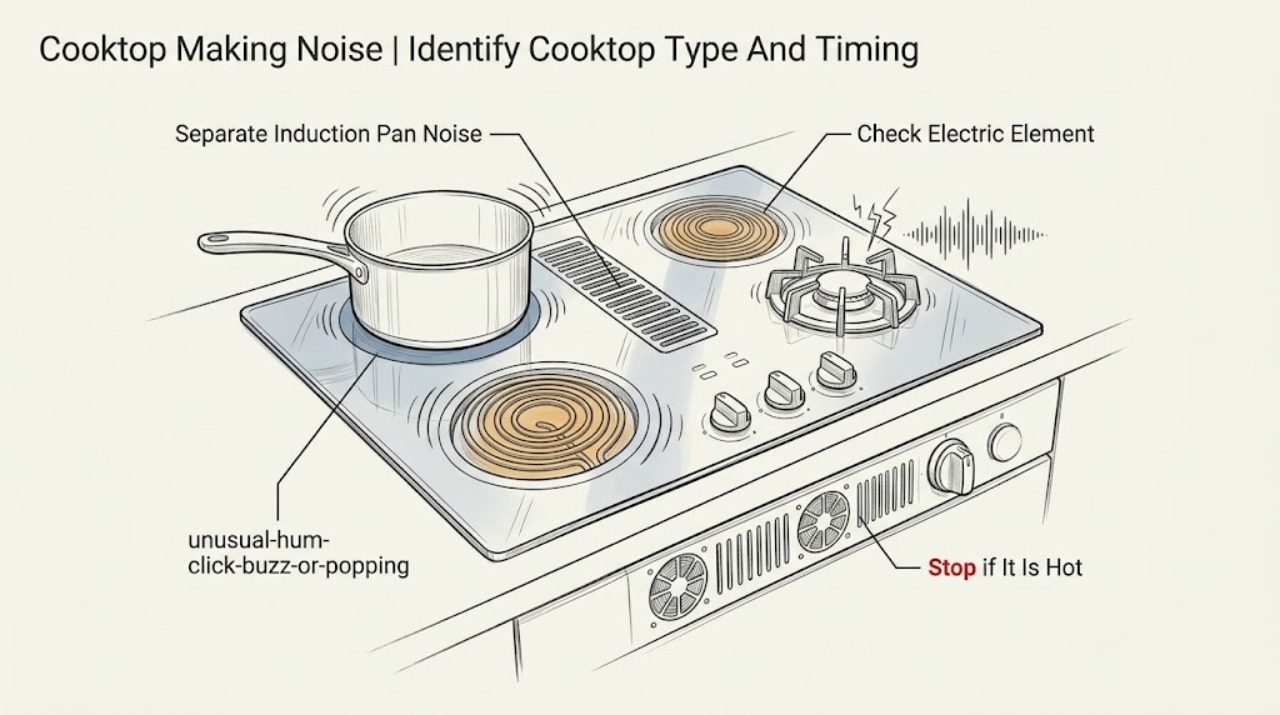
A GE cooktop can make a normal hum, buzz, click, or light pop when its heating system cycles or when induction cookware vibrates, but the right check depends on whether the cooktop is induction, radiant electric, electric coil, or gas. First record whether the sound occurs only while heating, after a setting changes, or while the controls are off. On induction models, compare the sound with a correctly centered magnetic pan and with adjacent zones off; on a radiant or coil model, a slight operating hum or element cycling may be normal; on a gas model, several igniters can click during one ignition, but a burner clicking while off needs attention. Stop for gas odor, smoke, burning smell, arcing, cracked glass, abnormal heat, a loose element, or a breaker that trips again, and arrange qualified appliance or electrical service.
Before you begin
Safety first
- This article covers safe observation and low-risk use checks only. Qualified service determines whether the cause is cookware, an element, igniter, fan, control, power section, gas system, wiring, or another internal component and performs any repair.
Work through in order
Diagnostic checks
Use only checks that match the exact appliance or system and its official guide.
-
Check 1
From a safe position, identify whether the GE cooktop has induction touch controls, a smooth radiant glass surface, exposed electric coils, or gas burners, then record which zone makes the sound and whether it starts with heating, ignition, a setting change, or no user input.
Expected result: The sound occurs only with a pan on an induction zone, during radiant or coil heating, during gas ignition, after cooking while the unit cools, or while the controls and burners are off.
Next step: Use the matching branch below and record a short audio clip if it can be made without approaching a hazard. Stop immediately for gas odor, smoke, burning smell, arcing, cracked glass, or abnormal heat.
Stop if: Do not remove the cooktop, lift an element to inspect wiring, or move close to a damaged or overheating area.
Why this matters
Why: Sound tied to a specific heating method has a different normal pattern: pan vibration on induction, element cycling on electric, or igniter operation on gas. A sound while the cooktop is off, or a sound paired with heat, odor, smoke, or visible damage, is not explained by ordinary operating noise alone.
-
Check 2
If the cooktop is induction, with the glass and pan safe to handle, compare the sound with one suitable flat magnetic pan centered within the marked cooking circle, then compare with the adjacent zone left off; do not slide the pan across the glass.
Expected result: The hum or buzz changes with a lighter or heavier pan, pan contents, pan position, pan size, or an adjacent zone, or it remains loud and unchanged with suitable cookware on one zone.
Next step: Use a stable pan that fully contacts the glass and covers the marked area as the model guidance permits. If the sound remains abnormal, heating is uneven, or a zone cuts out, stop that zone and arrange qualified appliance service.
Stop if: Do not use a warped, damaged, unstable, or overheated pan, place metal across controls, or open the induction assembly.
Why this matters
Why: GE describes induction humming and buzzing as influenced by cookware, contents, and interacting adjacent power settings; a change after correct centering supports normal pan or load vibration. A harsh or persistent sound tied to one zone, especially with unstable heating, needs service assessment.
-
Check 3
If the cooktop is radiant glass or electric coil, observe the affected element from a normal standing position while it operates, without touching it or lifting any part.
Expected result: A radiant element cycles on and off with a slight hum, an older coil vibrates or buzzes only while heating, the sound persists with the element off, or the element is loose, damaged, or heating unevenly.
Next step: If the sound is mild and follows ordinary heating, monitor it without altering the element. If the element is loose or damaged, the noise continues while off, or any electrical warning appears, leave the cooktop off and arrange qualified appliance or electrical service.
Stop if: Do not reseat an element while hot, bend or repair a coil, remove the glass, or touch exposed electrical parts.
Why this matters
Why: GE identifies slight radiant hum and cycling as normal and notes that an older coil can vibrate at its support. A sound while off, a loose or damaged coil, visible arcing, uneven heating, or abnormal heat points beyond a normal element cycle.
-
Check 4
If the cooktop is gas, observe from a safe distance whether clicking occurs only while a burner is being lit, whether several burners click during one ignition, or whether an igniter clicks when every burner control is off.
Expected result: Several igniters click during one normal lighting event, one igniter clicks intermittently after cleaning, a burner clicks while its knob is off, or there is a gas odor or a flame problem.
Next step: Confirm only from the front that the burner control is fully off and allow the appliance to dry as the manufacturer's guidance permits. If clicking continues, if a control will not stay off, or if any gas odor or flame concern exists, stop using the appliance and arrange qualified gas-appliance service.
Stop if: Do not relight repeatedly, adjust an igniter, remove burner wiring, or investigate a gas odor with a flame or electrical device.
Why this matters
Why: GE says multiple burners can click when one burner ignites, and moisture after cleaning can cause intermittent clicking. Clicking with the burner off may indicate a problem; gas odor or an abnormal flame is a safety condition, not a routine noise.
-
Check 5
From a dry, safe location, note whether the sound continues after all controls are off and the cooktop has had time to cool; inspect only for visible smoke, odor, scorching, cracked glass, a tripped household protective device, or other external damage.
Expected result: The sound stops after cooling, continues while the cooktop is idle, is accompanied by smoke or burning smell, the glass is cracked, or the household protective device has tripped.
Next step: Leave the appliance unused and arrange qualified service when the sound continues while idle, a safety sign is present, or a protective device trips. Provide the cooktop type, location, timing, and recording of the sound.
Stop if: Do not repeatedly reset a tripped device, touch a scorched area, open covers, or perform live electrical checks.
Why this matters
Why: A short cooling-related sound may be part of normal operation, but a persistent idle sound, smoke, odor, damaged glass, or a protective-device trip suggests a control, fan, wiring, or other fault. Repeated resets can increase risk and do not identify the cause.
-
Check 6
Compare the recorded sound with the matching GE guidance and decide whether it is mild, repeatable, and tied to normal operation or whether it is new, harsh, persistent, or associated with unstable heating or a safety sign.
Expected result: The sound is a mild operating hum or expected ignition click with stable cooking, or it remains unexplained, worsens, occurs while off, or accompanies heat, odor, smoke, damage, or repeated power interruption.
Next step: For the normal branch, keep the pan or burner arrangement that produces stable operation and monitor for change. For the fault branch, stop use and provide the model, cooktop type, sound recording, affected zone, timing, and safety observations to qualified service.
Stop if: Do not silence the sound by removing guards, changing wiring, bypassing a control, or replacing an internal part without a model-specific professional diagnosis.
Why this matters
Why: A stable sound that matches the cooktop type can be monitored. An unexplained or worsening sound changes the task from observation to repair diagnosis; the source could be cookware, an element, igniter, fan, control, power section, or gas system and cannot be identified safely from noise alone.
Use your observations
Decision map
Find the observation that best matches what you see, then follow the next safe action.
-
PATH 01Safety boundary
What you see
Gas odor, smoke, burning smell, visible arcing, cracked glass, abnormal heat, a loose or damaged element, or a protective device that trips again is present.
Do this next
Stop using the cooktop, keep people away, and arrange urgent qualified appliance, gas, or electrical service as appropriate to the hazard.
Why this path and its safety boundary
Safety stop: Do not use a flame or electrical device to locate gas, touch damaged surfaces, reset repeatedly, or open the appliance.
-
PATH 02Safety boundary
What you see
A mild hum or buzz occurs only while an induction pan is heating and changes with pan type, contents, position, size, or an adjacent zone.
Do this next
Use stable, suitable cookware centered on the marked zone and monitor stable heating; arrange service if the sound becomes harsh, the zone cuts out, or heating becomes uneven.
Why this path and its safety boundary
Safety stop: Do not modify the pan, cooktop, or internal controls to suppress normal vibration.
-
PATH 03Safety boundary
What you see
A slight hum or click follows radiant or coil-element heating and the element operates normally without damage or idle noise.
Do this next
Monitor the sound during ordinary use and request service if it persists while off, worsens, or is accompanied by uneven heating, arcing, or heat at the controls.
Why this path and its safety boundary
Safety stop: Do not touch, bend, lift, or repair the element while hot or energized.
-
PATH 04Safety boundary
What you see
A gas igniter clicks while its burner is off, continues after the controls are fully off and the unit is dry, or any gas or flame concern exists.
Do this next
Stop using the cooktop and arrange qualified gas-appliance service; provide the affected burner, timing, moisture history, and any odor or flame observation from a safe position.
Why this path and its safety boundary
Safety stop: Do not relight repeatedly, adjust ignition parts, or investigate gas plumbing yourself.
-
PATH 05Safety boundary
What you see
The noise is harsh, worsening, present while the cooktop is idle, tied to unstable heating, or not explained by the cooktop-type checks.
Do this next
Leave the cooktop unused and arrange qualified appliance service for model-specific diagnosis of the element, igniter, fan, control, or power system.
Why this path and its safety boundary
Safety stop: Do not open panels, perform live measurements, bypass controls, or install a generic internal part.
Helpful context
Understand the symptom
The cooktop type changes what a noise means
An induction cooktop transfers energy through a magnetic field and the pan can vibrate, so a hum or buzz may change with the pan, its contents, or a neighboring zone. A radiant glass cooktop can hum slightly as its element cycles, and an older electric coil can vibrate at the element support. A gas cooktop may click several igniters during one lighting event. Identify the heating method before treating a sound as a failed part.
Use timing and location as the first diagnosis
Record which burner or zone makes the sound, whether it follows a pan or flame, and whether it continues with all controls off. A sound limited to one pan or one zone points to a cookware, element, or igniter branch; a sound across the whole appliance or while it is idle makes the control, fan, power, or gas-safety branch more important. Do not remove the surface or make an internal electrical check to identify the source.
Normal sound does not include a safety warning
A mild, repeatable operating sound with stable heating can be a normal characteristic. Gas odor, smoke, a burning smell, visible arcing, damaged glass, a loose or damaged element, unusual heat at the controls, or repeated protective-device operation is different. Stop using the cooktop, keep people away, and arrange qualified service rather than trying to quiet the appliance by removing a shield or changing wiring.
Only after diagnosis
Potential parts
- induction coil or power module
Consider this part class only if qualified diagnosis links a persistent zone-specific induction noise or unstable heating to the coil or power section after cookware causes are excluded.
Confirm the full cooktop model and the manufacturer's fit information; noise alone does not establish which assembly is involved. - gas igniter or ignition control
Consider this part class only when qualified gas-appliance diagnosis finds continued clicking with controls off or an ignition fault after safe drying and control-position checks.
Gas ignition parts require model-specific fit and professional installation; do not order from the sound description alone. - radiant or electric surface element
Consider this part class only if a qualified diagnosis ties an abnormal electric-element hum, vibration, or uneven heat to a damaged element or support.
Confirm the exact model, element position, and approved fit information before any replacement.
When checks do not resolve it
Need a professional?
Arrange qualified appliance service when a noise is harsh, worsening, persistent while the cooktop is off, associated with unstable heating, or unexplained after the cooktop-type checks. Treat gas odor, smoke, burning smell, visible arcing, cracked glass, abnormal heat, a loose or damaged element, and repeated protective-device operation as an urgent safety stop.
Safety scope: This article covers safe observation and low-risk use checks only. Qualified service determines whether the cause is cookware, an element, igniter, fan, control, power section, gas system, wiring, or another internal component and performs any repair.
Have this ready
- Full cooktop model and heating type: induction, radiant, electric coil, or gas
- Affected burner or zone and whether the sound occurs with a pan, flame, element, or no operation
- A short recording made from a safe position and the sound's timing after controls are off
- Pan type, pan position, adjacent-zone setting, or gas control position as applicable
- Any odor, smoke, heat, arcing, glass damage, uneven heating, moisture, or protective-device trip
Common questions
FAQ
Is a humming sound from a GE cooktop normal?
It can be. GE describes normal humming or buzzing on induction models, influenced by pan type, size, contents, and nearby zones. Radiant and older electric-coil burners can also hum during operation. A harsh, worsening, idle, or damage-related sound needs service assessment.
Why does my GE induction cooktop buzz with one pan?
Induction cookware can vibrate and produce sound. Compare one flat magnetic pan centered on the cooking circle with adjacent zones off, without sliding it. If the sound changes with the pan or load and heating stays stable, it may be normal; if one zone remains harsh or cuts out, stop that zone and request service.
Is it normal for several burners on a GE gas cooktop to click?
GE says several igniters can click when one burner is being lit. Moisture after cleaning can also cause intermittent clicking. Clicking while a burner is off, continued clicking after safe drying, a control that will not stay off, or any gas odor requires stopping use and qualified gas-appliance service.
When should I stop using a noisy GE cooktop?
Stop for gas odor, smoke, burning smell, visible arcing, cracked glass, abnormal heat, a loose or damaged element, unstable heating, a persistent sound while the cooktop is off, or a protective device that trips again. Keep people away and arrange qualified appliance, gas, or electrical service.
Read the exact guide
Official sources
- Gas Range & Cooktop - One or More Burners Are ClickingGE Appliances · Supports the gas-ignition distinction between normal multi-igniter clicks, moisture-related intermittent clicks, and clicking while controls are off.
- Electric Range & Cooktop - Induction Cookware Size and ShapeGE Appliances · Supports checking magnetic cookware, full glass contact, centering, size, and the fact that cookware contributes to induction noise.
- Electric Range & Cooktop - Induction Cooktop Humming SoundGE Appliances · Supports normal induction hum or buzz, the effect of cookware and contents, adjacent-zone interaction, and safe monitoring of changes.
- Electric Range - Coil Burner Buzzing or HummingGE Appliances · Supports the distinction between older electric-coil vibration and a loose or damaged element that needs service assessment.
- Electric Range & Cooktop - Explanation of When Radiant Burners Will GlowGE Appliances · Supports radiant-element cycling and the possibility of a slight normal operating hum.
Community feedback
Share a repair observation
Share a plain-text repair observation. Accepted observations are published automatically; this page may take a moment to update.