
On this page
Start here
Quick answer
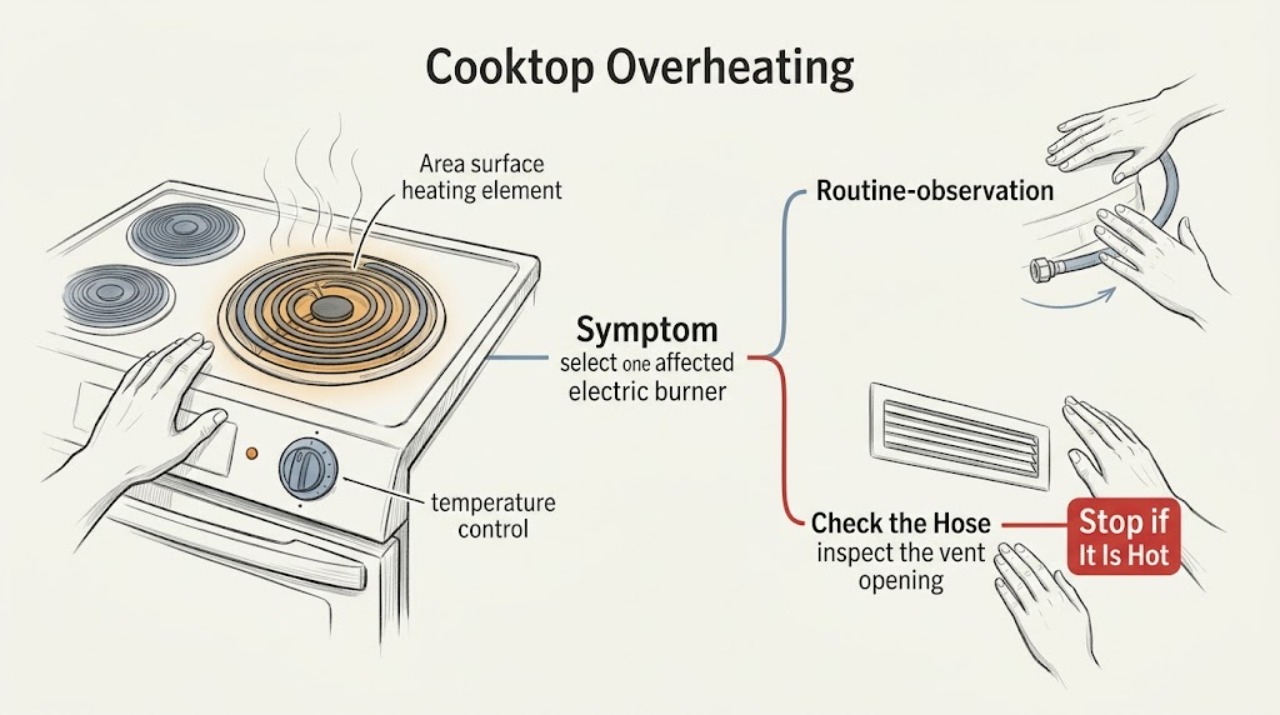
A GE electric cooktop can feel very hot while operating normally because radiant glass and the pan retain heat, and surface elements cycle on and off to hold the selected setting. Start with the pan's size and flatness, make sure any applicable oven vent is clear, and confirm that a burner actually stops heating when its control is turned to Off. If the burner remains energized, the glass is damaged, or the cooktop overheats again with suitable cookware, stop using it and arrange qualified appliance service.
Work through in order
Diagnostic checks
Use only checks that match the exact appliance or system and its official guide.
-
Check 1
With the cooktop clear and a suitable pan in use, select one affected electric burner and watch its element during a steady cooking setting without touching the surface.
Expected result: The element cycles between heating and not visibly glowing while the pan remains hot, or it appears to heat continuously and the control does not change the behavior.
Next step: If it cycles, continue with the cookware and vent checks. If it appears to stay energized regardless of the setting, turn the control to Off, stop using that burner, and arrange qualified service.
Why this matters
Why: Regular cycling is consistent with GE's temperature-control operation; continuous heating that ignores the selected setting points away from ordinary cycling and needs service attention.
-
Check 2
After the cooktop is cool enough to handle cookware safely, compare the affected burner with a pan whose flat bottom matches the burner size; avoid a pan that overhangs the ring substantially.
Expected result: The original pan is visibly oversized, rocks on the surface, or leaves an uneven contact area; the correctly sized flat pan heats more evenly.
Next step: Use the flat, correctly sized pan for a controlled retest. If the surface still overheats with suitable cookware, continue to the vent and control-response checks rather than replacing a part based only on pan behavior.
Why this matters
Why: A poor fit can trap heat between the pan and glass, transfer more heat into the cooktop, and make cycling seem excessive.
-
Check 3
If the cooktop is part of a GE range or a range-style unit with an oven vent near the backsplash, inspect the vent opening for pots, kettles, foil, or other objects before the next use.
Expected result: The vent is blocked or covered, or it is open and unobstructed.
Next step: Remove only objects that can be moved safely after the appliance has cooled, then retest. If this is a standalone cooktop without an oven vent, skip this check and proceed to the control-response check.
Why this matters
Why: A blocked vent can redirect heat toward the cooktop; an open vent makes that particular heat path less likely.
-
Check 4
Turn the affected burner control fully to Off and observe from a safe distance whether the element stops being powered; do not use touch to decide whether it is safe.
Expected result: The element stops heating and only residual warmth remains, or it continues to heat or glow as though the control were still on.
Next step: If only residual warmth remains, allow the cooktop to cool and monitor it. If active heating continues, stop using the cooktop and contact a qualified appliance technician; do not remove the glass or attempt live electrical testing.
Why this matters
Why: Residual heat in the glass and pan can be normal after shutdown, but continued active heating with the control Off indicates a control or element fault rather than simple heat retention.
-
Check 5
After all burners are Off, note whether the GE hot-surface indicator remains on while the glass and cookware cool; use the model's Owner's Manual for the indicator behavior specified for that control design.
Expected result: The indicator remains on for a cooling period, or it remains on after the surface is cool and all controls are Off.
Next step: Treat a short cooling-period indication as a warning that the surface may still be hot. If the indicator remains on after the appliance has cooled or a burner cannot be turned off, stop use and arrange service.
Why this matters
Why: GE uses both timed and temperature-sensing indicator designs, so an indicator that remains on briefly can be expected; a persistent indicator after cooling can indicate a sensor or control problem.
Use your observations
Decision map
Find the observation that best matches what you see, then follow the next safe action.
-
PATH 01Next step
What you see
The element cycles off and back on while the selected setting is maintained.
Do this next
Treat the cycling as potentially normal and check pan fit, flatness, and any applicable vent obstruction before judging the cooktop as defective.
-
PATH 02Next step
What you see
A large, warped, or poorly matched pan is the only clear heat trigger.
Do this next
Use a flat pan that matches the burner, retest once the surface is cool, and escalate only if overheating persists with suitable cookware.
-
PATH 03Next step
What you see
A burner continues actively heating after its control is Off, or the hot-surface indicator stays on after the surface has cooled.
Do this next
Stop using the cooktop and arrange qualified appliance service; do not disassemble the cooktop or perform live electrical checks.
-
PATH 04Next step
What you see
The glass is cracked, the control is damaged, there is smoke or a burning odor, or the heat remains uncontrolled.
Do this next
Stop use immediately, keep clear of the appliance, and contact qualified service for a safety assessment.
Helpful context
Understand the symptom
What may be normal on a GE electric cooktop
A radiant element does not necessarily stay visibly red or continuously powered at one level. GE describes the surface burner as cycling off and back on to maintain the selected heat, including at High. The glass and a hot pan can also keep food bubbling after the control is lowered. Judge the symptom by the control response and the cookware setup, not by a single moment of glow or surface warmth.
Use visual checks only while the surface is hot
Do not touch the glass, pan, element, or vent to test temperature. Move cookware only with appropriate heat protection, and let the surface cool before cleaning or inspecting it. Do not remove the glass or access wiring as a household troubleshooting step.
How to separate heat retention from a control fault
A correctly sized, flat pan and an unobstructed vent should reduce avoidable heat transfer. If the same burner keeps heating after its control is Off, or the symptom returns without the cookware and vent causes, the remaining checks are no longer a safe adjustment for an ordinary user.
Only after diagnosis
Potential parts
- radiant element temperature limiter
Only consider this component after a qualified technician confirms that the affected radiant element is overheating or cycling incorrectly with suitable cookware and an unobstructed vent.
Confirm the exact GE model and the manufacturer's fit information before ordering any component. - surface burner control component
Only consider a control component if the burner remains actively energized after its control is Off or the control cannot regulate the selected heat, and a technician identifies that fault.
Do not infer fit from appearance; a qualified technician should identify the component for the exact GE model.
When checks do not resolve it
Need a professional?
A technician is appropriate when the control response is abnormal, a burner remains energized after shutdown, the indicator behavior remains abnormal after cooling, or the cooktop has damaged glass.
Common questions
FAQ
Is it normal for a GE radiant burner to stay very hot after I lower the setting?
Often yes. The radiant glass, pan, and food retain and transfer heat, and the element cycles to maintain the selected setting. Persistent active heating with the control Off is different and needs service.
Can the pan make my GE cooktop seem like it is overheating?
Yes. An oversized, warped, or poorly matched pan can trap heat against the glass and increase cycling. Retest with a flat pan that matches the burner after the surface cools.
Why is the GE hot-surface light still on after I turn the burner off?
GE uses both timed and temperature-sensing indicator designs. A light that remains on during the cooling period can be expected; if it stays on after the cooktop is cool, arrange service.
Read the exact guide
Official sources
- Electric Range & Cooktop - Hot Surface Indicator Lights Stays OnGE Appliances · Explains timed and temperature-sensing hot-surface indicators and why an indicator can remain lit after shutdown.
- Electric Range & Cooktop - Radiant Element Temperature LimiterGE Appliances · Describes the temperature limiter that interrupts power when a radiant element becomes too hot and resets after cooling.
- Electric Range - Surface Seems Too Hot on Radiant Cooktop ModelsGE Appliances · Provides checks for blocked oven vents and oversized pans when a radiant cooktop surface seems too hot.
- Electric Range & Cooktop - Radiant Burner Too Hot After Setting to Lower TemperatureGE Appliances · Explains why a radiant burner, glass surface, pan, and food can remain hot after a setting is lowered.
- Electric Range & Cooktop - Surface Burners Cycle On and OffGE Appliances · Explains normal surface-burner cycling and how pan shape or size can increase cycling.
Community feedback
Share a repair observation
Share a plain-text repair observation. Accepted observations are published automatically; this page may take a moment to update.