
On this page
Start here
Quick answer
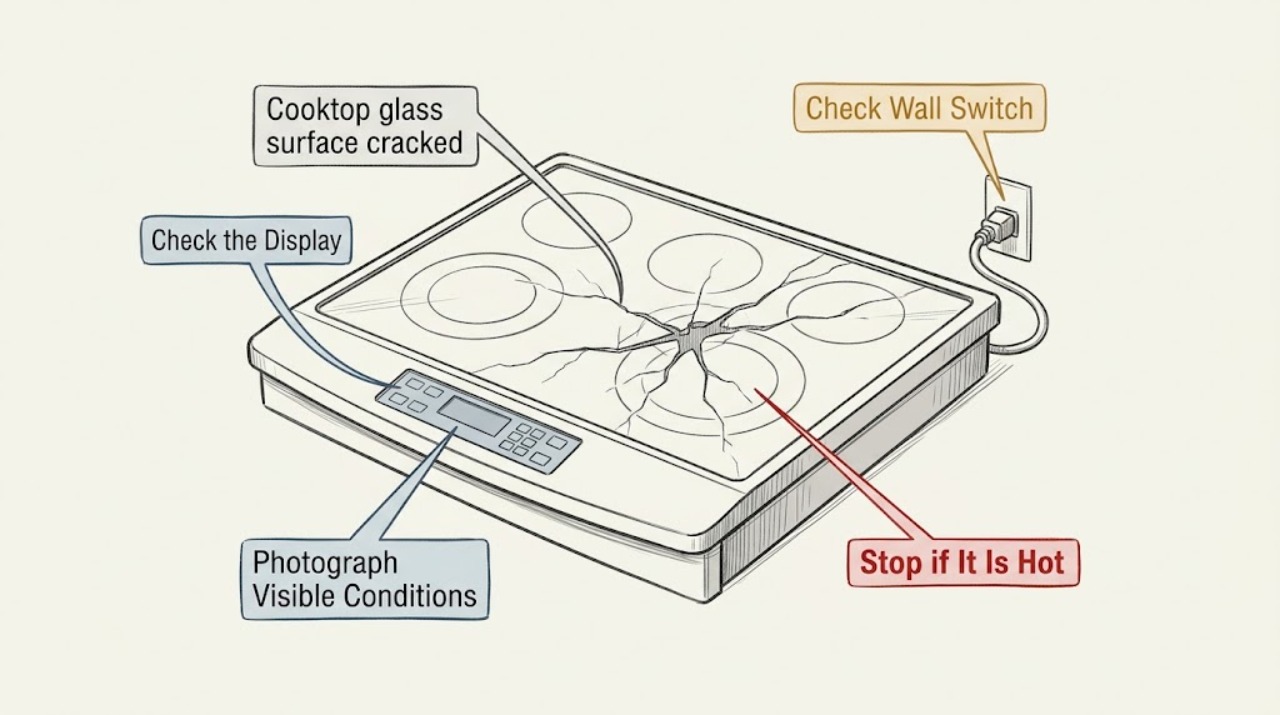
Do not use or clean a GE cooktop if its ceramic glass surface is cracked, broken, or pitted. Turn all controls off, keep cookware and people away from the damaged area, and isolate the electrical supply at the breaker only if you can do so safely; a gas-on-glass model may also require the gas supply to be handled by a qualified professional. Do not test a burner, apply cleaner, pour water, tape the crack, or scrape near it. A mark that is only a removable pan deposit can look different from a true split, but if you cannot confidently distinguish it without touching the surface, treat it as cracked. Record the exact model and serial information and arrange qualified GE appliance service. On a range, do not use the oven until GE has confirmed the cracked cooktop is safe to repair and operate.
Before you begin
Safety first
- Homeowner-safe steps are turning controls off, keeping clear of the damaged surface, recording the model and serial information, taking photographs without touching the glass, and isolating a clearly identified circuit when safe. Glass removal, cooktop lifting, wiring, element/control inspection, gas supply work, and live testing belong to a qualified professional.
Work through in order
Diagnostic checks
Use only checks that match the exact appliance or system and its official guide.
-
Check 1
Turn every cooktop control off and keep hands, cookware, children, and pets away from the damaged area; do not turn a burner on to see whether the crack is active or to test whether the glass still feels solid.
Expected result: The surface is cool and untouched, a hot pan is still present, the crack has sharp or loose edges, or a burner/indicator remains on.
Next step: Allow cookware to cool without moving it across the damage. If a burner will not turn off, keep clear and use qualified emergency or appliance help; do not touch the glass or controls near the break.
Why this matters
Why: Heat and loose glass increase burn and cut risk, while an active element or indicator means the appliance may still be energized. A crack is unsafe even if all burners appear to work.
-
Check 2
From a dry, safe location, identify the cooktop’s electrical disconnect or breaker and switch it off only if you can positively identify the correct circuit; do not remove the cooktop, access wiring, or rely on the knob position as proof of de-energization.
Expected result: The appliance is safely disconnected, the breaker is unknown or shared, the cooktop has no accessible disconnect, or the unit is gas-on-glass with a separate gas supply.
Next step: Leave the cooktop off and arrange qualified appliance/electrical service when the circuit cannot be safely isolated. Do not remove panels or open the junction box to confirm power.
Why this matters
Why: A broken glass surface can expose a path for liquid to reach electrical parts. An uncertain or shared disconnect creates additional shock and interruption risks, and gas supply work is a separate qualified task.
-
Check 3
Without touching the damaged surface, inspect it under good light from several angles and photograph the line, chip, or pitted area; compare only its appearance with a known pan mark or scratch, not by running a finger or scraper over it.
Expected result: The line branches, has a chip, changes width, catches light as a split, exposes a sharp edge, or appears to be a flat removable mark with no break in the glass.
Next step: Treat any uncertain, chipped, branching, or pitted area as damaged and keep the appliance off. Do not attempt normal cleaning to prove a crack is only a mark; let service make the final determination.
Why this matters
Why: Branching lines, chips, edges, and changes in the glass plane are consistent with damage that requires service. A flat mark may be residue or a scratch, but an image cannot prove structural integrity and a pitted surface is also a GE service condition.
-
Check 4
Record the GE model and serial number from the rating label or owner documents without moving the cooktop or lifting the glass; note whether it is a standalone cooktop or a range and whether it is radiant, induction, or gas-on-glass.
Expected result: The exact model is available, only a partial label is readable, or the label cannot be reached without removing trim or the appliance.
Next step: Provide all readable identifiers and photographs to the service provider. Do not remove trim, lift the cooktop, or select a replacement glass panel from dimensions alone.
Why this matters
Why: The model determines the replacement glass assembly, heating system, frame, and access method. A partial or missing identifier increases the risk of ordering a visually similar but unsafe part.
-
Check 5
Check the area around the crack from a distance for spilled liquid, food, smoke, a hot-surface indicator, tripped power, or a burner that behaved abnormally; do not wipe, rinse, or pour anything onto the damaged surface.
Expected result: Liquid or food has entered the crack, smoke or odor is present, an indicator stays lit, controls behave abnormally, or the damage is dry with no operating symptom.
Next step: Keep power isolated and the area clear. For smoke, arcing, or fire use emergency assistance; otherwise arrange qualified service and disclose any spill or abnormal operation.
Why this matters
Why: Liquid or debris can penetrate broken glass and increase shock or internal contamination risk. Smoke, odor, a stuck indicator, or abnormal control behavior suggests an active electrical or thermal fault. Dry damage still requires replacement/service before use.
-
Check 6
If the damaged surface is part of a GE range, leave the oven off as well and do not use its vented heat path until service confirms the cooktop assembly is repaired; do not cover the crack with foil, a mat, or cookware.
Expected result: The appliance is a range with an oven below, a separate cooktop, or the oven was running when the damage occurred.
Next step: Leave the entire appliance out of service and arrange a model-specific inspection. Keep the oven and cooktop controls off rather than testing whether only one section still works.
Why this matters
Why: GE advises against oven use on ranges with a cracked cooktop because oven heat vents near or onto the cooktop. Covering the damage can conceal worsening cracks, trap heat, or allow liquid to spread.
-
Check 7
Arrange qualified GE appliance service with the model information and photographs, and ask the technician to inspect the glass assembly and adjacent elements, controls, insulation, frame, and wiring before any replacement is installed.
Expected result: Service confirms a replaceable glass assembly, finds secondary component damage, identifies only a scratch/mark, or reports that the model information is insufficient.
Next step: Use only the exact model’s approved parts and repair procedure. Do not resume cooking until service confirms the repaired surface and controls are safe.
Why this matters
Why: A glass replacement may not be the only affected part after impact, thermal shock, or liquid penetration. A confirmed scratch or mark changes the repair decision, but that determination should be made without energizing a suspected crack.
Use your observations
Decision map
Find the observation that best matches what you see, then follow the next safe action.
-
PATH 01Next step
What you see
The glass has a branching line, chip, open edge, pitting, or any break that cannot be confidently classified as a superficial mark.
Do this next
Keep the appliance off and do not clean it. Isolate power only when safe, keep people away, and arrange qualified service with the exact model.
Why this path and its safety boundary
Why it matters: GE treats cracked or pitted glass as a service condition across radiant, induction, and gas-on-glass cooktops; continued use could expose the user to heat, cuts, or electric shock.
-
PATH 02Next step
What you see
The surface appears to have a flat pan mark or scratch with no chip or split, but the classification is based only on appearance.
Do this next
Do not heat or scrape the area to test it. Have service or the exact owner’s guidance confirm it is an intact mark before normal use; if uncertain, keep it off.
Why this path and its safety boundary
Why it matters: GE describes marks, mineral deposits, and some scratches that may be removable on an intact cool glass surface, but appearance alone cannot verify that the glass is structurally safe.
-
PATH 03Next step
What you see
Liquid entered the crack, a burner or indicator stays on, smoke/odor/arcing occurs, or the appliance trips power.
Do this next
Do not touch or test the cooktop. Isolate power if safe, leave the area for smoke or fire, and arrange qualified appliance/electrical service with the spill and symptom details.
Why this path and its safety boundary
Why it matters: The damaged surface may have allowed contamination or created an active electrical/thermal fault beyond a glass-only replacement.
-
PATH 04Next step
What you see
The cracked glass is on a GE range with an oven below, or the oven was used after the crack appeared.
Do this next
Leave both oven and cooktop off and request service. Do not use the oven as a substitute for the cooktop or cover the damaged surface.
Why this path and its safety boundary
Why it matters: GE specifically cautions against oven use until a cracked cooktop is repaired because oven heat vents near the cooktop; heat may also worsen damage.
-
PATH 05Next step
What you see
The surface is confirmed intact and only a removable mark is diagnosed, with no chip, pitting, abnormal heat, controls issue, or liquid penetration.
Do this next
Follow the exact GE cleaning instructions for that model and material, using non-abrasive approved methods. Stop if a line, chip, pitting, or new damage becomes visible.
Why this path and its safety boundary
Why it matters: Routine cool-surface cleaning may be appropriate, while a true crack has been excluded by the inspection rather than by a home stress test.
Helpful context
Understand the symptom
A crack is a stop condition, not a cosmetic repair
A true crack can allow liquid, food, or cleaning solution to reach energized parts below the glass. Heat can also worsen damage, and a sharp edge can cut someone. GE’s own guidance applies the no-use rule to radiant, induction, and gas-on-glass cooktops, so the safe first decision does not depend on which heating technology is underneath.
Do not mistake a surface mark for permission to cook
Metal transfer, mineral deposits, pan residue, and scratches can sometimes look like a crack in photographs or poor light. Cleaning guidance applies only to a cool, intact surface. If the line catches a fingernail, branches, changes with the light, has a chip or raised edge, or you cannot inspect it without touching a potentially sharp area, leave the cooktop off and have service identify it.
The repair needs the exact model
GE glass assemblies are not universal by appearance. The cooktop type, dimensions, burner layout, controls, brackets, and electrical connections affect fitment. A model number lets the service provider identify the correct glass assembly and check whether nearby elements, insulation, controls, or frame parts also need inspection.
Safety boundary
Stop conditions
- Do not operate or clean a GE cooktop with cracked, broken, chipped, or pitted glass. Spillovers and cleaning solutions can penetrate the damage and create an electric-shock risk.
- Do not touch suspected shards, pour water or cleaner on the surface, scrape across a suspected crack, cover it with foil or a mat, or test a burner to see whether the appliance still works.
- Do not remove the glass, lift the cooktop, access wiring, or replace a glass assembly without the exact model procedure and qualified appliance skills. Do not choose a panel by appearance or dimensions alone.
- For smoke, arcing, fire, a burner that will not turn off, water near electrical parts, or an immediate cut/burn hazard, keep clear, isolate power only when safe, and use emergency or qualified help.
Only after diagnosis
Potential parts
- GE model-specific glass cooktop or maintop assembly
Only consider this assembly after the exact GE model is identified and service confirms that the damage is limited to the glass assembly and the replacement is approved for that appliance.
Glass type, dimensions, burner cutouts, controls, frame, brackets, insulation, and connectors vary by model; confirm manufacturer fit information before ordering or installing. - GE cooktop surface support or adjacent heating/control component
Only consider an adjacent element, frame, support, or control part if inspection finds secondary damage after impact, thermal stress, or liquid penetration; a crack alone does not identify the affected component.
Adjacent parts and electrical connections are model-specific and require qualified disassembly and testing; do not substitute a generic component.
When checks do not resolve it
Need a professional?
Safety scope: Homeowner-safe steps are turning controls off, keeping clear of the damaged surface, recording the model and serial information, taking photographs without touching the glass, and isolating a clearly identified circuit when safe. Glass removal, cooktop lifting, wiring, element/control inspection, gas supply work, and live testing belong to a qualified professional.
Common questions
FAQ
Can I use a GE cooktop with a small crack in the glass?
No. GE says not to use a cooktop with cracked or pitted glass and recommends service before use, regardless of whether the surface is radiant, induction, or gas-on-glass. A small crack can still allow liquid through and create an electric-shock or cut hazard.
Can I clean a GE glass cooktop that is cracked?
Do not clean a suspected crack. GE warns that cleaning solutions or spillovers can penetrate broken glass. Keep the surface off and have service determine whether the line is damage or an intact removable mark.
How can I tell a crack from a scratch or pan mark?
Look without touching for branching lines, a chip, pitting, an edge, or a line that changes with the light. Marks and some scratches can be removable on an intact cool surface, but appearance alone is not a safety test. If uncertain, leave the cooktop off and request service.
Can I still use the oven if the GE range cooktop glass is cracked?
GE does not recommend using the oven on a range until the cracked cooktop is repaired, because the oven vents near or onto the cooktop. Leave the entire range out of service and arrange inspection.
Does a cracked GE cooktop glass surface need a whole new appliance?
Not necessarily. Service must identify the exact model and inspect the glass assembly and adjacent elements, controls, frame, insulation, and wiring. A model-specific glass or maintop assembly may be appropriate, but do not order one by appearance or dimensions alone.
Read the exact guide
Official sources
- GE Cooktop Important Safety InstructionsGE Appliances · Official GE safety manual for a cooktop model family; current model instructions control exact disconnect and service details.
- Electric Range & Cooktop - Scratches on Glass CooktopGE Appliances · GE electric smooth-top guidance for distinguishing marks and scratches; it does not authorize use of a cracked or pitted surface.
- Electric Range & Cooktop - Glass Cooktop Surface Seems Too HotGE Appliances · GE radiant and induction smooth-glass guidance; exact indicator and disconnect behavior vary by model.
- Electric Range & Cooktop - Glass Cooktop Cleaning InstructionsGE Appliances · GE electric glass-cooktop cleaning guidance; only applies to a cool, intact surface and the exact owner’s manual may differ.
- Cooktop - Glass CrackedGE Appliances · GE guidance covering radiant, induction, and gas-on-glass cooktops and ranges.
Community feedback
Share a repair observation
Share a plain-text repair observation. Accepted observations are published automatically; this page may take a moment to update.