
On this page
Start here
Quick answer
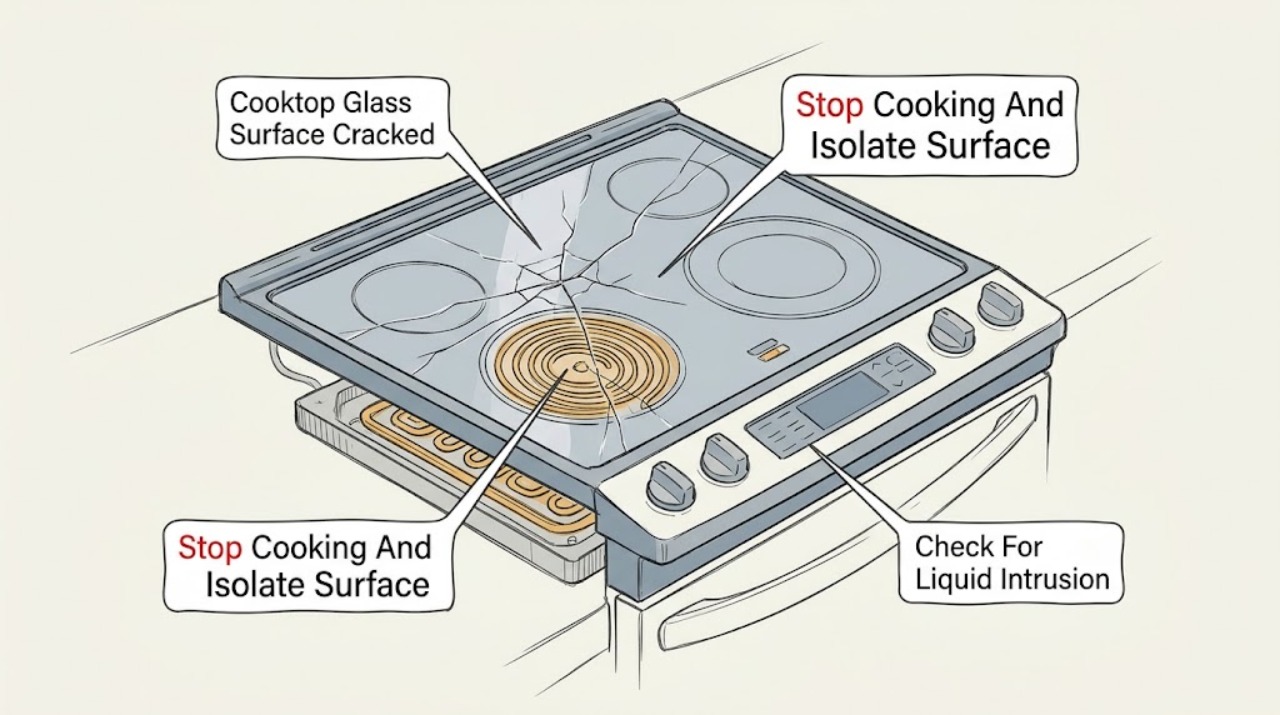
Do not cook on a Bosch cooktop with a cracked glass surface. Turn the appliance off, keep liquids and cookware away from the damaged area, and arrange an authorized service inspection. Bosch's safety guidance warns that a broken surface can let spills penetrate and create an electric-shock risk; the crack is not a surface-cleaning or cosmetic repair. From a safe position, document whether the mark is a true crack, chip, or only a scratch, whether it reaches a control or burner area, and whether the cooktop has heat, odor, smoke, sparks, or erratic controls. Do not scrape, glue, seal, sand, remove the glass, or open the cooktop to test it. The model and rating-plate information lets the technician identify the correct glass or cooktop assembly, but a part should not be selected from appearance alone.
Work through in order
Diagnostic checks
Use only checks that match the exact appliance or system and its official guide.
-
Check 1
Stop all cooking and turn the Bosch cooktop off using its normal controls from a dry, safe position. Keep cookware, cleaning liquid, and hands away from the damaged area. If the controls do not respond or the surface is hot, do not touch the glass; wait for it to cool and follow the model manual's safety direction.
Expected result: The cooktop turns off normally, a zone remains hot or energized, the controls do not respond, or smoke, odor, sparks, or other electrical symptoms are present.
Next step: Keep the appliance out of use and arrange authorized Bosch or qualified appliance service. For smoke, active sparking, or fire, move away and use local emergency guidance; do not pour water on an electrical or grease fire.
Stop if: Do not cook, heat the crack to observe it, touch a hot surface, or keep cycling a control that will not switch off.
Why this matters
Why: A cracked surface can allow liquid to reach electrical parts, so continued cooking is unsafe even if one zone still works. A control that will not turn off or any smoke, odor, or sparking raises the urgency beyond a routine glass replacement.
-
Check 2
Only after the surface is fully cool and the appliance is off, inspect the mark under ordinary light without applying pressure. Note whether it is a line through the glass, a chip or missing piece, a star-shaped fracture, a surface scuff, or damage near a control, frame, or heating zone. Do not scrape, sand, polish, glue, or press on the mark.
Expected result: The mark is an obvious crack or chip, catches a fingernail or has a visible edge, branches from an impact point, reaches a control or frame, or appears to be only a superficial scuff.
Next step: Photograph the cool surface for service and keep the cooktop unused. Ask Bosch or an authorized servicer to confirm whether the surface or complete cooktop assembly must be replaced; do not attempt a cosmetic repair.
Stop if: Do not test the mark with a burner, scrape it with a blade, fill it with sealant, or continue using the cooktop because the line looks shallow.
Why this matters
Why: A crack, chip, or fracture is a broken surface regardless of whether heating still works and should be treated as a service condition. A possible scuff cannot be declared safe from a visual check alone; abrasive cleaning or a heat test can make damage worse.
-
Check 3
From outside the cooktop, look for liquid or food residue in or alongside the break, a lifted or sharp glass edge, frame separation, discoloration, a control panel that behaves abnormally, or damage from a dropped or overheated pan. Do not wipe liquid into the crack and do not remove the frame or glass to inspect beneath it.
Expected result: Liquid or residue has entered the break, the glass edge is raised or sharp, the frame is damaged, controls are erratic, or the surrounding surface is dry and stable.
Next step: Keep power and use off and tell the technician about any spill, impact, control symptom, or sharp edge. Keep people away from the damaged area; do not attempt to remove fragments or clean inside the break.
Stop if: Do not touch exposed fragments, pour cleaner or water on the cooktop, or open the appliance to dry or inspect it.
Why this matters
Why: Liquid intrusion and damaged edges increase the chance of electric shock, cuts, or additional internal damage. A dry surface does not make a confirmed crack safe; Bosch still directs the user to switch off and obtain authorized service.
-
Check 4
Record the Bosch cooktop model or E-Nr. from the rating plate, manual, or existing appliance records without removing panels. Photograph the full surface and close-ups of the damage, and note when the crack appeared, whether a pan or thermal event preceded it, and whether any zone or control changed behavior.
Expected result: The model and rating-plate information are available, the model is unknown, the crack followed an impact or heat event, or there were control, heat, or odor symptoms.
Next step: Give the model, photographs, and symptom history to Bosch or an authorized servicer. If the model cannot be identified without disassembly, leave that identification to the technician.
Stop if: Do not remove the cooktop from the counter, lift the glass, or expose wiring to find a label.
Why this matters
Why: Bosch cooktop glass, frame, controls, and heating assemblies are model-specific. The damage history helps the servicer distinguish a surface replacement from a broader inspection, but it does not justify selecting a part or re-energizing the appliance.
-
Check 5
Confirm from a dry, safe position that the cooktop remains switched off and that no one is using it while service is pending. If the model manual and the home's electrical labeling clearly identify the dedicated supply disconnect, have a qualified person isolate it when needed; do not open the electrical panel or test the circuit yourself.
Expected result: The cooktop is off and isolated, the normal controls cannot switch it off, the dedicated disconnect is unknown, or a breaker trips or shows heat or damage.
Next step: Leave the appliance unused and arrange authorized appliance service; use qualified electrical help for the supply or disconnect. Provide the model and photographs so the service visit can address the correct assembly and any underlying damage.
Stop if: Do not reset a repeatedly tripping breaker, remove an electrical cover, probe terminals, or restore power to test a cracked cooktop.
Why this matters
Why: A cracked surface remains an electrical safety boundary even when the controls appear off. An unknown or damaged disconnect, a tripping breaker, or heat at the electrical equipment requires qualified electrical assessment rather than repeated resets.
-
Check 6
Keep the Bosch cooktop clear and protected from impact while waiting for service. Do not use it as a counter, place cookware or storage items on the glass, or clean it with abrasive pads, rough cookware, or unapproved chemicals. Recheck only visually from a safe distance for spreading cracks or new hazards.
Expected result: The crack spreads, a fragment loosens, liquid reaches the break, or the damage remains unchanged with the appliance unused.
Next step: Keep people away from the area and update the service request with any change. Do not resume cooking until an authorized servicer confirms the repair and safe operation.
Stop if: Do not tape over the crack as a repair, handle loose shards, or use the cooktop while waiting for an appointment.
Why this matters
Why: Movement, impact, moisture, and abrasive contact can worsen a damaged glass surface. An unchanged appearance does not restore safe operation; a spreading crack or fragment makes the service boundary more urgent.
Use your observations
Decision map
Find the observation that best matches what you see, then follow the next safe action.
-
PATH 01Next step
What you see
The mark is a visible crack, chip, star fracture, raised edge, or missing glass, even if every burner and control still works.
Do this next
Keep the Bosch cooktop switched off and arrange authorized service immediately. Provide the model or E-Nr. and photographs; do not cook or apply sealant.
Why this path and its safety boundary
Why it matters: The surface is broken and cannot be cleared as a cosmetic issue by a home heat test.
-
PATH 02Next step
What you see
The cool, unused surface appears to have a superficial scuff with no visible break, chip, sharp edge, or liquid entry.
Do this next
Use only Bosch's cool-surface care guidance for a confirmed scratch and avoid rough cookware or abrasive cleaning. If there is any doubt that the surface is intact, keep it off and ask an authorized servicer to inspect it.
Why this path and its safety boundary
Why it matters: A scratch may be cosmetic, but appearance alone cannot authorize heating a questionable surface; abrasive tools can also create or worsen marks.
-
PATH 03Next step
What you see
A spill has entered the crack, the edge is sharp or loose, or the frame or controls show secondary damage.
Do this next
Keep everyone away from the damaged area, leave the cooktop off, and arrange authorized appliance service. Do not wipe into the break or remove fragments.
Why this path and its safety boundary
Why it matters: Moisture, cut, and electric-shock risks are elevated and the cooktop should not be handled as a cleaning problem.
-
PATH 04Next step
What you see
The cooktop will not switch off normally, controls act erratically, a breaker trips, or there is smoke, burning odor, heat, or sparking.
Do this next
Stop using the cooktop and obtain qualified appliance or electrical help; use local emergency guidance for smoke, fire, or active sparking. Do not restore power to test it.
Why this path and its safety boundary
Why it matters: This is an active electrical safety condition rather than a glass appearance issue.
-
PATH 05Next step
What you see
The model cannot be identified without disassembly, the crack followed an impact or thermal event, or a burner or control also changed behavior.
Do this next
Have an authorized Bosch servicer identify the model and inspect the complete cooktop. Do not remove the appliance from the counter or select a replacement panel by visual similarity.
Why this path and its safety boundary
Why it matters: A glass-only replacement cannot be assumed; the frame, controls, heating assembly, or installation may also need inspection.
Helpful context
Understand the symptom
A crack changes the safety decision immediately
A scratch and a crack are not the same condition, but a user cannot safely prove that a damaged-looking line is harmless by heating the cooktop or pouring cleaner over it. Bosch's safety instructions treat a cracked surface as a reason to switch off the appliance and prohibit cooking on a broken cooktop because spills can penetrate the break. That means the first response is to stop use and arrange diagnosis, not to polish the mark or test a burner.
Do not mistake a cosmetic mark for permission to keep cooking
A shallow scratch may be cosmetic, while a chip, star-shaped fracture, line that catches a fingernail, or crack that changes as the glass warms can involve the cooktop surface. Without the exact model and an inspection, do not classify a mark by appearance alone. Bosch's care guidance also warns against rough cookware and abrasive tools because they can damage the glass, but those prevention steps do not repair a crack.
Only after diagnosis
Potential parts
- model-specific Bosch cooktop glass or complete cooktop assembly
Consider this only after an authorized servicer confirms that the visible crack is repairable by replacing the correct glass or complete assembly and checks for underlying control or heating damage.
Bosch glass surfaces, frames, heating zones, controls, and mounting hardware vary by E-Nr. Confirm the exact model and professional diagnosis before selection or installation. - model-specific Bosch frame, control, or mounting component
Consider this only if the service inspection finds impact, heat, frame, control, or mounting damage beyond the glass surface.
These components are model- and revision-specific and require safe appliance access. Do not infer the need from a photo or order a generic substitute.
When checks do not resolve it
Need a professional?
Do not use a Bosch cooktop with a confirmed or suspected cracked glass surface. Arrange an authorized Bosch service inspection for any crack, chip, sharp edge, liquid entry, spreading damage, unknown model, or underlying control or heating symptom. Use qualified electrical help when the appliance will not switch off, a breaker trips, wiring or the disconnect is damaged, or smoke, burning odor, heat, or sparking is present; use local emergency guidance for fire or active electrical danger. Do not cook, clean into the break, glue or seal the glass, remove panels, lift the cooktop, probe wiring, or restore power as a test.
Common questions
FAQ
Can I use a Bosch cooktop with a small crack in the glass?
No. Bosch's safety instructions say to switch off a cooktop with a cracked surface, not to cook on a broken cooktop, and to contact an authorized service provider. Do not heat the crack to see whether it worsens.
What should I do if liquid gets into a crack in my Bosch cooktop?
Stop using the cooktop and keep hands, cookware, and more liquid away from the damaged area. Bosch warns that spills can penetrate a broken cooktop and create an electric-shock risk. Do not wipe into the crack or open the appliance; arrange authorized service.
How can I tell whether the mark is a scratch or a crack?
After the cooktop is cool and off, look without pressing on the surface. A chip, missing piece, sharp edge, branching fracture, or line through the glass should be treated as a crack. A superficial scuff may be cosmetic, but do not use heat or abrasive tools to prove it; ask Bosch service if the surface is uncertain.
Can I repair a cracked Bosch cooktop with glue or sealant?
No. A crack is a safety and appliance-service condition, not a sealing or polishing job. Keep the appliance off and have an authorized servicer identify whether the exact model needs a glass surface or a complete cooktop assembly.
What information does a Bosch technician need for a cracked cooktop?
Provide the Bosch model or E-Nr. if available, photographs of the full surface and crack, when the damage appeared, any impact or heat event, whether liquid entered the break, and any control, heat, odor, or breaker symptoms. Bosch's parts lookup uses the appliance model to identify the applicable cooktop components.
Read the exact guide
Official sources
- Scratched Bosch Glass CooktopBosch Home Appliances · Bosch electric and induction glass cooktop scratch prevention and limits of scratch repair
- Bosch Electric Cooktop Replacement Parts.Bosch Home Appliances · Bosch electric cooktop model-number lookup and model-specific glass, cooktop, frame, control, and mounting parts
- Use and Care Manual NEM5466UC | Bosch, Manuel d'utilisation NEM5466UC | Bosch, Manual del usuario NEM5466UC | BoschBosch Home Appliances · Bosch electric cooktop safety, cracked-surface stop-use instruction, spill and electric-shock warning, and service boundary
- Bosch Electric Cooktop Troubleshooting & Repair | Bosch – Fix Cooktop Not Heating, Not Turning on & Other ProblemsBosch Home Appliances · Bosch electric and induction cooktop troubleshooting, cracked-surface repair routing, and authorized service
Community feedback
Share a repair observation
Share a plain-text repair observation. Accepted observations are published automatically; this page may take a moment to update.