
On this page
Start here
Quick answer
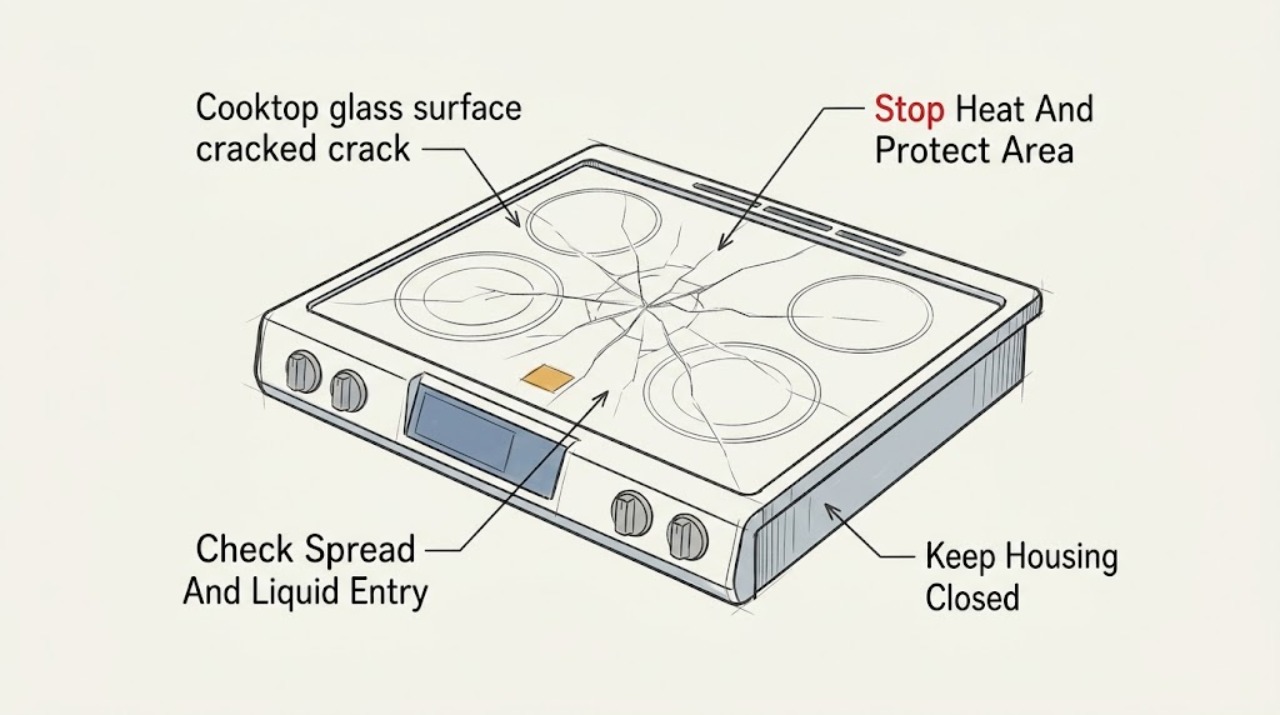
Treat a visible crack, split, or chip that reaches through a glass or ceramic cooktop surface as a stop-use condition, not a cosmetic cleaning problem. Turn all cooking zones off, keep people away from the damaged area, and let the surface cool without touching or cleaning the crack. Once it is cool, note whether the damage is a true crack, a chip or pit, how far it extends, and whether liquid or fragments can enter; do not cook on any zone and do not use the oven on a range if its vent discharges over the damaged cooktop. Manufacturer guidance says cracked or pitted surfaces need service and that the glass surface must be replaced, so arrange model-specific appliance repair rather than using glass glue, a cover, or a temporary patch. If the controls will not turn off, the appliance is hot, the crack is spreading, or liquid has entered the surface, use the appliance's documented disconnect method only if it is safe and accessible and call a qualified technician.
Before you begin
Safety first
- This article covers turning controls off, keeping people away, waiting for the surface to cool, no-touch visual documentation, model identification, and a safely accessible documented disconnect when necessary. Do not use the cooktop or range, clean or repair cracked glass, remove panels, handle wiring or gas, or test the appliance under power.
Work through in order
Diagnostic checks
Use only checks that match the exact appliance or system and its official guide.
-
Check 1
Turn every cooktop control off, remove hands and cookware from the damaged area only when it is safe to do so, and keep children, pets, and loose objects away from the surface while it cools.
Expected result: Confirm that no cooking zone remains visibly active, the surface is no longer being heated, and no person needs to cross the damaged area to reach a control.
Next step: Leave the cooktop unused and proceed only with a no-touch visual record after it is cool; arrange appliance service for the repair decision.
Stop if: Do not touch the crack, move a pan across it, or keep cooking on an apparently unaffected zone.
Why this matters
Why: A visible crack is not an ordinary operating issue. Continued heat or cookware contact can stress the damaged surface, while a hot cracked surface adds burn and fragment risk.
-
Check 2
After the cooktop has cooled completely, inspect the surface from above and from a shallow angle without wiping, scraping, pressing, or running a finger over the damaged area; photograph the visible line, chip, pit, or branching pattern.
Expected result: Record whether the mark is a continuous crack through the surface, a chip or pit, a raised or sharp fragment, or a mark that cannot be distinguished safely from a crack.
Next step: Treat an uncertain or damaged mark as a crack until the manufacturer or technician confirms otherwise; keep the appliance off and include the photographs with the service request.
Stop if: Do not clean a broken or cracked surface, use a razor or scraper to test it, press on the glass, or pick up fragments with bare hands.
Why this matters
Why: A true crack or pit keeps the appliance in the stop-use and service category. An uncertain mark cannot be safely cleared by forceful cleaning, and a sharp or loose fragment adds an immediate cut hazard.
-
Check 3
From a safe position, document whether the crack extends toward a heating zone, control area, edge, seal, or vent, and whether there are visible wet spots, residue, fragments, or an opening through which a spill could enter; do not move the appliance or remove trim.
Expected result: Note a stable hairline, a spreading or branching crack, a separated edge, liquid or cleaner near the break, a loose shard, or damage crossing a control or burner area.
Next step: Keep the appliance isolated from use and tell the technician exactly where the damage and any liquid entry are located; do not attempt to dry an opening by operating a burner or oven.
Stop if: Do not pour water or cleaner on the surface, touch fragments, open the appliance cabinet, or continue if there is smoke, smell, arcing, or an active electrical symptom.
Why this matters
Why: A crack that is spreading, open, wet, sharp, or near controls or heating components raises the urgency and cannot be managed with a cosmetic repair. Manufacturer safety guidance specifically warns that spillovers or cleaning solution can penetrate broken glass.
-
Check 4
Record the appliance model and serial information, whether it is a standalone cooktop or a range, and whether it is radiant, induction, or gas-on-glass; photograph the entire surface and the rating label without removing panels.
Expected result: Confirm whether the oven is part of the same range, whether the crack is near a control or vent, and whether the model information is complete and legible.
Next step: Provide the model, configuration, photographs, and damage location to the manufacturer or qualified appliance technician and wait for repair guidance; do not order a generic glass panel.
Stop if: Do not lift the cooktop, remove screws, disconnect wiring or gas, or use the oven to avoid the cracked surface unless the exact manufacturer and technician instructions explicitly address the repair.
Why this matters
Why: The replacement glass or cooktop assembly and the safe isolation method are model-specific. On a range, oven heat may vent toward the damaged cooktop, so the oven cannot be assumed safe to use while the crack remains.
-
Check 5
If a control remains active, liquid has entered the break, or another electrical symptom appears, use the appliance owner's documented disconnect method only when the switch or disconnect is safely accessible without touching the damaged surface, hot parts, water, or exposed wiring.
Expected result: Record whether all heat and indicator activity stops, whether the disconnect is accessible and dry, and whether smoke, odor, arcing, or a tripped protective device is present.
Next step: Keep the appliance out of use and arrange qualified appliance service; if there is smoke, fire, arcing, or immediate danger, leave the area and contact the appropriate emergency service.
Stop if: Do not reach behind the appliance, handle wet controls, open an electrical panel, remove covers, or restore power to test the cracked surface.
Why this matters
Why: Disconnecting a damaged appliance can reduce ongoing electrical exposure, but an inaccessible, wet, hot, or abnormal disconnect point is not a homeowner repair task. A persistent electrical symptom requires urgent professional assessment.
-
Check 6
After a qualified technician has repaired or replaced the model-specific glass surface or cooktop assembly, inspect the finished surface visually and follow the technician's and owner's instructions for any controlled function check.
Expected result: Confirm that the repaired surface is intact, seated, and free of sharp edges or visible gaps, and that the technician has addressed any liquid-entry, control, heating, or vent concerns.
Next step: Use the cooktop only after the technician releases it for service and the owner's instructions permit operation; report any new crack, gap, smell, heat, or control fault immediately.
Stop if: Do not cook on a surface with a new crack, sharp edge, loose trim, visible gap, or unresolved electrical or gas symptom.
Why this matters
Why: A replacement surface is not verified merely because the crack is no longer visible; the assembly, seals, controls, and appliance-specific safety functions must be returned to the manufacturer's intended condition.
Use your observations
Decision map
Find the observation that best matches what you see, then follow the next safe action.
-
PATH 01Safety boundary
What you see
The visible line is a crack through the glass or the surface has a chip, pit, or indentation that cannot be removed without force.
Do this next
Keep every cooking zone off, document the model and damage, and arrange qualified appliance service for the correct glass or cooktop assembly.
Why this path and its safety boundary
Why it matters: This is a service and likely surface-replacement condition, not a scratch-cleaning problem. Manufacturer guidance says not to use the cooktop until repaired.
Safety stop: Do not cook, clean, scrape, fill, glue, sand, or cover the damaged surface as a substitute for repair.
-
PATH 02Safety boundary
What you see
The mark cannot be confirmed safely as a crack after the cool, no-touch visual inspection, and there is no loose or sharp fragment.
Do this next
Keep the appliance off until the owner's manual or manufacturer service confirms the mark, and supply photographs and the model rather than scraping or pressing the glass.
Why this path and its safety boundary
Why it matters: It may be a scratch, metal transfer, residue, or a crack that is difficult to see; aggressive cleaning can turn an uncertain condition into damage.
Safety stop: Do not use a razor, abrasive powder, steel wool, knife, or pressure to prove that the mark is cosmetic.
-
PATH 03Safety boundary
What you see
The crack is spreading or branching, has a sharp or loose edge, has visible liquid or cleaner near it, or crosses a control, heating zone, or surface edge.
Do this next
Keep people away, do not move the appliance, use a safe documented disconnect only if accessible and dry, and request prompt qualified service.
Why this path and its safety boundary
Why it matters: The risk is higher because heat, liquid entry, or fragments can affect the appliance and people nearby; visual cleaning is not an adequate response.
Safety stop: Do not touch fragments, pour liquid on the surface, restore power, or open the appliance cabinet.
-
PATH 04Safety boundary
What you see
The cracked glass is part of a range that also has an oven venting toward or across the cooktop.
Do this next
Leave both the cooktop and oven unused until the surface is repaired and the technician or manufacturer clears the appliance.
Why this path and its safety boundary
Why it matters: Using the oven can expose the damaged cooktop to additional heat, and the oven cannot be treated as independent merely because its controls still work.
Safety stop: Do not cover the crack with foil, cookware, or a mat and run the oven or another burner.
-
PATH 05Safety boundary
What you see
The crack is accompanied by smoke, arcing, burning odor, a control that will not turn off, a tripped protective device, or an unusual gas symptom.
Do this next
Leave the area if there is immediate danger, use only a safely accessible documented shutoff or disconnect, and contact qualified emergency or appliance service as appropriate.
Why this path and its safety boundary
Why it matters: The issue has moved beyond a surface replacement decision and may involve an energized or fuel-related hazard.
Safety stop: Do not troubleshoot energized wiring, relight or test gas equipment, restore power, or use the appliance again.
Helpful context
Understand the symptom
A visible crack changes the answer immediately
A crack is different from a removable food mark or a superficial metal transfer. Once the glass or ceramic surface is visibly split, chipped through, or pitted, stop treating the area as a normal cleaning task. Heat, cookware, spills, and cleaning pressure can worsen damage or allow liquid into the appliance.
Do not test a cracked cooktop by using another burner
The damage does not become safe merely because one cooking zone looks unaffected. A cooktop can be radiant, induction, or gas-on-glass, and a range can vent oven heat toward the cooktop. Keep the whole cooktop out of use until the exact appliance has been inspected and the glass surface or assembly is repaired.
The homeowner check is documentation, not glass repair
After the appliance is off and cool, take clear photographs from above and at a shallow angle, record the model and serial information, and describe when the damage appeared. Do not scrape, polish, fill, glue, sand, lift, or remove the glass; replacement and any electrical or gas work belong to a qualified appliance technician.
Safety boundary
Stop conditions
- Do not operate any cooktop zone when the glass surface is visibly cracked, chipped through, or pitted; do not assume another burner is safe. A range oven should also remain off when its vent discharges over the damaged cooktop.
- Do not clean, scrape, polish, press, glue, fill, sand, cover, or remove a cracked glass surface. Spillovers or cleaning solution can penetrate broken glass and create an electrical-shock risk.
- Do not open panels, disconnect wiring or gas, handle fragments, or restore power to test the appliance. Use a documented disconnect only if it is safely accessible, dry, and cool; otherwise leave the area and call qualified service.
- Arrange prompt appliance service for any spreading crack, liquid entry, sharp fragment, smoke, arcing, burning odor, control that will not turn off, or tripped protective device.
Only after diagnosis
Potential parts
- cooktop glass surface or glass-top assembly
Consider this class only after the exact model confirms a cracked, chipped, or pitted surface that requires replacement and the technician verifies that the underlying frame and components are serviceable.
Match the complete appliance model, cooktop technology, dimensions, control layout, and manufacturer fit information; a similar-looking glass panel is not confirmed compatible. - cooktop surface seal or trim
Consider this class only when the technician finds that the model-specific seal or trim was damaged or must be renewed as part of the glass-surface repair.
Confirm the exact appliance model, seal location, heat rating, and installation method; do not use household adhesive or generic sealant on a cooktop. - cooktop heating or control component
Consider this class only when liquid entry, impact, or the model-specific inspection shows that a heating or control component was also damaged by the cracked surface.
Require qualified model-specific diagnosis and fit information; a surface crack alone does not identify a failed control or heating component.
When checks do not resolve it
Need a professional?
Arrange qualified appliance service for any visible crack, chip, pit, or indentation in the cooktop glass, even if only one zone appears affected. Use urgent help for spreading or wet damage, sharp fragments, smoke, arcing, burning odor, a control that will not turn off, a tripped protective device, or an unusual gas symptom. Provide the complete model, appliance type, glass technology, photographs, damage location, and whether any liquid entered the break.
Safety scope: This article covers turning controls off, keeping people away, waiting for the surface to cool, no-touch visual documentation, model identification, and a safely accessible documented disconnect when necessary. Do not use the cooktop or range, clean or repair cracked glass, remove panels, handle wiring or gas, or test the appliance under power.
Common questions
FAQ
Can I use the other burners if one area of the cooktop glass is cracked?
No. A visible crack or pit is a stop-use condition for the cooktop, even if another zone appears unaffected. Heat, cookware, and spills can worsen the damage or allow liquid into the appliance; arrange model-specific service.
Can I still use the oven when a range cooktop is cracked?
Do not assume it is safe. Manufacturer guidance says not to use the oven on a range when its vent discharges over the damaged cooktop; keep the range out of use until the surface is repaired and cleared.
Is a chip or pit in glass cooktop surface as serious as a crack?
Treat a chip, pit, or indentation as damaged glass until the manufacturer or technician confirms otherwise. Manufacturer guidance places pitting and indentation in the service or replacement category, not the ordinary cleaning category.
How should I clean a cracked glass cooktop?
Do not clean or scrape a visibly cracked surface. Turn the appliance off, let it cool, keep people away, document the damage without touching it, and arrange qualified service; broken glass can allow spillovers or cleaning solution to penetrate.
Read the exact guide
Official sources
- Electric Range & Cooktop - Glass Cooktop Cleaning InstructionsGE Appliances · GE electric ranges and cooktops with glass surfaces; cleaning guidance is not permission to clean or use a cracked surface.
- Cooktop - Glass CrackedGE Appliances · GE cooktops and ranges with radiant, induction, or gas-on-glass surfaces; exact model and service instructions control.
- Maintenance of Ceramic GlassWhirlpool Product Help · Whirlpool induction ceramic-glass cooktops covered by the maintenance page; exact appliance instructions control.
- WipeClean Glass Cooktop CleaningWhirlpool Product Help · Whirlpool WipeClean glass cooktops; use the exact appliance manual, and do not apply cleaning instructions to a visibly cracked surface.
- IMPORTANT SAFETY INFORMATIONGE Appliances · The GE appliance safety manual section covering radiant glass cooktop surfaces; exact appliance manual controls where model instructions differ.
Community feedback
Share a repair observation
Share a plain-text repair observation. Accepted observations are published automatically; this page may take a moment to update.