
On this page
Start here
Quick answer
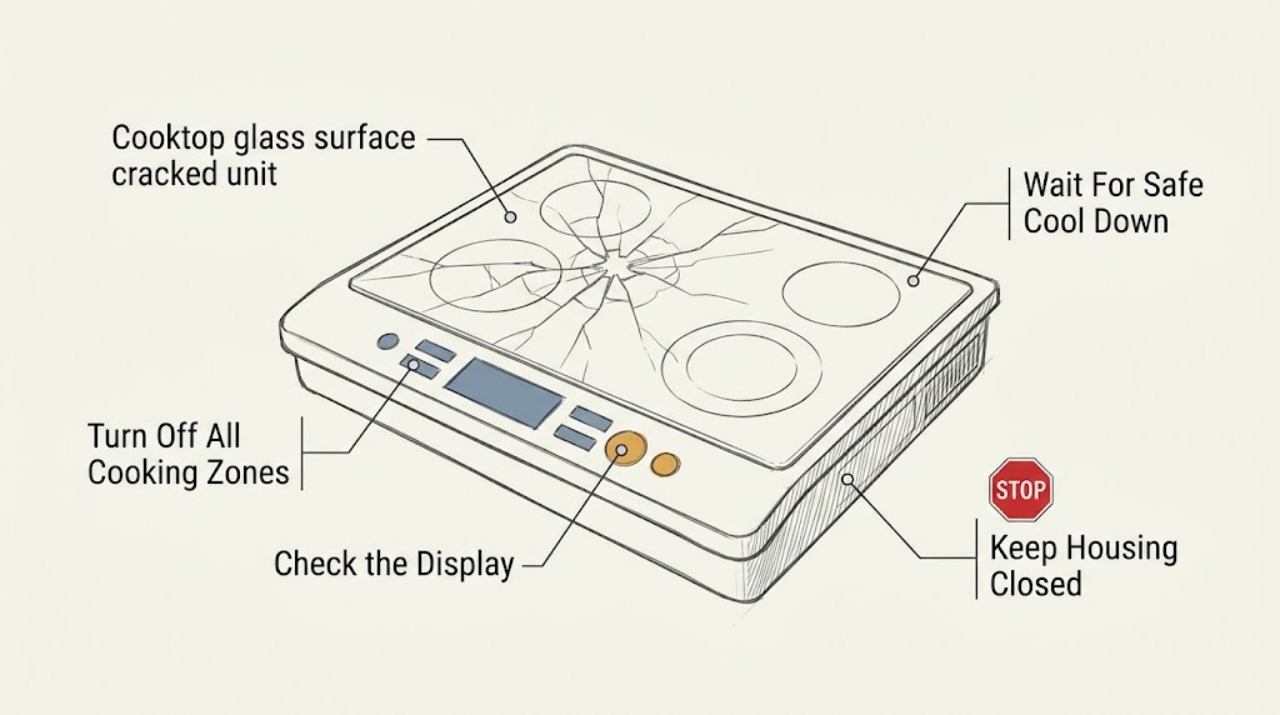
If a cooktop's glass surface is visibly cracked while the unit is still powered, turn all cooking zones off immediately and stop using the appliance. Do not touch, clean, scrape, press, or cover the crack while the surface is hot. When it is cool, make a no-contact visual record of the crack, chips, loose fragments, liquid entry, and model information. If the controls will not turn off, liquid has entered the break, or there is smoke, arcing, burning odor, or an abnormal gas symptom, use the owner's documented disconnect or shutoff only if it is safely accessible, dry, and cool; otherwise move away and get qualified help. Manufacturer guidance says cracked or pitted glass requires service and replacement, so do not test another zone, use the oven on a range, or apply a temporary patch while waiting.
Before you begin
Safety first
- This article covers turning controls off, keeping people away, allowing a safe cool-down, no-contact documentation, model identification, and a safely accessible documented disconnect when necessary. Do not use the cooktop or range, clean or repair cracked glass, handle fragments, remove panels, or test energized electrical or gas components.
Work through in order
Diagnostic checks
Use only checks that match the exact appliance or system and its official guide.
-
Check 1
Turn every cooking-zone control to Off, stop adding cookware or food, and keep everyone away from the cracked surface while the unit remains hot or powered.
Expected result: Confirm that no zone is visibly active, no cookware or liquid is resting on the crack, and the crack is not being touched to move a pan or test the surface.
Next step: Leave the cooktop and, if applicable, the range oven unused; wait for a safe cool-down before making a no-contact record and arranging service.
Stop if: Do not turn another zone on, slide cookware across the crack, or use a cover as permission to keep cooking.
Why this matters
Why: A broken or cracked surface must not be operated. Continuing heat or contact can worsen the damage and can expose people to burns, cuts, or electrical hazards.
-
Check 2
From a safe position, observe whether the controls respond normally after being turned Off and whether there is smoke, arcing, burning odor, unusual sound, liquid entry, or a protective device that trips; do not touch the crack, wiring, or hot surface.
Expected result: Record normal control shutoff versus a control that remains active, a wet or open break, smoke or sparks, an odor, repeated power interruption, or an unusual gas symptom.
Next step: For an abnormal symptom, move away and use only a safely accessible documented disconnect or fuel shutoff if the owner's instructions permit it; otherwise call qualified or emergency help without approaching the appliance.
Stop if: Do not restore power, handle wet controls, open panels, reach behind the unit, or investigate gas or electrical symptoms yourself.
Why this matters
Why: A control or electrical symptom means the problem may extend beyond the glass. Liquid or cleaner can penetrate broken glass, and abnormal heat, smoke, or arcing raises the urgency above a routine replacement appointment.
-
Check 3
Let the cooktop cool completely after all controls are Off, using only the model's residual-heat indication as a guide and keeping hands and objects away from the damaged area.
Expected result: Note whether the hot-surface or residual-heat indication clears, whether the glass is still radiating heat, and whether any fragment or edge has shifted without being touched.
Next step: Once cool, continue with a no-contact visual record only; if heat remains unexpectedly or the crack changes, stop and tell the technician.
Stop if: Do not pour water on the surface, wipe it while hot, place a cold pan over the break, or touch a sharp or loose fragment.
Why this matters
Why: Controls being Off does not mean the glass is immediately cool. Touching or moving cookware on a hot cracked surface can cause burns or disturb fragile fragments.
-
Check 4
After cooling, photograph the entire cooktop and the crack from above and a shallow angle without cleaning, pressing, scraping, lifting, or removing trim; record the complete model and serial information from an accessible label or owner documentation.
Expected result: Record whether the damage is a line, branching split, chip, pit, loose edge, or visible opening, and whether it reaches a cooking zone, control area, perimeter seal, or vent.
Next step: Send the photos, model, appliance type, and control behavior to qualified appliance service; do not order a generic panel or attempt to make the crack look cosmetic.
Stop if: Do not clean a broken surface, use abrasive products or a scraper, remove the glass, or handle fragments with bare hands.
Why this matters
Why: A crack, chip, pit, or indentation keeps the appliance in the service category. The model and appliance configuration determine whether the repair uses a glass surface or a larger cooktop assembly and what disconnect procedure is appropriate.
-
Check 5
If the controls cannot turn the unit off or the crack has liquid entry or an electrical symptom, use the owner's documented power-disconnect method only when the disconnect is safely accessible, dry, cool, and away from the damaged surface.
Expected result: Confirm whether all indicators and heating activity stop, whether the disconnect point was reachable without moving the appliance, and whether any smoke, arcing, heat, or odor continues.
Next step: Keep the appliance out of use and arrange qualified service; leave the area and contact emergency help if smoke, fire, active arcing, or immediate danger persists.
Stop if: Do not reach behind the appliance, open an electrical panel, pull wet plugs, remove covers, or restore power to test the crack.
Why this matters
Why: Removing power can stop an active appliance, but an inaccessible, wet, hot, or abnormal disconnect point is not a safe homeowner task. Continued symptoms require professional or emergency response.
-
Check 6
After a qualified technician repairs or replaces the model-specific glass surface or cooktop assembly, inspect the finished surface visually and follow the technician's and owner's instructions for any controlled function check.
Expected result: Confirm that the surface is intact and seated, no sharp edges or gaps remain, all controls are normal, and any liquid-entry or electrical concern has been addressed before operation is released.
Next step: Use the cooktop only after the technician or manufacturer clears it and the owner's instructions permit operation; report any new crack, gap, heat, smell, or control fault immediately.
Stop if: Do not cook on a repaired surface with a new crack, loose trim, visible gap, unresolved heat or control issue, or any electrical or gas symptom.
Why this matters
Why: Removing the visible crack is not enough to verify a safe repair if the assembly, seals, controls, heating components, or wiring were affected.
Use your observations
Decision map
Find the observation that best matches what you see, then follow the next safe action.
-
PATH 01Safety boundary
What you see
The controls turn all cooking zones Off, there is no smoke, odor, arcing, liquid entry, or loose fragment, and the surface is cooling.
Do this next
Leave the cooktop and any affected range oven unused, document the model and damage after cooling, and arrange qualified surface or cooktop service.
Why this path and its safety boundary
Why it matters: The immediate powered hazard appears controlled, but the visible crack remains a stop-use and service condition; normal controls do not make the glass safe to operate.
Safety stop: Do not resume cooking, clean the crack, or test another zone while waiting for service.
-
PATH 02Safety boundary
What you see
A control remains active, liquid or cleaner is near or inside the break, the crack is open or spreading, or a sharp or loose fragment is visible.
Do this next
Keep people away, do not touch or move the appliance, and use only a safely accessible documented disconnect if possible; obtain prompt qualified service.
Why this path and its safety boundary
Why it matters: The risk is higher than a stable surface crack because energized or wet components, heat, and fragments may be involved.
Safety stop: Do not reach behind the unit, wipe the break, handle fragments, restore power, or continue troubleshooting.
-
PATH 03Safety boundary
What you see
The powered cooktop produces smoke, visible arcing, a burning odor, a repeated protective-device trip, or an unusual gas symptom.
Do this next
Leave the area if there is immediate danger and contact appropriate emergency or qualified service help; use a shutoff or disconnect only when it is safely accessible and the manufacturer's instructions support it.
Why this path and its safety boundary
Why it matters: This may be an active electrical, fire, or fuel-related hazard and is beyond a glass-replacement decision.
Safety stop: Do not investigate energized wiring, relight gas, restore power, or approach the cracked surface to test it.
-
PATH 04Safety boundary
What you see
The cracked surface is part of a range whose oven vents toward or across the cooktop.
Do this next
Keep both the oven and cooktop off until the glass or assembly is repaired and the technician or manufacturer clears the range.
Why this path and its safety boundary
Why it matters: The oven can expose the damaged cooktop to additional heat, so the oven cannot be treated as independent while the crack remains.
Safety stop: Do not place foil, a pan, mat, or cover over the crack and run the oven or another zone.
-
PATH 05Safety boundary
What you see
After the surface is cool, the mark cannot be confirmed safely as a crack, and there are no sharp fragments or openings.
Do this next
Keep the appliance off until the exact owner manual or manufacturer service confirms the condition; provide no-touch photographs and model information.
Why this path and its safety boundary
Why it matters: It may be a scratch or residue, but an uncertain mark should not be made safe by pressure or abrasive cleaning while the unit's damage status is unresolved.
Safety stop: Do not use a razor, abrasive cleaner, knife, polish, or pressure to prove that the mark is cosmetic.
Helpful context
Understand the symptom
Power changes the first step, not the repair decision
A powered cooktop with a visible crack is an active safety concern. Turn the controls off and stop cooking; do not wait to see whether the crack spreads or whether another zone still heats. The visible crack remains a stop-use and service condition even if indicators go dark.
Cool the surface before documenting it
Glass and ceramic surfaces can remain hot after the controls are turned off. Keep hands, cookware, liquids, and people away until the surface has cooled. Then photograph the damage without rubbing or pressing it; a cool no-touch record is enough for the manufacturer or technician to identify the next step.
A crack is not a cosmetic repair
Do not use cleaner, a scraper, adhesive, foil, a mat, or a temporary cover to bridge the damage. Spillovers or cleaning solution can enter broken glass, and an internal repair requires model-specific access and electrical or gas safety. The technician may need to replace the glass surface or the complete cooktop assembly.
Safety boundary
Stop conditions
- Turn all cooking zones Off and do not operate a cooktop with cracked, chipped-through, or pitted glass. On a range, keep the oven off when its vent discharges over the damaged cooktop.
- Do not clean, scrape, press, polish, glue, fill, sand, cover, or remove cracked glass. Spillovers or cleaning solution can penetrate broken glass and create an electrical-shock risk.
- Do not reach behind the appliance, open panels, handle wiring or gas, touch fragments, or restore power to test the damage. Use a documented disconnect only when it is safely accessible, dry, and cool.
- Leave the area and obtain prompt qualified or emergency help for smoke, arcing, burning odor, a control that will not turn off, liquid entry, a repeated protective-device trip, an unusual gas symptom, or spreading or sharp damage.
Only after diagnosis
Potential parts
- cooktop glass surface or glass-top assembly
Consider this class only after the exact model confirms that the visible crack, chip, or pit requires surface replacement and a technician verifies the frame and underlying components.
Match the complete appliance model, glass technology, dimensions, control layout, and manufacturer fit information; a similar-looking panel is not confirmed compatible. - cooktop surface seal or trim
Consider this class only when the technician finds that the model-specific seal or trim was damaged or must be renewed with the glass repair.
Confirm the exact appliance model, seal location, heat rating, and installation method; do not use household adhesive or generic sealant. - cooktop heating, control, or wiring component
Consider this class only when qualified inspection shows that liquid entry, impact, or the crack also affected a model-specific heating, control, or wiring component.
Require qualified model-specific diagnosis and fit information; a powered glass crack alone does not identify an internal component failure.
When checks do not resolve it
Need a professional?
Arrange qualified appliance service for any visible cooktop crack, chip, pit, or indentation, even if the controls still work and only one zone appears affected. Escalate urgently for liquid entry, spreading or sharp damage, smoke, arcing, burning odor, a control that will not turn off, repeated power trips, or an unusual gas symptom. Provide the complete model, appliance type, glass technology, photographs, damage location, and whether the unit was powered when the crack was found.
Safety scope: This article covers turning controls off, keeping people away, allowing a safe cool-down, no-contact documentation, model identification, and a safely accessible documented disconnect when necessary. Do not use the cooktop or range, clean or repair cracked glass, handle fragments, remove panels, or test energized electrical or gas components.
Common questions
FAQ
What should I do first if my powered cooktop glass is cracked?
Turn all cooking zones Off, stop using the appliance, keep people away, and let the surface cool without touching or cleaning it. If a control remains active or there is smoke, arcing, odor, or liquid entry, use only a safely accessible documented disconnect and get qualified help.
Can I use another burner while the cracked area is not hot?
No. Manufacturer guidance treats cracked or pitted glass as a service condition, not a single-zone operating restriction. Keep the cooktop unused until the surface or assembly is repaired and cleared.
Can I clean a cracked cooktop after turning the power off?
Do not clean or scrape a visibly cracked surface. After it cools, make a no-contact visual record and arrange service; broken glass can allow spillovers or cleaning solution to penetrate.
When is a powered cracked cooktop an emergency?
Treat smoke, visible arcing, burning odor, a control that will not turn off, liquid inside the break, a repeated protective-device trip, a spreading crack, or an unusual gas symptom as urgent. Leave the area if needed and use qualified or emergency help rather than opening the appliance.
Read the exact guide
Official sources
- WipeClean Glass Cooktop CleaningWhirlpool Product Help · Whirlpool WipeClean glass cooktops; use the exact appliance manual, and do not apply cleaning instructions to visibly cracked glass.
- IMPORTANT SAFETY INFORMATIONGE Appliances · The GE appliance safety manual section covering radiant glass cooktop surfaces; exact appliance manual controls where model instructions differ.
- Usage cautionsDacor, a Samsung company · Dacor Modernist induction cooktop user manual represented by this document; apply only when the appliance design and manual match.
- Cooktop - Glass CrackedGE Appliances · GE cooktops and ranges with radiant, induction, or gas-on-glass surfaces; exact model and service instructions control.
- Electric Range & Cooktop - Glass Cooktop Cleaning InstructionsGE Appliances · GE electric ranges and cooktops with glass surfaces; ordinary cleaning instructions do not authorize cleaning a cracked surface.
Community feedback
Share a repair observation
Share a plain-text repair observation. Accepted observations are published automatically; this page may take a moment to update.