
On this page
Start here
Quick answer
Do not use a Frigidaire cooktop with a visibly cracked glass or ceramic surface. Turn the controls off from a safe position and leave the surface alone until it is cool; do not clean it, test another zone, tape or glue the crack, press on the glass, or remove the top. Frigidaire's owner guidance says that a broken cooktop can let spillovers or cleaning solutions penetrate and create an electric-shock risk, and directs the owner to a qualified technician. If there is smoke, arcing, a burning smell, water at the controls, loose glass, or a crack that is spreading, move away and seek appropriate urgent help. Otherwise photograph the damage, record the exact model and serial only from an ordinary-access label, and arrange model-specific service.
Before you begin
Safety first
- This article supports only ordinary-access observation, identification, and safe external isolation when the exact manual permits it. Do not operate the cooktop, move it, open a panel, touch wiring, remove the glass or heating parts, clean into the break, or improvise a patch.
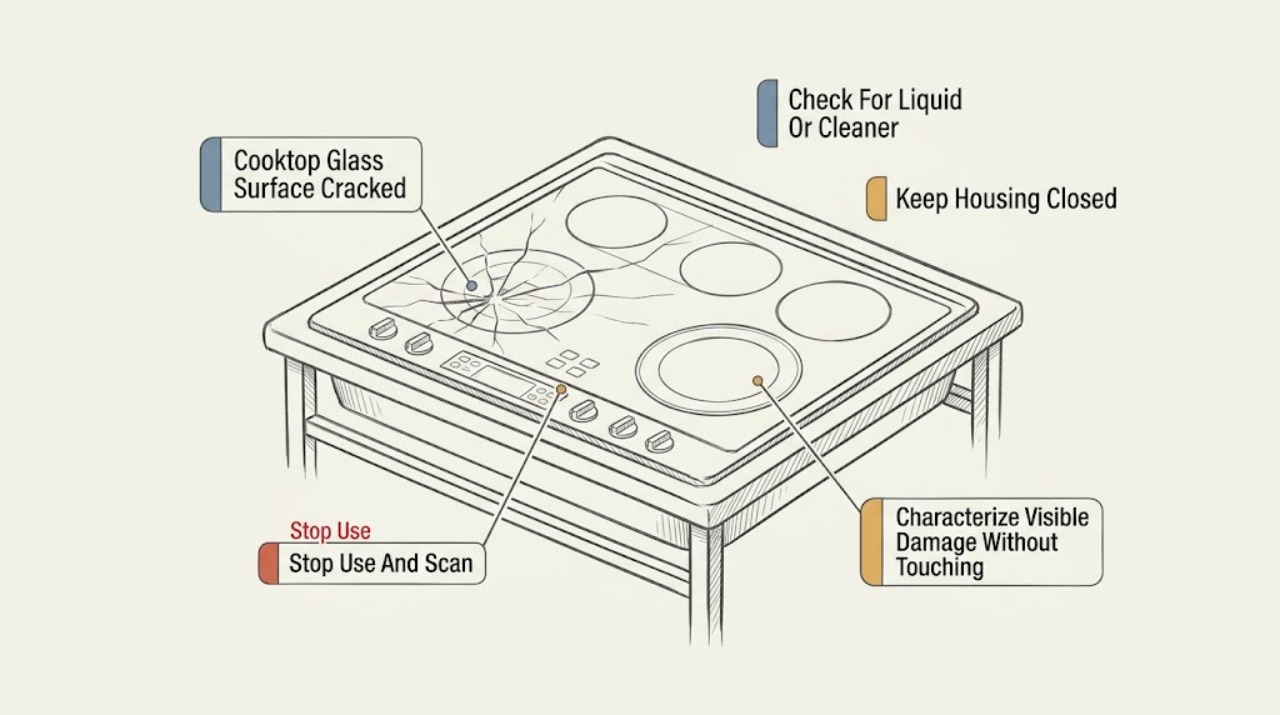
Work through in order
Diagnostic checks
Use only checks that match the exact appliance or system and its official guide.
-
Check 1
From a safe position, stop cooking and turn every cooktop control off. Look without touching the surface for smoke, arcing, glowing areas, a burning smell, water around the controls, shattered pieces, or glass that is moving or loose.
Expected result: Record whether there is an urgent symptom, only a visible crack, or no safe way to inspect because the area is hot, wet, dark, or obstructed.
Next step: For an urgent symptom, leave the area and contact appropriate emergency or utility help from a safe location; otherwise keep the cooktop off and continue only with non-contact checks.
Stop if: Do not touch fragments, wipe a wet break, or continue inspecting if there is smoke, arcing, an odor, unsafe heat, or water entering the appliance.
Why this matters
Why: Smoke, arcing, an odor, liquid near controls, loose glass, or unexpected heat can indicate a fire, shock, burn, or cut hazard. A quiet hairline-looking crack is still a broken-cooktop repair condition.
-
Check 2
When the cooktop is cool and off, photograph the damage from above and from a safe side angle without pressing the glass, tracing the line with a finger, removing trim, or moving the unit.
Expected result: Note whether the line crosses a heating zone, reaches an edge, branches, has a chip or missing piece, appears raised, or is accompanied by an impact mark or discoloration.
Next step: Keep every zone off, retain the photographs for service, and have a qualified technician determine the repair scope.
Stop if: Do not tape, glue, fill, sand, scrape, lift, or cover the crack, and do not test an unaffected zone to see whether it still heats.
Why this matters
Why: A crack, chip, branching line, or loose fragment is physical glass damage; its appearance cannot prove that an element, seal, support, sensor, control, or wiring below is still safe to use.
-
Check 3
Without spraying or wiping the cooktop, look from a safe position for water, food liquid, cleaner, residue, or a recent boil-over at or along the crack.
Expected result: Record whether the break is dry-looking, has visible liquid or residue, was cleaned while damaged, or was wet when the crack was found.
Next step: Do not clean, reset, or re-energize the cooktop after liquid or cleaner may have entered the break; tell the technician what substance was involved and when.
Stop if: Do not pour, spray, wipe into the crack, use a household dryer, or open the appliance to dry it.
Why this matters
Why: Frigidaire warns that spillovers and cleaning solutions can penetrate a broken cooktop and create an electric-shock risk. A surface that later looks dry does not show whether liquid reached internal parts.
-
Check 4
Read the model and serial information only from an ordinary-access label or the installed owner's documentation, without lifting the cooktop, moving the unit, removing a panel, or reaching into the burner box.
Expected result: Record the exact model and serial if safely visible, whether the unit is a built-in electric or induction cooktop, and the crack's location relative to the controls and heating zones.
Next step: Give the identity, surface type, photos, crack location, and event or spill history to qualified appliance service; do not order a replacement panel from a generic listing.
Stop if: Stop if finding the label requires pulling the cooktop out, opening a cover, touching wiring, or reaching into a hot, wet, sharp, or gas-connected area.
Why this matters
Why: Frigidaire's manuals and installation requirements vary by model. Exact identity and surface type determine the approved service procedure and the correct glass or top assembly; dimensions or appearance alone are not enough.
-
Check 5
Check the exact owner's manual for a user-accessible external disconnect. Use only a reachable, dry plug or disconnect that can be operated without moving the appliance, removing a cover, or touching damaged parts.
Expected result: Record whether the manual identifies an accessible disconnect and whether it is dry, unobstructed, and reachable without entering the cabinet or contacting wiring.
Next step: Use an external disconnect only when the manual and the physical conditions make it clearly safe; otherwise leave the appliance untouched and tell the technician it may still be energized.
Stop if: Do not remove an electrical panel, touch conductors, pull the cooktop from the counter, or attempt wiring work.
Why this matters
Why: An external isolation method may prevent accidental operation while service is arranged, but a hidden or hard-wired connection, wet area, or need to move the appliance is outside ordinary user work. Turning a control off does not make a broken cooktop safe to use.
-
Check 6
Prepare a service request with the model, serial, photos, crack location, and the last known intact condition; do not perform a heating test while waiting.
Expected result: Record whether the crack followed an impact, boil-dry or temperature event, cleaner or spill exposure, or an unknown event, and whether there were unusual indicators, heat, sounds, or odors.
Next step: Arrange qualified appliance service and keep the cooktop out of service until the technician confirms the model-specific repair and safe return to operation.
Stop if: Do not remove the glass, transfer heating parts, bypass controls, reconnect wiring, or resume use while waiting.
Why this matters
Why: These observations help a qualified technician decide whether the glass or ceramic top, frame, seal, heating element, sensor, controls, or wiring also needs inspection. They do not establish that any part can be reused.
Use your observations
Decision map
Find the observation that best matches what you see, then follow the next safe action.
-
PATH 01Safety boundary
What you see
The crack crosses a heating zone, branches, reaches an edge, has a chip or missing piece, or includes loose glass.
Do this next
Keep all cooktop zones off and arrange qualified service for an exact-model glass or cooktop assembly assessment.
Why this path and its safety boundary
Why it matters: The pattern confirms physical damage but cannot show whether heat, liquid, or impact also affected parts below the surface.
Safety stop: Do not place a pan over the damage or test another zone.
-
PATH 02Safety boundary
What you see
The cooktop is cool and dry-looking, with no smoke, arcing, odor, or loose fragment, but a visible crack remains.
Do this next
Leave the cooktop off, photograph it, identify the model without moving the unit, and request qualified repair.
Why this path and its safety boundary
Why it matters: The absence of an immediate symptom does not remove the break or the possibility that a future spill or cleaner could reach internal electrical parts.
Safety stop: Do not treat a small or hairline crack as a safe exception.
-
PATH 03Safety boundary
What you see
Water, food liquid, or cleaning solution was visible at the break or the surface was wet when the damage was found.
Do this next
Do not clean, reset, or retest. Keep people away from the appliance and have qualified service determine isolation, replacement, and any secondary damage.
Why this path and its safety boundary
Why it matters: Liquid may have reached internal parts even if the outside later looks dry; wiping the surface cannot verify the inside condition.
Safety stop: Do not open the cabinet, use a household dryer, or re-energize the cooktop.
-
PATH 04Safety boundary
What you see
The crack followed a dropped object, boil-dry or sudden temperature event, or an unknown event.
Do this next
Record the event and ask qualified service to inspect the complete top assembly and adjacent parts before any replacement is selected.
Why this path and its safety boundary
Why it matters: The initiating event may have affected the frame, seal, heating zone, sensor, controls, or wiring in addition to the visible glass.
Safety stop: Do not select a replacement from appearance or dimensions alone.
-
PATH 05Safety boundary
What you see
The model label or external disconnect cannot be reached without moving the cooktop, opening a panel, or entering a wet or unsafe area.
Do this next
Leave the appliance untouched and give service the visible brand, approximate type, photos, and installation context so the technician can identify it on site.
Why this path and its safety boundary
Why it matters: The remaining identification or electrical work is outside safe ordinary-access troubleshooting, especially because the damaged surface may conceal energized parts.
Safety stop: Do not pull out the unit, remove covers, or touch wiring to find a label or disconnect.
Helpful context
Understand the symptom
A crack is a safety condition, not a cleaning problem
A line that goes through the glass, a chip at the edge, branching near a heating zone, or a loose fragment should be treated as a broken cooktop. Do not run a finger over the line or scrape it to decide whether it is deep. Frigidaire describes the smooth glass as a surface over heating elements and warns that a broken cooktop may allow liquid to reach parts below it. A mark that is only a superficial scratch is a different condition, but when the damage is open, spreading, chipped, or uncertain, keep the appliance off until the exact manual or a qualified technician confirms the condition.
What can cause the visible damage
A dropped heavy or hard object can crack ceramic glass, and rough or dirty cookware can scratch it. A recent impact, boil-dry event, sudden temperature change, or unknown event should be recorded because the technician may need to inspect the supporting frame, seals, heating zone, sensor, controls, or wiring as well as the visible glass. The initiating event cannot be diagnosed safely by powering the cooktop back on.
Identify the exact cooktop without disturbing it
Frigidaire products vary by model, so use the owner's manual for the installed appliance. Record the model and serial only when the label is visible with ordinary access; do not lift the top, pull the cooktop from the counter, remove a drawer or cover, or reach into the burner box to find it. A replacement surface must be matched to the exact model and heating technology rather than its appearance or dimensions.
Safety boundary
Stop conditions
- Do not operate or clean a visibly cracked, chipped, or broken glass or ceramic cooktop, even if the crack looks small or another zone still responds.
- Do not tape, glue, patch, fill, sand, scrape, press, lift, or cover the crack, and do not remove the glass, trim, heating parts, or cabinet panels.
- Do not wipe liquid into or out of the break, spray cleaner, use a household dryer, reset power to test the appliance, or re-energize it after a spill or cleaner may have entered.
- Stop and leave the area for smoke, arcing, burning smell, loose or shattered glass, unexpected heat, or water near controls; seek appropriate emergency or utility help from a safe location.
- Do not order or install a replacement surface from appearance or dimensions alone; exact-model compatibility and inspection of adjacent components belong to qualified service.
Only after diagnosis
Potential parts
- glass or ceramic cooktop assembly
This is the likely repair category for confirmed glass damage, but the technician must verify the exact model, heating technology, mounting arrangement, and any secondary damage before ordering.
Match the exact Frigidaire model and revision through the manufacturer or qualified service; do not substitute a panel based on dimensions, color, or appearance. - cooktop frame, seal, or support
Consider only if inspection finds damage, missing support, or a seal that cannot be reused during an approved top-assembly repair.
Confirm the exact model and manufacturer's installation procedure; do not use household caulk or improvised spacers. - surface element, sensor, control, or wiring
These are conditional diagnostic categories only when impact, heat, or liquid exposure affected parts below the glass; visible damage alone does not identify any one component.
A qualified technician must diagnose and match the exact model and heating technology before any component is ordered or replaced.
When checks do not resolve it
Need a professional?
Arrange qualified appliance service for any visible crack, chip, pitting, loose glass, or uncertain mark that may be a crack. Seek urgent help for smoke, arcing, burning smell, loose or shattered glass, unexpected heat, water near controls, or a spill or cleaner that entered the break. Provide the exact model and serial if safely visible, appliance type, crack location and photos, recent impact or thermal event, spill history, and any unusual indicator or odor. Keep the cooktop off while waiting.
Safety scope: This article supports only ordinary-access observation, identification, and safe external isolation when the exact manual permits it. Do not operate the cooktop, move it, open a panel, touch wiring, remove the glass or heating parts, clean into the break, or improvise a patch.
Common questions
FAQ
Can I use the uncracked burners on my Frigidaire cooktop?
No. Treat a visible crack as a broken cooktop and keep every zone off. Frigidaire warns not to operate a broken cooktop because spillovers or cleaning solutions can penetrate the break and create an electric-shock risk.
Can I cover the crack with tape, glue, or a pan?
No. A patch or pan cannot restore the glass's heat and spill barrier and may hide worsening damage. Do not press, scrape, glue, tape, or cover the crack; arrange qualified, model-specific service.
What information should I give the technician?
Provide the exact model and serial if safely visible, the cooktop type, photos, crack location and pattern, the last known intact condition, any impact or thermal event, and any spill, cleaner, odor, heat, or indicator history. Do not move the unit or remove a panel to find the label.
Is a hairline crack safe if the cooktop still heats?
No. Working controls do not prove that the glass, seals, or parts below it are safe. Keep the cooktop off; the absence of smoke or arcing does not remove the manufacturer's broken-cooktop warning.
Can I clean the cracked surface before service?
No. Frigidaire says not to clean or operate a broken cooktop because cleaning solutions or spillovers can penetrate the break. Leave it alone, especially if liquid may already have entered.
Read the exact guide
Official sources
- ELECTRIC COOKTOP INSTALLATION INSTRUCTIONSFrigidaire · Frigidaire electric ceramic-glass cooktop installation instructions; installation and service work should follow the exact model's documentation and qualified procedures.
- User ManualFrigidaire · Frigidaire owner manual covering a ceramic-glass cooktop over heating elements; the installed appliance's exact manual controls model-specific operation.
- How do I use my display or controls?Frigidaire · Frigidaire support article applying to ranges, cooktops, and ovens; it directs owners to the Owner's Manual because product controls vary by model.
Community feedback
Share a repair observation
Share a plain-text repair observation. Accepted observations are published automatically; this page may take a moment to update.