
On this page
Start here
Quick answer
Treat a confirmed crack in a glass cooktop as a stop-use condition, especially when liquid could reach the controls or the opening below the glass. Turn all cooking zones off, keep hands and cookware away, and disconnect the appliance from power only if the connection can be safely reached without touching wet parts, opening panels, or entering a hazardous area. Do not use the cooktop, do not use an oven in a combined range unless the exact manual or technician confirms it is safe, and do not pour water, cleaner, or sealant over the crack. Photograph the damage and model label from a dry, stable position, then arrange authorized or qualified appliance service to assess the glass, controls, wiring, and any liquid entry. If there is smoke, arcing, burning odor, uncontrolled heat, or a gas smell, leave the area and use emergency or gas-emergency help.
Before you begin
Safety first
- This article supports turning controls off, keeping the area clear, safe external observation, photography, model identification, and power isolation only through a safe accessible method. It does not authorize cooktop or oven use, wet cleaning, panel removal, glass removal, live electrical testing, gas inspection, or replacement of the glass or controls.
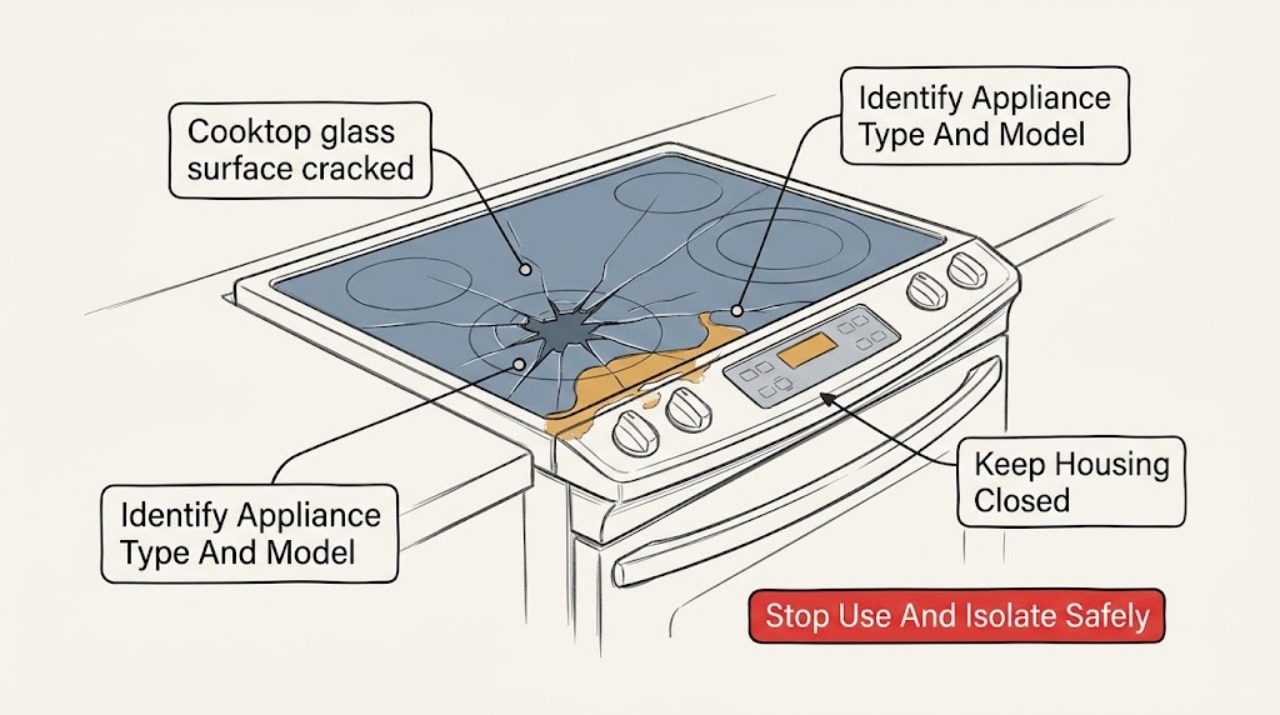
Work through in order
Diagnostic checks
Use only checks that match the exact appliance or system and its official guide.
-
Check 1
Turn every cooking zone and the normal appliance controls off. Keep people, pets, cookware, and cleaning liquids away from the cracked area. If the appliance is dry and its plug or clearly identified disconnect can be reached without opening a panel or touching wet parts, isolate power using the normal safe method; otherwise leave it alone and keep clear.
Expected result: Record whether the glass is dry or wet, whether a control remains lit or hot, whether a burner continues heating, and whether there is smoke, arcing, burning odor, or a gas smell.
Next step: Use the hazard branch that matches the strongest observation. Keep the appliance out of use until a qualified technician assesses it; leave immediately and use emergency or gas-emergency help for smoke, fire, arcing, or a gas smell.
Stop if: Do not touch wet controls, test a burner, reset power, open a panel, wipe liquid into the crack, or use water on an electrical fire.
Why this matters
Why: A confirmed crack with possible liquid entry is not safe to keep operating. A control that remains energized, uncontrolled heat, smoke, arcing, or a gas smell indicates a more urgent electrical, thermal, or gas hazard rather than a cosmetic glass repair.
-
Check 2
From a dry, stable standing position, photograph the entire cooktop and close views of the crack, chip, edge, controls, burner or cooking zones, and any visible liquid path or residue. Do not touch the crack or move a pan that is hot, unstable, or covering the damage.
Expected result: Record a hairline crack, branching or open crack, chip or missing glass, crack reaching a control or edge, liquid or residue near controls, or glass fragments on the surface.
Next step: Keep the appliance isolated and provide the photos to authorized or qualified service. If loose shards are present, keep everyone away and do not sweep or vacuum across energized equipment; ask the technician how to make the area safe.
Stop if: Do not press on the glass, lift embedded fragments, scrape the crack, cover it with tape, or clean a wet or energized control area.
Why this matters
Why: An open, branching, chipped, or control-adjacent crack is more likely to allow liquid and movement into the appliance than a superficial mark, but the surface cannot be declared safe from appearance alone. Liquid near controls adds a potential internal corrosion or electrical fault even if the controls still respond.
-
Check 3
After the appliance is off and the area is dry, record the model and serial label from its normal accessible location without removing trim or panels. Note whether it is radiant electric, induction, gas-on-glass, a standalone cooktop, or a range with an oven, and whether liquid was spilled, boiled over, or sprayed near the controls.
Expected result: Record reliable model information, an unknown model, appliance type, a recent spill or boil-over, impact event, thermal event, or evidence that liquid reached a control opening.
Next step: Give the model, appliance type, event history, and photos to the manufacturer or qualified service provider. Ask whether the complete appliance must remain isolated while awaiting glass and control inspection.
Stop if: Do not remove trim, lift the cooktop, inspect beneath the glass, or infer that an oven or gas burner is safe because one control still works.
Why this matters
Why: The glass assembly, controls, sensors, heating elements, ignition parts, and isolation method vary by model and appliance type. A range's oven can share or vent near the cooktop area, so a cracked surface may affect more than the individual cooking zones.
-
Check 4
Without touching the surface or controls, look from a safe position for continuing heat, indicator lights that do not go out, a wet control panel, a smell of overheated insulation, a tripped protective device, damaged wiring visible only from an existing open area, or a gas odor. Do not create an open area or re-energize the appliance to make this check.
Expected result: Record no secondary signs, persistent heat or lights, water around controls, smoke or burning odor, a tripped device, visible damage, or a gas smell.
Next step: Keep clear and arrange urgent electrical, appliance, or gas service for any secondary hazard. For smoke, fire, arcing, or gas smell, leave the building and contact emergency services or the gas utility; do not return to reset the appliance.
Stop if: Do not touch wet wiring or controls, reset a breaker, relight a burner, test continuity, open the control panel, or use a flame to look for a gas leak.
Why this matters
Why: Persistent heat, lights, water, smoke, odor, or gas indicates a possible control, electrical, thermal, or gas fault in addition to the cracked surface. A quiet, dry, isolated appliance still needs repair because the glass barrier is compromised.
-
Check 5
Arrange authorized manufacturer service or a qualified appliance technician for a cracked cooktop. Provide the model and serial information, appliance type, crack photographs, spill or impact history, power-isolation status, and any persistent lights, heat, odor, water, or gas observations. Request inspection of the glass, seals, controls, wiring, sensors, heating or ignition components, and any liquid entry before approving a part.
Expected result: The professional assessment should identify whether the glass surface, control area, wiring, sensors, heating or ignition components, or other assemblies were affected and state whether repair or replacement is safe.
Next step: Keep the cooktop isolated until the technician confirms a complete repair and safe operation. Follow the model's post-repair cleaning and spill instructions.
Stop if: Do not order glass by dimensions alone, install a replacement panel yourself, reconnect power to test an uninspected control area, or use the appliance while waiting for parts.
Why this matters
Why: A replacement glass panel may restore the barrier when the controls and supporting parts are sound; liquid entry or impact can require additional diagnosis. Manufacturer guidance consistently places cracked-glass repair with service rather than continued use or homeowner replacement.
Use your observations
Decision map
Find the observation that best matches what you see, then follow the next safe action.
-
PATH 01Safety boundary
What you see
A crack or chip is confirmed, the cooktop is dry and isolated, and no continuing heat, odor, smoke, water, or gas sign is present.
Do this next
Keep the cooktop out of service and arrange manufacturer or qualified appliance repair for glass and control inspection.
Why this path and its safety boundary
Why it matters: The immediate secondary hazard is not visible, but the glass barrier remains compromised and the cooktop is not cleared for use.
Safety stop: Do not use any cooking zone or assume a dry crack is cosmetic.
-
PATH 02Safety boundary
What you see
Liquid, residue, or a spill path is visible at the crack, control panel, burner opening, or area beneath the glass, or a control area was recently wet.
Do this next
Keep power isolated using only a safe accessible method, keep the area untouched and dry from a distance, and arrange urgent appliance or electrical service. Provide the liquid type and timing to the technician.
Why this path and its safety boundary
Why it matters: Liquid may have reached controls, wiring, sensors, or other internal components; corrosion or electrical faults may not be visible immediately.
Safety stop: Do not wipe liquid into the crack, open the appliance, restore power, or test the controls or burners.
-
PATH 03Safety boundary
What you see
The crack is accompanied by an indicator that stays on, a zone that stays hot, controls that respond unpredictably, smoke, burning odor, arcing, or a tripped protective device.
Do this next
Stay clear, isolate power only if it is safe and dry to do so, and arrange urgent qualified service. Leave and contact emergency services for smoke, fire, or arcing.
Why this path and its safety boundary
Why it matters: A control, wiring, heating, or power fault may be active in addition to the broken glass. This is an urgent electrical or appliance safety condition.
Safety stop: Do not touch the appliance, reset a breaker, operate another zone, or open the control area.
-
PATH 04Safety boundary
What you see
The appliance is a gas-on-glass cooktop, or a gas odor is present around a cracked cooktop or range.
Do this next
Do not operate burners or electrical controls. Leave the area for a gas smell and contact emergency services or the gas utility from a safe location; otherwise arrange qualified gas-appliance service before any use.
Why this path and its safety boundary
Why it matters: Gas ignition and supply hazards add to the cracked-glass risk. A glass-only repair assumption is unsafe until a qualified gas appliance professional assesses the appliance.
Safety stop: Do not light a flame, operate a switch, use a phone in the suspected gas area, or attempt to inspect burner or gas fittings.
-
PATH 05Safety boundary
What you see
The cracked glass is part of a range with an oven, or the crack is near the control or vent area and the manual does not clearly separate oven operation from the cooktop.
Do this next
Keep the entire range out of use until the manufacturer or technician confirms the safe scope; provide the model and crack location for service triage.
Why this path and its safety boundary
Why it matters: Heat, steam, or controls associated with the oven can affect the damaged cooktop area. GE specifically advises not using the oven on affected ranges until the cooktop is repaired.
Safety stop: Do not use the oven as a workaround or cover the crack with foil, a mat, or cookware.
Helpful context
Understand the symptom
A crack changes the appliance's safety boundary
A scratch that does not break the glass is different from a crack, chip, or split that can expose the area below the cooking surface. When liquid could enter the controls or internal components, continued cooking can add shock, short-circuit, heating, corrosion, or glass-breakage risk. Manufacturer guidance treats cracked glass as a repair condition rather than a surface-cleaning problem.
Keep the surface and controls dry and untouched
Do not test the burners, wipe liquid into the crack, apply tape or sealant, or remove trim to see how far the damage extends. If the surface or controls are wet, keep clear and isolate power only through a dry, accessible disconnecting method that does not require opening the appliance. A gas smell, smoke, sparks, or uncontrolled heating takes priority over photographing the damage.
Glass replacement is model-specific service
The correct replacement may be a complete glass cooking surface or another model-specific assembly, and liquid may have affected controls, wiring, sensors, or insulation below it. The appliance type—radiant electric, induction, gas-on-glass, or a range with an oven—changes the service scope. Use the model label and photos for the service call; do not select a panel by appearance alone.
Safety boundary
Stop conditions
- Do not use a cooktop or range with confirmed cracked, chipped, or broken glass, even if all controls currently respond; manufacturer guidance directs repair before use.
- Do not pour water or cleaner over the crack, wipe liquid into the controls, apply sealant or tape, lift the glass, or remove a control panel or trim.
- Do not reset power, test live circuits, touch wet wiring, or operate a burner or oven to see whether the appliance still works. Disconnect power only through a safe dry accessible method and only when no hazard is created.
- For gas-on-glass equipment, do not operate burners or switches when gas odor is present; leave the area and contact emergency or gas-emergency help from a safe location.
- Arrange authorized or qualified appliance service when the glass is cracked, liquid could enter controls, loose fragments are present, the appliance is a combined range, or any glass, control, wiring, heating, ignition, or gas work is indicated.
Only after diagnosis
Potential parts
- replacement glass cooktop surface
Consider this category only after the exact appliance model and glass type are confirmed and a qualified technician determines that the glass is the affected part.
Radiant, induction, gas-on-glass, and range assemblies differ in dimensions, sensors, heating elements, seals, controls, and mounting. Do not select glass by appearance or dimensions alone. - cooktop control, sensor, or wiring assembly
Consider this category only if service inspection finds that liquid entry, impact, heat, or a short caused secondary control or wiring damage.
Control layout, voltage, sensors, connectors, and software vary by exact model. Internal electrical diagnosis and replacement are professional-only tasks. - cooktop seal, trim, or mounting hardware
Consider this category only when the technician confirms that the glass replacement also requires model-specific seals, trim, or mounting hardware.
Seal materials, frame dimensions, fasteners, and clearances must match the appliance. A sealant patch is not a substitute for the designed assembly.
When checks do not resolve it
Need a professional?
Arrange authorized manufacturer service or qualified appliance repair for any confirmed cooktop glass crack, especially when liquid could enter the controls. Keep the entire appliance out of use until the glass and underlying controls are assessed. Treat smoke, arcing, burning odor, uncontrolled heat, water near electrical parts, or a gas smell as an urgent hazard: leave the area and contact the appropriate emergency service.
Safety scope: This article supports turning controls off, keeping the area clear, safe external observation, photography, model identification, and power isolation only through a safe accessible method. It does not authorize cooktop or oven use, wet cleaning, panel removal, glass removal, live electrical testing, gas inspection, or replacement of the glass or controls.
Common questions
FAQ
Can I use a cooktop with a small crack in the glass?
No. GE and Electrolux both direct owners not to use a cooktop with cracked or broken glass until it is repaired. A small-looking crack can spread with heat and can compromise the barrier over controls or energized parts.
What should I do if liquid could enter the cooktop controls?
Turn the controls off, keep the surface and control area untouched, and isolate power only through a safe dry accessible method if no hazard is present. Do not wipe liquid into the crack, restore power, or test a burner; arrange qualified appliance service to inspect for hidden control or wiring damage.
Is a cracked cooktop surface only a cosmetic problem?
Not reliably. A scratch may be cosmetic, but a confirmed crack, chip, or split needs service because it can spread and may expose or allow liquid toward components below the glass. Do not decide that the appliance is safe from a visual hairline alone.
Can I seal a cracked glass cooktop with tape, epoxy, or cleaner?
No. A surface patch does not restore the designed glass barrier or assess the controls beneath it. Keep the appliance out of use and have the exact glass and any affected components assessed by authorized or qualified service.
Do I need to stop using the oven too if the range cooktop glass is cracked?
Treat the entire range as out of use unless the exact manufacturer manual or a qualified technician explicitly confirms otherwise. GE advises not using the oven on a range until the cracked cooktop is fixed because the oven vents near the cooktop area.
Read the exact guide
Official sources
- Cooktop - Glass CrackedGE Appliances · GE Appliances consumer support guidance; exact appliance model and range configuration determine service scope.
- Using and Maintaining Toughened Glass in Cooking AppliancesConsumer Product Safety Office, Singapore Government · Singapore government guidance focused on gas hobs with toughened glass; the safety principles support this condition but local appliance and gas requirements still apply.
- Scratched / cracked glass on my cook topElectrolux · Electrolux support guidance for induction and radiant hobs; it is general safety context and does not replace the appliance's exact manual.
Community feedback
Share a repair observation
Share a plain-text repair observation. Accepted observations are published automatically; this page may take a moment to update.