
On this page
Start here
Quick answer
Stop using a cooktop as soon as its glass surface is cracked, split, or broken. Do not cook on it, clean it, pour liquid on it, or test a burner; a spill can penetrate the damaged surface and create an electric-shock or burn hazard, and a gas-on-glass model can still have heat or ignition hazards. Keep the appliance off and arrange qualified appliance service. From a safe position, note the crack's location, whether the damage is only a surface mark or an actual split, whether the cooktop or oven was operating, and the model information available without moving the appliance.
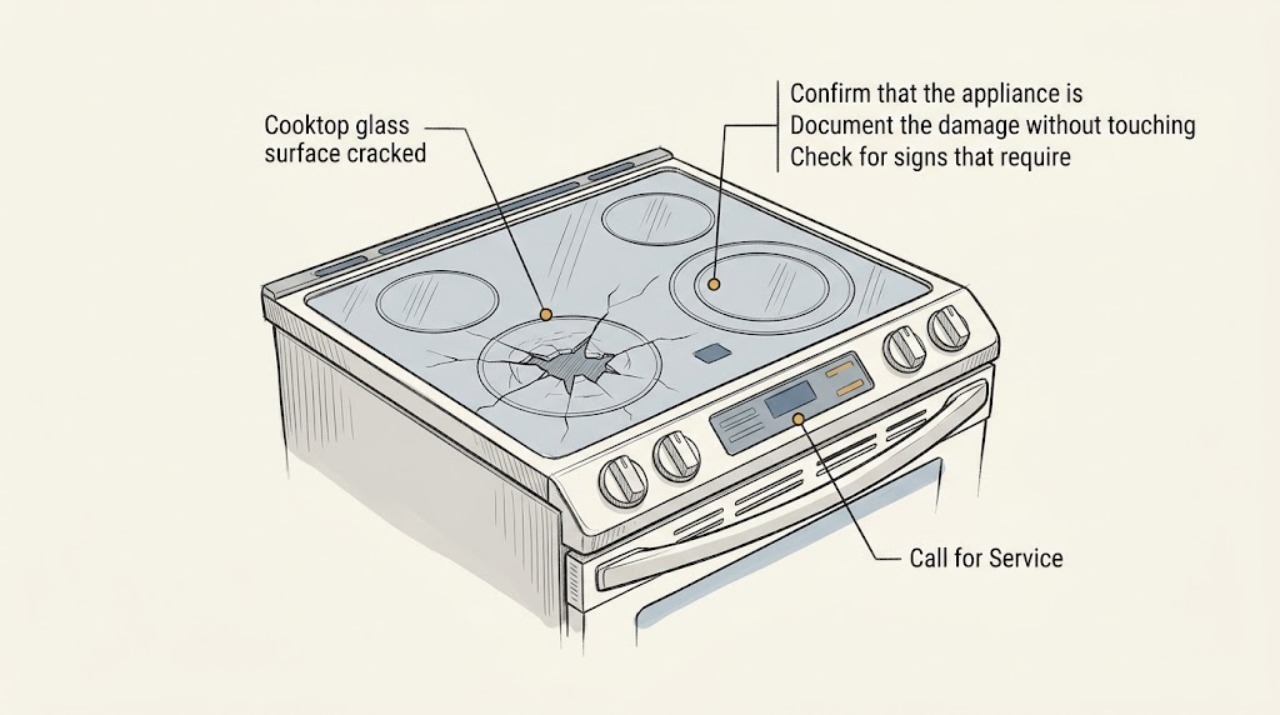
Work through in order
Diagnostic checks
Use only checks that match the exact appliance or system and its official guide.
-
Confirm that the appliance is not being used
From a safe position, look at the controls and display without touching the damaged surface or reaching over it. If something is active, use only the normal control that is safely accessible to turn it off; do not test another control or move cookware.
Expected result: Yes, the appliance is active or hot; or no active heat is visible and the appliance is cool.
Next step: For yes, stop using the appliance and keep everyone away until it is off and cool; if controls do not respond, leave the area and contact qualified service or emergency help as appropriate. For no, continue only with non-contact observation and arrange repair.
Stop if: Stop immediately if turning a control would require reaching across the crack, touching the glass, moving cookware, or contacting a wet surface.
Why this matters
Why: An active or hot cooktop can worsen the damage and create burn, fire, or shock risk. A cool, inactive appliance is safer to leave untouched, but a crack still requires service and must not be tested.
-
Document the damage without touching it
When the appliance is off and fully cool, take a photo from above or from the side without placing a hand, cloth, utensil, or camera against the glass. Note whether the line is a scratch-like mark, a chip, a star-shaped break, a split to an edge, or a separation near a burner or control area.
Expected result: The line is a confirmed crack or broken area; the damage reaches an edge or control opening; fragments are loose; or the mark cannot be identified safely.
Next step: Send the photo and description to qualified appliance service. If fragments are loose or the crack is spreading, increase the exclusion area and do not handle the pieces.
Stop if: Stop if a closer view would require touching, pressing, cleaning, lifting the glass, or placing weight on the cooktop.
Why this matters
Why: Any confirmed crack or broken area means the surface should remain unused. Edge damage, loose fragments, or uncertainty can change how the technician isolates and replaces the surface, but none of these conditions can be made safe by cleaning or patching.
-
Check for signs that require faster escalation
From outside the appliance's immediate area, note whether there was smoke, sparking, a burning or gas odor, a tripped breaker, a fluid spill into the crack, a hot spot, or an unusual control or display behavior. Do not recreate any symptom and do not remove panels to investigate.
Expected result: Smoke, flames, gas odor, sparking, repeated breaker trips, liquid under the glass, or a control that will not switch off is present; or none of these signs is present.
Next step: For smoke, flames, or a strong gas odor, leave the area and contact the appropriate emergency or utility service from a safe location. For sparking, liquid intrusion, repeated trips, or controls that will not switch off, keep clear and request urgent qualified appliance service. If none is present, keep it unused and schedule repair.
Stop if: Stop observation and leave the area if smoke, flame, strong gas odor, sparking, or escalating heat appears.
Why this matters
Why: These signs can indicate an electrical, heating, or gas hazard beyond the glass itself. The absence of these signs does not make a cracked cooktop safe to operate.
-
Give service the appliance identity
Without moving the appliance or opening a cabinet, record the model information from an accessible label, manual, or existing purchase record, and note whether the surface is radiant electric, induction, gas-on-glass, or unknown.
Expected result: The model and surface type are known; only partial information is available; or the label would require moving or disassembling the appliance.
Next step: Give the available identity, photos, crack location, and symptoms to the technician. If the label is inaccessible, let the professional identify it during service rather than moving the cooktop.
Stop if: Stop if obtaining the label would require moving, lifting, unplugging from an inaccessible location, or opening the appliance.
Why this matters
Why: Exact surface and trim parts vary by model and heating type. Partial or missing information is safer than risking contact with a damaged or energized appliance.
Use your observations
Decision map
Find the observation that best matches what you see, then follow the next safe action.
-
PATH 01Next step
What you see
The cooktop is active, hot, sparking, smoking, or a control will not switch off.
Do this next
Stop all use, keep people away, and use qualified urgent service; leave the area for fire or gas emergencies.
-
PATH 02Next step
What you see
The line is a confirmed crack, broken area, edge split, or loose fragment.
Do this next
Do not cook or clean on the surface and request service for the exact model.
-
PATH 03Next step
What you see
Liquid entered the damage, a breaker trips, there is sparking, or a gas odor is present.
Do this next
Keep clear and request urgent qualified help; use emergency or utility response for smoke, fire, or strong gas odor.
-
PATH 04Next step
What you see
Model or surface type is unavailable without moving or opening the appliance.
Do this next
Do not move or disassemble it; provide photos and have the technician identify the correct surface and parts.
Helpful context
Understand the symptom
Make the damaged cooktop safe
Do not touch the crack, lift the glass, remove knobs, open the appliance, or wipe the surface. Keep cookware, children, and pets away. If a burner or element is on, turn its control off without reaching across a hot or broken area; then stay clear until a qualified technician can assess it. Do not use the oven on a range with a cracked cooktop unless the manufacturer and service professional explicitly confirm that it is safe, because the oven's heat and venting can affect the damaged surface.
What the technician needs to know
Record the model and serial information only from an accessible label, manual, or existing documentation; do not pull out or lift the appliance. Describe when the crack appeared, what struck or overheated the surface if known, whether the crack reaches an edge or control area, and whether the appliance was hot, wet, sparking, or producing an odor. Do not attempt a temporary glass patch or replacement; the correct surface and installation depend on the exact appliance.
Only after diagnosis
Potential parts
- cooktop glass surface
Only consider after a qualified technician confirms the glass is the failed component and identifies the exact appliance model and surface type.
Confirm exact model fitment and installation requirements; do not order or install from a generic glass description. - cooktop trim frame
Only consider if the technician finds the perimeter frame or mounting trim damaged along with the cracked surface.
Trim geometry and mounting vary by model; a crack alone does not establish that this part is needed. - cooktop control panel
Only consider if service diagnosis finds that the crack or related event damaged controls or the user interface.
Do not infer control-panel compatibility from a glass-surface photo; confirm the exact model and revision.
When checks do not resolve it
Need a professional?
Request service promptly for any crack, split, chip that exposes damage, or broken glass. Use urgent service when there is liquid intrusion, sparking, smoke, a gas odor, repeated breaker trips, or controls that will not switch off.
Common questions
FAQ
Can I keep using a cooktop with a small crack?
No. Treat any confirmed crack or broken area as unsafe to operate or clean and arrange qualified service. A small-looking mark can still allow liquid or heat to reach areas that should remain protected.
Can I use the oven if only the cooktop glass is cracked?
Do not assume it is safe. On some ranges the oven vents near the cooktop, so leave the appliance unused until the manufacturer or a qualified technician confirms the safe next step.
Should I tape or seal the crack?
No. Do not patch, clean, press, or add liquid to the damaged surface. Keep it unused and let a qualified technician determine whether the glass and related parts need replacement.
What if I do not know whether it is a scratch or a crack?
Do not test the burner or rub the mark. Take a photo from a safe distance when the appliance is off and cool, provide the model information if accessible, and treat uncertainty as a reason to request service.
Read the exact guide
Official sources
- Cooktop - Glass CrackedGE Appliances · Radiant, induction, and gas-on-glass cooktops when the glass surface is cracked or pitted
- Use and Care & Installation Guide for ZGU650 and ZGU651GE Appliances · Manufacturer safety principle that broken or cracked glass should not be operated or cleaned
Community feedback
Share a repair observation
Share a plain-text repair observation. Accepted observations are published automatically; this page may take a moment to update.