
On this page
Start here
Quick answer
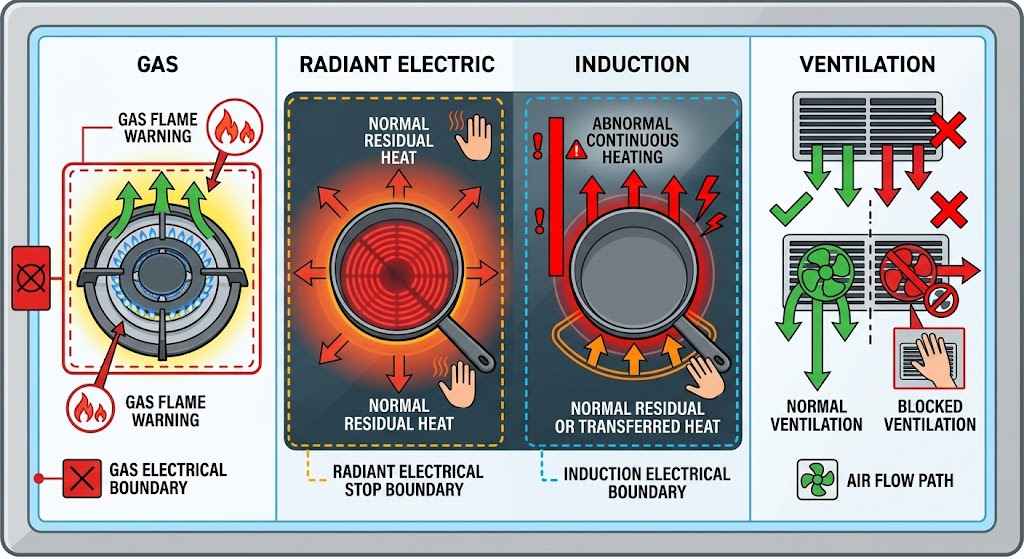
First identify the cooktop type: gas, radiant electric, or induction. A glass surface or cookware that remains warm after switch-off can be normal residual or transferred heat, while a zone that stays energized, a gas flame that remains high, a control area that overheats, blocked ventilation, smoke, scorching, sparking, a cracked glass surface, or a gas odor is not a normal check. Turn every control off, move people away from hot cookware, and never touch a hot surface to test it. If there is smoke, fire, gas odor, arcing, an electrical trip, visible melting, or cracked glass, stop immediately, cut energy only from a dry safe position when appropriate, and arrange emergency or qualified service. Do not open the cooktop or bypass a control, sensor, cooling fan, or safety device.
Work through in order
Diagnostic checks
Use only checks that match the exact appliance or system and its official guide.
-
Check 1
Turn all cooktop controls off and identify the technology from the model guide: gas, radiant electric, or induction. Without touching the hot surface, note whether heat is in the pan, the glass around a zone, a burner flame, the controls, the underside, or the supply area. Keep children, towels, plastic, and other flammables away.
Expected result: Heat is limited to a recently used pan or zone, a gas flame remains present, a zone heats with its control off, the controls or underside are unusually hot, or a hazard sign is visible.
Next step: Allow normal residual heat to cool while following the relevant branch. For a flame that will not extinguish, a zone that heats while off, abnormal electrical heat, smoke, gas odor, arcing, or cracked glass, stop and arrange urgent qualified help.
Stop if: Stop for smoke, flame outside normal cooking, gas odor, sparks or arcing, melting, a tripped breaker, cracked glass, uncontrolled heating, or a hot control or supply area.
Why this matters
Why: Transferred or residual heat can be expected, but a flame or energized zone that remains on, localized control or supply heat, or a hazard sign indicates a fault boundary. Technology type determines the safe next check.
-
Check 2
When the surface is cool enough to approach safely, confirm every knob is at OFF or every touch control shows OFF. Record whether a hot-surface or residual-heat indicator remains on, whether a zone responds to controls, and whether the heat fades after switch-off according to the exact manual. Do not touch the glass to verify temperature.
Expected result: The indicator remains on while the surface is still hot, the indicator stays on after the surface is cool, a zone remains energized after OFF, or controls do not respond.
Next step: Keep the cooktop off and use the model manual to interpret the indicator. If heat continues with controls off or the indicator behavior is abnormal, isolate electrical power from a safe dry position when applicable and arrange service; do not repeatedly toggle the control.
Stop if: Stop for uncontrolled heating, an unresponsive OFF control, smoke, odor, sparks, a trip, melting, or any need to remove the control panel.
Why this matters
Why: A residual indicator can be normal while the surface cools, but an indicator that remains after a cool surface or a zone that ignores OFF suggests a sensor or control problem. A nonresponsive control can prevent safe shutoff and overrides ordinary cooking checks.
-
Check 3
After cooling, inspect the pan's size, base, and position against the marked cooking zone and the exact manual. On induction only, confirm the pan is suitable for induction and centered; on radiant electric, compare the pan footprint with the zone; on gas, keep the pan centered over the correct burner and never leave it empty on a hot zone.
Expected result: The pan is much larger or smaller than the zone, off-center, unsuitable for induction, empty, warped, or otherwise transferring heat toward a control area; or it matches the model guidance.
Next step: Use a suitable, centered pan only after all hazards are absent and the manual permits continued use. If the nearby control remains abnormally hot or the zone overheats with suitable cookware, stop and arrange service.
Stop if: Stop for a warped or damaged pan, cracked glass, uncontrolled heat, a hot or melting control, smoke, an oil fire risk, sparks, or any need to touch hot cookware or glass.
Why this matters
Why: Cookware can transfer heat to neighboring glass or controls, change induction response, or let a gas flame extend beyond the base. Correct cookware may remove a cooking-performance cause, but it cannot explain a control that remains energized or an electrical hazard.
-
Check 4
With the cooktop fully cool and off, inspect only the accessible air openings, downdraft path, cabinet clearance, and area around the control panel for objects, grease, or cookware blocking ventilation. Do not insert tools or remove panels, and do not cover an opening to test whether the temperature changes.
Expected result: An opening is blocked, the underside clearance differs from the installation instructions, the cooling fan is unusually loud or absent when the manual says it should run, or ventilation appears clear.
Next step: Remove only a loose external obstruction after cooling. Follow the installation manual for clearance. If the cooktop still overheats, shuts down, or the fan behavior is abnormal, keep it off and request qualified service.
Stop if: Stop for smoke, grease fire, abnormal cabinet heat, melting, a cracked surface, electrical odor, arcing, a trip, or any need to open the underside or fan housing.
Why this matters
Why: Poor ventilation can cause an induction cooktop to overheat and shut down, while a blocked downdraft can reduce vapor removal and transfer heat. A fan that fails to behave as the manual describes may need service; its absence cannot be diagnosed by a live test.
-
Check 5
For a gas cooktop only, after the burner and cookware are cool, inspect the visible cap and burner base for correct matching, seating, moisture, or spill residue. Observe a flame only during normal, attended operation if there is no gas odor or other hazard; do not adjust pressure, enlarge ports, loosen fittings, or repeat ignition when the burner does not light correctly.
Expected result: The cap is displaced or wet, ports look obstructed, the flame is uneven, yellow, noisy, too high, wraps around the pan, or the burner remains lit after OFF.
Next step: Allow removable parts to dry fully and follow the exact manual for visible cleaning and placement. For an abnormal persistent flame, suspected conversion or pressure issue, gas odor, or failure to extinguish, turn controls off if safe, leave the area, and contact qualified gas service or emergency help.
Stop if: Stop for gas odor, flame outside the burner, delayed ignition, loud popping, yellow or unstable flame that persists, a burner that will not turn off, smoke, or any gas-fitting work.
Why this matters
Why: Whirlpool identifies cap seating, port condition, moisture, fuel type, and conversion as causes of abnormal gas flames. A flame that will not extinguish, gas odor, delayed ignition, or an unstable flame is a gas safety event, not a cleaning experiment.
-
Check 6
For an electric or induction cooktop, once cool and safely isolated, inspect only the accessible switch, plug if fitted, cord, socket, and nearby cabinet for scorch marks, discoloration, melted plastic, moisture, or a hot electrical smell. Do not remove a hardwired cover, test energized conductors, reset a tripping breaker repeatedly, or substitute an extension lead.
Expected result: There is visible damage or heat at the supply, the breaker or RCD trips, water is near electrical parts, or the accessible supply path looks normal.
Next step: Leave a damaged or wet supply disconnected and arrange a registered electrician or qualified appliance technician. If the supply looks normal, continue only with cool, model-specific checks; do not energize a cooktop that previously showed a hazard.
Stop if: Stop for burn marks, arcing, a hot or wet socket, melted plastic, exposed conductors, smoke, sparks, a repeated trip, or any need to open a live or hardwired area.
Why this matters
Why: Supply-path heat or repeated protective trips can come from the cooktop, connection, circuit, or installation. A normal visual check cannot clear an internal control, element, sensor, or power module.
-
Check 7
Only when the cooktop is cool, dry, correctly installed, free of visible damage, and has shown no hazard, decide whether one short, attended, model-approved check is appropriate with a suitable pan or normal burner setting. Do not run a recheck if a zone heated while off, controls failed, gas behavior was abnormal, the supply tripped, or overheating returned.
Expected result: The cooktop behaves normally, the same overheating returns with correct cookware and ventilation, a zone remains on, the unit shuts down again, or a new odor, smoke, spark, trip, or abnormal flame appears.
Next step: Keep the cooktop out of service for any recurrence and arrange qualified appliance repair. Provide the type, model, zone, cookware, setting, duration, indicator behavior, and all safety symptoms.
Stop if: Stop immediately for smoke, gas or burning odor, flame outside the burner, sparks, arcing, melting, uncontrolled heating, a trip, cracked glass, or abnormal cabinet heat.
Why this matters
Why: A normal brief check does not certify the appliance. A repeatable failure with correct settings points toward control, temperature sensing, element, power, cooling, or gas service; any hazard means further operation is unsafe.
Use your observations
Decision map
Find the observation that best matches what you see, then follow the next safe action.
-
PATH 01Next step
What you see
There is smoke, fire, gas odor, arcing, crackling, scorching, melting, a repeated trip, cracked glass, or a burner or zone cannot be turned off.
Do this next
Arrange qualified service and follow the exact model guidance.
Why this path and its safety boundary
Why it matters: Stop cooking and do not touch the hot surface. From a dry safe position isolate energy if appropriate, keep clear, and use emergency or qualified electrical, gas, or appliance help; do not re-ignite or re-energize for a test.
-
PATH 02Next step
What you see
A radiant zone or nearby glass remains warm after switch-off, the hot-surface indicator is on while the surface cools, and no zone is energized or hazardous.
Do this next
Arrange qualified service and follow the exact model guidance.
Why this path and its safety boundary
Why it matters: Treat the surface as hot until the exact manual's indicator and cooling guidance allow handling. Keep plastic, towels, and utensils off the glass and do not use residual heat as proof that controls are working incorrectly.
-
PATH 03Next step
What you see
An induction zone or area around the pan is unusually warm, power reduces, or the unit shuts down while cookware or ventilation is unsuitable.
Do this next
Arrange qualified service and follow the exact model guidance.
Why this path and its safety boundary
Why it matters: After cooling, center a suitable pan and clear only visible ventilation obstructions according to the manual. If overheating or shutdown returns with correct cookware and clearance, keep the unit off and request service.
-
PATH 04Next step
What you see
A gas flame is uneven, yellow, noisy, too high, extends beyond the pan, or the cap is wet, displaced, or mismatched.
Do this next
Arrange qualified service and follow the exact model guidance.
Why this path and its safety boundary
Why it matters: Turn the burner off when safe, allow it to cool, and use only the model manual for visible cap and port care. A persistent abnormal flame, conversion concern, gas odor, or failure to extinguish needs qualified gas service.
-
PATH 05Next step
What you see
A zone heats with its control off, the control ignores OFF, an indicator remains after the surface is cool, or one element stays on continuously.
Do this next
Arrange qualified service and follow the exact model guidance.
Why this path and its safety boundary
Why it matters: Do not continue cooking or cycle the control repeatedly. Isolate power from a dry safe position when applicable and arrange qualified appliance service for the control, sensor, element, or power module.
-
PATH 06Next step
What you see
A large, off-center, unsuitable, warped, or empty pan is transferring heat to the glass, controls, or surrounding area without another hazard.
Do this next
Arrange qualified service and follow the exact model guidance.
Why this path and its safety boundary
Why it matters: Let everything cool, then use cookware that matches the zone and the model instructions. If the same area overheats with suitable cookware, treat it as a service condition rather than changing ventilation or lowering the control by guesswork.
-
PATH 07Next step
What you see
The cooktop continues to overheat, shuts down, or behaves unpredictably after safe cookware, control, gas, and ventilation checks, or the type and model guidance are unclear.
Do this next
Arrange qualified service and follow the exact model guidance.
Why this path and its safety boundary
Why it matters: Keep it out of service and provide the model, cooktop type, zone, setting, cookware, indicator, timing, ventilation, and safety symptoms to qualified repair. Do not open the appliance or guess at a replacement part.
Helpful context
Understand the symptom
Make the hot cooktop safe before diagnosing it
Turn every knob or touch control off and keep hands away from the glass, grates, cookware, and steam. Move flammable items away only if this can be done without reaching over a hot zone. Smoke, flames, a gas odor, arcing, crackling, scorching, a trip, melting, or a cracked glass surface is an immediate stop condition. Do not throw water onto an oil or electrical fire; follow local emergency guidance and leave the area if the hazard cannot be controlled safely.
Normal heat depends on the technology
Radiant electric glass can stay hot and keep its indicator lit after switch-off. Induction usually leaves the glass cooler, but a pan can transfer substantial heat back to the zone. Gas heat is visible at the flame and should stay within the cookware footprint. A hot surface indicator is a warning, not permission to touch. The exact manual controls indicator timing, power sharing, cooling-fan behavior, burner adjustment, and any error indication.
Keep checks external and model-specific
Once everything has cooled, inspect cookware size and placement, visible controls, burner caps and ports on a gas model, and accessible ventilation openings. Do not lift the cooktop, remove control panels, probe wiring, adjust gas pressure, or defeat a temperature limiter. If the cooktop overheats again after a safe external review, keep it off and arrange qualified appliance service.
Do not confuse cooking performance with a safety fault
A large pan can warm a nearby control area, and an induction unit can reduce power or shut down when ventilation or cookware conditions are unsuitable. That is different from a control that ignores OFF, a flame that will not extinguish, a surface that heats with no selected zone, or electrical heat at the supply. Those symptoms need service rather than a longer cooking test.
Safety boundary
Stop conditions
- Smoke, fire, gas odor, delayed ignition, an abnormal or unextinguishable flame, sparks, arcing, crackling, scorching, or melting.
- A zone heats while its control is off, a control cannot switch a zone off, or an indicator remains abnormal after the surface is cool.
- Cracked or shattered glass, a hot or damaged socket, cord, switch, control area, cabinet, or repeated electrical trip.
- A blocked or failed cooling or downdraft path accompanied by abnormal heat, shutdown, smoke, grease, or electrical odor.
- Any need to remove the cooktop, open a hardwired supply, alter gas pressure, adjust a burner fitting, bypass a safety device, or test live parts.
- Overheating or abnormal behavior returns after one safe external review with correct cookware and settings.
Only after diagnosis
Potential parts
- cooktop temperature sensor or limiter
Consider this category only when the exact model documentation and qualified diagnosis link a zone that remains hot or a repeated overheat shutdown to the sensing or limiting circuit.
Confirm the complete model, technology type, sensor position, and safe service procedure before selecting a component. - cooktop heating element or power module
Consider this category only when a qualified diagnosis identifies a failed radiant element, induction power module, or associated control after the zone and supply behavior are documented.
Confirm the exact model, zone arrangement, electrical rating, and installation method; do not infer fit from a similar appearance. - gas burner cap or burner component
Consider this category only when the gas model manual and inspection confirm a damaged, mismatched, or persistently mis-seated visible burner component without gas-line work.
Confirm the exact model, burner position, cap marking, fuel type, and safe installation instructions; gas pressure and fittings require qualified service.
When checks do not resolve it
Need a professional?
A gas flame is abnormal, a burner will not extinguish, gas odor is present, or ignition is delayed or repeatedly fails., A radiant, electric, or induction zone heats while off, a control fails, a hot-surface indicator stays abnormal, or the unit shuts down from recurring heat., The plug, socket, switch, cord, control area, or cabinet is hot, scorched, melted, wet, or associated with arcing or a trip., Correct cookware and visible ventilation do not stop the overheating, or the fan, power-sharing, or error behavior does not match the exact manual., Diagnosis would require internal electrical, gas, element, sensor, control, cooling, or hardwired access.
Common questions
FAQ
Is it normal for a cooktop to stay hot after I turn it off?
Radiant glass can retain heat after switch-off, and induction glass can receive heat back from a hot pan. A hot-surface indicator may remain on while the zone cools. Treat the surface as hot until the exact manual says it is safe; a zone that remains energized or a control area that overheats is a service condition.
Why is my induction cooktop overheating or shutting down?
Check only after cooling: use a suitable, centered pan and clear visible ventilation obstructions according to the model instructions. Whirlpool notes that unsuitable cookware and poor ventilation can cause excessive heat and shutdown. If the unit overheats again with correct conditions, keep it off and arrange service.
What does an abnormally hot gas cooktop flame mean?
An uneven, yellow, noisy, too-high, or pan-wrapping flame can relate to cap seating, port condition, moisture, fuel type, or conversion. Turn the burner off when safe and follow the exact manual for visible cap care. Gas odor, delayed ignition, an unstable flame, or a burner that will not turn off requires qualified gas help.
Why is the control area hot when the burner is on?
A large pan can transfer heat toward a nearby knob or digital control area, but abnormal or persistent control heat can also indicate a clearance, ventilation, or control fault. Let the cooktop cool, use cookware that matches the zone, and stop if the control remains very hot, melts, smells, smokes, or ignores OFF.
When should I stop using an overheating cooktop?
Stop for smoke, fire, gas odor, abnormal or unextinguishable flame, sparks, arcing, a trip, scorching, melting, cracked glass, a zone that heats while off, or a hot supply or control area. Isolate energy only from a dry safe position when appropriate and arrange emergency or qualified appliance help.
Read the exact guide
Official sources
- Gas Burner Flame Level IncorrectWhirlpool · Gas cooktop abnormal flame, burner-port, burner-cap, moisture, fuel, and conversion guidance
- Lighting the Burners - Electronic IgnitionWhirlpool · Gas cooktop electronic ignition, burner cap, normal spark, and burner operation guidance
- Element(s) Too Hot - Glass CooktopWhirlpool · Radiant glass cooktop cycling, temperature limiting, hot surface behavior, and model-manual guidance
- Electric Range & Cooktop - Glass Smooth Top Surface Seems Too HotGE Appliances · Radiant and induction cooktop residual heat, hot-surface indicators, heat transfer, and safe cooling guidance
- Electrical Safety Advice for the KitchenElectrical Safety First · Kitchen electrical appliance wet-surface, heat, arcing, breaker, fire, and qualified repair safety guidance
- Excessive heat around cookware on cooktop - Product Help | WhirlpoolWhirlpool · Induction cooktop cookware size, cookware material, ventilation, overheating, and shutdown guidance
Community feedback
Share a repair observation
Share a plain-text repair observation. Accepted observations are published automatically; this page may take a moment to update.