
On this page
Start here
Quick answer
On a Miele G2182, do not treat “all lights flashing” as a diagnosis of one part. First record exactly which indicators flash, whether the intake/drain indicator is also involved, whether the machine beeps or drains, and how far into the wash this occurs. Miele's official all-indicators guidance directs the owner to clean the filter combination, non-return valve, drain pump, and spray arms according to the operating instructions, then contact Miele Service if the fault remains. Miele separately describes simultaneous Wash, Dry, and End sequence lights as a circulation-pump-blocked or technical-fault path, so that pattern should not automatically be applied to every G2182 light pattern. A matching G2182 community report occurred about 10 seconds into the cycle and remained unresolved; use it to document the timing, not to name a failed component.
Before you begin
Safety first
- No cabinet or base-panel disassembly, live electrical testing, pump access while energized, forced drain clearing, or repeated cycling to reproduce the fault.
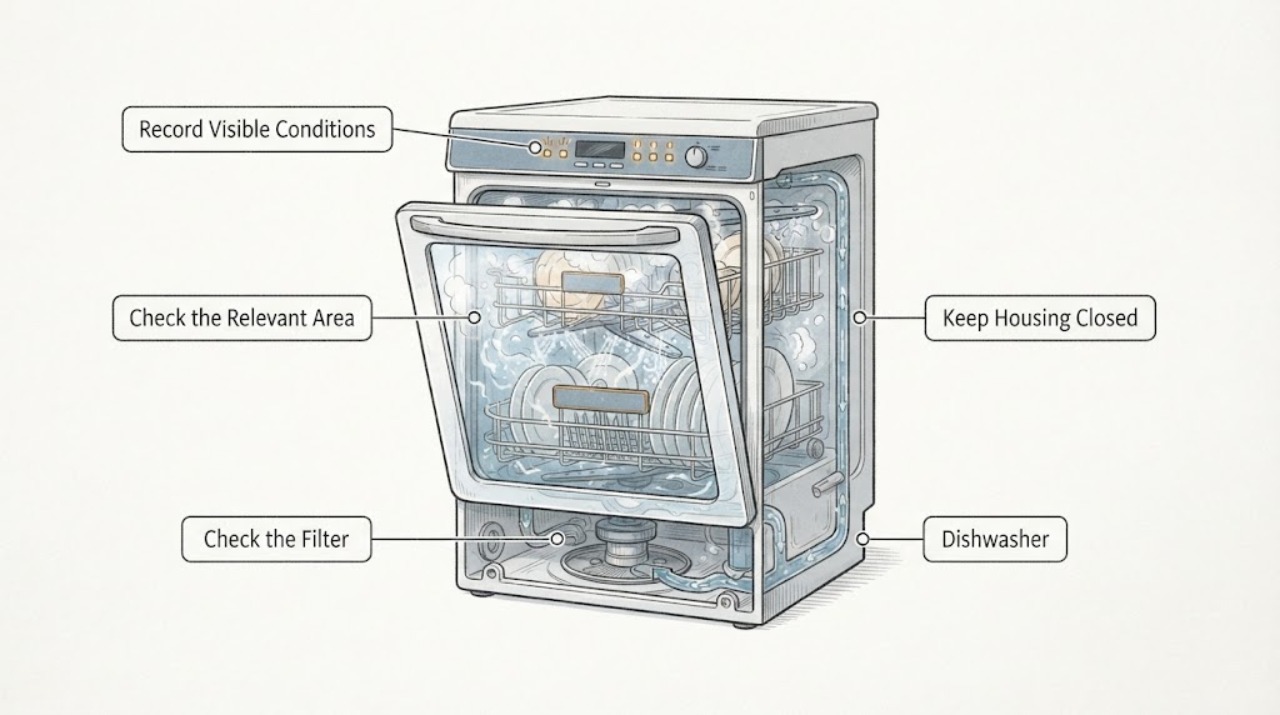
Work through in order
Diagnostic checks
Use only checks that match the exact appliance or system and its official guide.
-
Check 1
At the next safe opportunity, record the light pattern without trying to force another cycle: list every flashing program lamp, whether Intake/Drain is lit or flashing, the selected program, and whether the door is open or closed.
Expected result: Note whether all program indicators flash together, only Wash/Dry/End flash together, a separate Intake/Drain indicator is involved, or the pattern changes after the door is opened.
Next step: Save a photo or written sequence and use the matching branch below. Do not count a different lamp combination as the same fault.
Stop if: Stop if the cabinet leaks, there is smoke or an electrical odor, the pump runs continuously, or the door or wiring appears damaged.
Why this matters
Why: These are different Miele display patterns. The official all-indicators page and the separate Wash/Dry/End page do not establish the same cause, so the exact pattern is the first decision rather than a component diagnosis.
-
Check 2
Record when the flashing begins in relation to the wash cycle and whether the machine beeps, stops spraying, leaves water in the cabinet, or begins draining.
Expected result: Write down an approximate stage such as immediately after Start, about 10 seconds in, after filling, during circulation, or near the end; also note whether the wash cabinet is empty or holding water.
Next step: Use the timing and water result to select a branch; do not repeatedly restart cycles simply to make the lights flash again.
Stop if: Stop and keep the dishwasher off for standing water with a leak, a continuous drain sound, unusual grinding, or any electrical or burning odor.
Why this matters
Why: Timing and water state distinguish a start or circulation interruption from a drainage-related result. The exact G2182 report began about 10 seconds into the cycle, but that report did not prove why it happened.
-
Check 3
If the cabinet is safe to access and the machine is switched off, check only the user-accessible filter combination and visible wash-cabinet debris as described in the exact operating instructions.
Expected result: Look for heavy limescale, grease, food debris, a visibly obstructed filter, or spray-arm openings blocked by residue; note whether water remains and whether anything can be cleaned without reaching into the pump mechanism.
Next step: Clean only the documented accessible items for the exact G2182 instructions. If the same light pattern returns, stop troubleshooting and contact Miele Service.
Stop if: Do not reach into a running or exposed pump, remove the base or drain components beyond the manual's ordinary cleaning steps, or use tools to clear an unseen obstruction.
Why this matters
Why: Miele lists accumulated limescale, grease, or other soiling as a possible context for all indicator lights flashing and directs cleaning of the filter combination, non-return valve, drain pump, and spray arms according to the operating instructions. This guidance does not identify a failed pump or authorize disassembly.
-
Check 4
Compare the recorded lamps with Miele's separate Wash/Dry/End sequence guidance before attempting any reset.
Expected result: Confirm whether Wash, Dry, and End alone flash simultaneously, or whether every program indicator and other lamps flash. Note whether the dishwasher had been unused for weeks or months or was being commissioned for the first time.
Next step: If the exact Wash/Dry/End pattern matches, follow only the corresponding operating-instruction step and stop if it persists. If it does not match, keep the all-lamps record and use the service branch instead of adapting that procedure.
Stop if: Do not pour hot liquid into the dishwasher, repeat a pump-unblocking procedure, or run a test cycle unless the exact model instructions explicitly match the observed pattern and provide that step.
Why this matters
Why: Miele associates the specific Wash/Dry/End sequence with a potentially dry or stuck circulation pump after a long break or first commissioning, while also allowing for a technical fault. That explanation cannot be transferred to an all-lamps pattern without matching the indicators.
-
Check 5
Make at most one ordinary power-off and restart attempt only after the pattern, water state, and accessible checks are recorded; use the exact G2182 operating instructions for the program selection and Start control.
Expected result: Note whether the lights clear, whether the same lamps return at the same stage, whether the program completes and drains, and whether the display or beeps change.
Next step: If the same all-lights pattern returns, stop using the dishwasher and give Miele Service the exact lamp list, timing, water state, model, and any photo. Do not keep resetting it between cycles.
Stop if: Stop immediately for a leak, continuous draining, smoke, sparks, burning smell, a hot control area, or a breaker trip.
Why this matters
Why: Miele's support instruction permits a power-off, wait, reselect, and Start sequence for the Wash/Dry/End fault, but recurrence still means the fault has not been resolved. A temporary clear does not identify a component or prove the appliance is repaired.
Use your observations
Decision map
Find the observation that best matches what you see, then follow the next safe action.
-
PATH 01Next step
What you see
All program indicators flash together about 10 seconds into the cycle, with beeping, and the exact Miele G2182 report does not establish a successful repair.
Do this next
Record the pattern and water state, perform only the exact manual's accessible cleaning check, and contact Miele Service if it recurs; do not open the appliance.
Why this path and its safety boundary
Why it matters: This is a model-specific timing and display pattern, but it remains an undifferentiated technical or operating interruption. It is not enough to call the circulation pump, drain pump, heater, sensor, or control board failed.
-
PATH 02Next step
What you see
The flashing is accompanied by water remaining in the wash cabinet, a drain sound, or a separate Intake/Drain indicator.
Do this next
Switch the dishwasher off, check only the accessible filter and documented drain path, and contact Miele Service if water remains or the indicator returns. Do not remove the pump or pull out the built-in appliance.
Why this path and its safety boundary
Why it matters: A drainage or intake-related branch must be considered before interpreting the lights as a heating or circulation failure. Water condition and the separate indicator are more useful than the phrase “all lights.”
-
PATH 03Next step
What you see
Only Wash, Dry, and End flash simultaneously, and the dishwasher has been unused for weeks or months or is being commissioned for the first time.
Do this next
Follow the exact Miele instructions for that matching sequence once, then stop and request service if it returns. Do not substitute this sequence's procedure for a different G2182 lamp pattern.
Why this path and its safety boundary
Why it matters: This matches Miele's separate circulation-pump-blocked guidance more closely than a report in which every program lamp flashes. Even there, Miele also allows for a technical fault if the condition persists.
-
PATH 04Next step
What you see
A single power-off/restart clears the lamps, but the same pattern returns during the next wash or the cycle still stops early.
Do this next
Stop repeated resets and arrange Miele Service with the model, lamp pattern, cycle stage, water state, and cleaning result.
Why this path and its safety boundary
Why it matters: The reset changed the display state but did not demonstrate a repair. Recurrence keeps a technical fault or unresolved intake, circulation, or drain condition in play.
Helpful context
Understand the symptom
The pattern matters more than the phrase “all lights”
Older Miele panels can use several indicator combinations. “All indicator lights” is not interchangeable with only Wash, Dry, and End flashing, or with a separate Intake/Drain light. Write down the exact lamps, the delay before they flash, whether the door was open, and whether water or a drain sound was present before using a code-specific explanation.
Keep the response to ordinary access
Use only the filter and cleaning steps that the exact operating instructions allow. Do not remove the dishwasher, open the door panel or base, reach into a running pump, test live voltage, or infer a pump, heater, sensor, or control-board replacement from the lamps alone.
When checks do not resolve it
Need a professional?
Request Miele Service for a recurring G2182 all-lights pattern, an unresolved Wash/Dry/End pattern, a cycle that stops, or any intake, circulation, drain, or electrical symptom that ordinary access does not resolve.
Safety scope: No cabinet or base-panel disassembly, live electrical testing, pump access while energized, forced drain clearing, or repeated cycling to reproduce the fault.
Common questions
FAQ
Do all flashing lights mean the circulation pump is blocked?
Not necessarily. Miele has a separate support article for the specific Wash, Dry, and End sequence. Compare the exact lamps before applying that explanation; an all-program-lamps pattern needs its own timing and water-state record.
Can I clean anything before calling service?
Only the accessible items covered by the exact operating instructions. Miele's all-indicators guidance mentions the filter combination, non-return valve, drain pump, and spray arms, but it does not authorize cabinet disassembly or prove that a pump has failed.
What information should I give Miele Service?
Give the full G2182 designation, selected program, complete list of flashing lamps, approximate stage when they began, beeps or drain sound, water level, accessible cleaning result, and any leak, odor, smoke, or electrical symptom.
Read the exact guide
Official sources
- Miele Dishwashing | All indicator lights on the dishwasher are flashing.Miele USA · Miele's dishwashing support page addresses all indicator lights flashing and directs cleaning of the filter combination, non-return valve, drain pump, and spray arms according to the operating instructions, followed by service if the fault persists.
- Miele dishwasher - all lights flashingReddit r/Appliances · Exact-model community report for Miele G2182: buzzer and all program lights flashing about 10 seconds into a cycle.
- Operating manualsMiele USA · Miele's official manual finder asks for the product's full model name or serial number; use it to retrieve the operating instructions for the exact G2182 appliance before applying model-specific steps.
- Miele Dishwashing | The Wash, Dry, and End program sequence displays on the dishwasher are flashing simultaneously.Miele USA · Miele separately describes simultaneous Wash, Dry, and End sequence displays as a possible circulation-pump blockage after a long break or first commissioning, or as a technical fault if the condition persists.
Community feedback
Share a repair observation
Share a plain-text repair observation. Accepted observations are published automatically; this page may take a moment to update.