
On this page
Start here
Quick answer
Stop a Miele dishwasher leak before troubleshooting. Dry the floor and identify whether water appears at the door, underneath, or near a drain connection. A door that cannot close or a pump cover that does not engage can leak for different reasons. Do not run the machine with water near electrical parts; arrange service for a damaged hose, recurring leak, or any leak whose source is hidden.
Before you begin
Safety first
- Do not run leak tests with water near an outlet, open electrical panels, or remove sealed components.
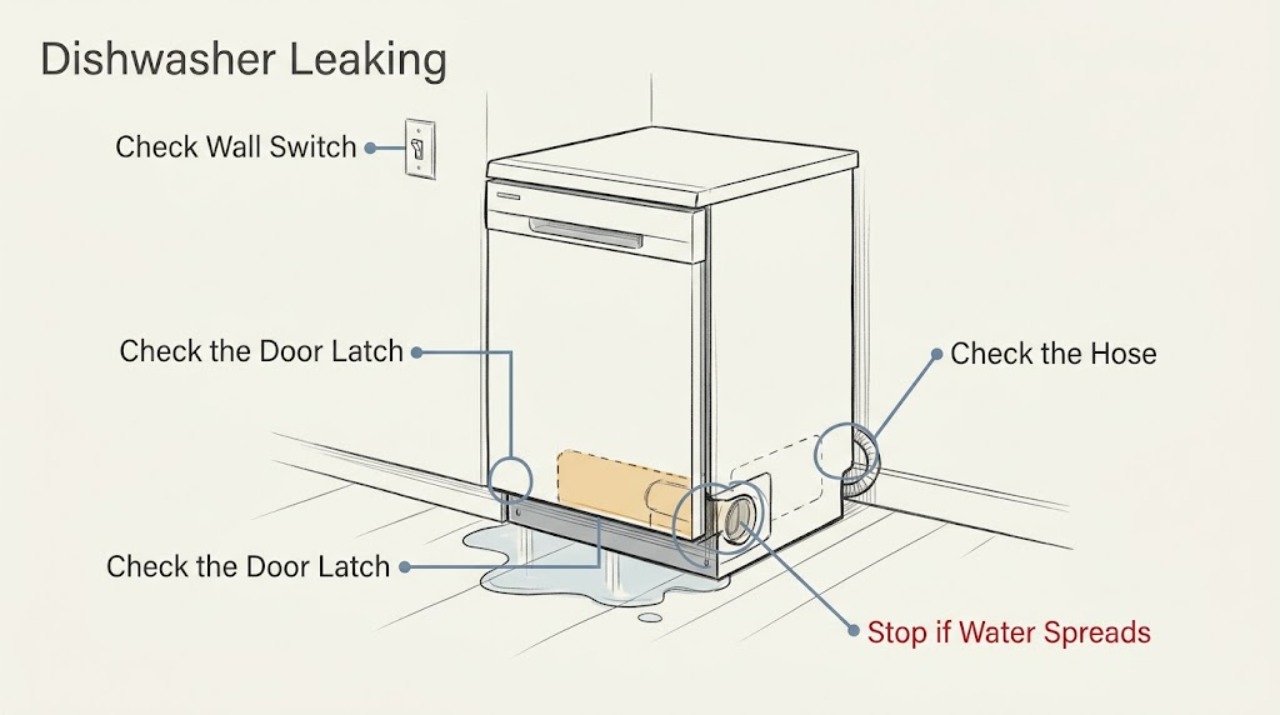
Work through in order
Diagnostic checks
Use only checks that match the exact appliance or system and its official guide.
-
Check 1
Switch off the dishwasher, keep power and water isolated when safe, dry the floor, and note whether water is at the door edge, below the cabinet, or beside a hose connection.
Expected result: The leak location is visible, or water is spreading from an inaccessible area.
Next step: Leave the appliance off and use the matching closure or drain check only if the area is safe and dry.
Why this matters
Why: A visible location determines the safe external branch; an unknown source should not be chased by repeated cycles.
-
Check 2
Inspect the door perimeter and latch area for a basket, dish, fragrance dispenser, or other object preventing full closure; do not force the door.
Expected result: The door is obstructed or misaligned, or it closes evenly with no visible obstruction.
Next step: Remove only the accessible obstruction and check alignment from outside. Stop if the latch, seal, or door is damaged.
Why this matters
Why: Miele identifies front-area obstructions and an appliance that is not standing straight as causes of a door that cannot close and leaks.
-
Check 3
For water that appears after draining, inspect the visible drain hose and accessible pump-cover area only after power is off; look for a kink, loose cover, or visible debris.
Expected result: A hose is kinked, the pump cover is not locked, or no accessible issue is present.
Next step: Correct or reseat only the documented accessible item, then test once while watching from a dry position.
Why this matters
Why: Miele links a kinked hose and improperly engaged pump cover to drainage problems and possible leakage; a clear path suggests a hidden fault.
-
Check 4
Check the floor, cord, plug, and nearby outlet from a dry position for water contact, heat, damage, or a breaker trip.
Expected result: Water has reached electrical parts or a breaker trips, or the electrical area is dry and stable.
Next step: Do not restore power when the area is unsafe; arrange qualified appliance or electrical service.
Why this matters
Why: Water near electricity or repeated protection trips is a safety boundary, not a routine leak check.
Use your observations
Decision map
Find the observation that best matches what you see, then follow the next safe action.
-
PATH 01Next step
What you see
Water starts at the front edge while the door is hard to close
Do this next
Correct only the accessible obstruction; request service for a distorted door, seal, or persistent leak.
-
PATH 02Next step
What you see
Water appears after draining and the pump cover or hose is abnormal
Do this next
Use the power-off documented check once and stop if water returns.
-
PATH 03Next step
What you see
The leak source is hidden, reaches electrical parts, or returns after one safe correction
Do this next
Keep the dishwasher off and provide service with the leak location, timing, and photos.
Helpful context
Understand the symptom
The location matters
A front-edge leak points toward closure or alignment, while water appearing during drainage can follow a pump-cover or drain-path problem. Stop first, then inspect only accessible surfaces.
When checks do not resolve it
Need a professional?
Keep the dishwasher off until a persistent leak is diagnosed.
Safety scope: Do not run leak tests with water near an outlet, open electrical panels, or remove sealed components.
Have this ready
- Provide the leak location, whether it occurs during fill/wash/drain, door condition, hose/pump-cover observations, and model number.
Common questions
FAQ
Can I run a Miele dishwasher once to find the leak?
Do not run it when water is near electricity or the source is hidden. After a safe, dry external correction, one monitored test may be reasonable; stop immediately if water returns.
Why does a Miele dishwasher leak after a drain problem?
Miele notes that an improperly engaged drain-pump cover can let the pump chamber leak and keep water from being pumped away. Switch off before inspecting that area.
Read the exact guide
Official sources
- DrainageMiele USA Support · Miele dishwashers with drainage faults or water remaining
- Dishwasher will not startMiele USA Support · Miele dishwashers with power or start symptoms
- Door does not close and is leakingMiele USA Support · Miele dishwashers with a door closure or front leak symptom
- Water not pumped away (G 1xxx–G 6xxx)Miele USA Support · Miele G 1xxx–G 6xxx dishwashers; follow the model manual
Community feedback
Share a repair observation
Share a plain-text repair observation. Accepted observations are published automatically; this page may take a moment to update.