
On this page
Start here
Quick answer
Note exactly when the Miele dishwasher stops: before filling, during washing, while draining, or near the end. A closed-door or faucet condition can prevent a start, while water remaining in the cabinet points toward drainage. If the cycle stops with a fault code, leak, repeated alarm, or an electrical trip, stop using the dishwasher and arrange service.
Before you begin
Safety first
- Switch off and disconnect power before accessible drain cleaning; do not open electrical covers or continue with a damaged hose.
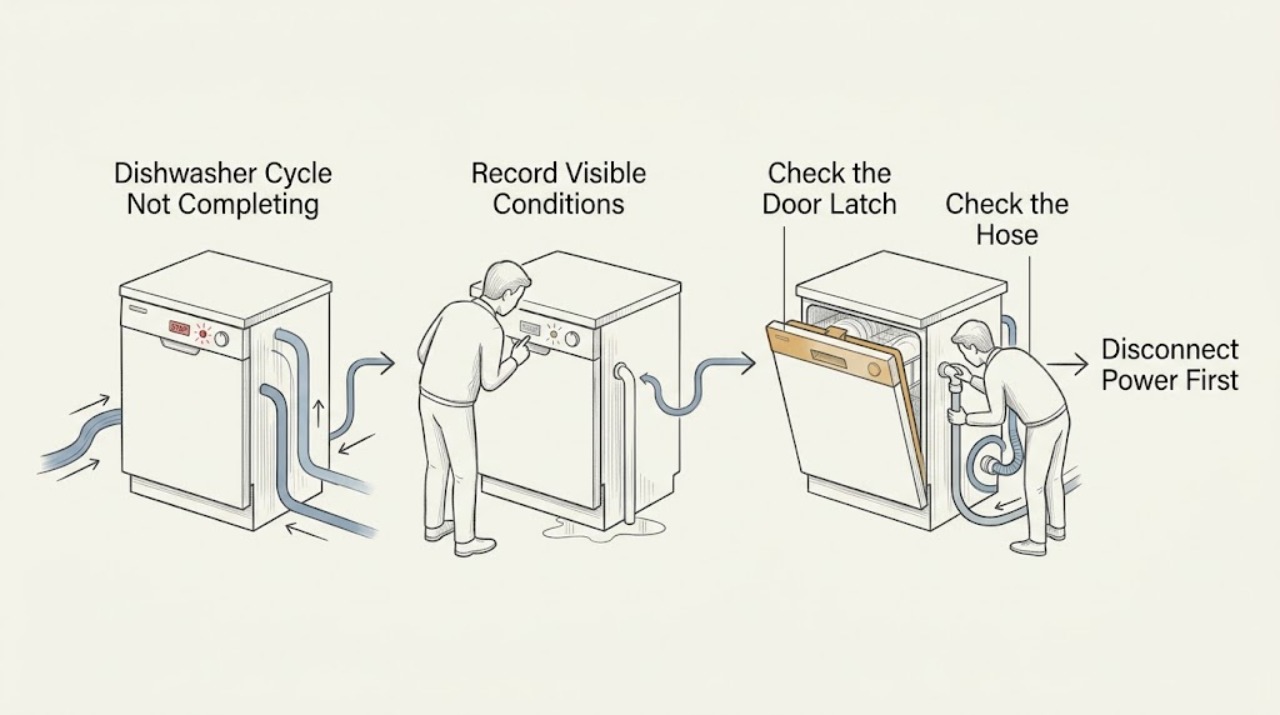
Work through in order
Diagnostic checks
Use only checks that match the exact appliance or system and its official guide.
-
Check 1
Write down the program, elapsed stage, display text or indicator, and whether the wash cabinet is empty, partly full, or full of water when the cycle stops.
Expected result: The machine stops before filling, after washing with water inside, or with a visible code.
Next step: Use the matching check below and keep the exact message for service if it returns.
Why this matters
Why: The stage separates door/intake conditions from drainage and model-specific faults; a code is more useful than the general phrase ‘cycle stopped.’
-
Check 2
Open and firmly close the door, checking that a dish, basket, or front accessory is not preventing the latch from engaging.
Expected result: The next start proceeds normally, or the dishwasher still refuses to continue.
Next step: Reposition only an accessible obstruction and retry once. Do not bypass or force the latch.
Why this matters
Why: Miele identifies an improperly closed door as a start barrier; failure with a normally latching door needs a different path.
-
Check 3
If the stop occurs immediately after starting, check that the faucet is open and the visible inlet hose is not kinked.
Expected result: The faucet was closed, the hose is restricted, or the visible supply is normal.
Next step: Correct a faucet or visible hose issue once, restart, and stop if the same interruption returns.
Why this matters
Why: A restricted water intake can stop a program at its beginning; a normal supply makes a drain, code, or internal fault more likely.
-
Check 4
If water remains after the stopping point, switch off power and inspect the accessible filter, drain-pump cover, and drain hose according to the model instructions.
Expected result: Debris, a loose pump cover, a kink, or no accessible restriction is found.
Next step: Clean or reseat only the documented accessible part and test once. Do not remove panels or handle hidden glass.
Why this matters
Why: Miele links these conditions to water not being pumped away; a clear path after a correct reseat suggests service-level diagnosis.
Use your observations
Decision map
Find the observation that best matches what you see, then follow the next safe action.
-
PATH 01Next step
What you see
The cycle never begins and the door or faucet condition is abnormal
Do this next
Correct the accessible condition once and restart; escalate if it does not hold.
-
PATH 02Next step
What you see
The cycle stops with water left after washing or rinsing
Do this next
Perform the power-off accessible drain checks and request service if drainage remains poor.
-
PATH 03Next step
What you see
The cycle stops at different stages with a recurring code or alarm
Do this next
Stop repeated restarts and provide Miele with the code, program, stop stage, water level, and model number.
Helpful context
Understand the symptom
The stopping stage narrows the path
A cycle that never begins is different from one that washes but cannot drain. Record the display and water level before changing settings, then follow the branch that matches the stopping stage.
When checks do not resolve it
Need a professional?
Use professional service for persistent stops, internal pump or control faults, leaks, and any electrical warning.
Safety scope: Switch off and disconnect power before accessible drain cleaning; do not open electrical covers or continue with a damaged hose.
Have this ready
- Provide the model, program, elapsed stage, display text, water level, and what changed after the one safe check.
Common questions
FAQ
Why does my Miele dishwasher stop before the cycle ends?
The stop stage matters. A stop before filling points to door or intake conditions, while water left in the cabinet points to drainage. Record the stage and message before restarting.
Should I restart a Miele dishwasher repeatedly after it stops?
No. Correct one accessible condition once, then stop if the interruption returns or a code, leak, or electrical warning appears.
Read the exact guide
Official sources
- Dishwasher will not startMiele USA Support · Miele dishwashers that will not start
- DrainageMiele USA Support · Miele dishwashers showing a drainage fault
- Water intake indicator light flashingMiele USA Support · Miele dishwashers with a water-intake indicator
- Water not pumped away (G 1xxx–G 6xxx)Miele USA Support · Miele G 1xxx–G 6xxx dishwashers; follow the model manual
Community feedback
Share a repair observation
Share a plain-text repair observation. Accepted observations are published automatically; this page may take a moment to update.