
On this page
Start here
Quick answer
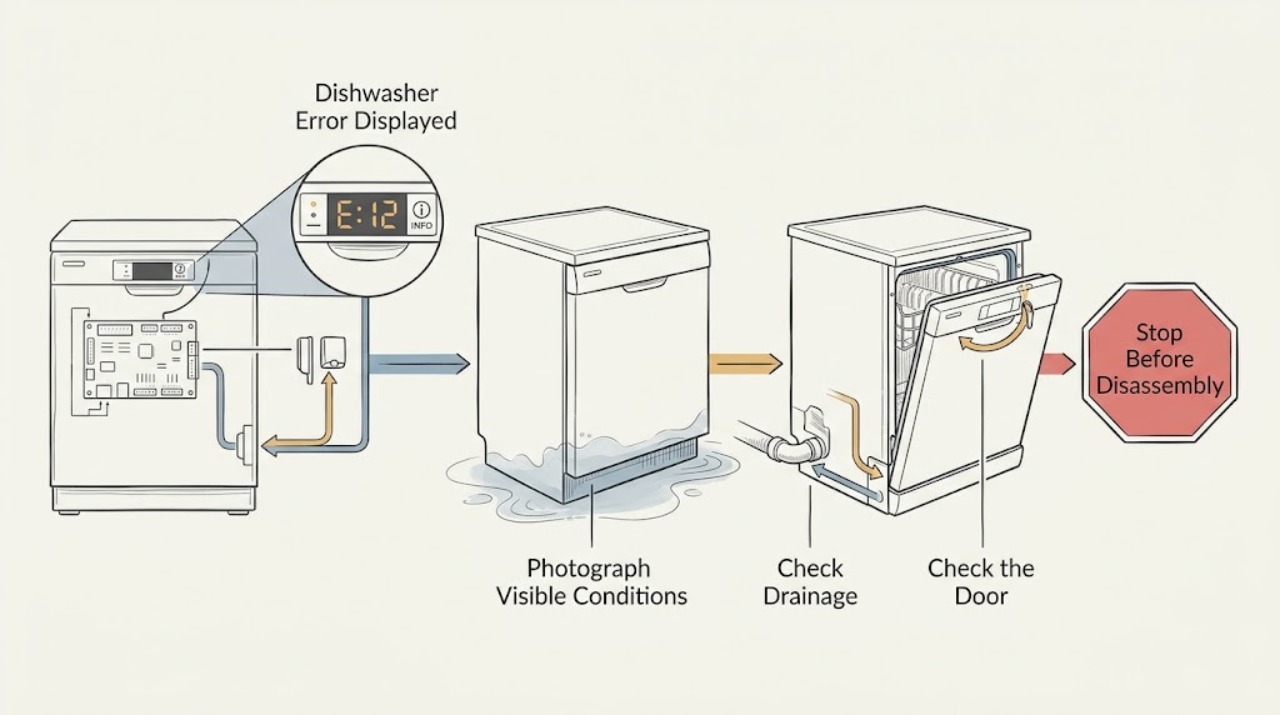
An error displayed on a Miele dishwasher is not one universal fault. Record the exact F-code or wording, indicator pattern, program stage, and water level before clearing it. Some codes identify technical faults that Miele says are not user-remedied; a drainage message instead directs you to a specific power-off inspection. Without the code and model, do not guess a part.
Before you begin
Safety first
- Do not probe live wiring, bypass interlocks, or dismantle the dishwasher to identify a code.
Work through in order
Diagnostic checks
Use only checks that match the exact appliance or system and its official guide.
-
Check 1
Photograph or transcribe the complete display, including the letter, number, punctuation, flashing lights, and whether an alarm sounds. Note the model from the rating plate without moving the appliance.
Expected result: A complete F-code or Drainage wording is available, or only a generic light pattern is visible.
Next step: Keep the record and use only the matching documented branch. Ask Miele for model-specific interpretation when the code is incomplete.
Why this matters
Why: A complete code can be matched to model-specific support; a generic pattern is not enough to identify a component.
-
Check 2
Check whether water remains in the wash cabinet and whether the display specifically says Drainage, without reaching into the pump area while powered.
Expected result: Water remains with a Drainage message, or the cabinet is empty and another code is shown.
Next step: For Drainage, switch off and use the documented accessible drain checks. For another code, do not substitute a drain remedy.
Why this matters
Why: Miele gives a drain-pump-cover and debris path for Drainage; other codes can represent unrelated technical faults.
-
Check 3
If the appliance will not start and no code-specific instruction applies, check only that the door closes, the dishwasher has power, a program is selected, and the faucet is open.
Expected result: One start condition is abnormal, or all accessible conditions are normal.
Next step: Correct one accessible condition and retry once. Do not bypass the door or repeatedly reset a technical fault.
Why this matters
Why: Miele lists these as ordinary start barriers; normal conditions with a persistent code need the code-specific service path.
-
Check 4
Compare the code with Miele's support guidance rather than inferring from a symptom such as poor heating or a stopped program.
Expected result: The code matches a documented technical fault such as F1 or F24, or no exact match is found.
Next step: Stop user-level troubleshooting for a documented technical fault and provide the code and model to Miele. If no match exists, request model-specific support.
Why this matters
Why: Miele describes F1 as a water/heating temperature sensor short circuit and F24 as a heating-relay contact fault; both are technical faults it directs to service.
Use your observations
Decision map
Find the observation that best matches what you see, then follow the next safe action.
-
PATH 01Next step
What you see
The display says Drainage and water is present
Do this next
Use the power-off filter, pump-cover, and hose checks documented for the model, then arrange service if the message returns.
-
PATH 02Next step
What you see
The exact code is F1, F24, or another code Miele classifies as technical
Do this next
Do not open the appliance or replace a guessed part; book Miele service and provide the code.
-
PATH 03Next step
What you see
Only a generic flashing light is visible and the model or code is missing
Do this next
Record the pattern and model, consult the exact manual, or contact Miele support instead of clearing the warning repeatedly.
Helpful context
Understand the symptom
The exact code is the identity of the problem
‘Error displayed’ is only the visible symptom. Miele's support pages distinguish sensor faults, heating-relay faults, and drainage faults, so the code and model determine which branch is safe.
When checks do not resolve it
Need a professional?
Use professional service for sensor, relay, control, heating, water-protection, or unexplained recurring faults.
Safety scope: Do not probe live wiring, bypass interlocks, or dismantle the dishwasher to identify a code.
Have this ready
- Provide the exact code or light pattern, model number, program, stop stage, water level, and whether one power cycle changed it.
Common questions
FAQ
Can I clear a Miele dishwasher error by switching it off?
A single power cycle may be part of model instructions, but it does not identify or repair a technical fault. Record the code first and arrange service if it returns.
What should I send Miele when an error is displayed?
Send the exact code or light pattern, model number, program, stop stage, and whether water remains. Those details distinguish drainage from technical faults.
Read the exact guide
Official sources
- Fault F24Miele USA Support · Miele dishwashers displaying fault F24
- Fault F1Miele USA Support · Miele dishwashers displaying fault F1
- Water not pumped away (G 1xxx–G 6xxx)Miele USA Support · Miele G 1xxx–G 6xxx dishwashers; follow model instructions
- DrainageMiele USA Support · Miele dishwashers displaying Drainage
- Dishwasher will not startMiele USA Support · Miele dishwashers that will not start
Community feedback
Share a repair observation
Share a plain-text repair observation. Accepted observations are published automatically; this page may take a moment to update.