
On this page
Start here
Quick answer
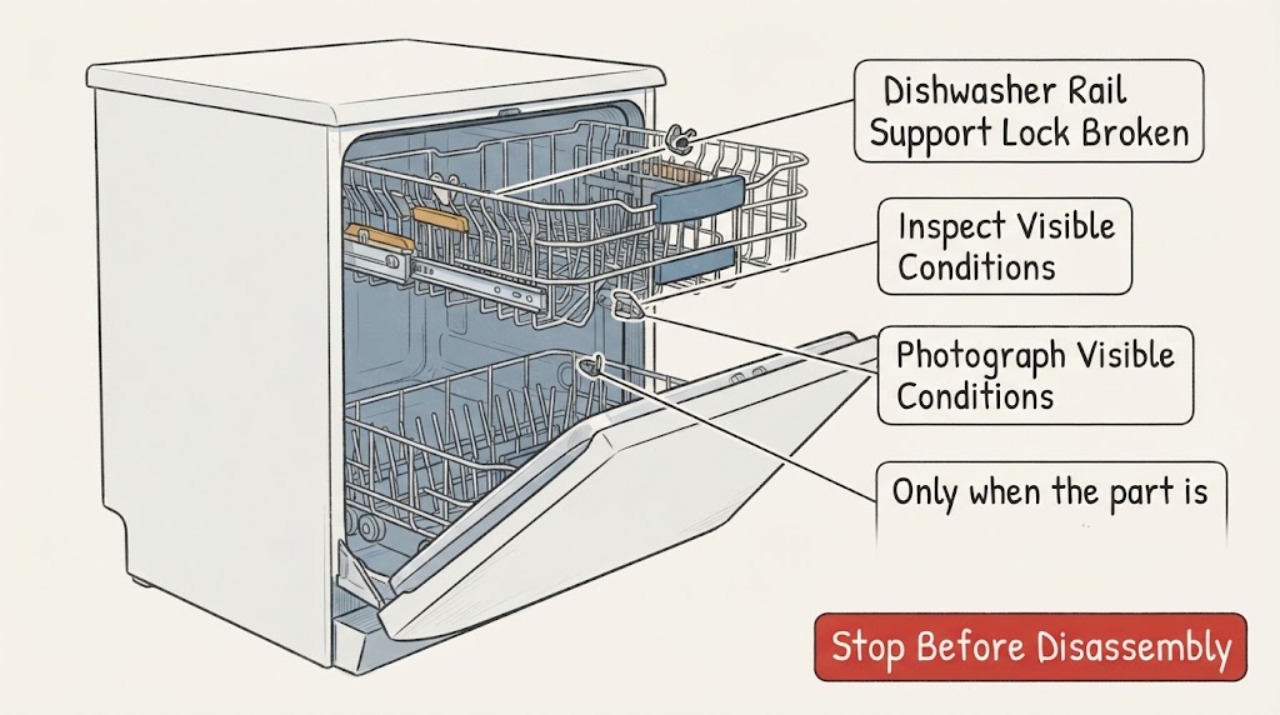
Do not order a generic Miele rail lock from the phrase alone. Miele's official dishwasher support uses the term safety clips for the two cutlery-tray runners and says that, after the cutlery tray is removed, a wrongly oriented clip can be pressed together and inserted into the rail again. A broken rail support lock could instead mean a cutlery-tray safety clip, a basket guide or stop, a rail attachment, or a door-related part, and no model was supplied. Empty the affected tray or basket, photograph the part and model label, check whether the rail still holds and slides without force, and keep the dishwasher out of use if a loose part can let the tray fall, obstruct a spray arm, prevent the door from closing or cause a leak. Use the exact Miele manual or parts lookup before ordering or replacing anything.
Work through in order
Diagnostic checks
Use only checks that match the exact appliance or system and its official guide.
-
Check 1
Turn the dishwasher off, let hot water and dishes cool, and empty the affected cutlery tray or basket. Look at the rail from the front and both sides without pulling against resistance; keep fingers clear of a cracked clip, sharp edge or unsupported tray.
Expected result: The tray/basket is supported and slides freely, or it drops, tilts, binds, leaves a loose fragment, or cannot be kept in the rail.
Next step: If the tray or basket is unstable, remove it only as the exact model manual permits and keep it out of service; do not run the dishwasher or force the runner. If it is stable, continue with the identity and clip checks.
Stop if: Stop for a sharp fragment, a rail that is pulling from the cabinet, a tray that can fall, or any need to remove a loaded or trapped assembly by force.
Why this matters
Why: A stable, unloaded assembly allows identification. A dropped, tilted or binding tray means the support is not safe for a loaded cycle; the phrase broken rail support lock does not establish which internal or rack part has failed.
-
Check 2
Identify where the broken piece sits: the two cutlery-tray runner ends, the side of an upper/lower basket, a basket guide/stop, the cabinet rail attachment, or the door edge. Photograph the intact opposite side and the broken area, and record the complete Miele model number from the data plate.
Expected result: The piece is clearly a safety clip on a cutlery-tray runner, or it is a different/unclear rail, guide, stop or attachment with no confirmed name.
Next step: If it is not clearly the cutlery-tray clip, stop short of reassembly and use the model-specific Miele manual or service channel. If the model cannot be read, preserve the photos and do not order by appearance or generic wording.
Why this matters
Why: Miele's support page gives a specific clip orientation procedure only for the cutlery-tray runner situation. Miele's parts catalog shows multiple guide, basket and rail categories, so a different location cannot be mapped to the same clip without model evidence.
-
Check 3
Only when the part is visibly the cutlery-tray safety clip and the runner itself is intact, compare both sides. With the tray empty, press the clip together and insert it into the rail in the orientation shown by Miele; do not bend a cracked clip or force a different rail part into place.
Expected result: Both clips seat in the rails and the empty tray runs evenly, or a clip will not seat, is broken, the two sides differ, or the tray still binds or drops.
Next step: If both clips seat and the tray is stable, leave it unloaded until the model manual confirms normal use and check door/spray-arm clearance. If the clip is broken or the rail remains unstable, keep the dishwasher off and request Miele parts/service; do not substitute a clip from another model.
Why this matters
Why: Miele's support instruction addresses a wrongly inserted safety clip after tray removal, not every broken rail support. A clip that will not seat or a rail that remains unstable indicates a damaged or different component.
-
Check 4
With all racks empty, push them fully home and close the door gently. Check that the damaged rail or support does not touch the door, door seal, detergent area or spray arm, and look for water at the door or tub edge during an external inspection; do not run a cycle to test a loose support.
Expected result: The door closes normally with no contact or leak, or the rail prevents closure, rubs the seal, blocks a spray arm or leaves a leak path.
Next step: If there is contact, a leak, or a spray-arm obstruction, keep the appliance off, close the water supply if water is actively escaping and safe to reach, and book Miele service. If clearance is normal, still use only the model-specific part/manual decision before loading the repaired rail.
Stop if: Do not energize the dishwasher with an unstable rail, obstructed spray arm, damaged seal area or active leak.
Why this matters
Why: Miele's official support routes a difficult-to-close or leaking dishwasher to service after checking related clips and obstructions. A support that affects door closure or water containment is beyond a safe generic rack-part substitution.
-
Check 5
Give Miele or a qualified appliance technician the complete model number, rail location, photos of the broken support and intact opposite side, whether the tray was recently removed, and whether the door closes and the rail slides. Ask them to identify the exact clip, guide, stop, rail or basket assembly before ordering.
Expected result: The model is missing, the original part cannot be named confidently, the rail/cabinet attachment is damaged, or the tray remains unstable after the visible clip check.
Next step: Keep the affected tray/basket unloaded and request an exact Miele parts or service determination. Do not use adhesive, wire, improvised stops, or a visually similar part as a structural substitute.
Why this matters
Why: The evidence is insufficient for cross-model compatibility. Miele's own catalog separates multiple dishwasher basket/rail components and sends unavailable or model-specific items through support/dealer channels.
Use your observations
Decision map
Find the observation that best matches what you see, then follow the next safe action.
-
PATH 01Next step
What you see
The broken item is clearly one of the cutlery-tray safety clips, the rail itself is intact, and both clips seat after the tray is empty.
Do this next
Keep the tray unloaded until the exact model manual confirms its position, then check smooth travel and door clearance. Replace or service the clip if it is cracked or will not retain the tray.
Why this path and its safety boundary
Why it matters: This matches the limited Miele support scenario for a wrongly oriented safety clip; it does not prove that a broken clip is reusable or that the procedure applies to a different basket or rail.
-
PATH 02Next step
What you see
The rail support is on a basket side, basket guide, stop or cabinet rail rather than the cutlery-tray runner, or the location cannot be identified.
Do this next
Do not force the rack or order a look-alike part. Keep the damaged assembly unloaded and obtain an exact Miele model-based parts or service identification.
Why this path and its safety boundary
Why it matters: The public Miele clip procedure cannot be transferred; the part identity and fitment remain unresolved without the model-specific manual or parts diagram.
-
PATH 03Next step
What you see
The tray drops, the rack binds, the rail pulls loose, the door will not close, the spray arm is blocked, or water appears at the door/tub edge.
Do this next
Stop use, close the water supply if there is active leaking and it is safe to do so, and contact Miele service with the model and photos. Do not run another cycle to see whether the part holds.
Why this path and its safety boundary
Why it matters: The damaged support is affecting safe movement or water containment, so a generic clip or rail substitution is not supported.
-
PATH 04Next step
What you see
The rail is stable, the empty tray/basket slides freely, the door and spray arms have clearances, and the exact model and part identity have been confirmed.
Do this next
Follow only the exact Miele manual or confirmed parts instructions, then recheck unloaded travel and door closure before loading. Escalate if the support moves or the symptom returns.
Why this path and its safety boundary
Why it matters: The issue may be limited to a documented user-accessible clip or an exact model-specific replacement, but the visible checks do not prove a structural repair is complete.
Helpful context
Understand the symptom
The name does not identify one Miele part
Miele's public support wording distinguishes safety clips on cutlery-tray runners from the surrounding rail. Its spare-parts catalog also lists basket guides and different basket or rail components. Without the model number and a view of the broken piece, do not assume that a rail support lock is the cutlery-tray clip, a basket stop or a door mechanism. The safe first decision is whether the tray or basket remains supported and whether the door, spray arms and tub are clear.
Keep the damaged rail unloaded
Remove dishes and cutlery before examining the rail. A loose clip or support can let a loaded tray drop, leave sharp plastic or metal edges, or put the rack out of alignment. Do not force a runner past a broken stop, drill the rail, glue a load-bearing piece or run a cycle while the damaged assembly can move into the door or spray path.
Common questions
FAQ
Is a Miele dishwasher rail support lock the same as a cutlery-tray safety clip?
Not necessarily. Miele's support page names safety clips on the two cutlery-tray runners, while its parts catalog lists several basket, guide and rail components. Identify the location and complete model before treating the broken part as that clip.
Can I keep using the dishwasher with the support lock broken?
Keep the affected tray or basket unloaded and stop use if it drops, binds, contacts the door or spray arm, prevents closure, or leaks. A stable clip scenario still requires the exact model's instructions before loading the repaired assembly.
Can I order a replacement Miele rail or lock by appearance?
No. The Miele catalog contains multiple dishwasher basket, guide, rail and stop components, and no model was supplied for this task. Use the complete model number and an official Miele manual/parts lookup or service channel to confirm fitment.
Read the exact guide
Official sources
- Operating Instructions G4228Miele USA · Opened an official Miele USA manual, but the task has no model and does not identify G4228. Only general safety statements about not operating without baskets, checking spray-arm obstruction, hot water and stopping use are retained as bounded safety context; no G4228-specific part or procedure is transferred.
- Dishwasher Spare Parts | Shop Online | Miele | Page 4Miele USA · Opened the official Miele USA parts catalog. It lists multiple dishwasher component categories and directs unavailable items to customer support/dealers; it does not establish compatibility for the task's unspecified model.
- The dishwasher door is difficult to close or cannot be closed at all, and is leakingMiele USA · Opened the official Miele USA support page. It specifically addresses safety clips on the two cutlery-tray runners after tray removal, so this article uses it only for that bounded scenario and for the door/leak escalation; it is not treated as proof of an unknown model's rail-part fitment.
Community feedback
Share a repair observation
Share a plain-text repair observation. Accepted observations are published automatically; this page may take a moment to update.