
On this page
Start here
Quick answer
Do not run the Miele G 575 SC Excellent with a salt-reservoir cap that is loose, cracked or missing. Turn the dishwasher off, allow it to cool, and inspect only the accessible cap and reservoir opening for salt caught on the threads or a visibly displaced seal. Use the official G 575/G 575 SC instructions for the cap procedure. If the cap still will not close firmly, the threads or reservoir neck are damaged, or water/brine is escaping, keep the dishwasher out of service and arrange Miele service; do not glue, force, bypass or substitute the cap.
Before you begin
Safety first
- Do not run the dishwasher with the cap loose, glue or force the cap, use a generic substitute, bypass a warning, open panels, or infer a valve/softener/control part from the cap symptom.
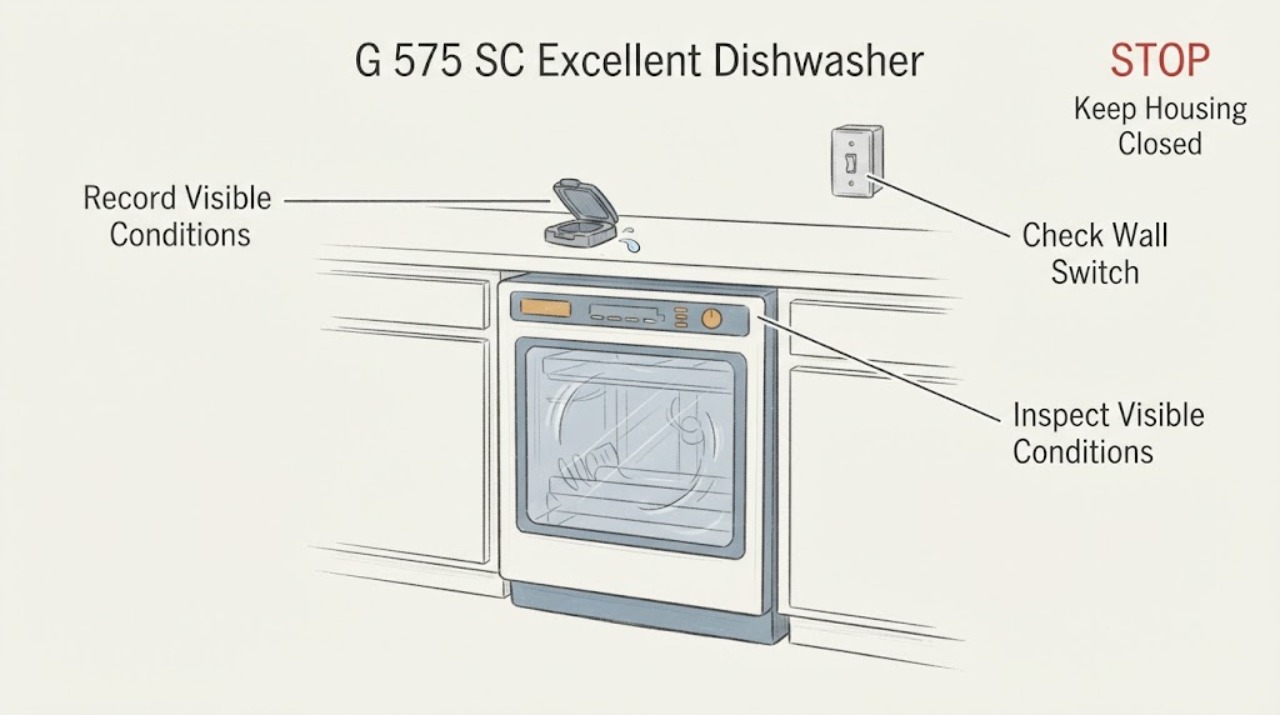
Work through in order
Diagnostic checks
Use only checks that match the exact appliance or system and its official guide.
-
Check 1
Stop the dishwasher and do not start another program with the salt-reservoir cap loose, cracked or missing. Record the full rating-label identity, including any regional suffix, and compare it with the official G 575/G 575 SC instructions before handling the reservoir.
Expected result: The label matches the assigned G 575 SC Excellent family, or the label/model naming differs or cannot be read.
Next step: Use the exact regional manual or Miele manual finder. Do not use another Miele model's cap dimensions or instructions as a substitute.
Why this matters
Why: A matching family manual can define the cap and salt-reservoir procedure; a different or unresolved model may use a different cap or softener arrangement.
-
Check 2
With the dishwasher switched off and cool, remove only the lower basket if needed to see the salt-reservoir cap. Look at the cap, visible threads, reservoir lip and any visible seal for loose salt, a cross-threaded position, cracks, missing pieces or deformation. Do not reach into the softener assembly or use tools to force the cap.
Expected result: The cap is intact and salt/debris is visibly caught at the threads, or the cap is cracked, stripped, missing a piece or will not seat flat.
Next step: If the cap is intact, clean only the accessible mating surfaces as the model instructions allow and refit it gently. If damaged or still loose, leave the machine unused and arrange Miele service.
Why this matters
Why: Visible residue or mis-seating may prevent closure; damage or persistent non-seating means the seal cannot be trusted. Neither observation identifies a replacement part or an internal valve fault.
-
Check 3
After any allowed cap cleaning/refitting, confirm that the cap closes firmly by hand without tools and that no salt or brine is escaping into the wash cabinet. If the cap opened during a program, follow Miele's support sequence: switch the dishwasher off, switch it back on, and restart only after the cap is securely closed.
Expected result: The cap closes firmly with no visible gap or leakage, or it cannot be made secure or liquid remains around the reservoir.
Next step: Do not run the dishwasher if the cap is not secure. Keep the door closed, protect the surrounding cabinet/floor from brine, and call Miele service for damaged or persistent sealing problems.
Why this matters
Why: A firm closure permits the model-directed program reset; a cap that will not seal remains an unresolved leak path and should not be tested by repeated cycles.
-
Check 4
For a cracked/missing cap, damaged reservoir neck, repeated salt-reservoir warning, visible water/brine leakage or any need to open panels, provide Miele service with the full model and photos of the accessible cap area. Do not glue the cap, install a generic lid, bypass a warning, or run the dishwasher with the salt system open.
Expected result: The problem is limited to a secure cap after cleaning, or the cap/neck remains damaged or the leak/warning returns.
Next step: Use Miele's manual finder and technician route. Keep the dishwasher out of service until the sealing problem is resolved.
Why this matters
Why: A secure cap with no leakage is a user-level closure result; persistent damage or leakage requires model-specific parts and inspection that the public sources do not establish.
Use your observations
Decision map
Find the observation that best matches what you see, then follow the next safe action.
-
PATH 01Next step
What you see
The cap is intact, but loose salt or debris is visibly caught on the threads or reservoir lip.
Do this next
With the dishwasher off and cool, clean only the accessible mating surfaces as the G 575 family instructions allow, refit the cap gently, and stop if it still will not seal.
Why this path and its safety boundary
Why it matters: The residue may prevent the cap from seating, but this does not prove that an internal softener part has failed.
-
PATH 02Next step
What you see
The cap will not close firmly, sits crooked, has a crack or missing piece, or the reservoir neck is visibly damaged.
Do this next
Do not run the dishwasher or improvise a replacement. Photograph the model label and cap area and arrange Miele service.
Why this path and its safety boundary
Why it matters: The salt-reservoir seal cannot be trusted and the dishwasher may leak brine or water during operation.
-
PATH 03Next step
What you see
The cap is intact and firmly closed, and it was opened during a program without visible leakage or damage.
Do this next
Switch the dishwasher off, switch it back on, and restart only after the cap is securely closed; stop if the warning or leak returns.
Why this path and its safety boundary
Why it matters: Miele's support procedure treats an opened lid as a closure/program-state issue, not proof of a failed component.
-
PATH 04Next step
What you see
Water/brine escapes, a salt-reservoir lid warning returns, or the source cannot be checked without opening the dishwasher cabinet.
Do this next
Keep the dishwasher out of service and arrange Miele service with the exact model and observations.
Why this path and its safety boundary
Why it matters: The accessible closure check did not resolve the problem; the public sources do not establish a compatible cap, seal, valve or softener repair.
Helpful context
Understand the symptom
Treat the cap as a water-softener seal
Miele's official G 575/G 575 SC operating instructions identify the salt reservoir and cap for this older dishwasher family. The assigned title says the cap is broken and will not seal, so the safe question is whether the cap can close as designed, not whether the dishwasher can be run with the lid off or loose. Keep the assigned G 575 SC Excellent identity and verify the label/manual region before seeking any part.
Use only accessible closure checks
Miele's salt-reservoir-lid support page says a lid warning means the lid is not firmly closed, and its first step is to close the lid. With the appliance switched off, a user can inspect visible salt or debris on the cap threads and reservoir lip and refit the cap exactly as the model instructions show. A cap that remains loose, cracked or unable to seal needs service; a clean-looking opening does not prove the underlying water-softener assembly is sound.
When checks do not resolve it
Need a professional?
Arrange Miele service for a cracked or missing salt-reservoir cap, damaged reservoir neck/threads, persistent lid warning, visible water/brine leakage, or any repair requiring panels or internal access.
Safety scope: Do not run the dishwasher with the cap loose, glue or force the cap, use a generic substitute, bypass a warning, open panels, or infer a valve/softener/control part from the cap symptom.
Have this ready
- Provide the full rating-label model/serial information, regional manual if known, photos of the cap and reservoir lip, whether the cap can close firmly, and when the warning or leak appears.
Common questions
FAQ
Can I run the Miele dishwasher with the salt cap loose?
No. A loose or broken cap cannot be trusted to seal the salt reservoir. Miele's support guidance says the lid warning means the lid is not firmly closed; secure it according to the model instructions or arrange service.
Should I glue a cracked salt-reservoir cap?
Do not glue or force it. The official sources do not establish a safe adhesive repair or a cross-model cap fit. Keep the dishwasher unused and ask Miele to identify the correct model-specific repair path.
What if the cap opened during a program?
Once the dishwasher is safe and the cap is firmly closed, Miele says to switch the dishwasher off, switch it back on, and restart the program. If the cap cannot close or the warning returns, stop and arrange service.
Read the exact guide
Official sources
- The dishwasher display shows Salt reservoir lid/Close salt reservoir lidMiele USA · Opened official Miele support page; supports closing the cap and the off/on/restart sequence if it opened during a program. It does not authorize operation with a damaged or loose cap.
- Operating Instructions — Dishwasher G 575 / G 575 SCMiele USA · Opened official Miele PDF for the G 575 SC Excellent naming variant and its G 575/G 575 SC family; used for family identity and the salt-reservoir/cap procedure. It does not establish a replacement part number for a broken cap. The exact normalized model string G575 SC Excellent is included as the assigned naming variant, while the PDF title uses G 575 / G 575 SC.
Community feedback
Share a repair observation
Share a plain-text repair observation. Accepted observations are published automatically; this page may take a moment to update.