
On this page
Start here
Quick answer
On a Miele 7000 Series dishwasher, first separate a removable film from glass that has been permanently altered. Miele's support guidance says wipeable clouding can be associated with low rinse-aid dosage, an empty or incorrectly capped salt reservoir on models with a water softener, unsuitable or incorrectly dosed detergent, or a water-softener setting that is too low. Increase or refill only the product the exact model calls for, and load glasses so water can drain freely. If the haze will not wipe off, Miele treats dull, discolored, altered glass as a glassware-suitability or surface-damage issue with no restoration remedy; older Miele glassware guidance also explains that etching is irreversible. Do not use a single glass or one wash to declare the water hard or the dishwasher faulty, and never mix acids, chlorine products, or other cleaners. Because “7000 Series” is not a complete model, use the matching manual for salt, rinse-aid, detergent, and program settings.
Before you begin
Safety first
- Do not use acids, chlorine products, descalers, vinegar, or other cleaners in combination with detergent, salt, or rinse aid; do not put unlisted chemicals in a reservoir; and do not open the dishwasher or alter the water-softener hardware to chase cloudy glass. Stop using valuable glassware when the haze is non-wipeable or the result persists despite documented settings.
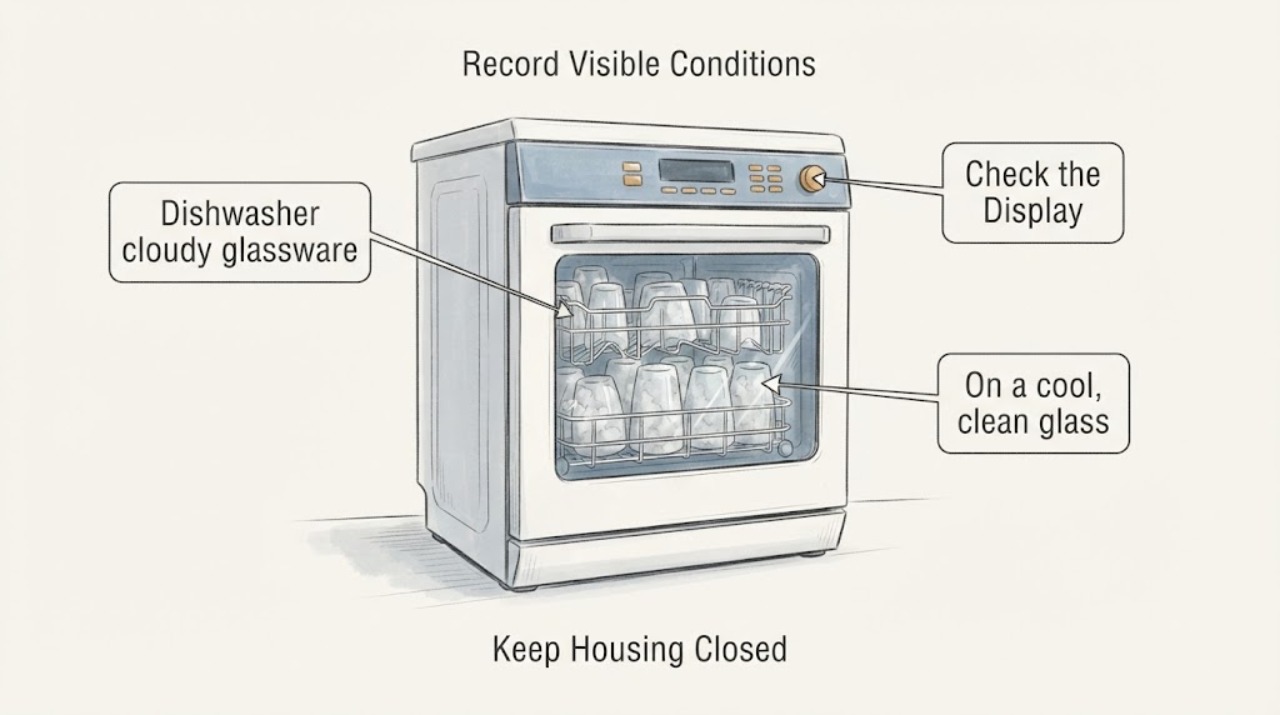
Work through in order
Diagnostic checks
Use only checks that match the exact appliance or system and its official guide.
-
Check 1
Confirm the complete Miele model and market from the rating plate and retrieve its owner manual. Record whether the machine is G 7xxx/7000 Series, whether it has a water softener, and whether it uses manual detergent or AutoDos; do not assume all 7000 models expose the same settings.
Expected result: The full model is known, the model has a water-softener or salt indicator, or the model and functions remain uncertain.
Next step: Use the exact manual for the settings and product type. If the model cannot be identified, keep the article at the wipeable-versus-permanent classification and ask Miele for the matching documentation.
Stop if: Do not change hidden service settings or transfer a different G 7xxx model's dosage or water-hardness value.
Why this matters
Why: Miele's G 7xxx material is model-dependent. Without the full identity, a salt, rinse-aid, detergent, or program instruction can be inapplicable.
-
Check 2
On a cool, clean glass, perform only a gentle wipe test using the normal glassware-care method. Compare the same area before and after wiping and note whether the film is powdery, spotty, iridescent, or unchanged; do not scrape or polish the glass.
Expected result: The film wipes off, partly wipes off, or remains unchanged and the glass stays dull or discolored.
Next step: Use the wipe result to choose the next setting check. Remove delicate or questionable glassware from further dishwasher cycles until the surface-damage possibility is clear.
Stop if: Do not use abrasives, acidic descaler, chlorine bleach, or mixed cleaners to force a change in appearance.
Why this matters
Why: Wipeable residue keeps rinse aid, salt, detergent, and water-softener settings in scope. A non-wipeable altered surface is consistent with damage or an unsuitable glass, not a removable dishwasher deposit.
-
Check 3
If the residue is wipeable, inspect the accessible rinse-aid level and salt indicator or reservoir only as described by the exact manual. Confirm the salt cap is seated, refill only the specified dishwasher salt or rinse aid, and do not substitute table salt or an unlisted product.
Expected result: Rinse aid is low, salt is absent on a softener-equipped model, the cap is not secure, or both supplies and the cap appear normal.
Next step: Correct only the documented accessible condition, then monitor more than one comparable load. If the exact model has no softener, do not invent a salt adjustment; use the model manual or Miele support.
Stop if: Do not open the appliance, alter internal water-softener hardware, or combine salt, rinse aid, detergent, and cleaners in one intervention.
Why this matters
Why: Miele lists low rinse aid and softener-related salt or cap conditions as causes of wipeable white residue. Normal visible supplies make detergent amount/type and the programmed hardness setting more relevant, but do not prove a machine fault.
-
Check 4
Review detergent and dispensing without changing several variables at once. Verify the product is intended for this Miele dishwasher, check whether AutoDos or manual dispensing is active, and follow the exact model's quantity guidance; load glasses with space so water can drain from their surfaces.
Expected result: The detergent is a combination product, quantity is clearly too high or low, AutoDos is mis-set for the model, or dispensing and loading match the manual.
Next step: Make one documented detergent or loading correction and compare several similar loads. If the film remains non-wipeable, stop treating it as a detergent-removable residue and protect the glassware.
Stop if: Do not mix detergents, add chlorine or acid, exceed the manual's dosage, or use a cleaner in the detergent or salt reservoir.
Why this matters
Why: Miele identifies unsuitable, insufficient, and excessive detergent as possible contributors to wipeable clouding, and loading affects rinsing and drying. A single cloudy load after a setting change cannot prove causation.
-
Check 5
Check the exact manual's water-hardness setting and change it only if the household water-hardness information and model instructions support the change. Keep a record of the original and new setting, salt/rinse-aid status, program, and the appearance of multiple comparable glasses.
Expected result: The softener setting is lower than the documented local hardness, the setting cannot be matched, or the setting already matches the available water information.
Next step: Use the manual and local water information to make one conservative documented adjustment. If the correct setting is uncertain, ask Miele support instead of cycling through values or using a single load as proof.
Stop if: Do not guess a hardness value, disable the softener, or conclude that the inlet, softener, or dishwasher is defective from appearance alone.
Why this matters
Why: A low programmed hardness setting can leave wipeable clouding on models with a water softener, but the cloudy glass itself does not establish the correct household hardness or a machine failure.
-
Check 6
If the film will not wipe off, stop washing the affected glasses in the same conditions and classify the damage conservatively. Photograph the glass under consistent light, retain the detergent and rinse-aid labels, and record whether the haze is on multiple glass types or only one.
Expected result: Only one unsuitable or delicate glass is permanently dull, several glasses have the same non-wipeable change, or the result changes when the model-documented settings change.
Next step: Protect affected glassware and contact Miele if multiple suitable glasses changed despite documented settings. Do not seek a part or run an aggressive cleaning cycle to restore glass that may be etched.
Stop if: Do not scrape, polish, acid-wash, chlorine-wash, or mix chemicals in an attempt to remove permanent haze.
Why this matters
Why: Miele says altered, non-dishwasher-safe glass has no remedy, while broader Miele guidance describes irreversible etching. A pattern across glasses may justify Miele review of settings and water treatment, but it does not make the damage reversible.
Use your observations
Decision map
Find the observation that best matches what you see, then follow the next safe action.
-
PATH 01Next step
What you see
The haze wipes off and the exact model has low rinse aid, an empty or unsecured salt reservoir, an unsuitable detergent, or a water-softener setting below the documented hardness.
Do this next
Correct one documented condition at a time and compare several similar loads with glasses loaded for free drainage. Do not add unlisted chemicals.
Why this path and its safety boundary
Why it matters: The result is consistent with a removable residue or water-treatment/dispensing condition, not proof of permanent glass damage or a failed dishwasher component.
-
PATH 02Next step
What you see
The haze wipes off but supplies, detergent, loading, and the model-documented hardness setting all appear correct, or the result cannot be reproduced across comparable loads.
Do this next
Keep the observation log and ask Miele support to confirm the full model settings; do not change multiple variables or book a parts repair from one glass.
Why this path and its safety boundary
Why it matters: The evidence is insufficient to call the household water hard or the dishwasher faulty. A one-off result can reflect the glass, load, program, or dispensing event.
-
PATH 03Next step
What you see
The film remains unchanged when wiped, and the glass is dull or discolored, especially when the same glass is not dishwasher-safe or only one glass is affected.
Do this next
Remove that glass from further dishwasher cycles and replace it only if desired. Do not run an aggressive chemical treatment or attribute the result to a machine part.
Why this path and its safety boundary
Why it matters: Miele treats altered, non-dishwasher-safe glass as having no restoration remedy; the surface may be permanently affected rather than covered by removable hard-water residue.
-
PATH 04Next step
What you see
Several otherwise dishwasher-safe glasses develop non-wipeable haze after repeated cycles, while the exact manual, detergent, salt, rinse aid, and water-hardness settings have been checked.
Do this next
Stop using valuable or delicate glasses, preserve the records and product labels, and ask Miele service or support for model-specific review. Do not order a softener, heater, or other part from the glass appearance.
Why this path and its safety boundary
Why it matters: Irreversible etching or a water-treatment/dispensing condition remains possible, but appearance alone cannot distinguish them or make the glass reversible.
-
PATH 05Next step
What you see
The full model is unavailable, a 7000 Series feature does not match the current G 7xxx guidance, or the owner manual cannot be located.
Do this next
Use the rating-plate information to request the matching Miele manual or support response. Until then, limit actions to gentle classification and normal loading; do not guess settings or chemicals.
Why this path and its safety boundary
Why it matters: There is not enough identity evidence to transfer a setting, dosage, or program instruction safely.
Helpful context
Understand the symptom
The wipe test is a classification step, not a hardness test
Hold the glass under ordinary light and try the cleaning method permitted by the glassware and dishwasher instructions. A film that wipes away keeps rinse aid, salt, detergent, and water-softener settings in scope. A haze that does not wipe away may be etching, detergent-related discoloration, or glass that is not dishwasher-safe; it should not be called a hard-water diagnosis from appearance alone.
Miele's current advice is setting-specific
For wipeable clouding, Miele lists low rinse aid, no salt in a water-softener model, an unsecured salt cap, detergent quantity or type, and a water-softener hardness setting that is too low. The relevant controls vary by model, and 7000 Series is a family label rather than a complete machine identity. Make one documented adjustment at a time and watch the pattern across comparable loads.
Protect the glass before trying to remove the film
Do not add extra chemicals or combine acid, chlorine, vinegar, descaler, detergent, or rinse-aid products. Avoid overloading or nesting glasses, and do not use one cloudy glass as proof that the dishwasher needs a part. If the same result persists after the exact manual's documented settings and loading checks, save the glass and product labels for Miele support rather than escalating to an unapproved cleaner or internal repair.
When checks do not resolve it
Need a professional?
Contact Miele support when the full 7000 Series model cannot be identified, the correct hardness or AutoDos setting is unclear, several suitable glasses repeatedly develop non-wipeable haze, or the dishwasher shows another performance or fault symptom. A single wipeable film or one cloudy glass is not enough to request an appliance part.
Safety scope: Do not use acids, chlorine products, descalers, vinegar, or other cleaners in combination with detergent, salt, or rinse aid; do not put unlisted chemicals in a reservoir; and do not open the dishwasher or alter the water-softener hardware to chase cloudy glass. Stop using valuable glassware when the haze is non-wipeable or the result persists despite documented settings.
Have this ready
- Provide the complete model and serial information, market, photos before and after a gentle wipe, whether the film wipes off, glass type and dishwasher-safety information, program, detergent and rinse-aid labels, salt status, water-softener setting, loading pattern, and the result across comparable loads.
Common questions
FAQ
How can I tell hard-water film from etching?
A film that wipes away keeps rinse aid, salt, detergent, and water-softener settings in scope. Miele says dull, discolored glass whose film cannot be wiped off has an altered surface with no remedy; its glassware guidance describes etching as irreversible. The wipe test classifies the symptom but does not measure household water hardness.
Should I add more salt or rinse aid on a Miele 7000 Series dishwasher?
Only if the exact model manual supports it and the reservoir or indicator shows the need. Miele lists low rinse aid and, on water-softener models, absent salt, an unsecured cap, or a low hardness setting as possible causes of wipeable residue. Do not invent a salt setting for a model without a softener.
Can vinegar, acid, or bleach remove cloudy glass?
Do not mix or experiment with acids, chlorine products, descalers, vinegar, detergent, salt, or rinse aid. Miele's guidance supports model-specific product and setting changes, not an improvised chemical treatment. Non-wipeable altered glass may be permanently damaged.
Does one cloudy glass prove my water is hard or my Miele dishwasher is broken?
No. Compare the wipe result, glass type, loading, product labels, settings, and repeated comparable loads. One glass or one cycle cannot establish household hardness or an appliance fault.
Read the exact guide
Official sources
- Common Dishwasher Glassware ProblemsMiele USA · Opened Miele's one-page glassware guidance. It is general material guidance rather than a 7000 Series model manual, so it is used only to distinguish irreversible etching and filming from the current model-dependent settings.
- Dishware spotted or not dryMiele USA · Opened Miele's current support page for spots and drying. It supports loading, rinse-aid, detergent, and water-softener observations while noting model-dependent features.
- Glassware dull and discoloredMiele USA · Opened Miele's current support page for glassware whose film cannot be wiped off. It attributes the altered surface to glassware that is not dishwasher-safe and states there is no remedy; it is not a machine-failure diagnosis.
- Dishware not clean (G 7xxx)Miele USA · Opened Miele's G 7xxx support page. It confirms that the family has model-dependent options and that loading, detergent, salt, rinse aid, and accessible circulation conditions affect results; it is not a glass-damage diagnosis.
- Miele - G 5056 SCVi SF Stainless SteelMiele USA · Opened a Miele product page showing G 7000-family program and product-feature context. It is not treated as the exact model page for an unspecified 7000 Series machine.
- White residue on wash itemsMiele USA · Opened Miele's current support page for wipeable clouding. It describes rinse-aid, salt, salt-cap, detergent, and water-softener causes with model-dependent qualifications; it does not diagnose a specific 7000 Series appliance.
Community feedback
Share a repair observation
Share a plain-text repair observation. Accepted observations are published automatically; this page may take a moment to update.