
On this page
Start here
Quick answer
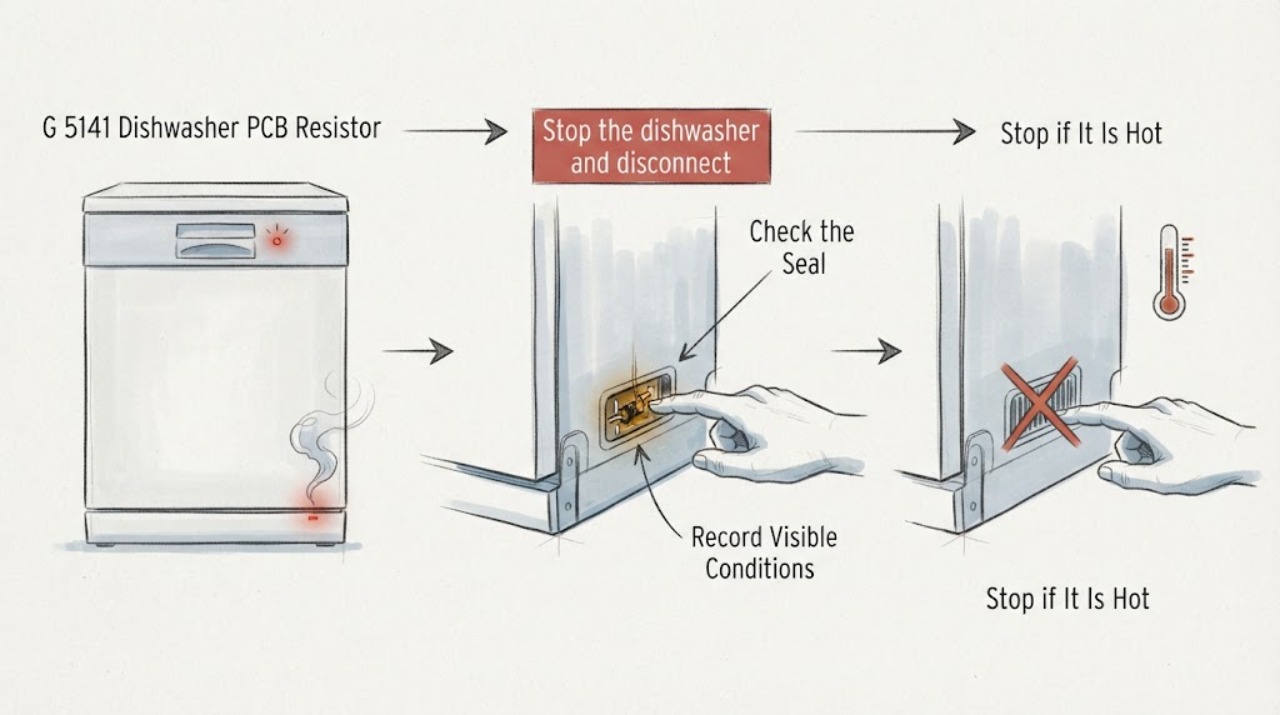
A power resistor that has exploded or burned on a Miele G 5141 dishwasher PCB is an electrical-failure and fire/shock warning, not a safe resistor-replacement job. Switch the dishwasher off and disconnect it from power if that can be done without touching exposed conductors, smoke, heat or damaged wiring. Do not plug it back in to see whether the board works, solder a guessed resistor, bridge the damaged part, replace it with a different wattage or resistance, or run the dishwasher with a cover removed. Miele states that repair, modification, testing and maintenance of electrical appliances require a qualified electrical professional and that service work must begin with safe separation from every live conductor. CPSC guidance likewise says an appliance that repeatedly trips protection or produces smoke/sparks should be unplugged and repaired or replaced. The exact G 5141 suffix, board revision and circuit cause must be verified before any part is selected.
Work through in order
Diagnostic checks
Use only checks that match the exact appliance or system and its official guide.
-
Check 1
Stop the dishwasher and disconnect its power at the accessible plug or isolation point only if the cord, plug and surrounding area are intact and there is no active smoke, arcing or exposed live part.
Expected result: The dishwasher is isolated without contact with damaged conductors, or smoke, sparks, heat, a burning odor, a wet area or exposed wiring makes disconnection unsafe to handle directly.
Next step: If direct unplugging is unsafe, leave the area and have a qualified person isolate the circuit; call emergency services for active fire or smoke. Do not reset a breaker repeatedly or re-energize the dishwasher.
Why this matters
Why: A blown or exploded PCB component can leave an energized or repeatedly faulting appliance. CPSC treats smoke/sparks and repeated electrical trips as reasons to stop use and obtain qualified repair.
-
Check 2
Do not press the power button, start a programme, or reconnect the dishwasher to test whether the damaged resistor still works; do not touch the PCB, soot, solder joints or exposed conductors.
Expected result: The board is visibly charred, cracked, missing material or has a loose fragment, or the board looks intact but the appliance had a spark, pop, smoke or electrical trip.
Next step: Leave covers in place if possible and keep the dishwasher disconnected. Do not solder, bridge, jumper, scrape carbonized material or substitute a component based on appearance; send the appliance or board details to qualified Miele service.
Why this matters
Why: Both a visibly destroyed component and an unexplained electrical event leave the cause unresolved. A resistor may have failed because of another circuit fault, so a second energization can repeat the failure or create shock/fire risk.
-
Check 3
Record the complete rating-plate identity before requesting parts or service: G 5141 suffix (such as SC, SCi or another variant), serial number, country/region and any board or harness label visible without handling the PCB.
Expected result: The full model and serial are readable, or only the broad G 5141 family is known and the suffix/serial is missing.
Next step: Use the exact model and serial with Miele's manual/service channel. Do not order a resistor or PCB from another G 5141 variant until an authorised or qualified technician confirms compatibility.
Why this matters
Why: Miele's manual finder asks for the product designation or serial number, and Miele service documentation includes model-specific parts, instructions and schematics. The family name alone cannot establish board revision or resistor specification.
-
Check 4
From outside the isolated appliance, note whether the household breaker or residual-current protection tripped, whether the receptacle or plug is warm/discolored, and whether the event occurred at plug-in, power-on or programme start.
Expected result: The outlet/plug is warm or damaged, the breaker/RCD trips again, or the external supply looks normal and only the PCB showed damage.
Next step: Stop using a warm or damaged outlet and arrange a qualified electrician. For an isolated dishwasher with PCB damage, arrange appliance service; do not make live voltage or continuity measurements.
Why this matters
Why: A circuit-side fault and an appliance-side board fault have different service boundaries. A normal-looking outlet does not clear the dishwasher's internal wiring or board, and a warm/damaged receptacle is an electrical hazard.
-
Check 5
Give the technician a safe description and photos taken without re-energizing or touching the board: the damaged area, model/serial label, connector labels as readable, breaker event, smell/smoke and any preceding water leak or programme behavior.
Expected result: The evidence can be documented while the appliance stays disconnected, or the board must be handled or removed to identify it.
Next step: Preserve the appliance as found and let authorised service inspect and test it under the required electrical isolation. Do not remove the board solely to read a resistor or attempt a bench repair.
Why this matters
Why: External identity and event timing help service locate the correct technical documentation. Removing or handling a damaged PCB can create shock, static, sharp-edge or additional damage hazards and still does not establish a replacement value.
Use your observations
Decision map
Find the observation that best matches what you see, then follow the next safe action.
-
PATH 01Next step
What you see
The resistor is visibly exploded/burned, or the dishwasher made a pop, spark, smoke or burning odor.
Do this next
Keep it disconnected and arrange qualified Miele or electrical service. Do not replace or bridge the resistor and do not perform a second power-on test.
Why this path and its safety boundary
Why it matters: The appliance has an unresolved electrical fault with potential shock or fire consequences; the resistor image does not identify the cause.
-
PATH 02Next step
What you see
The breaker or residual-current protection trips again, or the plug/receptacle is warm, discolored, loose or damaged.
Do this next
Stop using the receptacle and obtain a qualified electrician; leave the dishwasher isolated until both supply and appliance are assessed.
Why this path and its safety boundary
Why it matters: The supply circuit or appliance may have a continuing fault, and the outlet itself may be unsafe.
-
PATH 03Next step
What you see
Only the broad G 5141 family is known and the exact suffix, serial or PCB identification is missing.
Do this next
Use Miele's manual/service finder with the rating-plate information or book authorised service. Do not select a resistor or board from another variant.
Why this path and its safety boundary
Why it matters: Miele model variants and board revisions cannot be assumed interchangeable from a family name or a resistor photograph.
-
PATH 04Next step
What you see
There is no active smoke or heat, the appliance is safely isolated, and the event is limited to a documented PCB component failure.
Do this next
Keep the dishwasher out of service and provide the model, serial, photos and event history to a qualified technician for board-level or appliance-level diagnosis.
Why this path and its safety boundary
Why it matters: The immediate hazard is controlled, but the failed component may be secondary to another electrical fault and the machine is not cleared for use.
Helpful context
Understand the symptom
A destroyed resistor is a symptom, not a complete diagnosis
The assigned report identifies a Miele G 5141 dishwasher and a power resistor that exploded on its PCB. That visual description does not establish why the resistor failed, whether another board-connected load is shorted, or whether the board revision matches another G 5141 suffix. A replacement value seen in a photo or on a similar board is not enough to choose a safe part.
Keep the dishwasher out of service
The safe user decision is to isolate the appliance and preserve the evidence for qualified service. Do not repeatedly energize a damaged board, touch soot or exposed PCB conductors, or perform live measurements. Miele's professional-repair guidance specifically places electrical repair and testing behind qualified-worker and safe-isolation requirements.
Common questions
FAQ
Can I replace the exploded resistor with one that looks similar?
No. The visible damage does not establish the original resistance, wattage, safety class, board revision or the fault that caused it to fail. Do not select or solder a replacement without qualified model-specific diagnosis.
Can I power the dishwasher once to see if the resistor fails again?
No. Leave it disconnected. CPSC advises unplugging an appliance that repeatedly trips protection or produces smoke/sparks and obtaining qualified repair; a second energization can worsen an electrical fault.
Does G 5141 identify the correct PCB or resistor?
No. Use the complete rating-plate model and serial. Miele's manual finder and professional service documentation use exact product information, and Miele does not make the broad family name a compatibility guarantee for internal electrical parts.
What if the outlet or breaker also looks damaged?
Stop using that supply point and arrange a qualified electrician. CPSC identifies warm, damaged or repeatedly tripping electrical equipment as a service boundary; do not increase the fuse/breaker rating or keep resetting it.
Read the exact guide
Official sources
- CPSC and NESF Urge Consumers to ""Plug Into Electrical Safety""U.S. Consumer Product Safety Commission · Opened CPSC release used for the model-agnostic stop-use and electrician boundary; it does not diagnose the Miele PCB or resistor.
- Miele Customer AssistanceMiele USA · Opened official Miele support page used for the service route only. It does not make a part-compatibility or board-diagnosis claim for G 5141.
- Miele GebrauchsanweisungenMiele · Opened official Miele manual finder used only to establish the exact model/serial lookup boundary; it does not expose a G 5141 PCB schematic or resistor value on the opened page.
- Page 132 - Zabudovateľné prístroje pre domácnosť, ClassicMiele, s.r.o. · Opened Miele e-journal page used only to confirm that G5141 (printed as G 5141) is a Miele dishwasher model identity. It does not identify the PCB revision, resistor value, or repair procedure for this appliance.
- Professioneller ReparateurMiele · Opened Miele guidance used for the exact brand's electrical service boundary. It does not identify the failed resistor, board revision or replacement specification for this G 5141.
- CPSC Guide to Home Wiring HazardsU.S. Consumer Product Safety Commission · Opened CPSC guide used for external electrical hazard handling only. It does not support a resistor value, PCB repair or component substitution.
Community feedback
Share a repair observation
Share a plain-text repair observation. Accepted observations are published automatically; this page may take a moment to update.