
On this page
Start here
Quick answer
For a Miele G 4670 SC Vi dishwasher whose detergent dispenser does not open, wait until the program has ended and the cabinet is cool, then check only the visible loading and dispenser conditions. Miele says residue can obstruct the dispenser catch, the compartment must be dry when detergent is added, and a large item in front of the dispenser can block the lid or water jets. If those external conditions are clear but the door never opens, do not pry the lid, bend the dispenser, remove panels, or order a replacement drawer on a tenant's own authority. Record the model and symptom and ask the landlord or property manager to arrange Miele-authorized service; the exact G 4670 SC Vi operating manual was not available through the opened official manual-finder path, so an internal spring, solenoid, or part cannot be identified from this evidence.
Work through in order
Diagnostic checks
Use only checks that match the exact appliance or system and its official guide.
-
Check 1
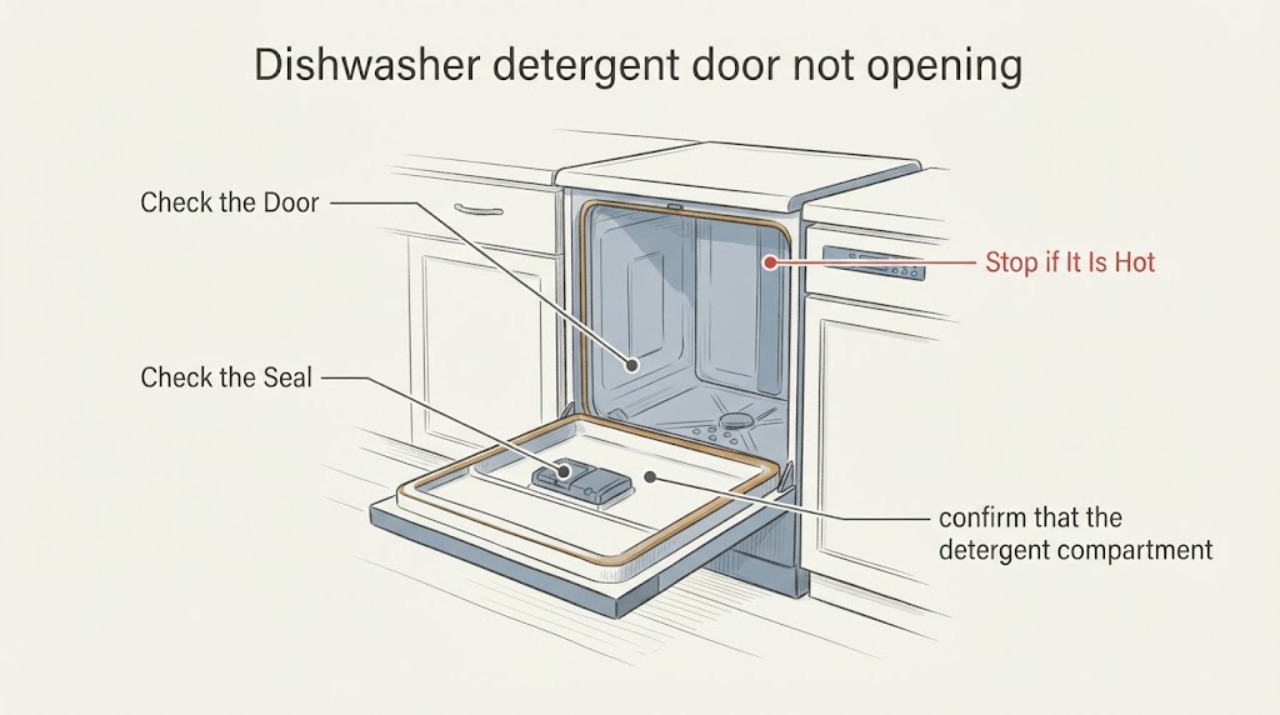
Let the program finish and wait for the dishwasher to cool before opening it. From the normal closed-door position, note whether the detergent lid is closed during the program and whether it remains closed after the end of the program; do not press, pry, or force the lid.
Expected result: The lid is closed only during the active program, or it remains closed after the program has ended and the cabinet is cool.
Next step: If it is only closed during the cycle, do not repair the dispenser. If it remains closed after cooling, continue with the external checks below and document the result for the landlord or service provider.
Stop if: Stop and stay clear if opening the door releases unusually hot steam, hot water, smoke, or an electrical odor; allow it to cool and request service.
Why this matters
Why: A closed lid during washing is not by itself a fault. A lid that remains closed after completion supports a dispenser-release or obstruction concern, but does not identify an internal part.
-
Check 2
With the dishwasher off and cool, remove only loose visible detergent residue from the dispenser catch and surrounding recess using the normal access available from the open door. Do not insert a tool, bend the lid, or remove the dispenser assembly.
Expected result: Caked detergent is visibly blocking the catch, or the catch and lid area are clean.
Next step: If residue was present, clean it, leave the compartment dry, and tell the owner what was found; if the clean lid still does not open after a normal owner-authorized cycle, stop troubleshooting and request service.
Stop if: Do not continue if the lid, catch, or surrounding plastic is cracked, loose, sharp, or wet with an unknown substance.
Why this matters
Why: Miele identifies residual detergent as a cause of a dispenser catch being blocked. A clean catch makes that external explanation less likely but does not prove a failed release mechanism.
-
Check 3
Before the next owner-authorized cycle, confirm that the detergent compartment is dry and that no large plate, pan, or other item sits directly in front of the dispenser in the lower basket. Rearrange only the load; do not change the dispenser hardware.
Expected result: The compartment is damp, or a large item can contact or obstruct the lid/jet path; alternatively, the compartment is dry and the front of the lower basket is clear.
Next step: Dry the compartment and correct the loading if needed, then record whether the problem repeats on a permitted cycle. If the lid still never opens with a dry compartment and clear loading, ask for model-specific service rather than repeating tests.
Stop if: Do not run another cycle if there is a leak, a cracked dispenser, exposed wiring, burning odor, or any condition the landlord has not authorized you to operate.
Why this matters
Why: Miele says detergent should be added only to a dry compartment and that large items in front of the dispenser can obstruct the lid or water jets. Clear loading does not rule out an internal release fault.
-
Check 4
If the owner or service provider asks for one final external observation, look through the open door for obvious food debris blocking the visible spray-arm path and note whether the arm can move freely without force; do not remove the arm, use a sharp object, or reach into a hot cabinet unless the exact manual authorizes it.
Expected result: A visible obstruction is present, or the visible path is clear but the dispenser remains closed after completion.
Next step: Report the observation and stop. The landlord or an authorized Miele technician should use the exact model/serial documentation to decide whether any cleaning or repair is appropriate.
Stop if: Do not dismantle the spray arm, dispenser, door trim, or electrical parts in a rental appliance.
Why this matters
Why: Miele links a clogged middle spray arm with detergent residue, but the opened support article does not prove that this exact G 4670 SC Vi has the same access or that a spray arm is the cause of the dispenser door symptom.
Use your observations
Decision map
Find the observation that best matches what you see, then follow the next safe action.
-
PATH 01Next step
What you see
The detergent lid is closed during the program but opens after completion and cooling.
Do this next
Do not force or replace anything. If dishes remain dirty, document the cycle and detergent conditions for the landlord, using the normal support path for the exact model.
Why this path and its safety boundary
Why it matters: The reported timing does not establish a failed dispenser; the lid may be behaving normally during the active wash.
-
PATH 02Next step
What you see
The lid area has caked detergent, the compartment was damp, or a large lower-basket item was directly in front of it.
Do this next
Clean only the visible residue, dry the compartment, correct the load, and report whether a permitted cycle changes the symptom. Escalate if the lid still does not open.
Why this path and its safety boundary
Why it matters: Miele's external explanations for residue or obstruction are plausible, but clearing one condition does not confirm that the internal dispenser is healthy.
-
PATH 03Next step
What you see
The dishwasher is hot, steaming, leaking, smells electrical, or has cracked/loose dispenser plastic.
Do this next
Stop using the dishwasher, keep clear of hot water or steam, and contact the landlord or property manager for authorized Miele service. Do not repeat the cycle or open panels.
Why this path and its safety boundary
Why it matters: The situation is outside a safe tenant cleaning check and could expose the user to burn, water, or electrical risk.
-
PATH 04Next step
What you see
The compartment is dry, the lower-basket loading is clear, no visible residue or obstruction explains the symptom, and the lid still never opens after completion.
Do this next
Leave the dispenser unmodified, give the landlord the full model/serial number and observations, and request model-specific Miele-authorized service. Do not order a whole dispenser or transfer a procedure from another Miele model.
Why this path and its safety boundary
Why it matters: The public evidence supports a persistent dispenser problem but does not identify the spring, actuator, wiring, control, or a compatible replacement for G 4670 SC Vi.
Helpful context
Understand the symptom
A dispenser that stays closed is not enough to prove a broken spring or solenoid. First distinguish a lid that is normal during an active program from a lid that is still closed after the cycle has finished. The report for this exact model is from a rental apartment, so the safe goal is to document an external obstruction and give the owner a clear service request rather than alter the dispenser.
Miele's public support articles are family-level dishwashing guidance rather than an opened G 4670 SC Vi manual. They support cleaning visible residue, keeping the compartment dry, and loading the lower basket so the lid and jets are not blocked. They do not establish the internal mechanism, a replacement dispenser, or a model-specific release procedure for this dishwasher.
If a cycle has just run, hot water or steam may be present. Do not reach into a running or hot dishwasher to test the lid. A tenant should not pry, bypass, or dismantle the dispenser; report the symptom, cycle used, detergent type, visible residue, and the full model/serial information to the landlord or property manager for an authorized repair decision.
When checks do not resolve it
Need a professional?
Arrange landlord-authorized Miele service when the dispenser remains closed after the external residue, dry-compartment, and loading checks; immediately stop use for a leak, electrical odor, hot damaged plastic, smoke, or a door/dispenser that cannot be operated safely.
Common questions
FAQ
Can I pry open or bend the Miele detergent door so the pod releases?
No. A tenant should not force the lid, bend the catch, bypass the dispenser, or remove the door assembly. Clean only loose visible residue when the dishwasher is off and cool, then ask the landlord to arrange model-specific service if the lid remains closed.
Could a wet compartment or a large dish explain the problem?
They can contribute to detergent residue or obstruct the lid and water jets. Miele says to add detergent only when the compartment is dry and to keep large items away from the dispenser. These checks do not prove an internal dispenser failure.
Should I buy a replacement dispenser drawer for the G 4670 SC Vi?
Do not order one from this symptom alone. The opened official manual-finder path did not provide a verified G 4670 SC Vi technical procedure or part match, and the Reddit discussion did not confirm a failed component. Give the full model and serial information to the landlord or authorized Miele service first.
Is it safe to open the dishwasher immediately after a cycle?
Wait for the program to finish and the cabinet to cool; use caution around hot water or steam. If there is a leak, smoke, electrical odor, or damaged plastic, stop using the dishwasher and request service rather than repeating the cycle.
Read the exact guide
Official sources
- Detergent dispenser lid will not closeMiele Great Britain · Official Miele family-level guidance for visible detergent residue blocking the dispenser catch; not an opened G 4670 SC Vi manual.
- Detergent residue in the detergent compartmentMiele USA · Official Miele dishwashing guidance for a dry detergent compartment, visible spray-arm/loading checks, and large items obstructing the dispenser lid or jets; model-specific access must be confirmed separately.
- Miele GebrauchsanweisungenMiele · Official Miele manual lookup path; used only to require exact product/serial matching and to document that an exact G 4670 SC Vi procedure was not verified here.
- How to Repair Miele Dishwasher Detergent Door?Reddit / r/appliancerepair · Exact community report for the assigned Miele G 4670 SC Vi, detergent-door symptom, and rental context; not an authoritative diagnosis or repair result.
- Operating Instructions Dishwasher G856Miele USA · Generic Miele dishwasher safety warning about hot water/steam only; this retired G856 document is not evidence of G 4670 SC Vi controls, parts, or repair steps.
- All articles for Dishwashing supportMiele USA · Official Miele support index showing dispenser, spray-arm, manual-finder, technician, and contact topics; it does not establish G 4670 SC Vi internal repair details.
Community feedback
Share a repair observation
Share a plain-text repair observation. Accepted observations are published automatically; this page may take a moment to update.