
On this page
Start here
Quick answer
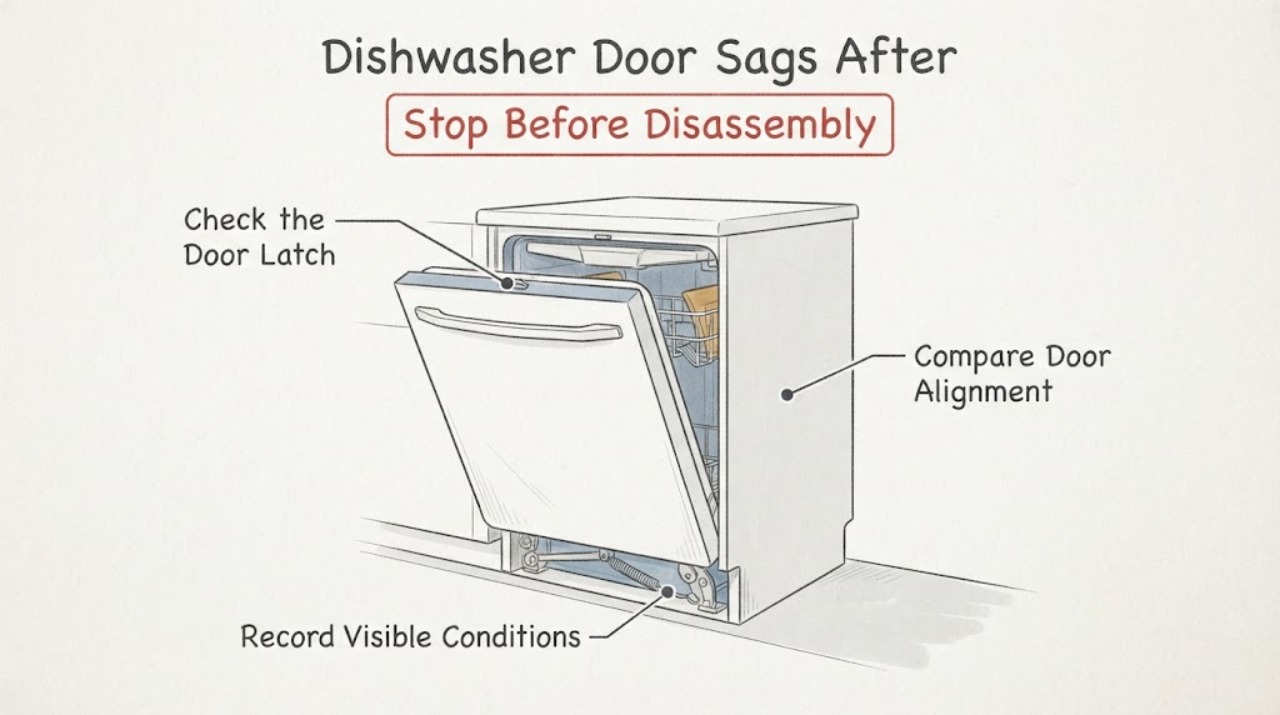
Treat a Miele dishwasher door that points downward after someone loaded the open door as possible door, hinge, spring, mounting or cabinet damage. Stop using the open door as a step or work surface, unload it, and do not force it closed, keep operating it with a poor latch, or adjust/remove hinge springs without the exact model procedure. With the dishwasher switched off, inspect from outside for a changed gap, rubbing, loose mounting, a door that will not latch or any water leak. Miele says the door should stay at about 45 degrees when released when its springs are correctly balanced, and that a freestanding unit requires a Miele technician because the appliance must be opened. After an impact, arrange model-specific service rather than treating spring tension as the confirmed fault.
Work through in order
Diagnostic checks
Use only checks that match the exact appliance or system and its official guide.
-
Check 1
Stop loading the open door and remove the lower basket or any dishes only if they can be removed without forcing the door. With the dishwasher switched off, close the door gently and observe the side gaps, whether the door rubs the frame, whether the latch engages evenly and whether the appliance rocks or moves in its opening.
Expected result: The door will not latch, rubs or binds, sits visibly low on one side, the cabinet moves, or the door closes evenly without force.
Next step: If the door cannot latch, binds or the appliance moves, leave it out of service and arrange Miele or qualified appliance service. If it closes normally, continue only with the external leak and installation checks; do not load the door to test it.
Why this matters
Why: A changed gap, binding latch or cabinet movement after an impact is evidence of an unresolved alignment or structural condition; it is not proof that a spring alone needs tightening.
-
Check 2
Inspect the visible door perimeter, inner edge, handle area and surrounding cabinetry for a bent panel, cracked trim, pulled mounting point, exposed sharp edge or a seal that is no longer seated. Do not remove the outer door, hinge cover or spring hardware.
Expected result: There is visible deformation, a loose attachment, a sharp edge, a displaced seal or no visible damage despite the changed door angle.
Next step: Keep the dishwasher unused if damage or a sharp edge is present and provide photographs plus the full model number to service. If no damage is visible, do not compensate by turning spring screws without the exact Miele procedure.
Why this matters
Why: Visible impact damage needs model-specific assessment and may explain the sag, but an intact exterior does not rule out a hidden hinge, spring or mounting problem.
-
Check 3
Identify the installation type from outside: freestanding, built-under or fully integrated, and record the complete Miele model number from the rating plate. Do not pull a built-in appliance out or open the base just to inspect the springs.
Expected result: The dishwasher is freestanding, or it is built-under/fully integrated and the model and door panel information are available.
Next step: Give the installation type, model number and impact history to Miele service. Do not use a generic spring adjustment or hinge replacement instruction from another Miele series.
Why this matters
Why: Miele's service boundary differs by installation: its official guidance requires a technician for freestanding units because the appliance must be opened, while spring balance and door-panel weight are model/installation dependent for built-in units.
-
Check 4
Check for water only from the outside around the lower door edge and floor, without running a programme to reproduce the problem. If there is a leak or the door cannot seal, switch the appliance off and close the stopcock when safe; do not operate it with the door misaligned.
Expected result: Water is present, the door seal is visibly displaced, or the floor and seal remain dry with the door closed gently.
Next step: For any leak or failed seal, keep the dishwasher off, close the water supply when safe and arrange service. Even without a leak, service is appropriate if the door angle changed after the impact.
Why this matters
Why: A leak combined with impact-related misalignment can damage the cabinet or floor and requires service. A dry floor does not prove the door is safe to use if the latch or spring balance is wrong.
Use your observations
Decision map
Find the observation that best matches what you see, then follow the next safe action.
-
PATH 01Next step
What you see
The door will not latch, rubs/binds, has a sharp or bent panel, the appliance moves in the cabinet, or the child could contact the damaged door.
Do this next
Keep the dishwasher out of service, keep children away from the open door, and arrange Miele or qualified appliance service. Do not open the door mechanism or remove springs.
Why this path and its safety boundary
Why it matters: The impact has created a mechanical and injury risk that cannot be reduced by an external spring adjustment guess.
-
PATH 02Next step
What you see
The door closes evenly without force, the latch engages, the cabinet is stable and there is no visible leak or deformation.
Do this next
Keep the door unloaded, obtain the exact model instructions and ask Miele service whether an inspection is needed before normal use; do not perform a loaded-door test.
Why this path and its safety boundary
Why it matters: The external checks do not show an immediate failure, but a changed door angle after a child loaded the open door still does not prove that the springs and hinges are correctly balanced.
-
PATH 03Next step
What you see
The dishwasher is freestanding and the door dropped or points downward after the impact.
Do this next
Book Miele service and provide the model number and impact history. Do not pull the appliance apart or adjust hidden spring hardware.
Why this path and its safety boundary
Why it matters: Miele explicitly requires a service technician for the spring work on freestanding units because the appliance must be opened.
-
PATH 04Next step
What you see
The unit is built-under or fully integrated, but the door panel, mounting or spring balance changed after the impact.
Do this next
Use the exact model manual only to identify the approved service route and arrange an inspection. Do not remove the door panel, hinge or spring without model-specific professional guidance.
Why this path and its safety boundary
Why it matters: Miele's built-in adjustment information is installation and weight dependent; it does not establish that a spring screw alone will correct impact damage.
Helpful context
Understand the symptom
An impact changes the service boundary
The supplied problem describes a child jumping on an open Miele dishwasher door, followed by a downward-pointing door and a lower tray that can roll toward the floor. That history makes a bent panel, hinge, spring attachment, mounting point or cabinet alignment possible, but it does not identify which part is damaged. A spring adjustment that helps an undamaged installation is not a safe diagnosis after an impact.
Keep the door and appliance stable
Use the exact Miele model manual for the installation type and door hardware. Keep the door unloaded and supported by its normal handle, avoid reaching into a pinch point, and do not remove panels, disconnect springs or operate the dishwasher if the door cannot latch or the unit leaks. Miele's safety and service guidance makes correct spring balance and professional escalation part of safe operation.
Common questions
FAQ
Can I tighten the Miele dishwasher door springs after a child jumped on the open door?
Do not assume spring tension is the only problem after an impact. Miele's spring information is installation and model dependent, and it requires a technician for freestanding units because the appliance must be opened. Obtain the exact model service guidance instead of turning screws or removing springs as a generic repair.
Should I keep using the dishwasher if the door still closes?
A door that closes without a leak is reassuring but does not prove the hinges, springs, panel or mounting survived the impact. Keep the door unloaded, do not force the latch, and arrange model-specific advice if its angle changed or it rubs.
What should I do if the damaged door is leaking?
Switch the dishwasher off, close the stopcock when safe, protect the floor and arrange service. Do not run another programme or open the door assembly to look for a hinge or spring fault.
Read the exact guide
Official sources
- Miele Dishwashing | The door is difficult to close or cannot be closed at all, and is leaking.Miele USA · Opened Miele's official support page. It supports checking obstructions and appliance alignment/feet, keeping the front area clear and contacting Miele Service when closure/leak symptoms persist. It does not authorize a generic hinge or spring repair after impact.
- Miele Dishwashing | The door of the dishwasher falls down quickly when opening.Miele USA · Opened Miele's official dishwashing support. It explains the 45-degree spring-balance observation, identifies adjustment context for built-in/fully integrated appliances and requires a Miele service technician for freestanding units because the appliance must be opened. It does not diagnose the impact damage on an unspecified model.
- G7910gbMiele · Opened an official Miele operating-instructions PDF. It states that the dishwasher must be operated only with properly adjusted door springs and to contact Miele if the door cannot be adjusted properly; the model-specific PDF is used only for the general safety boundary, not as the exact task model manual.
Community feedback
Share a repair observation
Share a plain-text repair observation. Accepted observations are published automatically; this page may take a moment to update.