
On this page
Start here
Quick answer
A Miele dishwasher's Drain light flashing after the cycle has run for a while, followed by an interrupted programme, is a drainage warning at the family-support level when water remains in the wash cabinet; it is not a model-specific fault-code diagnosis. Switch the dishwasher off, note whether water remains, and use only the model's documented user checks: clean and correctly lock the filter combination, inspect the visible drain hose for kinks or blockage, and—only when the exact manual shows the same access—check the non-return valve and drain-pump area with the power disconnected. If the light returns, the hose is damaged, there is a leak, the pump runs continuously, or the model's access differs, stop and contact Miele service rather than guessing a pump, valve or control part.
Work through in order
Diagnostic checks
Use only checks that match the exact appliance or system and its official guide.
-
Check 1
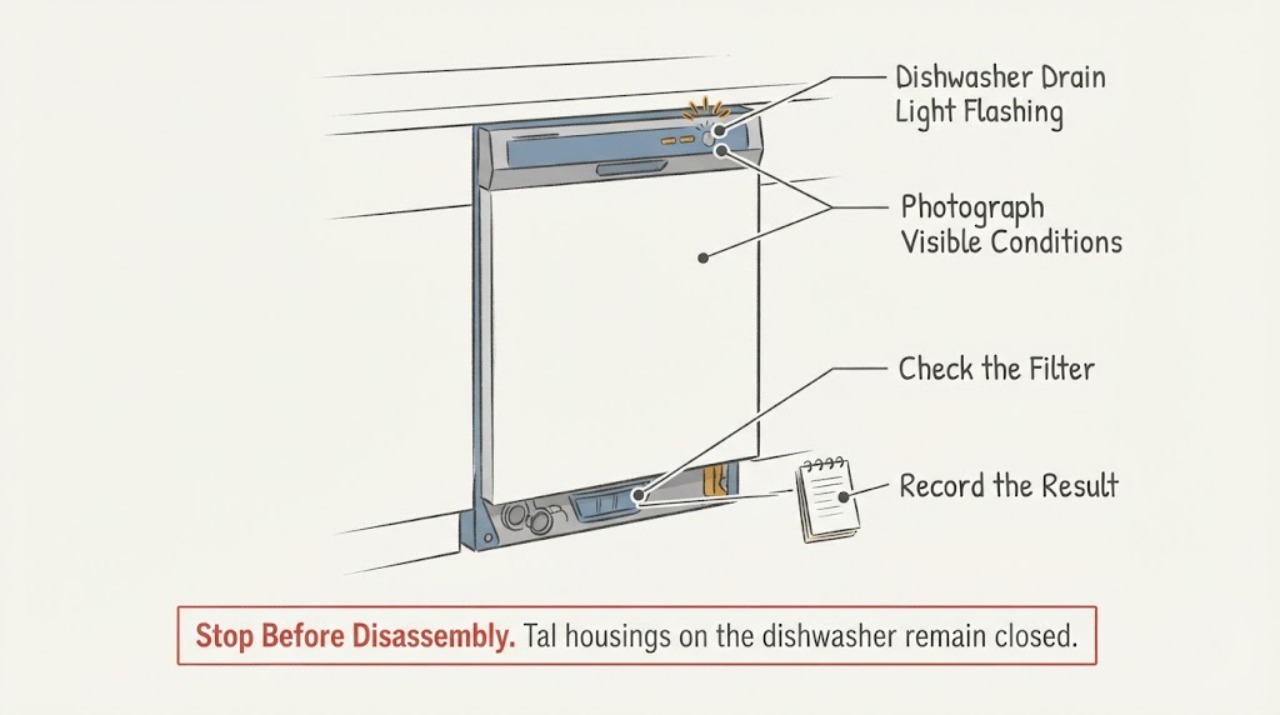
When the programme stops, record whether the light is labelled Drain or Inlet/Drain, whether a display message or buzzer is present, when the light starts, and whether water remains in the wash cabinet. Photograph the panel and rating label before switching anything else.
Expected result: Water remains in the cabinet; the cabinet is empty but the light flashes; or the label/message differs from the Drain wording.
Next step: Keep the model number and exact wording for the Miele manual lookup. Do not borrow a fault-code definition or button-reset sequence from another Miele family.
Why this matters
Why: Miele's Drain support page ties the flashing Drain light and interrupted programme to water present during a drainage fault. A different light label or no standing water may belong to another model-specific support path, so the symptom alone does not identify F11, a pump, a valve or a control board.
-
Check 2
Switch the dishwasher off before inspecting the filter or drain area. If the exact manual calls for access below the filter, disconnect the mains plug or isolate the appliance at the accessible supply before removing the filter combination, non-return valve or pump cover. Close the water tap if there is a leak or the Waterproof system appears to have reacted.
Expected result: The dishwasher powers down normally and there is no leak, or the pump continues to run, water is leaking, or the supply cannot be safely isolated.
Next step: If power cannot be safely isolated, there is a leak, or the pump will not stop, leave the appliance off, close the water tap where applicable, and arrange Miele service. Do not remove panels or perform live tests.
Stop if: Stop immediately for leaking water near electrical parts, a damaged cord/plug, burning smell, repeated breaker trips or a pump that continues running after safe isolation.
Why this matters
Why: Miele's official guidance requires the appliance to be switched off before drainage checks and the plug disconnected for pump-area work; a continuously running pump or Waterproof response is a service/safety boundary rather than a reason to keep restarting.
-
Check 3
With the dishwasher off and the exact manual confirming the same filter layout, remove the filter combination, clear coarse soil, rinse all pieces under running water and use a soft brush for deposits. Reassemble the filter and lock it flat in the wash cabinet as the manual shows; keep loose debris from falling into the circulation system.
Expected result: The filter is visibly soiled, the flap does not close, or the filter cannot be reinstalled flat and locked.
Next step: If the filter will not close or lock, do not run the dishwasher. Photograph the assembly and use model-specific service; if it is clean and seats correctly, continue only to the visible hose check.
Why this matters
Why: Miele identifies a soiled or incorrectly secured filter combination as a possible restriction and warns that poor seating can allow coarse soil into the circulation system. A clean, correctly locked filter does not prove the pump or hose is healthy.
-
Check 4
Without disconnecting the plumbing, inspect the visible drain hose behind or under the unit for a sharp kink, crushed section, excessive tension or an obvious external blockage. Do not pull hard on the hose or remove a built-in connection without the installation instructions.
Expected result: The hose has a kink or crushed section, appears blocked/taut, is damaged, or looks free and undamaged.
Next step: Correct only a simple visible loop if it can be done without stressing the connection. If the hose is damaged, blocked at a connection, or remains taut, leave the dishwasher off and contact Miele service or a qualified installer.
Why this matters
Why: Miele lists a kinked, blocked or restricted drain hose as a possible cause and warns that damaged plastic may tear. A free-looking hose only narrows the external branch; it does not rule out a hidden restriction or internal fault.
-
Check 5
Only if the exact model's operating instructions document user access below the filter, remove standing water with a small container and inspect the non-return valve and drain-pump opening for visible foreign objects after power is disconnected. Use gloves and extreme care around glass; do not force the impeller, probe wiring, or open the base of the appliance.
Expected result: A visible obstruction is present and can be removed without force, the pump area is clear, or glass/damage/uncertain access is present.
Next step: Reinstall only the parts that the exact manual shows and ensure the catch engages. If access is different, glass is suspected, the impeller is damaged, or the light returns after the documented check, stop and request model-specific service.
Stop if: Stop before this check if the exact manual is unavailable, the model's filter/pump layout differs, standing water is hot, glass may be present, or any cover/panel must be forced.
Why this matters
Why: Miele identifies foreign objects in the non-return valve or drain pump as one possible drainage restriction but warns that glass splinters are difficult to see and that components are delicate. A clear pump area does not establish that the pump, pressure sensing or electronics are working.
Use your observations
Decision map
Find the observation that best matches what you see, then follow the next safe action.
-
PATH 01Next step
What you see
The Drain light flashes, the programme is interrupted, and water remains in the wash cabinet; the filter layout matches the exact Miele manual.
Do this next
Switch off, clean and lock the filter as documented, inspect the visible hose, and use the exact manual's conditional pump-area check only if it is user-accessible. Escalate if the light returns.
Why this path and its safety boundary
Why it matters: This matches Miele's general drainage-fault description. A filter, non-return valve, pump opening or drain hose can be restricted, but the light does not identify which one.
-
PATH 02Next step
What you see
The indicator says Inlet/Drain, another message appears, or the cabinet is empty and the panel does not match the Drain page.
Do this next
Record the exact label, display and model, then use the matching Miele support page or manual. Do not apply the Drain-only sequence as a universal reset.
Why this path and its safety boundary
Why it matters: Miele distinguishes water-supply/drain combination faults and multiple model-specific display messages; no-model information is insufficient to assign a particular code meaning.
-
PATH 03Next step
What you see
The filter is clean and locked, the visible hose is free, and any model-authorized accessible check found no obstruction, but the light returns after a programme attempt.
Do this next
Keep the dishwasher out of service, provide Miele with the model, light timing, standing-water status and checks already completed, and request model-specific diagnosis.
Why this path and its safety boundary
Why it matters: The official guidance directs service when the fault persists; the remaining cause could be inside the drainage or sensing system, but the public no-model evidence does not identify a component.
-
PATH 04Next step
What you see
The pump runs continuously, water is leaking, the Waterproof system is suspected, there is damage near the electrical supply, or safe power isolation is unavailable.
Do this next
Switch off power if safe, close the water tap, leave the appliance off and arrange Miele service or qualified appliance service.
Why this path and its safety boundary
Why it matters: This is a water/electrical safety boundary, not a prompt to tilt the appliance, open its base or perform a live test.
Helpful context
Understand the symptom
The delayed timing matters as a symptom, but it does not identify a particular Miele code or failed part. Miele uses both Drain and Inlet/Drain labels across dishwasher families, and its official support pages separate those conditions from model-specific fault messages. Record the exact light wording, any display message, whether water remains in the wash cabinet, and the full model before applying a manual sequence.
Start with the accessible filter, hose and water-level observations. A filter or drain path can be restricted without proving that the pump or control electronics has failed. Any check beneath the filter or around a pump must follow the exact model manual, with power disconnected and care around hidden glass.
When checks do not resolve it
Need a professional?
The Drain light persists after model-authorized filter and visible hose checks, or there is uncertain access, a leak, continuous pump operation, damaged plumbing or an electrical/water safety condition.
Common questions
FAQ
Does a Miele Drain light flashing after about a minute prove the drain pump failed?
No. Miele's official Drain guidance describes a drainage fault and lists the filter combination, non-return valve/pump area and drain hose as possible user-check branches. The symptom does not identify a failed pump or any replacement part, especially without the model.
What should I check first when water remains in the Miele dishwasher?
Switch the dishwasher off, clean and correctly lock the filter combination if the exact manual shows that layout, then inspect the visible drain hose for kinks or blockage. Any pump-area check requires power disconnection and the matching model instructions.
Can I use a different Miele manual because my dishwasher has no model number?
No. Miele publishes multiple indicator labels and model-specific fault messages. Record the rating-plate model and use the matching manual; until then, limit work to safe observations and the general service boundary.
Read the exact guide
Official sources
- Miele Dishwashing | The Drain indicator light on the dishwasher is flashingMiele Great Britain · Opened Miele's official Drain indicator support page. It directly matches the assigned symptom wording and supports family-level external checks, while not establishing a model-specific fault code or part diagnosis.
- Miele Dishwashing | The Inlet/drain indicator light is flashing on and offMiele USA · Opened Miele's official USA support page. It is used only to distinguish the Inlet/Drain label from Drain-only wording and to reinforce power isolation and service boundaries; it is not used to transfer an error code between models.
- Troubleshooting for Display messages & light indicators problem with Miele DishwashingMiele USA · Opened Miele's official support index. It lists separate Drain, Inlet/Drain, fault-code and model-family support entries, supporting the requirement to identify the exact model and indicator before assigning a code meaning.
Community feedback
Share a repair observation
Share a plain-text repair observation. Accepted observations are published automatically; this page may take a moment to update.