
On this page
Start here
Quick answer
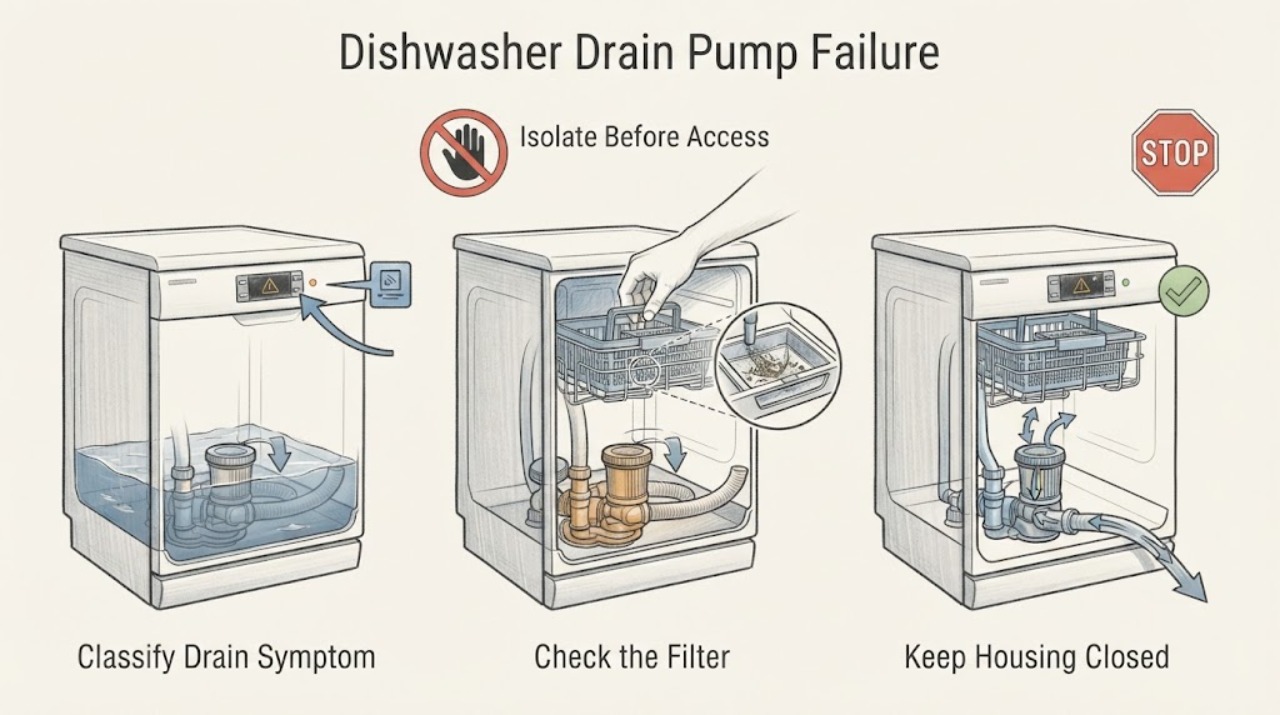
Do not assume the drain pump has failed just because water remains. First identify whether the dishwasher is not pumping away, the drain pump runs continuously, a drainage indicator appears, or water is leaking. From a safe, de-energized appliance, Miele's dishwashing guidance supports checking the accessible filter, non-return valve, pump-cover seating, visible drain hose and foreign objects; glass fragments are a cutting hazard. A clear pump path with persistent poor drainage does not prove a pump replacement is needed, especially without a model. Use the exact operating instructions and arrange Miele service for a recurring fault, a pump that runs with the door open, a leak, or any internal/electrical diagnosis.
Work through in order
Diagnostic checks
Use only checks that match the exact appliance or system and its official guide.
-
Check 1
With the dishwasher stopped and viewed from a safe position, record whether water remains at the end of a programme, the display or drain indicator reports a drainage fault, the pump runs continuously, the pump is silent, or water is leaking; also record any exact code and whether the cycle had completed.
Expected result: The cabinet has standing water, a drainage message/light, continuous pump operation, no pump sound, or visible leakage.
Next step: Follow the matching branch. If there is a leak, water near electrics or a pump running with the door open, do not start another programme.
Why this matters
Why: These are different drainage observations. Standing water alone does not distinguish a blocked path from a failed pump, and an unverified code does not identify a component.
-
Check 2
Before opening the filter or pump-cover area, switch the dishwasher off and disconnect it from the electrical supply; if water remains, scoop it out with a small container. Work only when the floor and access area are safe and use gloves/eye protection appropriate for possible glass fragments.
Expected result: Power is isolated and the wash cabinet can be accessed safely, or the appliance cannot be safely isolated/dried.
Next step: Continue only with model-documented user access when fully isolated. If isolation is unsafe, leave the area and arrange qualified service; do not reach into the pump or test it live.
Why this matters
Why: Miele instructs users to disconnect power before drain-pump access and warns that glass splinters can be hard to see. An unsafe isolation or wet electrical area is a service condition.
-
Check 3
With power isolated and only if the exact Miele instructions permit it, remove and rinse the user-accessible filter, inspect the non-return valve and pump-cover area for food, glass or other foreign objects, and refit the cover/filter so the catch engages and the filter lies correctly.
Expected result: Debris or glass is present, the non-return valve/pump cover is not seated, the filter is clogged, or the accessible area is clear and correctly reassembled.
Next step: Remove only safe, visible debris, avoid forcing delicate components, and use the exact manual for the model. If the path is clear but drainage remains poor, proceed to hose/drain checks and service rather than ordering a pump.
Why this matters
Why: Miele identifies these conditions as possible reasons water is not pumped away. Clearing debris or reseating the cover can remove a drainage obstruction; a clear path does not prove the pump has failed.
-
Check 4
Inspect the visible drain hose for a kink or crush and the accessible pump impeller only as the exact model documentation allows; Miele describes a little resistance when manually turning the impeller, not a live electrical test.
Expected result: The hose is kinked/damaged, the impeller area contains a foreign object, the impeller turns with the expected slight resistance, or the accessible path is clear but water still does not drain.
Next step: Correct only an obvious accessible hose position or remove a visible obstruction with power isolated. A damaged hose, persistent no-drain condition or suspected electrical/pump fault should go to Miele Service.
Why this matters
Why: A kink, obstruction or hose/drain restriction can mimic a failed pump. If the hose/path is clear and the impeller is not obstructed, the remaining cause is not established by this article and may require internal diagnosis.
-
Check 5
Record the full Miele model, serial/production information if available, the exact programme stage, remaining water, pump sound and every display/indicator message. Use the matching Miele manual and support article rather than a generic pump reset.
Expected result: The exact model manual documents a matching user-level drainage procedure, or the code/indicator returns, is not listed, or belongs to a different model family.
Next step: Follow one documented model-specific user action only. If the fault returns or the manual does not clearly cover it, keep the dishwasher off and arrange Miele or qualified appliance service.
Why this matters
Why: Miele's support index has separate drainage, pump-running, indicator and fault pages, and the pump guidance states that model-specific information is in the operating instructions. Cross-model code or reset transfer is unsupported.
-
Check 6
Stop using the dishwasher for a recurring drainage fault, a pump that runs while the door is open, an active leak, smoke/burning smell, water near electrical parts, or any condition requiring cabinet disassembly or live measurement.
Expected result: The issue clears only after isolation, returns after the accessible path is clear, or cannot be isolated safely.
Next step: Close the faucet when applicable, keep power off from a safe location, do not bypass safety devices or restart repeatedly, and arrange Miele Service with the model and recorded symptoms.
Why this matters
Why: These are service boundaries, not evidence that a replacement pump is the correct part. Miele directs a Waterproof-system reaction to closing the faucet and contacting service, and directs persistent drainage faults to repair support.
Use your observations
Decision map
Find the observation that best matches what you see, then follow the next safe action.
-
PATH 01Next step
What you see
Water remains in the wash cabinet at the end of a programme, but there is no active leak or electrical hazard.
Do this next
Isolate power, use the exact model manual, inspect only the accessible filter/valve/pump-cover area and visible hose, then arrange service if drainage still fails.
Why this path and its safety boundary
Why it matters: Miele lists filter, non-return-valve, pump-cover, foreign-object and drain-hose conditions before a pump is treated as failed.
-
PATH 02Next step
What you see
The filter, non-return-valve/pump area or drain hose contains visible debris, a kink or a cover that is not engaged.
Do this next
With power isolated, correct only the documented user-accessible condition, refit the parts correctly and observe one model-permitted drain test. Stop and request service if water remains.
Why this path and its safety boundary
Why it matters: The accessible path can explain poor drainage; this observation does not establish a failed motor or pump assembly.
-
PATH 03Next step
What you see
The accessible filter, pump-cover/valve area and visible hose are clear and correctly refitted, but the dishwasher still leaves water or reports a drainage fault.
Do this next
Keep the appliance off and provide Miele Service the exact model, code, programme stage, remaining water and pump sound; do not order or install a pump based only on the symptom.
Why this path and its safety boundary
Why it matters: A clear external path narrows the possibilities but cannot prove a drain-pump failure without the model-specific diagnosis.
-
PATH 04Next step
What you see
The drain pump runs even with the dishwasher door open, or water is leaking/near electrical equipment.
Do this next
Close the faucet, keep the dishwasher off and contact Miele Service. Do not restart, bypass the system or open the cabinet to test the pump.
Why this path and its safety boundary
Why it matters: Miele identifies a pump running with the door open as a reacted Waterproof system and treats leaks/electrical proximity as a safety issue.
-
PATH 05Next step
What you see
A drain indicator, code or recurring fault appears and the exact model is unknown or the message is not covered by the matching manual.
Do this next
Do not transfer a code meaning from another Miele family. Record the model and indicator, then arrange service or use the exact model manual.
Why this path and its safety boundary
Why it matters: Miele provides separate model/family support articles and does not establish one universal code-to-pump mapping for all dishwashers.
Helpful context
Understand the symptom
A drainage symptom is not proof of a failed pump
Water left in the cabinet can result from a dirty filter, a blocked non-return valve or pump area, a pump-cover that is not seated, a kinked hose, an on-site drain restriction, or an internal fault. Miele's opened support separates these observations. Without a model, code and result of the accessible checks, label the issue as a drainage fault rather than ordering a pump.
Use the exact Miele instructions
Miele's dishwashing support index contains separate articles for drainage, pump operation with the door open, drain indicators and model-family faults, and each page links to the manual finder. The task has no model, so only the safe common observations below are general. If the manual for the exact model does not describe a step, stop before removing a cover or non-return valve.
Stop when drainage becomes a safety problem
Close the water faucet and keep the dishwasher off if the drain pump runs with the door open, water is leaking, water is near electrical parts, or a fault returns after the accessible path is clear. Miele routes these conditions to service rather than a guessed pump replacement.
When checks do not resolve it
Need a professional?
Arrange Miele Service if the accessible filter/valve/pump-cover and visible hose checks do not restore drainage, if a drainage indicator returns, or if the suspected fault needs internal pump, wiring or control diagnosis., Close the faucet and keep the dishwasher off if the drain pump runs with the door open, there is an active leak, water near electrical parts, smoke or a burning smell., Do not perform live electrical tests, bypass the Waterproof system, force delicate covers, or order a drain pump without the exact model and a service diagnosis.
Have this ready
- complete Miele model and serial/production information
- remaining-water amount and whether the issue occurs at programme end or during a stage
- exact display/indicator message or code
- filter, non-return valve, pump-cover, impeller-area and visible hose observations
- whether the pump runs with the door open, whether a leak or electrical hazard occurred, and whether power/water were isolated
Common questions
FAQ
Does water left in a Miele dishwasher prove the drain pump is bad?
No. Miele lists a clogged filter, blocked non-return valve or pump area, an incorrectly seated pump cover, a kinked hose and other drainage conditions before internal pump diagnosis. A clear path with persistent failure should go to service rather than a guessed replacement part.
Can I clean the Miele dishwasher drain-pump area myself?
Only if the exact model instructions permit the user-accessible procedure. Turn the dishwasher off, disconnect power, remove standing water safely and beware of hidden glass splinters; do not force delicate covers or perform live tests.
What if the drain pump keeps running with the door open?
Miele says this indicates the Waterproof system has reacted: close the faucet and contact Miele Service. Keep the appliance off and do not bypass the system or keep restarting it.
What information should I give Miele Service?
Provide the full model, exact code or indicator, programme stage, remaining water, pump sound, hose/filter observations and whether the pump runs with the door open. Miele support has separate model/family drainage and fault guidance, so do not transfer another model's code meaning.
Read the exact guide
Official sources
- Miele Dishwashing | There is water in the wash cabinet of the dishwasher at the end of the program.Miele USA · Official Miele USA dishwashing support page opened directly. Supports safe filter, drain-pump cover, foreign-object, impeller and drain-hose observations; exact model instructions remain controlling.
- Miele Dishwashing | The dishwasher display shows Drainage. There is a water drainage fault.Miele USA · Official Miele USA drainage support page opened directly. Supports pump-cover seating, foreign-object and impeller observations and service/manual escalation; it does not prove a failed pump for an unidentified model.
- Troubleshooting for Display messages & light indicators problem with Miele DishwashingMiele USA · Official Miele USA display/indicator index opened directly. Used only for the model/code gate and to avoid transferring a drain indicator or fault meaning across Miele families.
- Miele Dishwashing | Grinding noises can be heard in the dishwasher’s wash cabinet at the start of a program or after 75% of the program sequence.Miele USA · Official Miele USA dishwashing support page opened directly. Supports foreign-object and non-return-valve checks, impeller observation, model-specific manual gate and service boundary; used only for drainage-path reasoning, not to infer a grinding complaint in this task.
- Miele Dishwashing | The drain pump is still running, even with the dishwasher door open.Miele USA · Official Miele USA dishwashing support page opened directly. Supports the narrow boundary for a pump running with the door open: close the faucet and contact Miele Service.
- Troubleshooting for All problem with Miele DishwashingMiele USA · Official Miele USA dishwashing support index opened directly. Used to establish separate drainage, pump-running, indicator and model-family fault articles and the manual/service routes; the index itself is not used as a technical procedure.
Community feedback
Share a repair observation
Share a plain-text repair observation. Accepted observations are published automatically; this page may take a moment to update.