
On this page
Start here
Quick answer
For the Miele G 6820, the opened official manual labels the drainage fault Wasserablauf and first directs you to switch the dishwasher off, check the filter, drain pump, non-return valve, and drain-hose routing. If the problem began after the dishwasher was moved, make the transport-related installation check first: without pulling out a built-in appliance, record whether the accessible drain hose is kinked, under tension, sharply looped, or connected in a way that could restrict or back up drainage. The manual also requires a level installation and a tight drain connection. Only after safe power-off and with no leak should you clean the user-accessible filter/pump-cover path as the exact manual describes. If the display literally says Wasserabfuhr rather than Wasserablauf, preserve that exact wording for Miele because the opened G 6820 manual uses the latter label; do not substitute a different model's code meaning.
Before you begin
Safety first
- Do not pull out or tilt a built-in dishwasher, open the cabinet, disconnect plumbing under pressure, probe live wiring, disassemble the drain pump, or repeatedly run cycles to reproduce an intermittent fault. Miele states that repairs and electrical work belong to authorized qualified personnel.
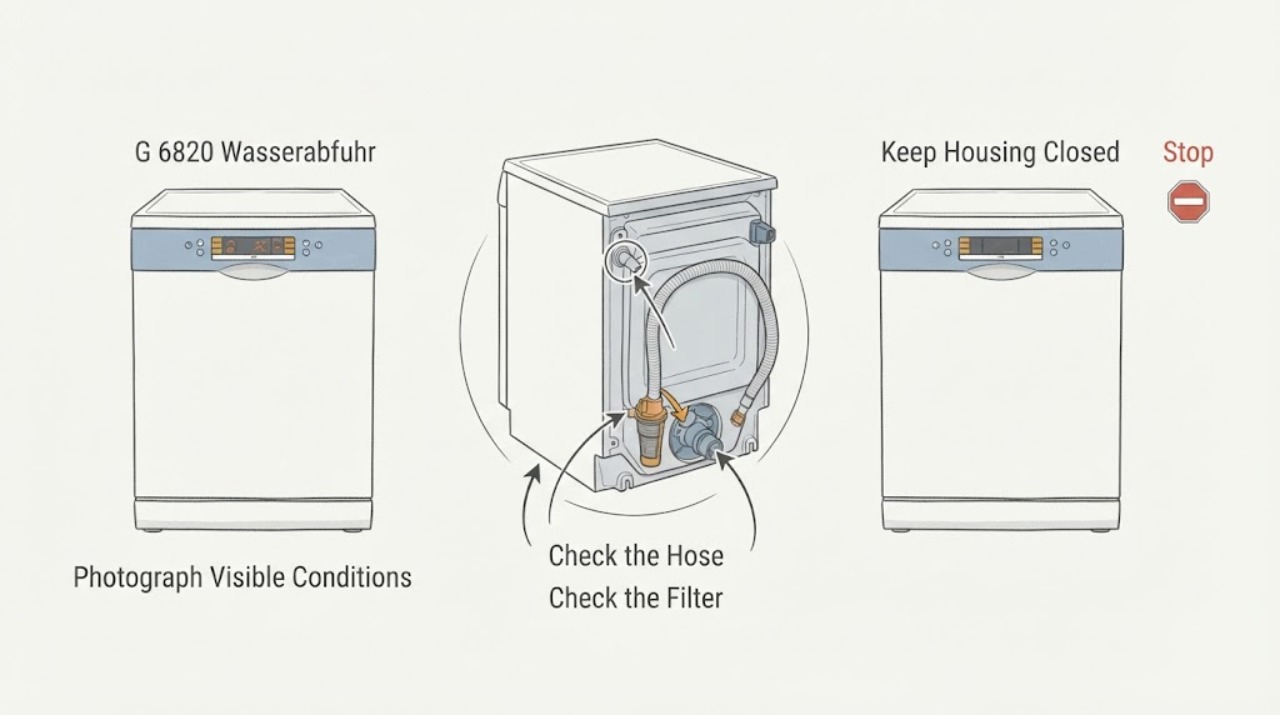
Work through in order
Diagnostic checks
Use only checks that match the exact appliance or system and its official guide.
-
Check 1
Photograph or transcribe the complete display before pressing buttons, including whether it literally says Wasserabfuhr, Wasserablauf, or another message; record the G 6820 model variant, serial information, program stage, and whether water remains in the wash cabinet.
Expected result: The exact drainage wording and model identity are confirmed, or the display is translated, abbreviated, or otherwise uncertain.
Next step: Use the exact Miele manual for the model and market. If the wording cannot be matched, give Miele the photograph and do not borrow a code interpretation from another G-series dishwasher.
Why this matters
Why: Miele's G 6820 manual uses Wasserablauf for a drainage fault and says model and serial information are needed for service. A different literal word may be a regional or model-specific label rather than the same documented branch.
-
Check 2
Because the failure began after transport, without pulling out or tilting a built-in dishwasher, inspect only the accessible drain-hose route and connection for a kink, sharp high loop, compression, tension, an overly inserted connection stub, or a loose connection; also note whether the appliance appears level.
Expected result: The drain hose is visibly kinked, under pressure or tension, routed unusually after the move, connected at an abnormal depth, or the appliance is no longer level; alternatively, the accessible route looks normal.
Next step: Correct only a plainly accessible routing issue that can be changed without moving the appliance or opening plumbing. If the built-in route cannot be inspected safely, stop and have Miele service or an installer check it.
Why this matters
Why: Miele specifies kink-free, pressure- and tension-free drain-hose routing, a drain connection that is tight, and level installation. A post-transport change makes an installation restriction or backflow path more plausible than a random control failure, while a normal accessible route does not rule out an internal blockage.
-
Check 3
If water remains and the exact manual permits user cleaning, switch the dishwasher off, disconnect it from power, remove only the interior filter assembly, and inspect the documented drain-pump-cover and non-return-valve area for a visible foreign object; scoop standing water first and keep hands away from sharp debris.
Expected result: The filter, pump-cover path, or non-return valve contains a visible obstruction, or the accessible path is clean.
Next step: Remove only the visible obstruction following the exact manual, reinstall every component correctly, and stop if the area is damaged, hot, unsafe, or different from the manual. Do not probe or disassemble the pump.
Why this matters
Why: Miele lists the filter, drain pump, and non-return valve as user-accessible drainage checks for the G 6820. A visible obstruction can explain an intermittent drainage fault; a clean path makes an internal pump, valve, hose, or control issue more likely but does not identify which part failed.
-
Check 4
After the external route and documented interior checks are complete, do not repeatedly restart the dishwasher. Only if there is no leak, the appliance is safely reassembled, and the exact manual permits a test, run one short empty or approved drain-related program while observing from a dry position.
Expected result: The program drains normally once, or the drainage message returns, water remains, the pump sounds abnormal, or the fault is intermittent again.
Next step: Stop testing after one documented result and arrange Miele service if the message returns, water remains, or any leak or abnormal sound appears.
Why this matters
Why: One successful drain after a corrected route or visible blockage supports that condition as a contributor, but it does not prove the appliance is repaired. A returning or intermittent fault after a clean path points to a persistent mechanical, hose, valve, or control diagnosis.
-
Check 5
Prepare the service record with the exact display wording, G 6820 variant and serial, transport date, whether the appliance was tilted or disconnected, hose-routing observations, remaining-water level, filter/pump-cover result, and the result of any single permitted test.
Expected result: The problem can be reproduced after transport, or it occurs only intermittently with no confirmed trigger.
Next step: Provide the complete record to Miele service or a qualified installer. Do not order a pump or valve from the drainage wording alone.
Why this matters
Why: A transport history and timing can direct service toward installation, drain routing, backflow, or a disturbed connection before parts are selected. Miele's manual says the model designation and serial number are required for a service case.
Use your observations
Decision map
Find the observation that best matches what you see, then follow the next safe action.
-
PATH 01Next step
What you see
The drainage message began immediately after transport and the accessible drain hose is kinked, compressed, under tension, unusually looped, or the appliance is no longer level.
Do this next
Correct only the plainly accessible routing or leveling condition without moving a built-in appliance or opening plumbing, then use one manual-approved check. If the message returns, arrange Miele service or installer inspection.
Why this path and its safety boundary
Why it matters: A changed installation or drain-routing condition is more likely than an unexplained electronic fault, because Miele specifies level placement and pressure- and tension-free drainage routing.
-
PATH 02Next step
What you see
The drain route looks normal, water remains, and a visible obstruction is found in the filter, drain-pump-cover, or non-return-valve path.
Do this next
With power disconnected and the exact manual followed, remove only the visible obstruction and reinstall the parts correctly. Stop and request service if the message returns or a component is damaged.
Why this path and its safety boundary
Why it matters: A foreign-body restriction can explain intermittent failure and is one of the G 6820 manual's documented drainage checks.
-
PATH 03Next step
What you see
The hose route and accessible filter/pump-cover/non-return-valve path are clean, but Wasserablauf or the reported Wasserabfuhr wording returns intermittently or water remains.
Do this next
Leave the dishwasher unused and book Miele service with the model, serial, exact display, transport history, and checks completed. Do not select a replacement part from the display alone.
Why this path and its safety boundary
Why it matters: The fault is no longer explained by the documented external checks; an internal drain pump, non-return valve, hose connection, backflow condition, or control diagnosis is required.
-
PATH 04Next step
What you see
The display literally says Wasserabfuhr, the model variant cannot be confirmed as the documented G 6820 family, or the message does not match Wasserablauf in the opened manual.
Do this next
Keep the display photograph and obtain the matching regional manual or Miele support interpretation before repeating a reset or cleaning a component.
Why this path and its safety boundary
Why it matters: The code identity is unresolved at the exact model/market level. A translation or similar-looking Miele code cannot safely establish the same drain branch.
-
PATH 05Next step
What you see
There is a leak, damaged hose, water near electrical parts, a burning smell, repeated breaker trip, or the appliance was damaged during transport.
Do this next
Stop use, close the water tap if it can be done safely, disconnect power only from a dry safe position, and obtain Miele-authorized service or a qualified installer. Do not move or open the appliance.
Why this path and its safety boundary
Why it matters: The situation has crossed the user-level drainage boundary and may involve water or electrical safety risk.
Helpful context
Understand the symptom
Wasserabfuhr versus Wasserablauf
The task wording says Wasserabfuhr, while the opened official G 6820 manual displays the drainage message as Wasserablauf. That may be a translation, transcription, or regional wording difference. Photograph the display and keep the exact model and serial information; do not treat the two labels as interchangeable across Miele models without checking the matching manual.
Why transport changes the first check
A drainage fault that starts after moving the appliance deserves an installation-path check before a pump or control part is guessed. Miele's G 6820 documentation specifies level placement, a drain hose that is not kinked or under pressure or tension, a limited drain length and pump height, and a sealed drain connection. These are routing and installation constraints, not proof that the pump has failed.
Only after diagnosis
Potential parts
- drain pump or non-return valve assembly
Only consider this category after the exact G 6820 documentation and service diagnosis rule out hose routing, filter, visible debris, backflow, and installation changes after transport.
Confirm the full model variant, serial range, regional documentation, and Miele fit information before any part decision. Wasserabfuhr or Wasserablauf alone does not identify a failed pump or valve.
When checks do not resolve it
Need a professional?
Request Miele service or qualified installer help when the drainage message returns after the permitted external and user-accessible checks, the fault is intermittent after transport, the drain route cannot be inspected without moving the appliance, water remains, or any leak or electrical symptom is present.
Safety scope: Do not pull out or tilt a built-in dishwasher, open the cabinet, disconnect plumbing under pressure, probe live wiring, disassemble the drain pump, or repeatedly run cycles to reproduce an intermittent fault. Miele states that repairs and electrical work belong to authorized qualified personnel.
Have this ready
- Provide the exact display word, model variant and serial, transport history, whether the appliance was tilted or disconnected, water level, drain-hose observations, filter/pump-cover and non-return-valve result, and the result of one permitted test.
Common questions
FAQ
What does Wasserabfuhr mean on a Miele G 6820 dishwasher?
The opened official G 6820 manual labels its drainage fault Wasserablauf and directs the user to switch off, check the filter, drain pump, non-return valve, and drain hose. If the display literally says Wasserabfuhr, preserve the exact wording because it was not the label found in that manual.
Why can a drainage error start after moving the dishwasher?
Transport can change an accessible hose route, connection, level, or backflow condition. Miele specifies a level appliance, a kink-free and pressure- or tension-free drain hose, a tight drain connection, and limits on drain height and length. These checks do not prove that transport caused the fault, but they are the correct first comparison.
Can I clean the drain pump and non-return valve myself?
The G 6820 manual documents a power-off, water-removal, filter, drain-pump, and non-return-valve cleaning path. Follow only the exact manual, disconnect power first, avoid sharp debris, and stop if the parts or appliance differ from the manual or the message returns.
Should I replace the pump after an intermittent drainage error?
No. Miele's drainage guidance starts with routing, filter, pump, and non-return-valve checks and directs service for a returning fault. The display alone cannot identify a failed pump, valve, hose, or control.
Read the exact guide
Official sources
- Miele GebrauchsanweisungenMiele · Official Miele manual finder opened to confirm that product/model identity and the regional manual are the controlling source when the displayed drainage wording differs.
- Gebrauchsanweisung – Geschirrspüler G 6820 / G 6825Miele Germany · Official Miele G 6820/G 6825 German operating manual opened for the assigned G6820 topic. It uses the display label Wasserablauf for drainage, documents the filter/pump/non-return-valve checks, and specifies post-installation drain routing and safety limits.
Community feedback
Share a repair observation
Share a plain-text repair observation. Accepted observations are published automatically; this page may take a moment to update.