
On this page
Start here
Quick answer
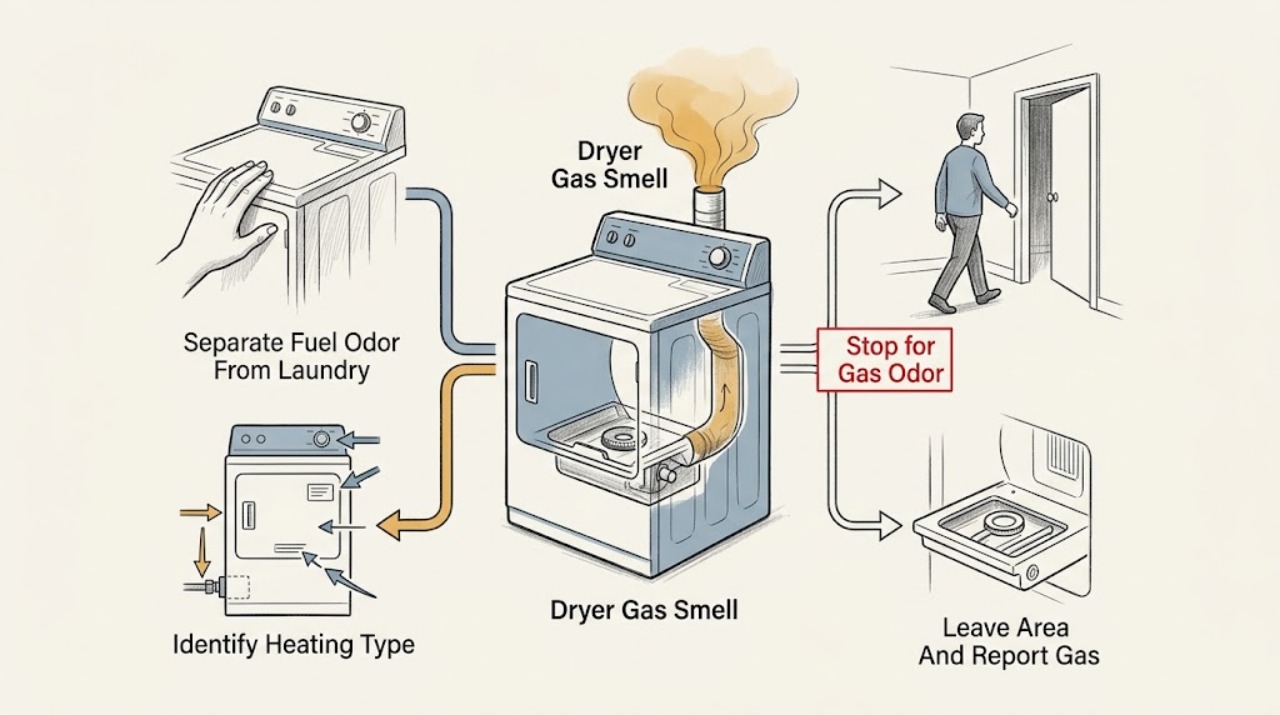
Treat a gas smell as an emergency before treating it as a dryer fault. Leave the area, avoid flames and electrical switches, and contact the gas emergency service or emergency services from a safe location. Do not restart the dryer or investigate inside the cabinet. Miele does make gas-heated Professional dryers, but its product literature also lists electric and heat-pump dryers, so the exact model and data plate must establish whether the appliance has a gas system. If the smell remains after the area is made safe, it may come from a pipe, meter, another appliance or the dryer installation rather than the drum. Only after qualified responders clear a gas emergency should a technician inspect the dryer; a burning or electrical odor, smoke, sparks, abnormal heat or a tripped breaker is also an immediate stop condition.
Before you begin
Safety first
- Only identification from safe documentation and non-invasive observations are described. Do not operate switches in a suspected gas area, test live circuits, open the cabinet, adjust gas controls, convert fuel type, bypass interlocks or restart after a hazard.
Work through in order
Diagnostic checks
Use only checks that match the exact appliance or system and its official guide.
-
Check 1
If you smell rotten-egg or sulfur-like gas, hear hissing, or cannot rule out fuel, stop the dryer only if it can be done without approaching the suspected leak or operating a switch. Leave the building or affected area, keep flames and ignition sources away, and contact the gas emergency service or emergency services from a safe location.
Expected result: The smell may be strongest near the dryer, gas connection, meter, utility room or outside piping, or it may remain detectable after the dryer is off. People may also report headache, dizziness, nausea or breathing difficulty.
Next step: Do not re-enter to locate the source, reset power, use a flame, or run another cycle. Follow the responding gas utility or emergency service instructions before anyone returns.
Stop if: Stop all troubleshooting for any suspected fuel odor, hissing, symptoms, smoke, fire or inability to leave safely.
Why this matters
Why: A continuing or widespread odor is not evidence of a failed dryer part; it can indicate an external gas leak or an unsafe installation. Symptoms increase the urgency of leaving and obtaining emergency help.
-
Check 2
Only after the area has been cleared as safe, read the Miele model and heating type from the data plate, manual cover or installation record without removing panels. Look for a documented gas-heated Professional variant, an electric heater, or a heat-pump system; if the type is unclear, treat the appliance as unverified and leave it disconnected for qualified inspection.
Expected result: The documentation may identify gas heating, electric heating or a heat-pump system, or it may not identify the fuel type at all. A home appliance can also be connected to a nearby gas appliance or pipe that is not part of the dryer.
Next step: Give the exact model, serial information and heating type to the gas utility and Miele-authorized service. Do not infer a missing gas part or open the rear cabinet.
Stop if: Stop if the data plate is behind a hot or damaged panel, the cord or connection is wet, or the smell returns while approaching the appliance.
Why this matters
Why: Miele's Professional literature lists several heating methods, so the brand name alone does not establish that a dryer has a burner or gas line. An apparently electric dryer does not rule out an external gas source in the room.
-
Check 3
Do not perform a restart test. After the gas emergency has been cleared by the responsible authority, describe whether the odor was on the laundry only, inside the drum, around the cabinet, at the exhaust outlet, or throughout the room. Note whether it started before heating, during a cycle, after a vent or installation change, or after the dryer was moved.
Expected result: Damp fabric or a dirty filter can produce an unpleasant laundry odor, while a fuel-like odor near a connection or room-wide odor is a different pattern. A scorched, plastic-like or electrical odor is also not a normal laundry smell.
Next step: Keep the dryer off and provide the odor description and timeline to Miele service or the qualified gas technician. Do not add fragrance, chemicals or heat to mask the smell.
Stop if: Stop for any return of fuel odor, smoke, sparks, scorching, abnormal heat or a breaker event.
Why this matters
Why: Miele's odor guidance covers damp fabrics, detergent and maintenance for ordinary unpleasant smells, but it does not establish that a gas-like or scorched odor is harmless. The location and timing help a qualified professional choose between gas, exhaust, lint/fire and electrical checks.
-
Check 4
If the model is a Miele Professional gas-heated dryer, do not touch the gas valve, burner, regulator, gas hose, conversion parts or combustion controls. Provide the model, serial number, fuel type, installation region and any display code to Miele Professional Service or a registered gas installation specialist.
Expected result: The documentation may show a gas-heated variant, an installation or burner fault, a gas-type mismatch concern, or no appliance-specific fault at all.
Next step: Keep the appliance out of service until the specialist has checked the gas path, installation, ventilation and combustion safety. Do not order or fit a valve, burner or conversion component based on the odor alone.
Stop if: Stop immediately if the odor, hissing, heat, smoke, spark or visible damage returns; leave and report the emergency from a safe location.
Why this matters
Why: Miele's installation instructions reserve gas connection, gas conversion, leak checks and cabinet work for registered or authorized specialists. A smell cannot identify a safe component replacement from outside the machine.
-
Check 5
For a model documented as electric or heat pump, keep the dryer disconnected after any suspected gas, burning or electrical odor and record the exact model, cycle, display code, load, odor location, smoke or heat, breaker behavior and recent installation or vent work. Do not open panels or perform live tests.
Expected result: The issue may be an external gas source, lint or exhaust overheating, a damaged electrical part, a control fault, or an ordinary damp-fabric odor that occurred without a safety symptom.
Next step: Arrange Miele-authorized appliance service and, when fuel odor is plausible, the local gas utility or registered gas specialist. Do not return the dryer to operation until the responsible professional clears it.
Stop if: Do not energize the appliance if it will not stop, smells scorched, smokes, sparks, overheats, leaks, or trips the breaker.
Why this matters
Why: An electric or heat-pump Miele dryer cannot create fuel gas in its heating circuit, but it can still be near a gas source, and a hot or scorched smell can indicate a fire or electrical hazard. The exact model and event sequence are needed for a safe diagnosis.
Use your observations
Decision map
Find the observation that best matches what you see, then follow the next safe action.
-
PATH 01Safety boundary
What you see
The smell is rotten-egg or sulfur-like, the source is uncertain, the odor spreads through the room, or hissing or symptoms are present.
Do this next
Leave the area, avoid flames, engines and electrical switches, and contact the gas emergency service or emergency services from a safe location. Do not return until cleared.
Why this path and its safety boundary
Why it matters: Treat this as a possible gas leak, including a leak outside the dryer.
Safety stop: Do not operate the dryer, a light switch or other electrical control, and do not attempt to find or repair the leak.
-
PATH 02Safety boundary
What you see
The exact documentation identifies a Miele Professional gas-heated dryer.
Do this next
Keep it off and arrange Miele Professional Service or a registered gas specialist with the model, serial information and installation details.
Why this path and its safety boundary
Why it matters: The appliance has a regulated gas installation and specialist-only gas and burner work.
Safety stop: Do not close, adjust, convert, test or replace gas components yourself; leave again if odor returns.
-
PATH 03Safety boundary
What you see
The exact documentation identifies electric or heat-pump heating and no fuel odor remains after the area is cleared.
Do this next
Keep the dryer off for a suspected burning or electrical odor and arrange appliance service. Only ordinary odor concerns may be discussed with Miele's filter and heat-exchanger care instructions after safety clearance.
Why this path and its safety boundary
Why it matters: The odor may be ordinary damp-fabric smell, lint or exhaust overheating, or an electrical fault, but the nearby room can still have an external gas source.
Safety stop: Do not run a test cycle for a scorched smell, smoke, sparks, abnormal heat, damaged cord or breaker event.
-
PATH 04Safety boundary
What you see
A qualified safety check rules out fuel and electrical hazards, and the odor is limited to damp laundry or a maintained dryer without heat or smoke symptoms.
Do this next
Follow the exact operating instructions for lint-filter and heat-exchanger care, dry parts fully, and remove damp laundry promptly. Escalate if the odor changes to fuel, scorching or electrical odor.
Why this path and its safety boundary
Why it matters: Miele identifies damp fabrics left in the appliance and filter or heat-exchanger maintenance as possible ordinary unpleasant-odor causes.
Safety stop: Do not mask a changing odor with fragrance or continue if heat, smoke, sparks or a breaker event appears.
-
PATH 05Safety boundary
What you see
The smell began after installation, relocation, vent work or a gas connection change, or the exhaust and room ventilation are not documented as compliant.
Do this next
Leave the dryer off and have the installation checked by Miele or an authorized specialist under local requirements. Do not alter ducting, gas piping or the cabinet yourself.
Why this path and its safety boundary
Why it matters: The installation, gas path, exhaust arrangement or ventilation may be involved; the drum symptom does not identify the cause.
Safety stop: Leave immediately if gas odor, hissing, smoke, sparks or abnormal heat occurs.
-
PATH 06Safety boundary
What you see
There is burning or plastic odor, smoke, sparks, abnormal heat, a damaged cord or outlet, water near electrics, inability to stop, or repeated breaker operation.
Do this next
Stop using the dryer. Disconnect power only if it is safe and dry to do so without approaching a hazard; leave the area and obtain emergency help when needed, then arrange qualified appliance service.
Why this path and its safety boundary
Why it matters: This is a fire, electrical or water-safety event even if no gas system is present.
Safety stop: Do not re-energize, bypass a safety device, open panels or keep testing.
Helpful context
Understand the symptom
Gas smell changes the order of troubleshooting
Do not prove the source by running another cycle. Odorized fuel can collect before a visible symptom appears, and the source may be outside the dryer. Move away first and use the local gas-emergency procedure from a safe location. If anyone has symptoms or there is an immediate fire risk, follow emergency instructions.
Confirm whether this Miele model can use gas
Miele Professional documents gas-heated vented dryers as well as electric and heat-pump designs. A domestic Miele dryer or a Professional heat-pump model may not have a burner or gas connection at all. Read the model and heating type from the data plate only when it is safe; never remove a cover to look for a gas valve.
Do not confuse ordinary laundry odor with fuel odor
Miele says damp fabrics left in a dryer can smell unpleasant and that filters and the heat exchanger should be maintained according to the operating instructions. That guidance does not make a suspected fuel smell safe to test. A rotten-egg odor, hissing, symptoms, smoke, scorched insulation or a smell that returns when the dryer heats all require the appliance to remain off and professional assessment.
Safety boundary
Stop conditions
- Any suspected fuel odor, hissing, room-wide gas smell, symptoms or uncertainty about the gas source.
- Burning or plastic odor, smoke, sparks, abnormal heat, a damaged cord or outlet, inability to stop, or repeated breaker operation.
- Water near electrical parts, a damaged gas line, a damaged cabinet or a door or panel that must be forced.
- Any need to access a gas valve, burner, regulator, conversion part, live wiring, combustion path or sealed cabinet.
- An odor that returns after the area is cleared or after installation, relocation, vent work or service.
When checks do not resolve it
Need a professional?
Treat a suspected gas smell as an emergency first: leave and contact the gas emergency service or emergency services from a safe location. Arrange Miele-authorized appliance service for any Miele dryer that has a fuel-like, burning, electrical or persistent unexplained odor, and use a registered gas specialist for a Professional gas-heated model or any gas connection. Provide the exact model, heating type, installation region, serial information, odor location and timing, display code, recent work and all safety symptoms.
Safety scope: Only identification from safe documentation and non-invasive observations are described. Do not operate switches in a suspected gas area, test live circuits, open the cabinet, adjust gas controls, convert fuel type, bypass interlocks or restart after a hazard.
Common questions
FAQ
Does every Miele dryer use gas?
No. Miele Professional documents electric, gas-heated, water-heated and heat-pump dryer types. Identify the exact model and heating type from safe documentation; do not infer fuel type from the Miele name alone.
What should I do if my Miele dryer smells like gas?
Leave the area, avoid flames and electrical switches, and contact the gas emergency service or emergency services from a safe location. Do not restart the dryer, locate the leak, or open the cabinet. Return only when the responsible responders clear the area.
Could the gas smell come from somewhere other than the dryer?
Yes. It may come from a gas pipe, meter, another appliance or the dryer installation. A Miele electric or heat-pump dryer has no gas heating circuit, but it can still be near an external fuel source. Treat an unexplained fuel odor as an emergency.
Can I inspect the burner or gas valve myself?
No. Miele's Professional instructions reserve gas connection, conversion, leak checks and cabinet work for registered or authorized specialists. Keep the dryer out of service and provide the exact model and installation details to qualified service.
When is an odor more likely to be ordinary laundry odor?
Only after fuel and electrical hazards have been ruled out by the responsible professionals. Miele notes that damp fabrics left in the appliance can smell unpleasant and that filters and the heat exchanger require model-specific care. A rotten-egg, scorched or electrical odor is not an ordinary-laundry diagnosis.
Read the exact guide
Official sources
- DryersMiele Professional · Miele Professional commercial dryer range; it does not establish the heating type of an unspecified domestic model.
- Recognizing and Responding to Pipeline EmergenciesU.S. Department of Transportation, Pipeline and Hazardous Materials Safety Administration · U.S. government safety guidance for an odorized natural-gas emergency; local emergency and utility procedures may differ.
- PDR918 G EU IG E02XMiele Professional · A specific Miele Professional gas-heated product sheet; it is not evidence that every Miele dryer is gas heated.
- The laundry or tumble dryer smells unpleasantMiele USA · Miele USA support for unpleasant laundry or dryer odor; it does not clear a suspected fuel, smoke or electrical odor.
- Operating and installation instructionsMiele Professional · Opened Miele Professional operating and installation instructions; exact requirements depend on model and region.
Community feedback
Share a repair observation
Share a plain-text repair observation. Accepted observations are published automatically; this page may take a moment to update.