
On this page
Start here
Quick answer
First check whether the Miele freezer is actually off, has lost power, or is running without cooling. Close the door, confirm the On/Off control and temperature setting from the exact model manual, and check the plug and household breaker only from a dry, safe position. Do not use a power strip or extension cord, move a built-in appliance, open panels, or work on wiring. A Miele display or alarm can report a power interruption or a high temperature rather than a failed start; the freezer may need time to return to temperature after power is restored. If food has partly or fully thawed, keep the door closed, assess the food according to safe-food guidance, and do not refreeze it raw. Stop for a wet outlet or cord, burning smell, smoke, sparks, exposed wiring, a repeatedly tripping breaker, damaged cabinet or cord, or an appliance that still will not cool after a safe power and control check. Leave it disconnected and arrange qualified Miele or appliance service.
Before you begin
Safety first
- Do not use a power strip or extension cord, move a built-in appliance, open panels, remove the lighting cover, probe live parts, bypass controls, or reconnect a wet or damaged freezer. Stop for smoke, burning smell, sparks, exposed wiring, hot or wet electrical parts, or a repeatedly tripping breaker.
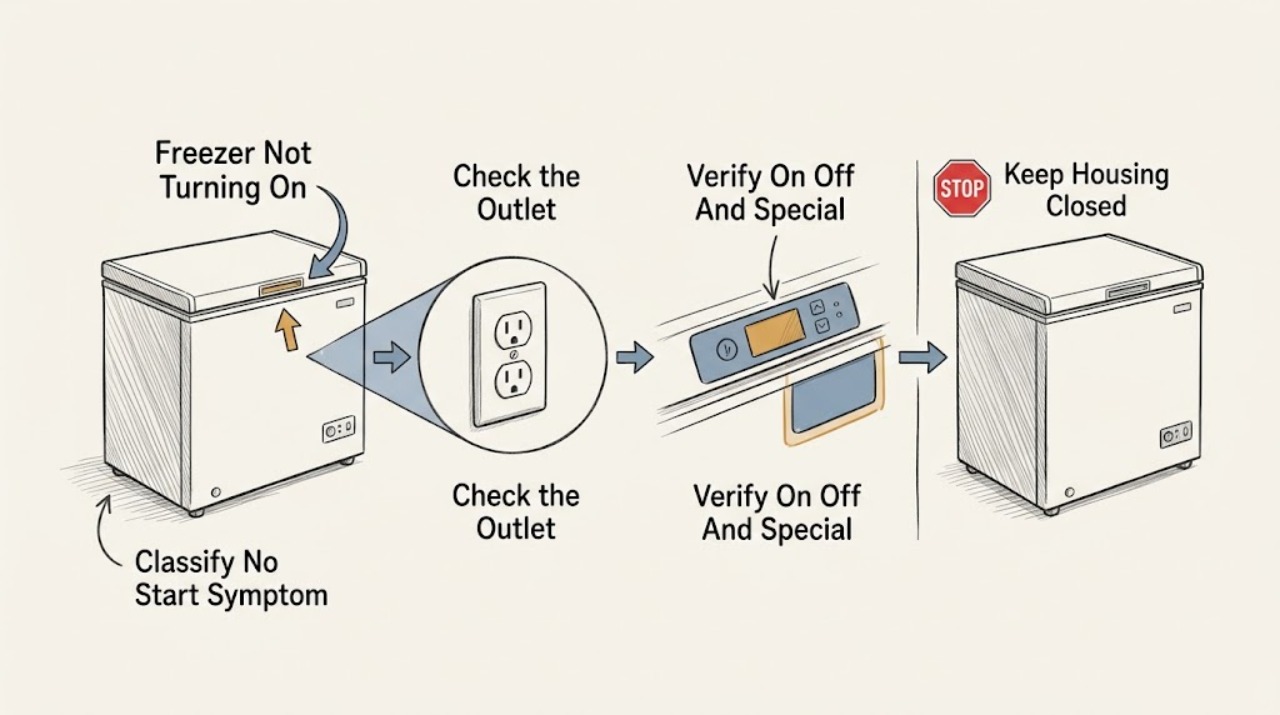
Work through in order
Diagnostic checks
Use only checks that match the exact appliance or system and its official guide.
-
Check 1
From a dry, safe position, note whether the Miele freezer display, interior light, alarms, and any sound of cooling operation are present. Do not open covers, move a built-in unit, or touch a wet cord or outlet.
Expected result: The display and light are dark, the display is lit but the freezer is warm, a power-failure or temperature symbol is shown, or the appliance is making normal cooling sounds but appears not to start.
Next step: Use the matching external power, control, alarm, and food-safety branches. If there is a burning smell, smoke, spark, exposed wire, or water near electricity, stop all checks and keep the appliance disconnected.
Stop if: Do not open a panel, probe wiring, or reconnect equipment that is wet, visibly damaged, or producing smoke or sparks.
Why this matters
Why: A dark display points toward power or control; a lit display with warmth may be a setting, Demo mode, door, recovery, or cooling fault. An alarm symbol may record a prior temperature rise or power loss rather than current power absence.
-
Check 2
If the area is dry and there is no electrical damage, inspect the accessible plug, cord, outlet, and household breaker from outside the cabinet. Fully seat a visibly loose plug only if it can be reached without moving the appliance; reset a tripped breaker no more than once when safe.
Expected result: The plug and outlet appear sound and the breaker is on, the plug was loose, the breaker was tripped and stays on, or the breaker trips again or the cord/outlet is hot or damaged.
Next step: After a single safe correction, check whether the display or cooling returns while keeping the door closed. For a repeat trip, damaged cord/outlet, or inaccessible plug, leave the freezer off and contact a qualified electrician or Miele service.
Stop if: Do not use an extension cord or power bar, pull a built-in freezer forward, replace an internal fuse, or repeatedly cycle the breaker.
Why this matters
Why: A loose plug or isolated trip can explain a no-start condition. A repeat trip, heat, damage, water, or uncertain hardwired connection indicates an electrical or appliance fault and is not a reset problem.
-
Check 3
If the display is available, use the exact Miele model instructions to confirm that the freezer section is switched on and check for a safety lock, Sabbath mode, Demo mode, or an unusual temperature setting. Close the door without force and remove only a visible package preventing the gasket from seating.
Expected result: The freezer was switched off or in a special mode, the door was not sealing, the setting is normal, or the controls respond but cooling does not start.
Next step: Correct only the documented setting or visible door obstruction and allow the unit to respond. If it remains warm or controls do not respond, keep the door closed and arrange model-specific service.
Stop if: Do not force buttons, bypass the safety lock, remove the lighting cover, or dismantle the door or gasket.
Why this matters
Why: An Off state, Demo mode, safety lock, wrong setting, or open door can imitate a no-start or no-cooling problem. Correct settings do not prove the compressor or cooling system is healthy.
-
Check 4
Read and record any flashing temperature symbol, power-failure symbol, nA message, or stored warmest temperature without repeatedly opening the door. Follow the model manual's alarm acknowledgement procedure only from the controls.
Expected result: The alarm follows a known outage or frequent opening, the displayed temperature begins returning toward the set value, the warmest recorded value indicates thawing, or the alarm persists while the freezer remains warm.
Next step: Keep the door closed and assess thawed food according to Miele's guidance. If the unit does not recover or the alarm returns without an identified cause, keep it off or closed as appropriate and call service.
Stop if: Do not silence an alarm and continue storing food when the freezer remains warm, and do not refreeze partially or fully thawed food raw.
Why this matters
Why: Miele says alarms can follow power loss, door opening, a large fresh-food load, or a fault. A recovered display does not establish that food is safe or that the cooling system is repaired; persistent warmth needs diagnosis.
-
Check 5
Keep the freezer closed while checking food condition from the shortest practical opening. Separate food that is still hard frozen from food that is partially or fully thawed, and note the time and temperature shown by the appliance.
Expected result: Food remains hard frozen, ice crystals remain but food has softened, food is fully thawed, packages are leaking, or the food condition is unknown.
Next step: Follow the appliance manual and applicable food-safety guidance, use or cook thawed food promptly when confirmed safe, and arrange a functioning freezer or temporary cold-storage plan.
Stop if: Do not taste-test questionable food, refreeze thawed food raw, or leave food in a freezer that remains warm while waiting indefinitely for it to restart.
Why this matters
Why: A temperature alarm and food condition are related but not interchangeable. Miele says partially or fully defrosted food must not be refrozen raw; it may be cooked before freezing again, and questionable food should not be treated as safe by assumption.
-
Check 6
After a confirmed power return or documented setting correction, keep the door closed and observe the display and normal cooling sounds from outside for the model-appropriate recovery period. Do not add warm food or repeatedly unplug the unit to test it.
Expected result: The temperature trends toward the set value, the alarm clears after recovery, the display returns but the freezer stays warm, or there is no cooling sound after power and controls are normal.
Next step: If recovery is stable, continue monitoring. If not, keep the door closed, protect food, and arrange qualified Miele or appliance service with the recorded observations.
Stop if: Do not keep cycling the power, force a start, or open the rear cabinet to identify a silent component.
Why this matters
Why: A freezer may need hours to stabilize after an interruption, especially when loaded. Continued warmth or no cooling after a reasonable recovery period points to a control, compressor, fan, sealed-system, or other fault that cannot be selected by listening alone.
-
Check 7
Without moving or opening the appliance, look for water near the outlet or base, a hot or damaged cord, burning smell, smoke, sparks, exposed wiring, cabinet damage, or a breaker that will not stay on.
Expected result: No hazard is visible, or water, heat, odor, smoke, spark, damage, or a repeat breaker trip is present.
Next step: For a hazard, keep people away, disconnect only if this can be done without touching a wet or damaged area, and contact qualified electrical or appliance service. Use emergency services for active smoke or fire.
Stop if: Do not touch wet electrical parts, spray the appliance, reset a repeatedly tripping breaker, or reconnect a damaged freezer.
Why this matters
Why: A normal external appearance permits only the low-risk checks above. Any electrical or water hazard can cause shock, fire, or further appliance damage and overrides a desire to restore cooling quickly.
-
Check 8
Arrange qualified Miele or appliance service when the freezer stays warm after safe power and control checks, the display or controls fail, the alarm persists, food is at risk, or any internal component would need inspection.
Expected result: The unit has a persistent no-start/no-cooling condition, an unresolved alarm, an electrical hazard, or a symptom that briefly clears and returns.
Next step: Keep the freezer in the safest state indicated by the hazard and food branches, and give service the full model, display symbols, power history, temperature, food condition, and photos from a safe dry position.
Stop if: Do not disassemble, bypass controls, replace internal parts, or continue storing food in a freezer that is not maintaining a safe temperature.
Why this matters
Why: Possible causes include power wiring, controls, Demo mode, door or temperature sensing, compressor, fan, sealed system, or another model-specific fault. A generic replacement part cannot be chosen safely from this symptom.
Use your observations
Decision map
Find the observation that best matches what you see, then follow the next safe action.
-
PATH 01Safety boundary
What you see
The area is dry, the cord and outlet look undamaged, and a visibly loose plug or isolated breaker trip is found.
Do this next
Correct the connection only from the external safe position, restore power once, keep the door closed, and observe recovery.
Why this path and its safety boundary
Why it matters: A connection or household power interruption may explain the no-start symptom, but a successful display return does not prove cooling recovery.
Safety stop: Stop for heat, water, odor, damage, or another breaker trip; do not use a power strip or extension cord.
-
PATH 02Safety boundary
What you see
The display works and the freezer is switched off, in Demo mode, safety locked, in a special mode, set incorrectly, or prevented from closing by a visible package.
Do this next
Use the exact model manual to correct the setting or visible door obstruction and allow the unit to stabilize with the door closed.
Why this path and its safety boundary
Why it matters: A documented control or door condition can imitate a failed start, but it does not clear a persistent warm freezer.
Safety stop: Do not force controls, remove covers, bypass locks, or dismantle the door.
-
PATH 03Safety boundary
What you see
A temperature or power-failure indicator, nA message, or warmest-temperature record follows a known interruption.
Do this next
Keep the door closed, acknowledge the alarm only as the manual permits, monitor recovery, and assess thawed food according to Miele guidance.
Why this path and its safety boundary
Why it matters: The alarm may be a record of the outage and can clear after the freezer returns to temperature; food condition still requires a separate safety decision.
Safety stop: Do not refreeze partially or fully thawed food raw or silence a persistent warm condition and leave food inside indefinitely.
-
PATH 04Safety boundary
What you see
Food has softened, partially thawed, fully thawed, leaked, or its exposure history is unknown.
Do this next
Follow the model instructions and applicable food-safety guidance; use or cook confirmed-safe thawed food promptly and arrange temporary storage while service is arranged.
Why this path and its safety boundary
Why it matters: The freezer's alarm does not itself certify food safety. Miele says partially or fully defrosted food must not be refrozen raw.
Safety stop: Do not taste-test questionable food or refreeze thawed food raw.
-
PATH 05Safety boundary
What you see
Water is near electricity, the cord or outlet is hot or damaged, smoke or a burning smell appears, sparks are visible, wiring is exposed, or a breaker trips again.
Do this next
Keep people away and disconnect only if it can be done without touching a wet or damaged area; contact qualified electrical or appliance service, using emergency services for active fire or smoke.
Why this path and its safety boundary
Why it matters: The immediate risk is electrical shock, fire, or equipment damage, not a freezer setting.
Safety stop: Do not touch wet parts, spray water, open panels, reset repeatedly, or reconnect the appliance.
-
PATH 06Safety boundary
What you see
Power and documented controls are normal, but the display is warm, cooling does not resume after an appropriate recovery period, or the symptom returns.
Do this next
Keep the door closed to protect food, leave the freezer in the safest available state, and arrange qualified Miele or appliance diagnosis.
Why this path and its safety boundary
Why it matters: A compressor, fan, sensor, control, sealed-system, door, or other model-specific fault remains possible; external observation cannot identify the part.
Safety stop: Do not open the cabinet, test live components, bypass controls, or keep storing food at an unsafe temperature.
Helpful context
Understand the symptom
Not turning on can mean no display, no cooling, or a power alarm
Separate the visible symptom before touching anything. A dark display and no interior light suggest a power or control question. A lit display with no cooling can mean the freezer is turned off, in Demo mode on models that have it, set incorrectly, or has a cooling-system fault. A flashing temperature or power-failure indicator may be a record of an earlier interruption rather than proof that the appliance is currently off. Miele's manuals and support pages use model-specific controls, so record the model before interpreting symbols.
Begin with a dry, external power check
Look at the plug, cord, outlet, and breaker without pulling the appliance forward or opening a panel. A plug that is visibly loose can be fully seated only if it is accessible and dry; a breaker can be checked once, but it should not be repeatedly reset. Miele warns against power bars and extension cords and says the appliance must be isolated before installation, maintenance, or repair. A wet outlet, damaged cord, smell of overheated insulation, or repeated trip changes this from a low-risk check to an electrical-service call.
Check the Miele controls and door without forcing them
If the display is available, confirm that the freezer section is switched on and that the safety lock, Sabbath mode, Demo mode, or another special setting is not suppressing normal operation on that model. Close the door gently and check for a package preventing the seal from seating. A door alarm can be silenced while the door remains open, so silence is not the same as a good seal. Never force a stuck control, remove the lighting cover, or bypass a lock.
A temperature alarm is also a food-safety decision
If the freezer has a flashing temperature symbol, a power-failure indicator, or an nA message, record the displayed or stored temperature and keep the door closed. Miele says the alarm can follow a power outage, frequent door opening, a large load of fresh food, or a fault; the nA display can show the warmest recorded temperature after an interruption. If food has started to thaw, do not decide that it is safe merely because the appliance later restarts. Follow the model's instructions and applicable food-safety guidance; Miele says thawed food should be used promptly or cooked before refreezing, not refrozen raw.
Allow a normal recovery period after a power return
After a confirmed interruption and a safe return of power, keep the door closed and listen or look for normal operation from outside the cabinet. Miele notes that the temperature can take hours to settle after an adjustment or restart, depending on the load. Do not repeatedly unplug and reconnect the freezer, cycle the breaker, or add warm food to test it. If the display returns but the temperature does not move toward its set value over the model-appropriate recovery period, treat that as a cooling or control fault and arrange service.
Do not turn a silent freezer into a live-circuit repair
A freezer can have live components under the lighting cover or behind the cabinet even when the display is dark. Miele says installation, repair, and maintenance should be performed by an authorized technician and that defective components should be replaced with original parts. Do not remove the rear cover, test a compressor terminal, bridge a thermostat, replace a fuse inside the cabinet, or probe a control board. If the appliance is wet or damaged, do not reconnect it just to see whether the compressor starts.
Protect food and document the symptom
Keep the door closed while deciding what to do, move food only if you can do so safely without extending the exposure, and separate clearly thawed items from still-hard-frozen items. Photograph the display, temperature alarm, plug area, and food condition from a dry, safe position. Record when the freezer stopped, whether a storm or outage occurred, whether the lights or display worked, and whether the compressor or fan was heard. This information helps service distinguish power, controls, door sealing, and cooling-system faults without unsafe exploratory disassembly.
When checks do not resolve it
Need a professional?
Safety scope: Do not use a power strip or extension cord, move a built-in appliance, open panels, remove the lighting cover, probe live parts, bypass controls, or reconnect a wet or damaged freezer. Stop for smoke, burning smell, sparks, exposed wiring, hot or wet electrical parts, or a repeatedly tripping breaker.
Common questions
FAQ
Why is my Miele freezer not turning on even though the display is dark?
Check the accessible plug, outlet, and household breaker from a dry, safe position, and confirm the freezer is not simply switched off. Miele also identifies a tripped fuse or electrical fault as a possible cause. Do not move a built-in appliance, open panels, or repeatedly reset the breaker; arrange service if power does not return safely.
Why is my Miele freezer warm even though the display and lights work?
Confirm the freezer section is switched on and that Demo mode or another special setting is not active on your model. After an outage or setting correction, keep the door closed and allow an appropriate recovery period. If it stays warm or the alarm persists, a control, fan, compressor, door, or cooling fault needs qualified diagnosis.
What does a power-failure or temperature alarm mean on a Miele freezer?
Miele says these indicators can follow a power interruption, frequent door opening, or a large fresh-food load, and an nA message can show the warmest temperature recorded during an interruption. Keep the door closed, record the message and temperature, and assess food separately; a cleared alarm does not by itself prove food safety or a repaired freezer.
Can I refreeze food if my Miele freezer stopped working?
Do not refreeze partially or fully thawed food raw. Miele advises checking whether food has thawed and says thawed food may be cooked before freezing again when it is confirmed safe. Follow applicable food-safety guidance and discard questionable food rather than taste-testing it.
Can I use an extension cord to restart my Miele freezer?
No. Miele warns against power bars and extension cords because they can create a fire hazard and may not provide the required safety. Use the installed supply only, and have a qualified electrician or Miele technician assess an inaccessible, damaged, wet, or repeatedly tripping connection.
What should I do if my Miele freezer smells hot or the breaker keeps tripping?
Stop using it. Keep away from wet or damaged electrical areas, do not repeatedly reset the breaker, and do not open a panel or reconnect a damaged cord. Contact qualified electrical or appliance service; use emergency services for active smoke or fire.
When should I call service for a Miele freezer that will not start?
Arrange service when power and documented controls are normal but the freezer remains warm, the display or controls fail, the temperature alarm returns, food is thawing, or the issue recurs. Stop immediately for water near electricity, burning smell, smoke, sparks, exposed wiring, damaged cord, or repeated breaker trips.
Read the exact guide
Official sources
- FNS37492iE_us.vpMiele · Miele operating instructions for the FNS 37492 iE freezer family; exact model instructions and local service requirements control a particular installation.
- nA appears on the freezer zone temperature displayMiele USA · Miele USA support guidance for models displaying nA; exact model manual controls the alarm interface.
- Temperature alarm sounds and temperature display flashingMiele USA · Miele USA support guidance for refrigeration appliances; exact model controls and food-safety rules apply to a particular unit.
- Storing food correctly in the freezerMiele USA · Miele USA food-storage guidance; applicable food-safety authorities and package instructions also govern a particular food.
Community feedback
Share a repair observation
Share a plain-text repair observation. Accepted observations are published automatically; this page may take a moment to update.