
On this page
Start here
Quick answer
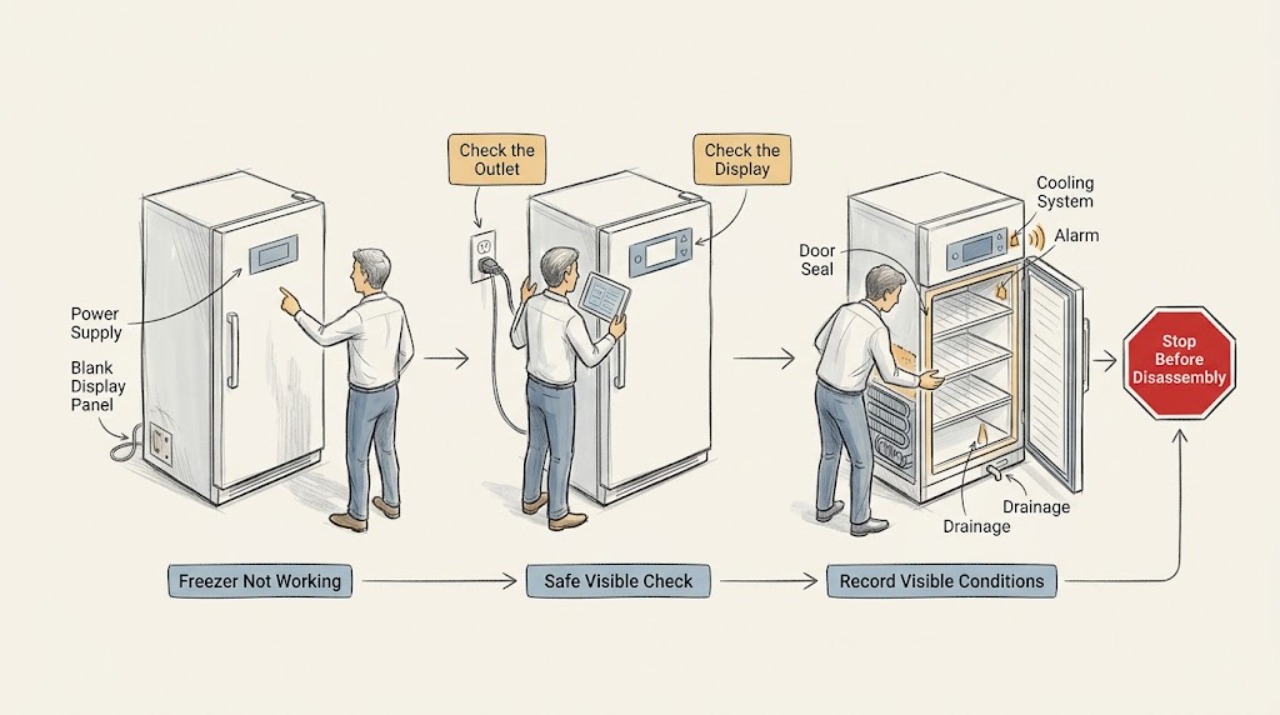
When a Miele freezer is not working, first decide whether the display is dark, the freezer zone is switched off, the appliance has power but is not cooling, or an alarm is reporting a temperature rise. Check only the accessible plug, the labeled breaker, the freezer-zone setting, door closure, ventilation openings, and any visible frost or water; use the exact model manual for controls. Miele says a temperature alarm can follow frequent door opening, a large load of fresh food, or a power interruption, but food that has started to thaw must be assessed and cooked before it is frozen again. Keep the freezer closed while it is warming, move food to safe cold storage if needed, and do not scrape ice, remove panels, test live circuits, or work on the sealed cooling system. A blank display, repeated alarm, persistent warm compartment, heavy or returning frost, unusual compressor noise, water near electrical parts, or a damaged door needs qualified Miele appliance service.
Work through in order
Diagnostic checks
Use only checks that match the exact appliance or system and its official guide.
-
Check 1
Keep the freezer door closed, stop using the appliance if there is smoke, burning odor, sparking, water near electrical parts, a hot cord or outlet, severe cabinet heat, or a damaged door, and move food only if it can be done safely without prolonged opening.
Expected result: The compartment is warming, a safety hazard is present, food has started to thaw, or the appliance is cool and free of an immediate hazard.
Next step: For a hazard, leave the freezer off and arrange appropriate emergency or qualified appliance service. For thawed or partly thawed food, follow local food-safety guidance and Miele's instruction to cook it before refreezing. If safe, continue with the power and display check.
Stop if: Stop for smoke, sparks, burning odor, water near controls or wiring, a warm or damaged receptacle, a leaking sealed component, or a door or shelf that may fall.
Why this matters
Why: Food quality can decline while the freezer is warm, and electrical, water, or overheating symptoms must be addressed before ordinary troubleshooting.
-
Check 2
Without moving the appliance or removing covers, check whether the display lights, the freezer zone is enabled, the plug is seated, and the labeled household breaker has tripped; use only a single documented reset with the appliance stopped if the exact manual permits it.
Expected result: The display is blank, the freezer zone is switched off, the plug or breaker is not supplying power, or the display and supply appear normal.
Next step: Correct only an obvious zone setting or loose accessible plug and allow the appliance to stabilize with the door closed. If the display remains blank, the breaker trips again, or power appears normal but the zone stays warm, arrange service.
Stop if: Stop for repeated breaker operation, a damaged plug or outlet, exposed wiring, a warm cord, or any need to measure electricity or open a panel.
Why this matters
Why: Miele identifies a disabled zone or lost power as direct causes of a non-cooling freezer. A normal display and supply shift attention to temperature, door, airflow, frost, or cooling-system checks.
-
Check 3
If an alarm symbol, warning, or power-failure indication is shown, record the exact message and highest temperature information before silencing it; check whether the door was left open, a large amount of fresh food was added, or power was interrupted.
Expected result: The alarm follows frequent opening or a fresh load, follows a power interruption, clears after the door remains closed, or remains after the cause is no longer present.
Next step: Keep the door closed and let a documented temporary condition recover while checking food safety. If the alarm persists, the compartment remains warm, or the message identifies a fault, leave the freezer closed and arrange Miele service.
Stop if: Stop for a persistent warning, rapidly warming food, unusual heat, smoke, water damage, or any request to clear a fault by disconnecting unknown wiring.
Why this matters
Why: Miele says these events can temporarily raise freezer temperature, but a persistent alarm or a freezer that does not recover indicates a fault or continuing condition that needs diagnosis.
-
Check 4
With the freezer closed between observations, inspect the door gasket, drawer or door seating, accessible ventilation gaps, and visible frost or ice; do not force the door, chip ice, block vents, or dismantle the interior.
Expected result: The door does not seal, a drawer is obstructed by ice, ventilation gaps are blocked, a heavy frost layer is present, the compartment has a puddle, or the seal and accessible airflow path appear normal.
Next step: Close the door and remove only a loose external obstruction without tools. If heavy frost, a damaged gasket, a puddle, or a blocked internal path remains, stop normal use and arrange service rather than forcing drawers or applying direct heat.
Stop if: Stop for a split gasket, trapped food preventing closure, heavy ice around wiring or fans, water under the appliance, or any need to scrape, heat, or remove panels.
Why this matters
Why: A door left open or blocked airflow can raise temperature and create excess frost. Heavy or recurring ice, water, or a damaged seal can also point to defrost, drainage, installation, or cooling faults.
-
Check 5
From outside the cabinet, note whether the compressor or fan runs, whether the sound is normal or newly loud, whether cooling returns after a safe temporary cause, and whether water or frost returns; do not touch fans, refrigerant lines, or electrical parts.
Expected result: The freezer is silent and warm, runs continuously but stays warm, makes clicking, grinding, or loud vibrating sounds, cools normally, or has returning water or frost.
Next step: For persistent warmth, abnormal noise, recurring frost, or water, leave the freezer running only if there is no hazard and the exact manual permits it; otherwise switch it off and arrange qualified service. Do not diagnose refrigerant or compressor faults by adding gas or opening the system.
Stop if: Stop for grinding, burning odor, repeated clicking with no cooling, severe vibration, water near electricity, exposed refrigerant tubing, or any need to open the compressor or sealed circuit.
Why this matters
Why: A silent warm appliance can have a supply, control, compressor, or start fault; continuous operation with poor cooling can involve airflow, door, frost, or sealed-system conditions. Noise and leaks require model-specific inspection.
-
Check 6
Record the full Miele model number, display messages, temperature or alarm history, power event, door and gasket condition, frost pattern, water location, sounds, food condition, and which safe external checks changed the symptom.
Expected result: The freezer recovers after an obvious setting, door, or power correction, or it remains warm, alarmed, noisy, wet, heavily frosted, or unresponsive.
Next step: For persistent or unsafe symptoms, keep the freezer closed or off as appropriate and arrange qualified Miele appliance service. Provide the model and food-safety observations; do not buy or install a part from a generic symptom.
Stop if: Stop DIY work for panel removal, sealed-system work, compressor or fan access, defrost-heater work, live electrical testing, or any repair beyond exact user instructions.
Why this matters
Why: A one-time documented operating condition differs from a repeatable appliance fault. Persistent failure needs diagnosis of controls, sensors, fan, defrost, drain, compressor, or sealed cooling parts.
Use your observations
Decision map
Find the observation that best matches what you see, then follow the next safe action.
-
PATH 01Next step
What you see
Food has started to thaw or the freezer compartment is warming while a power, alarm, or cooling fault is present.
Do this next
Arrange qualified service and follow the exact model guidance.
Why this path and its safety boundary
Why it matters: Keep the door closed, follow local food-safety guidance, and cook thawed food before refreezing it. Arrange service if the freezer does not recover.
-
PATH 02Next step
What you see
The display is blank, the freezer zone is disabled, the plug is disconnected, or the breaker has tripped.
Do this next
Arrange qualified service and follow the exact model guidance.
Why this path and its safety boundary
Why it matters: Correct only the documented zone or accessible supply condition. Persistent blank display or a repeat trip needs qualified appliance or electrical service.
-
PATH 03Next step
What you see
The alarm follows frequent door opening, a large fresh-food load, or a recent power interruption and the freezer begins recovering with the door closed.
Do this next
Arrange qualified service and follow the exact model guidance.
Why this path and its safety boundary
Why it matters: Minimize openings, check food safety, and monitor recovery. A continuing alarm or warm compartment needs service.
-
PATH 04Next step
What you see
The door does not seal, frost blocks drawers or airflow, ventilation gaps are blocked, or water is pooling.
Do this next
Arrange qualified service and follow the exact model guidance.
Why this path and its safety boundary
Why it matters: Correct only a loose external obstruction without tools. Do not scrape or heat ice; leave the appliance off and arrange service for heavy frost, water, or seal damage.
-
PATH 05Next step
What you see
The freezer is warm, runs continuously, stays silent, makes abnormal noise, or repeatedly loses cooling.
Do this next
Arrange qualified service and follow the exact model guidance.
Why this path and its safety boundary
Why it matters: Keep it out of normal use as appropriate and arrange model-specific Miele service. Do not access the compressor, fan, wiring, or sealed cooling system.
-
PATH 06Next step
What you see
The freezer recovers after a documented power, zone, door, or temporary loading condition and no hazard or repeat alarm occurs.
Do this next
Arrange qualified service and follow the exact model guidance.
Why this path and its safety boundary
Why it matters: Monitor temperature and food condition with minimal door opening. Request service if the symptom returns or cooling becomes unstable.
Helpful context
Understand the symptom
Separate no power from no cooling
A blank display and a freezer that has power but is warm are different faults. Miele's support path starts with whether the freezer zone is switched on and whether the appliance is connected to power. If the display is lit, record the set temperature, any warning text, fan or compressor sounds, and whether the compartment is cold before changing settings.
Keep the door closed while checking food
Opening the door repeatedly loses cold air and makes an alarm harder to interpret. If a power interruption or warm compartment may have affected food, keep the door closed, check the highest temperature or alarm information the model provides, and assess food before refreezing. Follow local food-safety guidance; Miele says thawed food should be cooked before it is frozen again.
Frost, water, and noise identify different paths
A thin temporary frost pattern, a thick layer blocking drawers, a puddle in the freezer, and a new loud or repeated compressor sound are not interchangeable symptoms. Photograph frost and water before wiping only a safe accessible surface. Do not chip ice, pour water into vents, move panels, or infer a refrigerant fault from frost alone.
Use model-specific service boundaries
Miele freezer designs differ in controls, door alarms, defrost systems, ice makers, and ventilation. The manufacturer's manual finder is the right place to identify the exact operating instructions. Persistent warm temperatures, blank displays, recurring alarms, sealed-system concerns, or electrical and water damage should be handed to qualified appliance service.
Only after diagnosis
Potential parts
Only after exact-model inspection confirms a sealing or alignment fault; do not force the door or order a seal from appearance alone.
Only after a qualified diagnosis links persistent warm, frost, water, alarm, or noise symptoms to the exact model component.
Only after qualified appliance service confirms a sealed-system or compressor fault; do not open refrigerant lines or attempt a recharge at home.
When checks do not resolve it
Need a professional?
The display stays blank, the freezer zone will not switch on, or the breaker trips again., The freezer remains warm, runs continuously without cooling, or repeatedly triggers a temperature alarm., Food has thawed, food safety is uncertain, or the freezer cannot maintain safe cold storage., Heavy or returning frost, a puddle, a damaged gasket, blocked internal airflow, or water near controls is present., The compressor or fan is silent, clicks repeatedly, grinds, vibrates unusually, smells hot, or does not cool., Repair would require removing panels, scraping or heating ice, testing live electricity, accessing a compressor or fan, or opening the sealed cooling circuit.
Common questions
FAQ
Why is my Miele freezer not working after a power outage?
Miele says a power interruption can trigger a temperature alarm and display the highest temperature reached. Keep the door closed, check the accessible plug and breaker once power is restored, assess food safety, and arrange service if the compartment does not recover.
What does a Miele freezer temperature alarm mean?
It means the freezer temperature rose above the set condition. Miele lists frequent door opening, a large fresh-food load, and power failure as possible temporary causes, but a persistent alarm or warm compartment can indicate a fault and needs service.
Should I scrape ice from a Miele freezer?
Do not chip, scrape, or apply direct heat to heavy ice. Check only the door seal and accessible ventilation without tools, keep the freezer closed, and arrange service for heavy or returning frost or a drawer blocked by ice.
What should I do with Miele freezer food that has thawed?
Follow local food-safety guidance and Miele's direction to cook food that has thawed before freezing it again. Keep the door closed while arranging service so the remaining food stays as cold as possible.
When should I stop troubleshooting a Miele freezer?
Stop for smoke, burning odor, sparks, water near electricity, a warm or damaged outlet, repeated breaker trips, severe noise, heavy frost around internal parts, a damaged door, or any need to open panels, access the compressor, or work on the sealed cooling system.
Read the exact guide
Official sources
- Troubleshooting for All problem with Miele RefrigerationMiele USA · Opened official Miele troubleshooting index; select the exact symptom and model-specific manual for the applicable procedure.
- Miele Refrigeration | nA appears on the freezer zone temperature display.Miele USA · Opened official Miele support article; the display label and button behavior are model-specific.
- Miele Refrigeration | The fridge zones or freezer zones in the refrigeration appliance are not working.Miele USA · Opened official Miele support article; the exact freezer model and operating instructions control the applicable procedure.
- Miele Refrigeration | Temperature alarm sounds and temperature display flashingMiele USA · Opened official Miele support article; alarm behavior varies by model and the matching manual takes precedence.
Community feedback
Share a repair observation
Share a plain-text repair observation. Accepted observations are published automatically; this page may take a moment to update.